
Visual Technology Transformation Journey
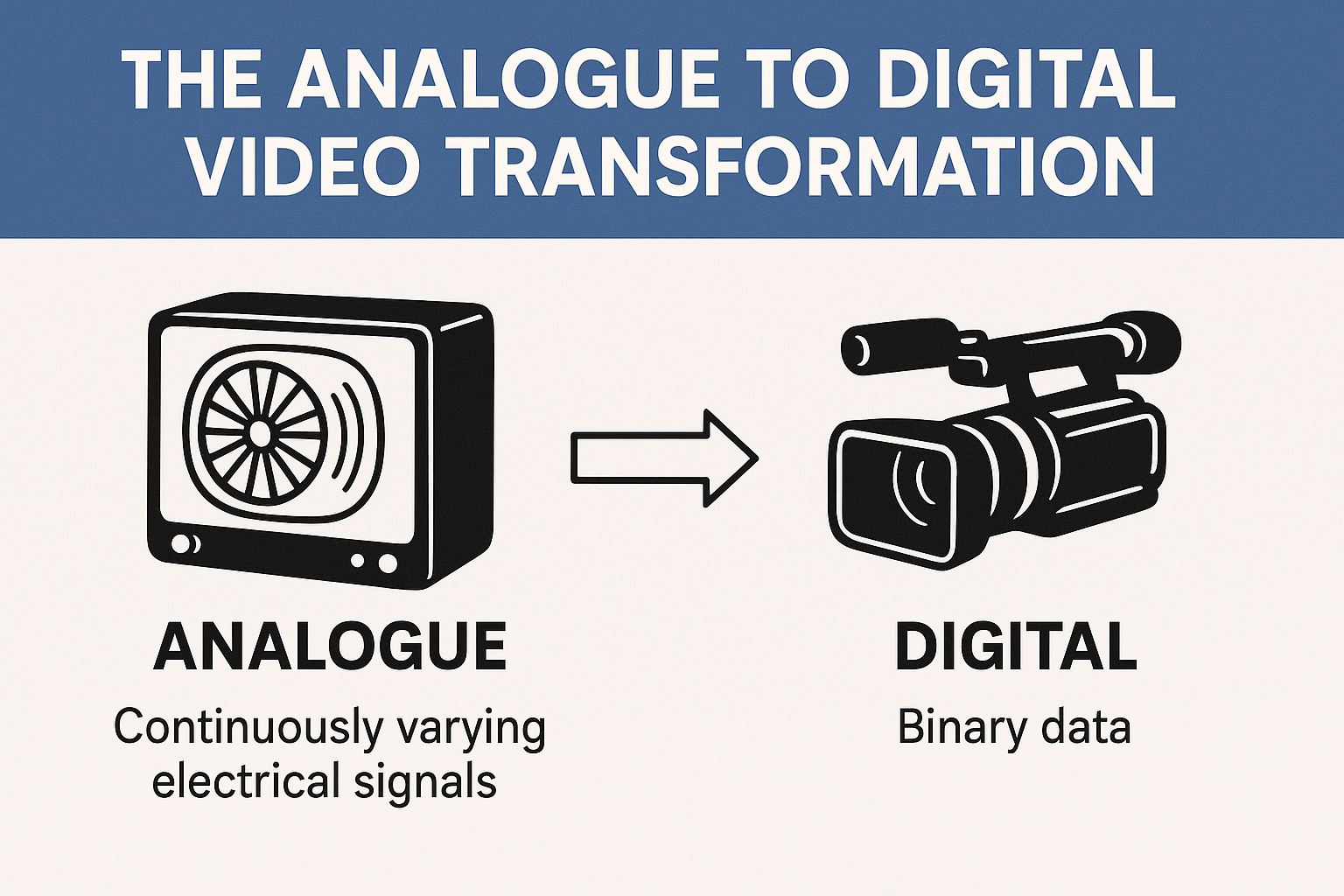



For much of the 20th century, video was an analogue medium, where images were represented as continuously varying electrical signals.
However, analogue technology had limitations — it was prone to signal degradation, suffered from generation loss during copying, and offered limited flexibility for editing and distribution. The rise of digital electronics in the latter half of the century opened the door to a new way of capturing, processing, storing, and transmitting video.
The analogue-to-digital transformation was not a single invention, but a multi-decade journey involving pioneering engineers, global standards bodies, and the convergence of computing with broadcasting. From the first digital video experiments at Bell Labs in the 1960s, to the introduction of the CCIR 601 standard in the 1980s, and finally to today’s IP-based streaming and Ultra HD broadcasting, this shift revolutionized the AV industry.
Here’s a structured journey with the key milestones and inventors:
1. Analogue Video Era (1920s–1970s)
Before digital, all video was analogue — continuous waveforms representing brightness (luma) and color (chroma).
-
1927 – First mechanical television:
-
Inventor: John Logie Baird (Scotland)
-
Used spinning disks and neon lamps to scan and display images.
-
-
1930s–1950s – Electronic TV:
-
Inventor: Vladimir Zworykin (RCA, USA) and Philo Farnsworth (USA) independently developed the cathode ray tube (CRT) camera (Iconoscope) and receiver.
-
Introduced broadcast standards: NTSC (USA), PAL (Europe), SECAM (France/Russia).
-
-
Analogue video connectors:
-
RCA, BNC, SCART, S-Video, VGA.
-
Video storage: magnetic tape (Ampex Quadruplex VTR, 1956, Charles Ginsburg team).
-
2. Digital Video Concepts Emerge (1960s–1980s)
The first moves toward digital representation of video started in labs.
-
1967 – First digital video experiments at Bell Labs using PCM (pulse-code modulation).
-
1972 – A. Michael Noll (Bell Labs) demonstrated digital image processing.
-
Late 1970s – Digital frame stores allowed still frames from analogue video for editing.
3. The True Digital Video Breakthrough (1980s–1990s)
Digital video meant converting analogue waveforms into binary data via ADC (Analog-to-Digital Converters) and back via DAC.
-
1981 – Sony & NHK demo early high-definition TV (HDTV) prototypes (still analogue).
-
1984 – ITU publishes CCIR 601 standard (now Rec. 601) for digital component video (Y’CbCr).
-
1990s – Digital Betacam, DV, DVCAM formats replace analogue tape in professional environments.
Key inventors & contributors:
-
Charles Poynton – widely recognized for standardizing digital video color encoding.
-
Dr. Hiroshi Kanekiyo (NHK) – HDTV encoding pioneer.
4. Consumer Digital Video Boom (1995–2005)
-
1995 – DVD introduced (MPEG-2 compression).
-
1999 – DV camcorders become mainstream.
-
2003 – HDV and early HD cameras appear.
-
Connectors start shifting: VGA (analogue Video) → DVI (digital Video) → HDMI (digital Video + Digital audio).
Inventors & companies:
-
HDMI – developed in 2002 by consortium: Hitachi, Panasonic, Philips, Silicon Image, Sony, Thomson, Toshiba. (HDMI Licensing Administrator, Inc.)
5. Full Digital Era & IP Video (2005–Present)
-
Broadcast & cinema: Digital cinema projectors (DLP by Larry Hornbeck, Texas Instruments).
-
AV distribution: SDI → HD-SDI → 12G-SDI; NDI, SMPTE 2110 over IP.
-
Analogue video essentially phased out in pro AV and broadcast by 2015. (AV-Analogue sunset)
Analogue → Digital Transformation Summary
| Era | Technology | Connector/Format | Inventors / Key People |
|---|---|---|---|
| 1927–1950s | Mechanical & CRT TV | Coax, BNC | John Logie Baird, Philo Farnsworth, Vladimir Zworykin |
| 1960s–1970s | Early digital processing | PCM experiments | Bell Labs researchers |
| 1980s–1990s | Digital component video | SDI, Digital Betacam | Charles Poynton, NHK engineers |
| 2000s | Consumer digital video | DVI, HDMI | HDMI Founders Consortium |
| 2010s–Present | Fully digital/IP | NDI, SMPTE 2110 | Larry Hornbeck (DLP), AJA, Blackmagic, NewTek |
Following are the key associations in the analog-to-digital video transformation journey, showing when each major player made its mark:
1970s – Early Digital Video Foundations
-
SMPTE – Began digital component video research; groundwork for future SDI standards.
-
ITU-R – (then CCIR) starts defining recommendations for video signal parameters.
1982 – Standardizing the First Digital Video Formats
-
ITU-R – Publishes BT.601, the first major global standard for converting analog video to digital (component YCbCr, 4:2:2 sampling).
-
SMPTE – Adopts aligned U.S. standards based on BT.601 for professional broadcasting.
1990–1995 – Digital Broadcast Infrastructure
-
SMPTE – Releases SMPTE 259M (SD-SDI) for uncompressed digital video over coax.
-
EBU – Pushes European broadcasters toward digital production chains.
1993–1998 – Compression & Digital TV
-
ISO/IEC (MPEG) – MPEG-1 and MPEG-2 enable compressed video for DVDs and digital TV.
-
DVB Project – Founded (1993), launches DVB-S and DVB-T standards for Europe.
-
ATSC – Founded (1993), releases ATSC 1.0 digital TV standard for North America (1995).
2000–2005 – Consumer Digital Interfaces
-
DDWG – Creates DVI (Digital Visual Interface) in 1999–2000, replacing VGA in early LCD displays.
-
HDMI Forum – Launches HDMI 1.0 in 2003, unifying audio+video over a single digital cable.
-
SMPTE – Introduces SMPTE 292M (HD-SDI) for high-definition broadcasting.
2005–2010 – HD Broadcast & IP Video
-
ISO/IEC (MPEG) – H.264/AVC becomes the dominant HD broadcast and Blu-ray format.
-
SMPTE – Begins IP video transport standards (SMPTE 2022).
-
IEEE – Promotes 1394/FireWire and Ethernet-based AV standards.
2010–Present – Ultra HD, Streaming & IP Transition
-
SMPTE – Releases ST 2110 for all-IP, uncompressed broadcast video.
-
HDMI Forum – Updates HDMI (2.0, 2.1) for 4K/8K, HDR.
-
ISO/IEC (MPEG) – HEVC (H.265) and VVC (H.266) for 4K–8K streaming efficiency.
-
DVB & ATSC – DVB-T2, ATSC 3.0 enable UHD and hybrid broadcast+internet services.
Conclusion
Digital video brought higher quality, easier duplication without loss, seamless editing, and the ability to transmit content over networks — setting the stage for everything from YouTube to 8K cinema.

- Started Journey as Live sound System Engineer For small AV company in 2007.
- Then join one Dubbing studio and Done Some Movies Dubbing and Music Mixing Till 2008.
- After 2008 Started working as Freelancer for Audio Jobs as Recording, Dubbing and Mixing engineer for regional language Music and Movies.
- From 2010 corporate journey Started with Manufacturer of AV Acessories in India.
- Till 2012 worked as Technical Marketing team Head for the Product developments and Possible solutions for Pro Audio and Video Industry Acessories.
- After 2013 Started working for Pro Audio Industry Products as BDM for West India.
- From 2016 Working as Individual Audio, Video and Acoustics Design Consultant for freelance projects across India and in global market.
-
Xchange Advocates are recognized AV/IT industry thought leaders and influencers. We invite you to connect with them and follow their activity across the community as they offer valuable insights and expertise while advocating for and building awareness of the AV industry.
Recommended Content
How AI camera tracking gets confused by reflections
Calibration in audio isn’t just “making it sound good”


Please sign in
If you are a registered user on AVIXA Xchange, please sign in