LetsTalkAVbyAlexis Series: Episode 5:The Most Repeated Mistake in AV Projects: Treating AV as Equipment, Not a System
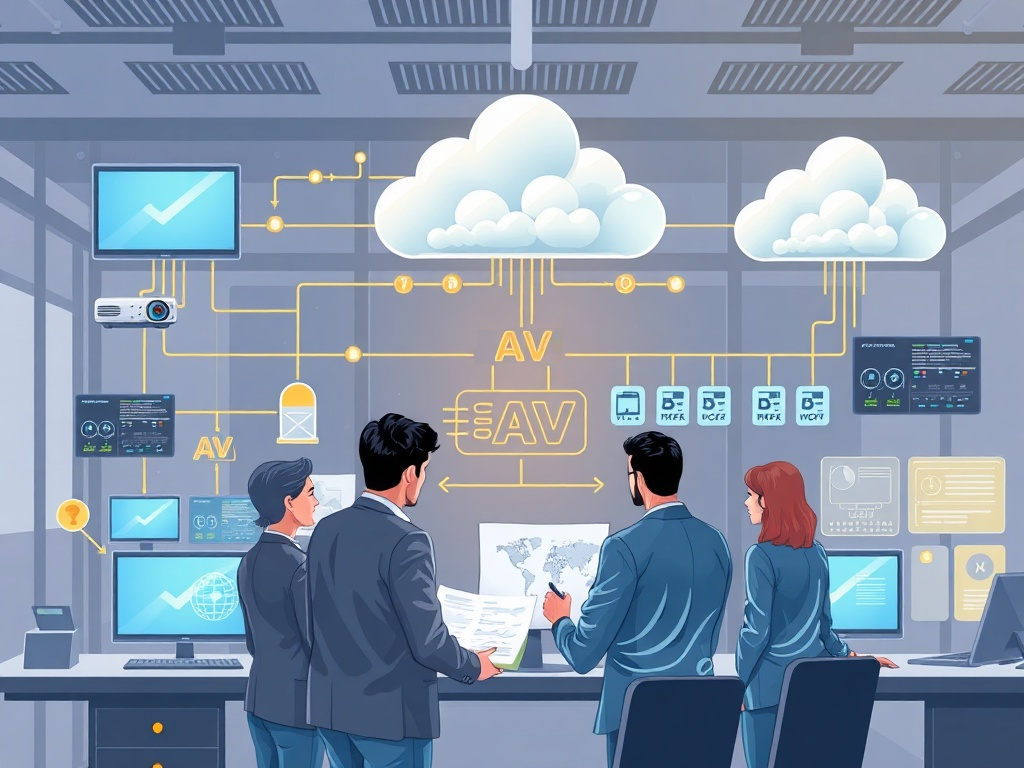




Welcome back to “Let’s Talk AV with Alexis,” where we break down the realities of AV modern integration.
After exploring the AV Rack Room, AVoIP foundations and Commissioning in previous episodes and the phase that determines the success of every AV project long before installation begins and now it is time for Episode 5.
Episode 5:The Most Repeated Mistake in AV Projects: Treating AV as Equipment, Not a System
After years of working on AV and ELV projects across corporate, education, government, and mission-critical environments, one mistake continues to appear — regardless of budget, region, or brand selection.
It is not poor hardware quality.
It is not lack of features.
It is not even user training.
The most repeated and damaging mistake in AV projects is treating AV as a collection of devices instead of a complete system architecture.
This mindset gap is subtle, but its consequences are serious: security risks, operational failures, strained relationships with IT, and systems that degrade rapidly after handover.
As AV systems become fully networked, software-defined, and remotely managed, this mistake is no longer acceptable yet it still happens every day.
The Legacy Mindset That No Longer Works
Historically, AV systems were isolated.
-
Point-to-point signal paths.
-
Minimal interaction with IT.
-
Limited security exposure.
-
Standalone operation.
In that environment, AV design focused primarily on:
-
Signal flow.
-
Audio intelligibility.
-
Visual performance.
-
User interface simplicity.
That approach worked — then.
Today’s AV systems are:
-
Connected to corporate networks.
-
Integrated with UC platforms.
-
Accessible remotely.
-
Managed via cloud portals.
-
Updated through firmware and software.
In short, AV systems are now IT endpoints.
Yet many projects are still designed using the old logic:
“Select the right devices and everything else will work itself out.”
It won’t.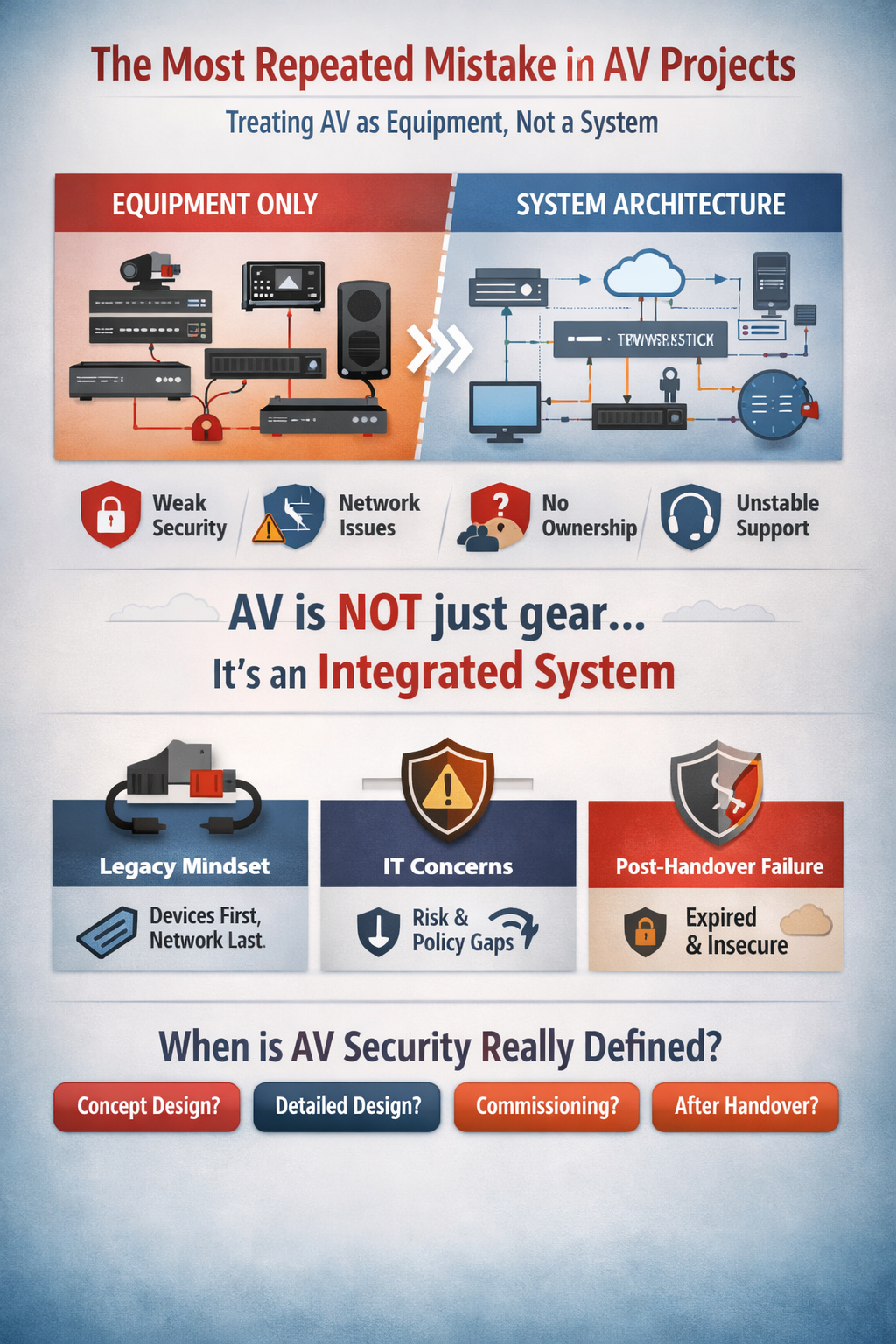
Symptoms of the “Equipment-First” Mistake
You can identify this mistake early by recognizing common symptoms during projects.
1. Network Design Is an Afterthought
AV equipment is specified without:
-
VLAN allocation.
-
IP addressing strategy.
-
Bandwidth calculation.
-
Multicast planning.
-
QoS definition.
These topics are deferred until commissioning — when changes are costly and political friction is high.
2. Cybersecurity Is Treated as Configuration, Not Architecture
Security discussions focus on:
-
Changing default passwords.
-
Enabling HTTPS.
-
Disabling unused services.
These are necessary steps — but they are not a security strategy.
True security starts with:
-
Network segmentation.
-
Access control models.
-
Trust boundaries.
-
Management plane isolation.
3. Ownership Is Undefined
After handover, no one clearly owns:
-
Firmware updates.
-
Credential management.
-
Certificate renewal.
-
Monitoring and logging.
-
Incident response.
AV becomes “someone else’s problem,” often caught between AV, IT, and facilities teams.
4. Remote Support Becomes a Risk
Remote access is requested urgently:
-
VPN exceptions.
-
Port forwarding.
-
Shared credentials.
-
Temporary access that becomes permanent.
What was meant to improve supportability becomes a long-term vulnerability.
Why Hardware Selection Alone Is Not Enough
Many AV projects proudly specify:
-
Enterprise-grade displays.
-
DSPs with advanced processing.
-
Networked video distribution.
-
AI-enabled cameras.
But hardware quality does not compensate for weak system design.
An AV system must be evaluated across five architectural layers:
-
Physical layer – cabling, power, mounting.
-
Network layer – switching, routing, segmentation.
-
Control layer – command, authentication, APIs.
-
Application layer – UC platforms, management tools.
-
Operational layer – support, monitoring, lifecycle.
Ignoring any one of these layers introduces risk.
Most repeated mistakes occur at layers 2–5, not at the physical layer.
The AV vs IT Gap: A Structural Issue
This mistake is often blamed on “poor coordination,” but the reality is deeper.
AV and IT teams historically speak different languages:
-
AV talks about signal paths and user experience.
-
IT talks about risk, policy, and lifecycle management.
When AV is treated as equipment, IT sees it as:
-
Unmanaged endpoints.
-
Security liabilities.
-
Exceptions to policy.
This leads to predictable outcomes:
-
Delayed approvals.
-
Restricted access.
-
Limited trust.
-
Workarounds instead of solutions.
The solution is not more meetings — it is better design responsibility.
Security Is a Design Decision, Not a Commissioning Task
One of the most dangerous beliefs in AV projects is:“We’ll secure it during commissioning.”
By that stage:
-
Network topology is fixed.
-
IP schemes are assigned.
-
IT policies are enforced.
-
Budgets are exhausted.
Security added late is always compromised.
Proper AV security design should define, at minimum:
-
Dedicated AV VLANs.
-
Access control lists.
-
Management plane separation.
-
Role-based access.
-
Secure remote access strategy.
Without these decisions made early, technical teams are forced into reactive solutions.
The Hidden Cost: Operational Failure After Handover
Many AV systems perform well during the first months after deployment — then slowly degrade.
Common post-handover issues include:
-
Expired certificates.
-
Firmware incompatibilities.
-
Credential changes not communicated.
-
Devices blocked by network policy updates.
-
Cloud services disabled without notice.
None of these are hardware failures.
They are operational design failures.
A system that cannot be maintained securely and predictably is not a successful system — regardless of how good it looked on day one.
AV as a Managed System, Not an Installation
A modern AV system should be designed like any enterprise system:
-
Defined architecture.
-
Clear ownership.
-
Documented access models.
-
Lifecycle planning.
-
Alignment with IT governance.
This requires AV professionals to move beyond:
-
Device selection.
-
Signal diagrams.
-
Control logic only.
And step into:
-
System architecture.
-
Network-aware design.
-
Security-conscious decision-making.
This shift is not optional anymore.
What “System Thinking” Looks Like in AV Design
When AV is treated as a system, projects change noticeably.
During Design
-
Network topology is discussed early.
-
IT is involved before procurement.
-
Security constraints shape solutions.
-
Management platforms are selected intentionally.
During Implementation
-
Commissioning follows a defined plan.
-
Access is controlled and logged.
-
Testing includes failure scenarios.
-
Documentation supports operations.
After Handover
-
Responsibilities are clear.
-
Updates are planned.
-
Remote support is secure.
-
The system evolves, not degrades.
This is the difference between installation success and system success.
Why This Mistake Keeps Repeating
This mistake persists because:
-
Project timelines are compressed.
-
AV scope is undervalued.
-
Responsibility boundaries are unclear.
-
Many teams are still trained in legacy AV models.
But the industry has already changed.
AV is no longer peripheral — it is core infrastructure.
The Way Forward for AV Professionals
To avoid this repeated mistake, AV professionals must:
-
Think like system architects.
-
Design with IT constraints in mind.
-
Address security at concept stage.
-
Advocate for proper ownership models.
-
Educate stakeholders with clarity, not confrontation.
This evolution is already happening — but unevenly.
Those who adopt it early will:
-
Gain trust from IT teams.
-
Deliver more resilient systems.
-
Reduce long-term risk.
-
Elevate the role of AV in organizations.
Final Thought
AV projects do not fail because of poor equipment.
They fail because architecture is ignored.
When AV is treated as a system designed, secured, and managed accordingly, it becomes reliable, scalable, and trusted.
That is the standard modern AV projects must meet.
Question to the AV Community:
At what stage is AV cybersecurity and system architecture truly addressed in your projects?
-
Concept design.
-
Detailed design.
-
Commissioning.
-
After handover.

With over 20 years of experience in the AV and ELV industries, I specialize in AV system design, installation, management, and integration across diverse sectors, including corporate, education, sports, healthcare, hospitality, and government. My career began in 2003 with the AV team at a 5-star hotel in Lebanon, where I developed a passion for AV systems.
Technical leadership spans advanced audiovisual ecosystems including digital signage networks, broadcast and media systems, large-format LED environments, video mapping, PAVA and emergency communication systems, intelligent wayfinding, collaboration spaces, lecture theatres, hospitality technologies, and integrated control platforms.
Known for bridging the gap between consultants, architects, operators, and technology vendors to ensure cohesive design delivery and future-ready infrastructure. Strong focus on user experience, operational efficiency, scalability, and reliability across complex facilities.
Certified Project Management Professional (PMP) and AVIXA CTS-D / CTS-I, demonstrating mastery in AV system design, integration, and project governance. Active contributor to the global AV community as an AVIXA Xchange Advocate across the Middle East and GCC.
Industry speaker at the Integrated Systems Europe (ISE) 2023 & 2025 in Barcelona, Infocomm India Sep 2025, representing Qatar and contributing insights on evolving AV technologies, project delivery practices, and knowledge collaboration within the global AV community.
Currently, I am part of BLINQ, a division of IMAR Trading and Contracting in Qatar, where I serve as the ELV Projects Manager, focusing on ELV systems and immersive AV solutions. I am committed to continuous learning, staying ahead of industry trends, and mentoring emerging professionals to elevate the AV field
-
Xchange Advocates are recognized AV/IT industry thought leaders and influencers. We invite you to connect with them and follow their activity across the community as they offer valuable insights and expertise while advocating for and building awareness of the AV industry.