
Why Many Immersive Projects Struggle After Opening Day

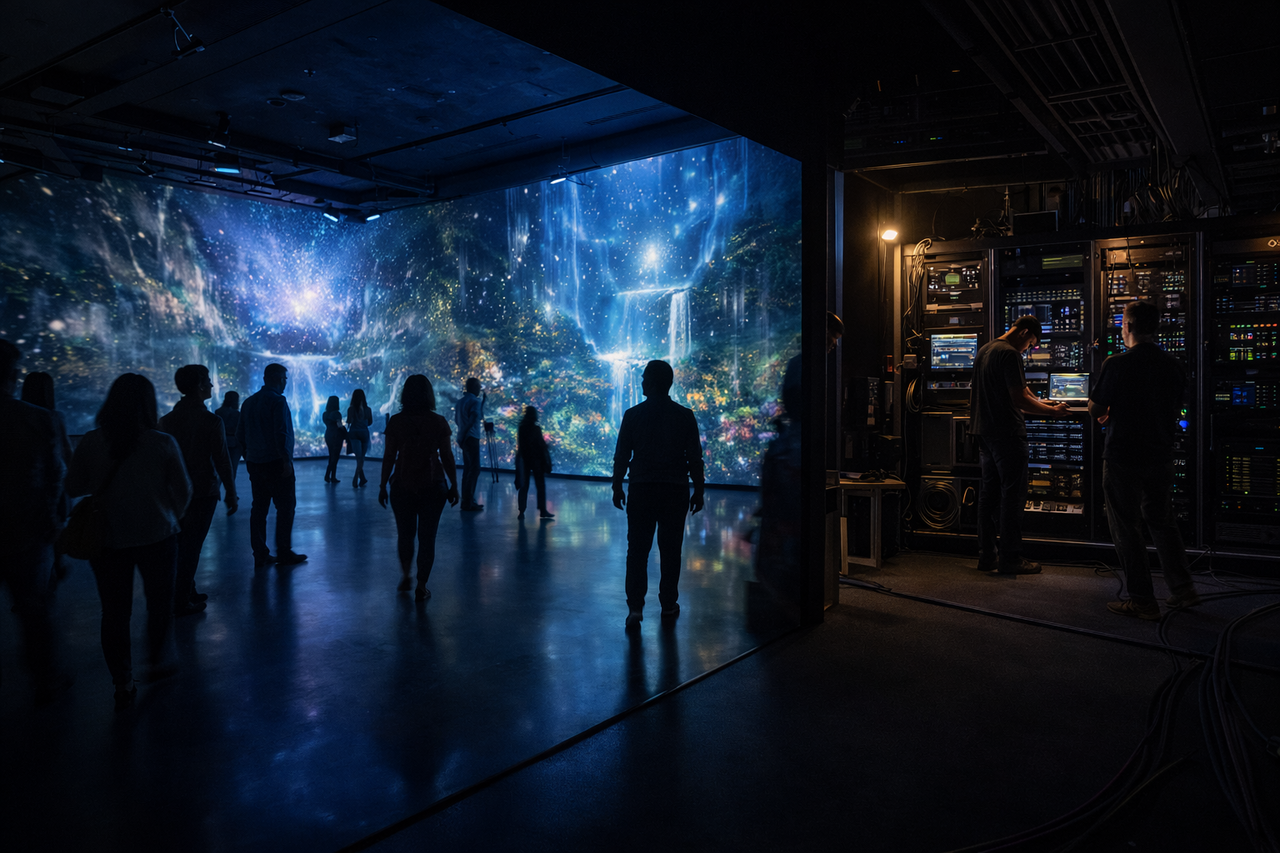
Opening day is a powerful moment in any immersive project. The lighting is perfect, the content is fresh, the systems are tuned and the audience reaction is exactly what everyone hoped for. It is the moment that represents months or years of creative work finally coming to life.
However, opening day is only the beginning of an immersive environment’s real life.
For developers, institutions and operators, the true measure of success is not the launch event but how that experience performs over the years that follow. Does the technology remain reliable? Can the experience be operated by staff without specialist intervention? Does the content remain relevant? Does the system continue delivering the emotional impact that justified the investment in the first place?
These questions are becoming increasingly important as immersive environments evolve from experimental attractions into long-term strategic assets.
Across museums, destinations, wellness environments and cultural institutions, immersive spaces are now expected to operate continuously, integrate with broader building systems and support revenue generation or audience engagement over many years. The expectations placed on these environments have shifted dramatically.
Yet many immersive projects are still designed primarily for opening day.
The creative and technical energy of a project naturally focuses on the moment when the experience is first revealed. Design teams want the reveal to be spectacular. Clients want the press launch to generate excitement. Integrators are working against tight schedules to deliver complex systems under significant time pressure.
This focus is understandable, but it can unintentionally prioritise short-term impact over long-term resilience.
In practice, the challenges that emerge after opening are rarely related to the original creative vision. More often they relate to operational complexity. Systems that require constant specialist support. Content pipelines that are difficult to update. Hardware configurations that are hard to maintain or scale. Environments where the operational team inherits technology that was never designed with their daily workflow in mind.
Over time these pressures accumulate. Maintenance becomes more expensive than expected. Content refresh becomes difficult. Reliability begins to affect the audience experience. What began as a powerful immersive environment slowly loses the consistency that made it compelling.
None of this is inevitable. In most cases these issues are not the result of poor intent or lack of expertise. They are the result of how immersive projects are traditionally structured.
When operational thinking is introduced late in the design process, many key decisions have already been made. System architecture, control strategies and infrastructure choices are often locked in before long-term operational scenarios are fully explored. By the time integration begins, the opportunity to simplify or future-proof the system has often passed.
This is why lifecycle thinking needs to start much earlier.
When immersive environments are approached as long-term infrastructure rather than installations, the design priorities shift. Reliability becomes a design parameter rather than a maintenance concern. Content management workflows are considered alongside storytelling. Hardware choices are evaluated not only for performance but also for serviceability and longevity.
Operational teams become part of the conversation long before opening day.
At Blue Alchemy Labs we have increasingly approached immersive environments through this lens. The objective is not simply to create a compelling moment at launch, but to design experiences that remain operationally resilient and creatively relevant for years. That means embedding systems thinking early, ensuring control architecture is clear and maintainable, and considering how content and technology can evolve without requiring complete reinvention.
In many ways this is less about technology and more about mindset.
Immersive environments are moving into a phase where they are treated as long-term assets within larger destinations and institutions. As that shift continues, the studios and design teams involved will need to think beyond the opening moment and consider the full operational lifecycle of the experiences they create.
Opening day will always be exciting. It is the visible celebration of creative collaboration and technical achievement.
But the real success of an immersive project is measured quietly over the years that follow, in the reliability of the systems, the ease of operation and the sustained impact on audiences who continue to experience it long after the launch event has passed.
Designing for that longevity is becoming one of the most important responsibilities in immersive design today.
Mike's illustrious career as a multi-award-winning Creative Technical Director is marked by his profound expertise in designing and executing large-scale fixed installations and live event projects that consistently redefine the frontiers of technology and innovation.
Over the span of more than two decades, Mike has meticulously honed his craft, amassing invaluable experience across a diverse range of industries, including live events, automotive exhibitions, financial expos, museums, science centres, and themed entertainment attractions. His ability to seamlessly adapt to these varied domains is a testament to his versatility and technical acumen.
Mike's extensive portfolio is an impressive showcase of his technical prowess, featuring a broad spectrum of projects, from intricately detailed small-scale endeavours to grand, technologically advanced installations. Collaborating with eminent institutions and corporate giants such as The Sphere – Las Vegas, Walt Disney Imagineering, Universal Studios, The Smithsonian Institute, The Adler Planetarium, The American Museum of Natural History, Apple, Barclays, Coca-Cola, Nike, Farah Leisure, Hyundai, Cedar Fair, Changi Airport Group, Merlin Entertainment, Dubai Parks and Resorts, and the BBC highlights the depth and technical diversity of his skill set.
What truly distinguishes Mike is his exceptional proficiency in merging creative artistry with cutting-edge technology. This intricate fusion is often overlooked in the industry, but it forms the cornerstone of his specialized skill set. Whether he's developing immersive environments that seamlessly integrate state-of-the-art audio-visual systems, interactive displays, and sensory experiences to educate and entertain or orchestrating intricate technical collaborations between creative and engineering teams, Mike consistently delivers projects that not only meet the highest technical standards but also captivate and engage audiences with unprecedented technical precision.
Mike's journey is a testament to his unwavering dedication to pushing the boundaries of immersive experiences and technical innovation. His visionary approach, complemented by his exceptional grasp of complex technical intricacies, has firmly established him as a luminary in the realm of creative and technical direction, setting new industry benchmarks and inspiring others to embrace the intricacies of technology and innovation.
-
Xchange Advocates are recognized AV/IT industry thought leaders and influencers. We invite you to connect with them and follow their activity across the community as they offer valuable insights and expertise while advocating for and building awareness of the AV industry.
Recommended Content

A Visit to Firdaus Studio – Where Music, Technology, and Women’s Empowerment Converge

The Immersive Industry Doesn’t Have a Creativity Problem. It Has an Operating Model Problem.
Please sign in or register for FREE
If you are a registered user on AVIXA Xchange, please sign in