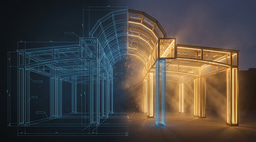
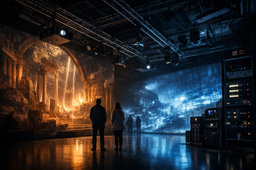
A lot of experience projects look viable at concept stage because the expensive problems are still invisible. The render looks good, the guest journey makes sense, and the creative intent is strong. Stakeholders can see the potential, the story has energy, and the project feels like it has momentum. At that stage, it is natural for most of the conversation to focus on what the audience will experience: the reveal, the emotion, the media, the scenic environment, the interaction, and the moments that make the project worth building.
But some of the most important questions sit underneath all of that. Where does the infrastructure go? What are the power requirements? How does data move through the space? What network architecture is required? Where are the racks located? How is the system cooled? How are cable paths coordinated? What controls what? Who updates the content? Who maintains the system after handover? What does the operator actually have to do every day to keep the experience running? None of these questions are as exciting as the creative reveal, but they are often where cost, complexity and compromise begin to build.
The challenge is that early concept work can make a project feel more resolved than it really is. A strong visual direction can create confidence before the supporting conditions have been properly understood. A beautiful render can imply that the environment is buildable, even when the infrastructure, systems and operational model are still largely undefined. As experience projects become more technically integrated and operationally demanding, the relationship between creative ambition and underlying systems becomes harder to separate. Media, lighting, audio, show control, interactivity, networking, content management and building systems all influence one another, which means a decision in one area can quietly create consequences somewhere else.
A change to media resolution may affect playback hardware, storage, bandwidth and cooling. A spatial design change may impact projector placement, speaker coverage, sightlines, cable routes and maintenance access. A new interactive layer may introduce additional sensors, network devices, control logic and content states. A decision about where equipment is located may influence serviceability for years. At concept stage, these may seem like details to be worked out later. In reality, they often define whether the project can be delivered cleanly.
Once a project moves into detailed design, procurement or construction, flexibility reduces quickly. Decisions that were once open become fixed by architecture, budget, programme, procurement paths or stakeholder approvals. By the time infrastructure issues surface, teams are often solving around constraints rather than designing from first principles. That is when workarounds begin: rack rooms end up too far from the systems they support, cable pathways become difficult because architectural coordination happened too late, cooling is underestimated because equipment loads were not fully understood, network requirements expand beyond what was planned, and operational teams inherit processes that were never designed around their daily reality.
None of these problems necessarily stop a project from opening. Talented teams can usually make things work by launch, often through extraordinary effort. But opening is not the same as succeeding. A project can look impressive on day one while being harder to maintain than it should be. It can deliver the intended moment while relying on too many manual workarounds. It can technically function while creating operational friction that slowly affects reliability, cost and consistency over time.
That is why these issues should not be treated as technical details to be resolved later. Many of them are not purely technical problems at all. They are early coordination problems. The real issue is whether the right conversations happened early enough between creative, technical, architectural, operational and commercial teams. It is whether assumptions were tested before they became expensive. It is whether the project was viewed as an integrated experience system, rather than a collection of separate design packages.
Bringing infrastructure and system planning into the conversation early does not mean technology should lead the experience. Quite the opposite. It means understanding the conditions required to protect the creative intent. Good system planning gives the experience more room to succeed. It helps the creative team understand what is possible, what is risky, and where the best opportunities sit. It helps clients make better decisions about scope, budget and phasing. It allows operational teams to influence the design before they are handed a system they have to live with. It gives delivery teams fewer surprises at the most expensive point in the programme.
For developers, destinations and cultural institutions investing in permanent experience environments, this matters. These are not temporary installations that disappear after a short run. They are long-term assets expected to perform reliably, attract audiences, support revenue or engagement goals, and remain relevant beyond opening day. That requires a different level of thinking, especially at the earliest stages of project definition.
At Blue Alchemy Labs, this is a space we have been deliberately building into. Our focus is increasingly on helping teams shape complex experience projects earlier, bringing creative, technical, strategic and operational thinking together before things become too locked in. That might mean interrogating a concept before a major capital decision is made, identifying hidden infrastructure dependencies, aligning creative ambition with technical systems and delivery pathways, or supporting owners, developers and institutions as an independent layer between vision, design, integration and operation.
The common thread is clarity. The most expensive mistakes in experience projects are rarely the obvious ones. They are the assumptions nobody challenged, the infrastructure that was not properly coordinated, the operational requirement left until later, or the interface between disciplines that everyone thought someone else owned. By the time those issues become visible, they are often much harder and more expensive to resolve.
That is why early planning matters. Not because it makes projects less creative, and not because it slows ambition down, but because it gives ambition a stronger foundation to stand on. The best experience projects are not just imagined well. They are shaped well, coordinated well, and built on systems that allow the creative intent to survive contact with reality.
Xchange Advocates are recognized AV/IT industry thought leaders and influencers. We invite you to connect with them and follow their activity across the community as they offer valuable insights and expertise while advocating for and building awareness of the AV industry.