Welcome back to “Let’s Talk AV with Alexis” : where technology meets real-world integration.
Over the past episodes, we explored critical foundations of AV success: from the AV Rack Room and AVoIP fundamentals, to commissioning and most recently, one of the most repeated mistakes in AV projects. Each topic highlighted a simple truth: the success of an AV system is rarely determined at installation , it is shaped much earlier, during design and intent definition.
That brings us to Episode 6.
Episode 6:Designing a Successful Auditorium: Where Acoustics, Technology and Intent Converge.
In last few weeks i received many question related to what does it really take to design a successful auditorium?
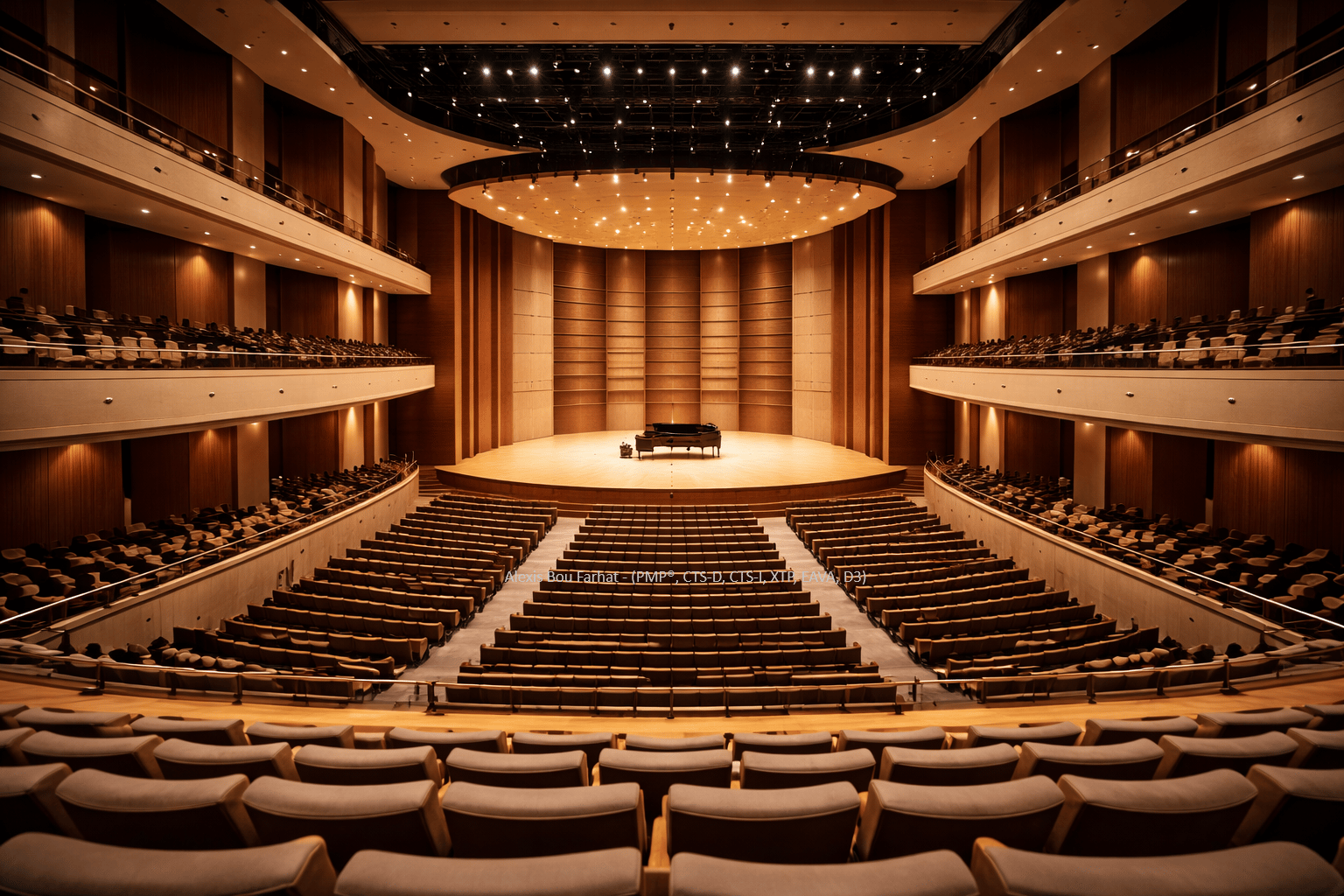
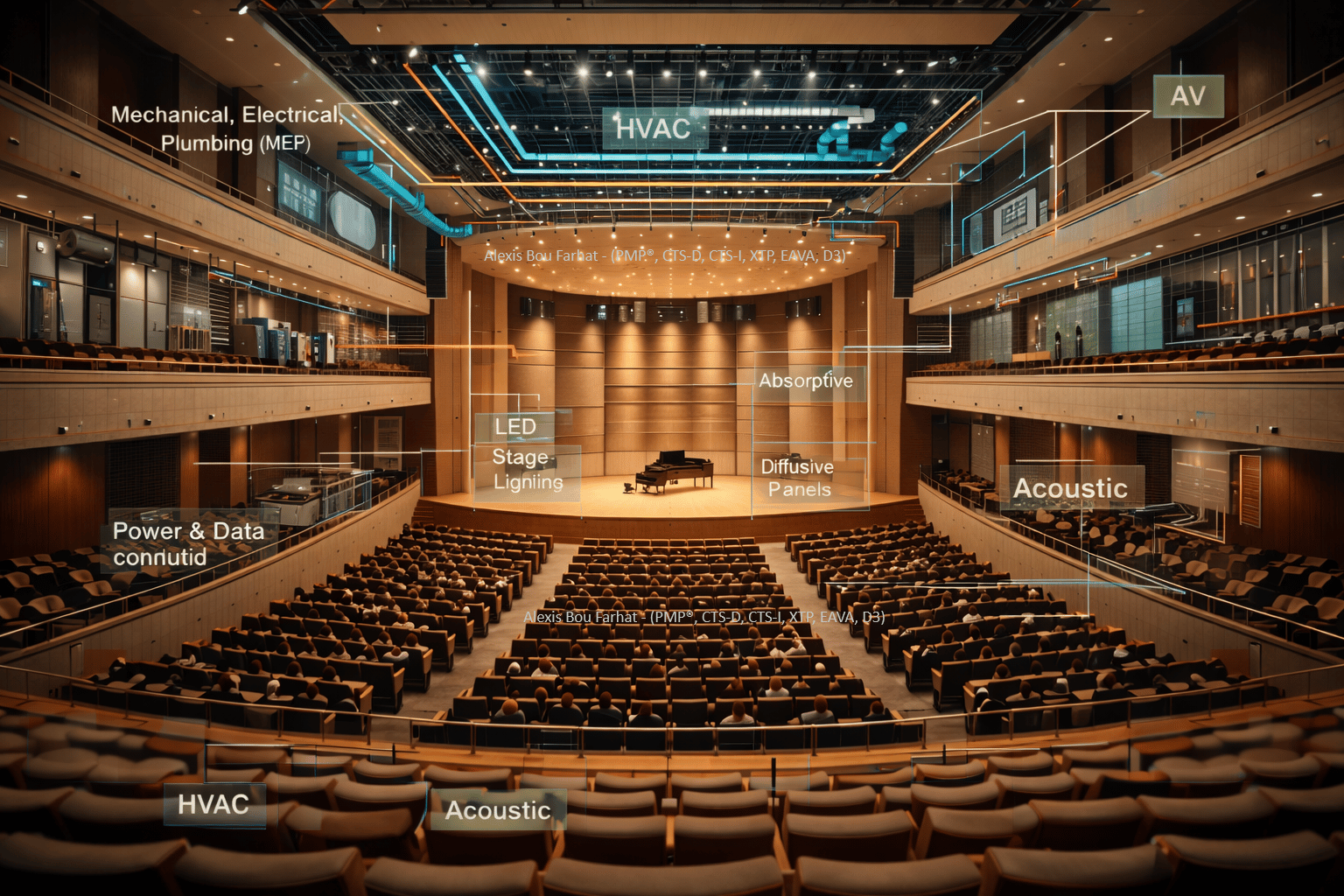
This question comes up often and the answer is never about a single system or discipline. A successful auditorium is the result of orchestrating architecture, acoustics, AV, lighting and MEP into one unified experience—where technology supports the performance without drawing attention to itself.
Clarity of Purpose Comes First:
Every auditorium design must begin with a clear understanding of its intended use:
Speech.
Music.
Theater.
Multipurpose.
Without this definition, even the most advanced technical solutions can fall short. A hall designed for unamplified opera or classical music will inherently behave differently from one intended for amplified concerts or corporate events. The key is not choosing one at the expense of the other, but planning for adaptability from day one.
The Three Core Pillars of Auditorium Design:
A complete auditorium design rests on three fundamental pillars:
Audience Experience –> comfort, immersion and emotional impact.
Technical Performance –> acoustic integrity, intelligibility and reliability.
Long-Term Sustainability –> flexibility, durability and future readiness.
Key Elements of a Complete Auditorium Design:
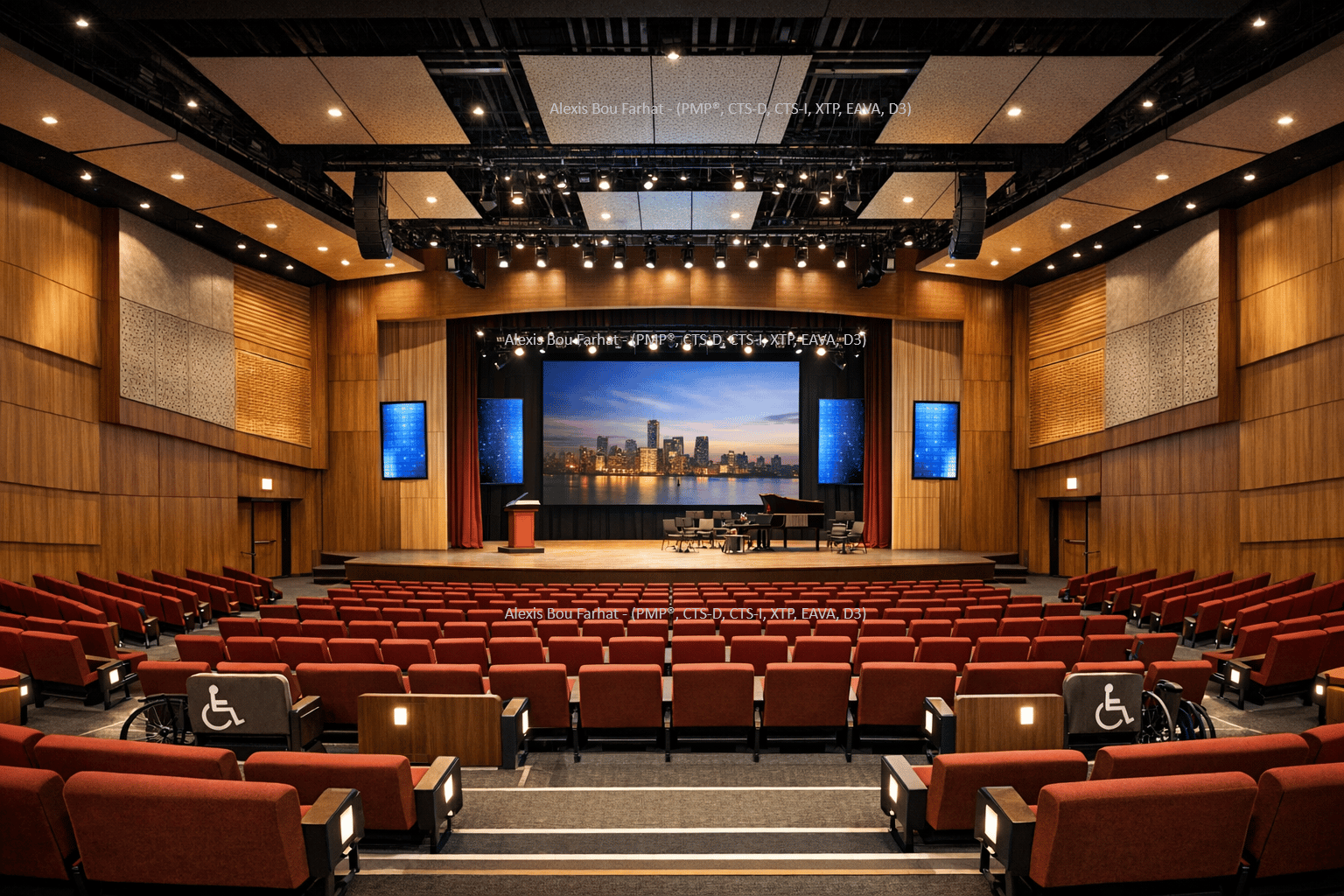
🔹 Seating & Sightlines
Accurate seating capacity calculations.
Raked seating geometry for unobstructed views.
Accessible seating (wheelchair, companion and hearing-impaired locations).
Proper aisle widths and circulation for safe egress.
Good sightlines ensure that visual engagement matches the acoustic experience—one cannot succeed without the other.
🔹 Acoustics & Audio
Acoustics remain the emotional foundation of any auditorium:
.Room geometry, volume and reverberation time control.
Strategic use of absorption, diffusion and low-frequency treatment.
Isolation from external noise and structural vibration.
Sound system design for uniform coverage and high speech intelligibility.
While acoustic perfection is often the goal, the real challenge lies in balancing acoustic excellence with functional flexibility. Variable acoustics, controlled reverberation strategies and adaptable electro-acoustic systems allow a venue to support multiple performance types without compromising its identity.
🔹 Visual Systems
Projection screens or LED walls (type, size and placement).
Viewing angle optimization and glare control.
Seamless integration with lighting and architectural elements.
Visual systems must complement the performance, not dominate it.
🔹 Lighting Design
Stage and house lighting systems.
Fixture selection based on performance needs.
Lux level calculations and uniformity.
Light spill control and visual comfort.
Lighting directly influences perception, mood and focus—and must work in harmony with audio and visuals.
🔹 Stage & Back-of-House
Stage dimensions and structural load capacity.
Backstage circulation and technical access.
Control rooms, racks and equipment spaces.
Operational efficiency behind the scenes is critical to smooth performances in front of the audience.
🔹 MEP & Comfort
Silent HVAC systems suitable for performance spaces.
Thermal comfort across all seating zones.
Coordination to avoid noise, drafts and vibration.
Comfort should be felt, not heard.
🔹 Codes, Standards & Future-Proofing
Compliance with fire, life safety and international standards.
Budget alignment, durability and maintenance strategy.
Infrastructure allowance for future technology expansion.
From a technology perspective, long-term flexibility has become a key driver. Modular beam-steering loudspeakers, precise energy control at the listener plane, discreet system integration and scalable infrastructure are no longer “nice to have” they are expectations.
Interoperability across Dante, AES67, AES-EBU and analogue systems, combined with robust DSP platforms and preset recall, ensures that venues can evolve with changing use cases without major redesigns.
🔹 Coordination Is Everything
Architectural, acoustic, AV, lighting and MEP disciplines must function as one integrated system, not isolated silos. Many auditorium challenges arise not from poor design, but from poor coordination.
Finally, An auditorium succeeds when the audience forgets the technology and simply experiences the performance.
True success lies in achieving the closest possible balance between acoustic excellence, functional flexibility and future readiness without compromising the immersive emotional impact that defines great performance spaces.
Question for #AVcommunity: What do you think is most often overlooked in auditorium projects acoustics, sightlines, or long-term flexibility?
Xchange Advocates are recognized AV/IT industry thought leaders and influencers. We invite you to connect with them and follow their activity across the community as they offer valuable insights and expertise while advocating for and building awareness of the AV industry.