Strategic Path: The Intelligent Workplace™ for the C-Suite

A Unified Operating System for Intelligent Work
Most organizations believe their workplace challenges stem from hybrid work, employee behavior, or insufficient technology.
In reality, these issues are symptoms of a deeper structural problem.
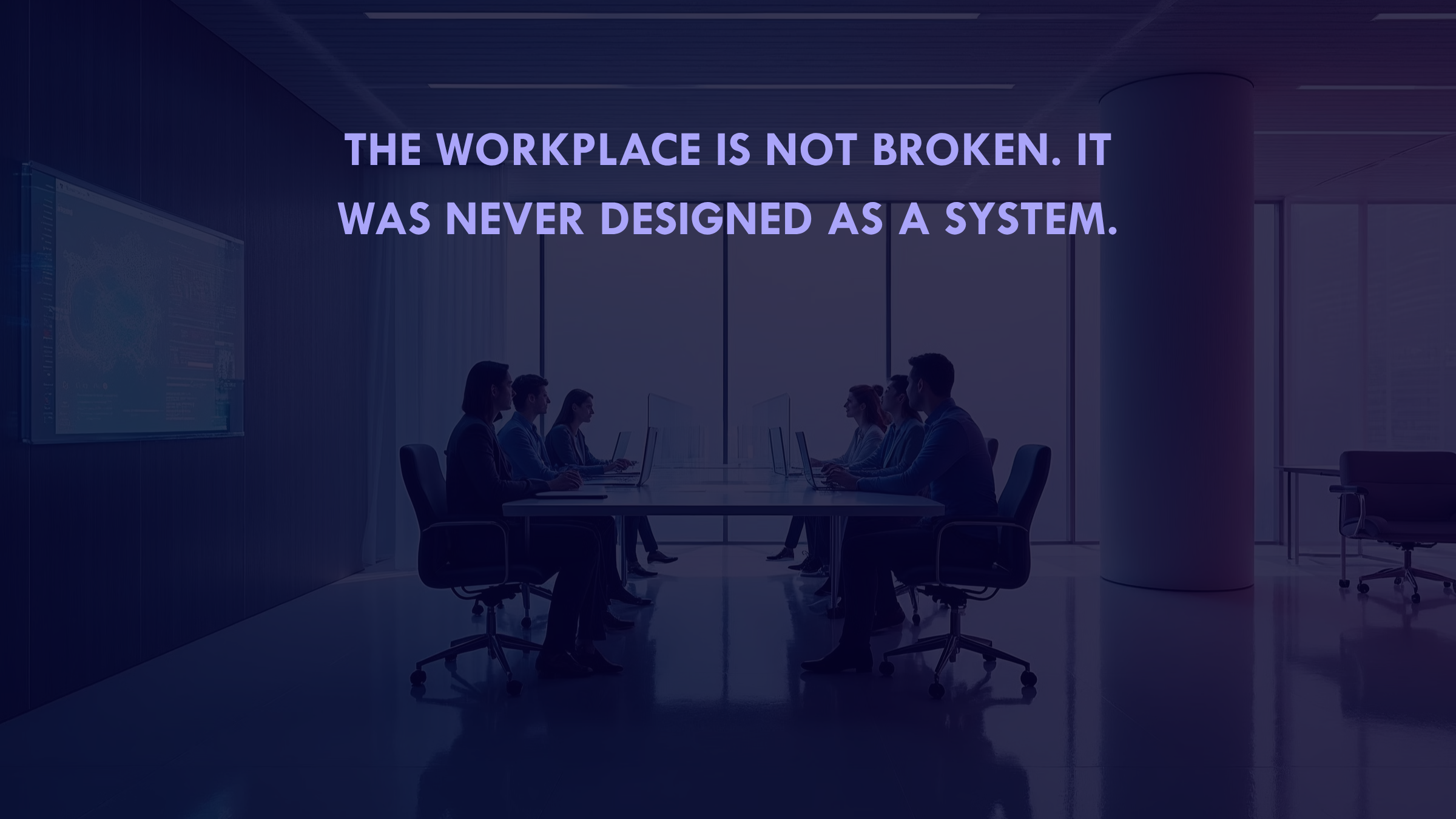
The workplace was never designed as a coherent system.
Over the past decade, enterprises invested heavily in collaboration tools, office redesigns, flexible work policies, and more recently, AI. Yet productivity gains remain uneven, collaboration quality is inconsistent, and AI initiatives often struggle to scale beyond individual or departmental use cases.
The reason is not lack of effort or investment. It is misalignment.
The Workplace Evolved in Silos
For years, workplace decisions were made in isolation.
HR focused on people and policies.
IT focused on platforms and infrastructure.
Facilities focused on space and utilization.
Operations focused on process and efficiency.
Each decision made sense independently.
Employees, however, experience all of these dimensions simultaneously. When they are not aligned, friction becomes embedded in everyday work: in meetings, workflows, handoffs, decision making, and collaboration.
This friction is often invisible to leadership but deeply felt across the organization.
From Digital Workplace to Intelligent Workplace
The next era of work will not be defined by more technology or better offices.
It will be defined by intelligence.
An Intelligent Workplace is a unified operating system that aligns four critical dimensions:
- Workforce – how people work, collaborate, learn, and adapt
- Workflow – how work moves across teams, systems, and decisions
- Workspace – how physical and digital environments support outcomes
- WorkTech – the technology foundation enabling reliability, integration, and AI readiness
When these dimensions are designed and governed together, the workplace shifts from a collection of disconnected initiatives to a performance engine that supports productivity, efficiency, collaboration, and innovation.
Why AI Depends on Workplace Alignment
AI does not fix broken systems. It amplifies them.
Without consistent workflows, reliable collaboration environments, clean inputs, and aligned human behaviors, AI delivers fragmented results and introduces operational risk. Organizations that succeed with AI first ensure their workplace foundations are ready.
AI value is constrained less by algorithm capability than by organizational and workplace readiness.
The Strategic Shift Leaders Must Make
High-performing organizations no longer ask:
“What tools should we buy next?”
They ask:
“How does work actually happen, and what system supports it end to end?”
By treating the workplace as an operating system rather than a series of projects, leaders unlock measurable gains in productivity, efficiency, collaboration, and innovation.
Why This Matters Now
In 2026, workplace performance directly impacts execution speed, employee experience, and competitive advantage.
Organizations that continue to optimize individual components will fall behind those that design the whole system.
The Intelligent Workplace is not a future concept. It is the model required to operate effectively today.
👉 Read the full whitepaper
The Intelligent Workplace: A Unified Operating System for Modern Work Delivering this is a capability question. The approach is documented in the Capability Delivery engine.
https://intelligentworkplace.ai/resources/f/the-intelligent-workplace

Marc A. Rémond is the founder of Strategic Pathways, a business advisory firm helping technology leaders design the business operating models required to scale.
With 25+ years of sales leadership across AV, UC, and enterprise technology, at Alcatel-Lucent, Polycom, and Barco, among others, he has built go-to-market strategies, channel ecosystems, and AI transformation programmes for global technology companies.
He is the creator of the Intelligent Workplace™, the 4W/4D/4C/4P Frameworks, the Strategic Diagnostic Engine, and the Human-AI Intelligence Charter, and the architect of the Synchronised Growth Architecture.
He is the author of EVOLVE-OR-DIE.AI: Leading in the Era of Human and AI Intelligence, available on Amazon and Apple Books, and the architect of the Intelligent Leader Programme, a twenty-eight module executive curriculum.
He runs two authority brands, an advisory practice, seven content pipelines, and the Intelligent Leader Programme as a single operator.
He writes on market expansion, sales execution, market narrative and workplace transformation at strategicpathways.asia and intelligentworkplace.ai.
Follow him on LinkedIn at linkedin.com/in/marcalexremond.
-
Xchange Advocates are recognized AV/IT industry thought leaders and influencers. We invite you to connect with them and follow their activity across the community as they offer valuable insights and expertise while advocating for and building awareness of the AV industry.