
InfoComm 2026 Review In Depth


That shift matters because the industry is now being shaped by more than display specs or system design alone. Economic pressure, supply-chain strain and rapid AI adoption are changing what buyers expect, how vendors compete, and how integrators deliver value.
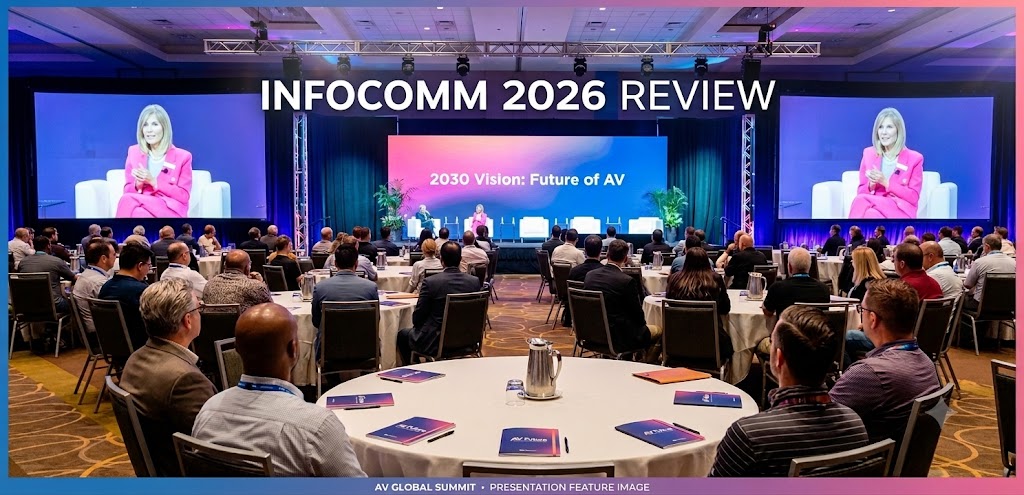
“The Experience Economy Revisited” was the title of a keynote presentation offering excellent background for what attendees experienced at the Las Vegas Convention Center. A week’s worth of exhibits and sessions highlighting multi-channel media players, video walls, enterprise edge and AI processors both inspired and challenged more than 20,000 attendees.
In his presentation, Michael Sullivan-Trainor, senior industry analyst at AVIXA, the show producer, articulated the various challenges and opportunities the Pro AV industry faces as he released the results of the most recent quarterly AVIXA buyer study.

Michael Sullivan-Trainor of AVIXA speaks on the Experience Economy at Infocomm 2026.
“This presentation is primarily about the future of Pro AV and how it is redefining the Experience Economy,” Sullivan-Trainor stated in his presentation. “But before we take a step into the future, let’s take a step back. Today we view the Experience Economy by its technology characteristics; those are the provision of environments that are immersive, interactive and offering personalization. But the concept started as an economic model by management consultants Joe Pine and James Gilmore, who were in turn inspired by Alvin Toffler’s 1970 book, ‘Future Shock,’ about the disorientation we experience when technology change happens too fast.”
Many, if not most attendees at Infocomm 2026 were too young to remember Alvin Toffler’s 1970 book. In it, the futurist anticipated the world we currently live in, and he predicted the role of the “specialized experience maker,” a prediction borne out by the very existence of Infocomm. (Those who have not read the book are hereby encouraged to do so.)
Today, differentiating through experience has become increasingly important to consumers, and Pro AV may well be the leading (though not only) enabler of that capability, as evidenced by the Infocomm 2026 show floor. The capabilities are transforming what customer experiences today’s technology can deliver.
Sullivan-Trainor cited three highlights of Pro AV’s impact on today’s customer experience transformation: 1) the industry’s resilience to economic shocks (caused by trade tariffs, wars and inflation): the AVIXA buyer study revealed that most Pro AV buyers expect to increase budgets in Q3 2026, continuing a five-year trend, 2) the emergence of the professional broadcasting grade workplace, and 3) the evolution of agentic driven experiences.
Pro AV technology goes multi-channel
While AVIXA mainly focuses on the Pro AV, broadcasting and workplace management industries, many of the observations at Infocomm increasingly apply to retail, hospitality, events, transportation and public venues.
“The show is evolving into much, much more than just one AV channel,” AVIXA CEO David Labuskes stated in an Infocomm Show Daily article. “I see more application of AV as a solution and as a delivery tool for experiences.”
This “expansion” theme cited by Labuskes speaks to the blurring of distinctions between customer experience verticals, driven by AI and other technologies. Innovations such as AI agents, conversational voice and curved LED displays that might have been designed for events, for example, can easily augment the retail customer experience.
Helen Matthews, senior market analyst at Futuresource Consulting, told the Infocomm Show Daily that AI simplifies some of the operational complexity of broadcast technology that once required an engineer. Where broadcast and Pro AV were separate industries with their own vendors, customers and operating models, Matthews noted, the two industries are converging, as was evidenced on the show floor.
Other veteran observers have noted how Pro AV technology is transforming the modern workplace, retail environments, live events and entertainment experiences.
Sam Phenix, CEO of Phenix Consulting, told the Show Daily that effective retail environments use AV tech to support story telling, personalize content, reduce friction, improve navigation and create discovery.
But in order to accomplish this cross channel utilization, tech stacks must integrate successfully.
Integrated tech stacks emerge
To this end, a section on the exhibition floor flagged as “The Pitch,” powered by Diversified, showcased a fully integrated technology stack – including broadcast systems, control platforms, displays, collaboration tools, audio, and graphics – synchronized to power live events, dynamic sports and entertainment. Attendees explored how venues and media spaces can support everything from live game day production to decision-making and audience engagement.
Highlights at “The Pitch” included:
- Broadcast control environments that manage live feeds, graphics and real-time production workflows.
- Draft room strategy spaces designed for collaboration, data visualization and decision-making.
- Premium viewing lounges that flex between hospitality, presentations and live events.
- Fan engagement activations that transform audiences into participants through interactive, branded moments.
As noted at last month’s National Restaurant Show in Chicago, the adoption of emerging customer experience technologies oftentimes requires integrating disparate tech stacks, which in the early stages can be cumbersome. This refers to the technologies used to operate a software product, which can include the front end, back end, servers, database and support tools.
Beyond “The Pitch,” other specific exhibits and some of the education sessions took on the unified tech stack challenge.
Meeting the tech stack challenge
Espen Løberg, vice president and general manager of collaboration devices at Cisco, noted in a keynote presentation that as organizations reimagine how and where work happens, the systems that enable collaboration – from IT infrastructure to AV to AI-driven experiences and workplace analytics – oftentimes are managed separately. This can result in complex deployments, inconsistent user experiences and limited visibility into how workspaces actually perform.
Challenges notwithstanding, the growing retail adoption of Pro AV technology was evidenced by another area on the exhibition floor flagged as “The Retail Experience,” which offered a hands-on, connected store environment. Attendees explored how AV, data and digital signage come together in the customer journey in real time, powered by integrated solutions from Samsung, BrightSign, Bluesound Professional and Poppulo. The exhibit featured a fully integrated, high-end retail mockup showcasing how audio, lighting and digital displays synchronize. From first impression to final transaction, the experience demonstrated how integrated systems personalize engagement and drive measurable business outcomes.
Still another exhibition section, flagged “Smart Workplace,” powered by Forte, demonstrated a fully integrated technology stack – including control systems, collaboration platforms, audio, video, and analytics – working together to deliver consistent and scalable workplace solutions.
“Smart Workplace” highlights included:
- Meeting environments designed for seamless in-room and remote participation.
- Broadcast-ready communication spaces that elevate internal and external messaging.
- Workplace intelligence systems that provide real-time visibility into space utilization and performance.
- Personalized workspaces that adapt to individual preferences and tasks.
The Kiosk Manufacturer Association (KMA), together with The Industry Group (TIG) and KioskIndustry.org, also demonstrated tech stack convergence with an exhibit featuring kiosk hardware, digital signage software, touch technology, edge AI computing, accessibility and interactive display solutions. Vendors included Insight Touch, which specializes in advanced interactive touchscreen solutions and hardware, including commercial displays, touch monitors, and interactive kiosks; SiteKiosk, which offers a kiosk software solution designed to securely lock down public-access computers, displays, and tablets into safe, tamper-proof digital signage or interactive kiosks; and URway Holdings, which provides conversational voice with its AI Connect Bar that combines microphones with a speaker system into one sleek peripheral with a single USB connection to attach to touchscreen computers and kiosks.
10 takeaways
Following are 10 takeaways from the show.
- AI continues to drive innovation, but the adoption is still in its early stage. Espen Løberg, vice president of product management at Cisco Collaboration Devices, noted in his keynote presentation that there is a gap between what AI promises and what the current physical infrastructure offers. AI is already being used by the majority (65%) of Pro AV users surveyed by AVIXA, but adoption of agentic AI, which automatically plans and takes action, lags. Most are using generative AI or AI assistants, which allow faster integration of information, but it does not change the workflow or procedures. To allow greater adoption of agentic capability into the Pro AV operations, governance and security frameworks are needed.
- As AI and automation create new capabilities, vendors must provide unified tech stacks to enable customers to optimize their technology investments. As noted in point number one, the current infrastructure does not sufficiently support AI adoption, which unified tech stacks can address. To this end, Cisco introduced its Connected Intelligence, demonstrating how integrated AV, IT, and AI-driven infrastructure can bring together collaboration platforms, devices, networks and AI-enabled infrastructure to deliver more seamless, scalable and intelligent workplace experiences. Creston Electronics, for its part, showed Collab Compute, which features next-generation hardware core for scalable collaboration, delivering enterprise-grade performance, AV integration and AI-ready Windows OS compute for meeting spaces. In addition, Forte demonstrated a series of interconnected spaces – from arrival and social areas to meeting rooms, personal workspaces, and a broadcast center.
- Immersive retail continues to make strides, as evidenced by The Retail Experience as well as many other exhibits. According to AVIXA’s 2026 Industry Trends report, businesses and organizations are looking for more engaging methods to present information, leading to the growing presence of video walls and immersive displays. The Retail Experience exhibit featured fully integrated, high-end retail mockup showcasing how audio, lighting and digital displays synchronize. From first impression to final transaction, the experience demonstrated how integrated systems personalize engagement and drive measurable business outcomes. Other exhibits demonstrated avatars, video walls, microLEDs, conversational voice, gesture recognition, facial recognition, ePaper, holograms and chatboxes.
- Broadcast AV, the use of broadcast quality equipment, workflows and standards outside traditional media, is on the rise, cited by AVIXA as the second largest solution area in ProAV. Infocomm dedicated its first broadcast “AV zone” on the show floor to highlight the hardware and software driving precision performance in live events and content creation. Exhibits included production control and automation, IP and cloud integration, immersive technology and live event hubs. The term describes the application of broadcast quality equipment in markets outside traditional entertainment and media, and it naturally finds a place in environments where live video has become operationally critical. The growth has been especially strong in workplace settings, boosted by the pandemic and AI-driven production.
- AI-enabled conversational voice continues to surge. An interactive experience, conversational voice can greet guests, answer questions, provide directions and engage in natural, multi-lingual conversations in real time. URway Holdings, part of the Kiosk Manufacturer Association exhibit, presented its AI Connect Bar which combines a beam-forming microphone array with amplified speaker system for voice-first interaction, enabling conversational voice in self-service environments. In addition, Glass-Media introduced its AI-enabled transparent concierge kiosk which combines LG Electronics’ 55-inch transparent OLED commercial display with Glass-Media’s battery-powered enclosure, integrated high-definition camera and conversational AI technology. In addition, Ed Crowley, URway Holdings, chief engagement officer, said conversational voice will become the “horizontal solution” during a panel session on how AI and intelligent systems create connected experiences.
- Technology needs to become less visible to the customer. The customer, be they at retail, at work, or at an event, is interested in a fast, easy and fulfilling customer experience. They are not interested in “how” it works. “When you integrate AI the right way, your customer shouldn’t even notice,” Alec Mauer, director of experience at Neon Studios, said during a panel session. “They want convenience, speed and accuracy,” agreed panelist Ed Crowley, chief engagement officer at URway Holdings. “If you can give them those things, they really don’t care if it’s AI, human or not.” The point was further underscored by exhibits on the show floor that emphasized minimizing hardware visibility, such as Christie, a provider of projection, LED video walls, image processing and interactive visualization; Epson America Inc., a provider of digital imaging, printing and automation solutions; and MSI, a provider of business and productivity computing solutions.
- To succeed, technology must consider the best interest of all the stakeholders: the provider, the venue and the customer. Simple as it sounds, some observers noted this has not always been the case. Case in point: why do reports show that many people have a negative perception of grocery self checkout? A panel session on how AI and intelligent systems create connected experiences noted that grocery self checkout was not sufficiently vetted, resulting in a negative customer experience. “If that (technology) comes at the expense of the shopper experience…you’re not really creating a net win.” said panelist Mario Paganini, chief marketing officer at Mashgin, an AI-powered self-checkout system using computer vision and machine learning to instantly identify items without barcodes. By testing the customer experience and gaining the support of the on-site employees, the store has a better chance of serving the customers successfully, delivering a triple win: the manufacturer, the venue and the customer.
- Workplace concierge services, boosted by the pandemic, continue to expand, tapping AI-enabled meetings and emerging AV broadcasting technologies. AVIXA’s 2026 Industry Trends report cited meeting interoperability as one of the top five Pro AV trends, central to enabling hybrid work and cross-platform collaboration. Organizations will increasingly value systems that let participants join calls from any service or endpoint with ease, ensuring that meetings are easy to start and manage regardless of conferencing tools. The “Smart Workplace” exhibit on the show floor demonstrated a fully integrated technology stack – including control systems, collaboration platforms, audio, video, and analytics – working together to deliver consistent and scalable workplace solutions. Exhibits offering workplace technology included AISpeech, Appspace, Barco, Cisco, Creston Electronics, Envoy, HP Inc. and Humly.
- Transparency and information privacy continue to drive customer concerns about experience technology. One panel noted that ethical and effective AI in public displays requires balancing personalization with privacy. By deploying edge-based sensors, anonymized data and transparent governance frameworks, displays can deliver context-aware signage without compromising personal identities or violating government privacy regulations. Another panel on how AI creates connected experiences tackled the need to balance convenience with trust and transparency. Panelist Ed Crowley of URway Holdings said brands that inform customers how they handle data win more trust and strengthen brand loyalty. On the show floor, Avalue Technology Inc. introduced privacy display technology in its computers to enhance information security while MSI introduced all-in-one PCs that integrate a pop-up webcam providing on-demand privacy.
- ADA compliance continues to enhance the customer experience. Studies have shown that most people hold a more positive view of businesses that work to be inclusive. The ADA requires that facilities first occupied on or after Jan. 26, 1993 meet or exceed minimum requirements, while alterations to facilities, spaces or elements (including renovations) on or after Jan. 26, 1992 also must comply. One Infocomm session explored universal design for ADA in the context of accessible course materials and future-proofing AV systems. On the show floor, Peerless-AV highlighted its ADA-compliant SmartMount Ultra-Slim Universal Scissor Wall Mount and accessories while Heckler highlighted its Heckler Framework that enables AV teams to autonomously commission fully functional video meeting rooms while supporting ADA compliant floor AV displays.
Beyond the special sections, specific exhibits addressed the various challenges the Pro AV faces in expanding its capabilities.

Ed Crowley of URway Holdings addresses a panel, flanked at left by moderator Kimberly Carney, Alec Mauer of Neon Studios and Mario Paganini of Magshin.
Show floor highlights
Following are exhibit highlights in alphabetical order:
22 Miles
22 Miles, a visual experience platform provider, showcased its DX Pro, a unified web-native management platform for digital signage, wayfinding, immersive experience and space management. The product, winner of the AV.technology Best of Show Award for enterprise AV platform and the Commercial Integrator Best Award for digital signage software, brings content creation, device management, fleet monitoring and governance into a single browser interface, supporting both cloud and on-premise deployment.
DX Pro supports a range of visual experiences within a single platform: digital signage, wayfinding, videowalls, mobile applications and multi-touch and interactive experiences. It also offers fleet visibility and governance modern IT infrastructure demands, with self-service device and license management, a fleetwide alert center and device overview providing player health with direct links to individual screen managers.
The platform offers map editing, screen grouping and mass scheduling tools to enable content teams to manage big, multi-location deployments, while the emergency overwrite capability allows instant network content takeover. Native enterprise integration capabilities include Microsoft Places, Zoom Enterprise, Teams, Outlook Space Finder, SharePoint, Office 365, Google Workspace and social media platforms.
AI native capabilities to reduce technical barrier to content creating and wayfinding include:
- AI Template Designer generates production-ready signage content from plain language prompts with element-by-element editorial control for enterprise communication standards.
- AI Map File Creation converts 2D floor plans to editable SVG wayfinding maps.
Absen
Absen, a provider of LED display solutions, showed several microLED offerings, including the CL0.7 Pro V3, an indoor microLED display for corporate lobbies, exhibition halls, conference spaces and control rooms. Built on flip-chip, chip-on-board (COB) technology and Absen’s nine-layer ultra-black packaging process, the CL V3 Series supports up to 97% DCI-P3 color gamut, delivers brightness up to 1,600 nits and achieves a 30,000:1 contrast ratio.
For control room applications, Absen presented units from the KLCOB series. Built on microLED and common-cathode technology, the KLCOB series is designed to improve contrast and energy efficiency while supporting stable performance.
Offerings also included:
- The Absen iCon X136 V2, part of the company’s X V2 all-in-one line that streamlines traditional LED display, with standardized size, resolution, installation and interfaces.
- The M54 microLED display offers a 54-inch 1080P LED display with plug‑and‑play HDMI connectivity, 3‑in‑1 integrated design and seamless splicing. It also features flip chip COB, 600 nits brightness, 10000:1 contrast, and VESA installation.
- The ALT1.2 luxury texture display is designed with natural textures and conforms to modern decorative aesthetics, providing full-dimentional, customized services. Features include 1.25mm pixel pitch, 94.49- by 53.15-inch screen size, 600-nit brightness and 1920X1080 screen resolution.
- The AE6.9 Max Ultra-High Transparency Holographic Screen features 6.9mm pixel pitch, 4,500-nit brightness, concealed wiring design available in Ethernet or Type C wireless version, and panel removable from canvas with independent access to the module.
Advantech Co. Ltd.
Advantech Co. Ltd., a provider of edge AI computing and IoT solutions, displayed its Vega-7030, a media server for accelerated video processing based on the Intel 12th-15th generation Core desktop processors. Supporting up to 24 CPU cores with on-board Intel UHD graphics and quick-sync video functionality, the unit supports software video workflows while its four PCI express slots fit a range of video accelerators or video I/O cards such as the Advantech Vega HUD encoding/acquisition cards.
The Vega-1030 integrates into streaming networks with three 2.5-Gigabit and 1-Gigabit Ethernet connections and supports protocols such as SRT.
Features include a user-programmable LCD and keypad and an OLED confidence monitor for video display.
The unit can be supplied as an application-ready platform with a range of accelerator options from UHD 4-4-2 HEVC capture and encode cards to high-performance FPGA and multi-channel transcoders with Linux and Windows software packages that streamline product development and shorten time-to-market for OEM video requirements.
AISpeech
AISpeech, a provider of conversational AI, highlighted its Matrix Array Microphone MA600D for meeting rooms, featuring unique audio algorithms supporting multiple installation methods, including desktop, floor stand, pole mount, suspension cable and wall mount.
The solution offers an intelligent matrix microphone system featuring a 64-channel omnidirectional array with up to 6-meter pickup radius and 24 independently configurable pickup zones. Powered by the ClearSpeakAI algorithm suite for AI-driven noise reduction, it supports desktop, ceiling and wall mounting.
The solution integrates Dante and analog audio and delivers sound reinforcement and remote conferencing across diverse spaces.
Appspace
Appspace, a workplace experience platform for employee communications, digital signage, space reservation and visitor management, introduced its Bring Your Own Model (BYOM) to enable organizations to apply AI across employee communications, knowledge discovery, workplace services, space reservation, visitor management, and other employee and workplace experiences from a single platform.
Appspace BYOM supports Microsoft Azure OpenAI, Azure AI Foundry and Google Gemini at launch, with additional models planned.
While many workplace AI offerings focus primarily on chat and content generation, Appspace applies AI across the workplace experience, from communications and knowledge discovery to employee services, space reservation and workplace workflows.
Rather than requiring organizations to adopt a specific model or ecosystem, BYOM enables them to extend existing AI investments and provider relationships.
Because requests are routed through the customer’s own AI environment and API keys, organizations maintain control over data governance, provider agreements, compliance requirements and usage costs. This allows them to select the best model for each use case, from content creation and workplace insights to employee services and workflow automation.
BYOM helps organizations address some of the most common barriers to enterprise AI adoption, including governance, cost control and vendor lock-in. Organizations can leverage existing enterprise agreements while maintaining control over policies, compliance requirements and data governance as AI technologies evolve.
BYOM is part of Appspace’s broader AI strategy, which also includes MCP-based integrations that connect AI assistants to enterprise systems and workplace workflows.
Audfly Technology
Audfly Technology, a provider of directional sound technology, presented integrated directional audio solutions that combine directional sound emission, directional sound pickup and scalable system architecture for system integrators, OEM partners and smart-space deployments.
Features include:
- A private sound field offering privacy without wearables.
- Immersive 3D spatial audio that delivers left and right channel separation directly to the ears without using headphones.
- AI powered sound tracking integrated with camera sensing and AI algorithms that tracks the listener’s position in real time.
- Hearing enhancement for accessibility that improves speech intelligibility for users with mild to moderate hearing loss.
The company also showed its Focusound Screen, an audio technology that transforms a display into a directional speaker by integrating transparent, micron-level composite film into the screen structure (LCD or OLED).
The company showed a full range of directional speakers for digital signage, kiosks, retail displays, transportation facilities and other applications. Other offerings included:
- Directional audio modules offer compact directional sound pick-up that enables OEM partners and system integrators to build custom directional audio solutions.
- Transparent directional audio film offering a patented technology that transforms displays into personal sound zones without visible speaker hardware.
- Multi-zone directional audio demonstrating how multiple independent audio streams can operate simultaneously in the same space.
Audio Visual Furniture International
Audio Visual Furniture International, a manufacturer of audio visual furniture, demonstrated corporate and board room solutions, education and government furniture, and broadcasting and control room furniture. Products include podiums, lecterns, stands, mobile carts, tables, decks, racks and accessories.
New products include:
- The LEX2601 mobile presentation lectern features a color palette, along with sharp lines and clean surfaces, a 22.5- by 23-inch work surface with a fixed shelf, an adjustable shelf, and wheels for easier maneuverability. Features also include a thermowrap work surface and body finish, and one fixed and one adjustable shelf for document storage.
- The CL400 adjustable height TV cart offers a single 32- to 75-inch display, featuring a push-button electric TV lift for higher display visibility, metal corners and handles for durability, and dual-wheel locking casters for mobility. The locking interior can accommodate a PC and an 8RU drop-in rack.
- The MC1000 mobile metal cart with TV mount comes in multiple display mount configurations. Standard features are: 280-pound total TV capacity, welded steel construction, acrylic locking front door, a movable rear access panel with built-in handles for maneuvering, front and rear usable rack rails, optional speakers behind side panels, perforated metal sides for ventilation, and 5-inch casters, two of which lock.
Avalue Technology Inc.
Avalue Technology Inc., a provider specializing in industrial computer solutions, showed its latest privacy display innovations and Advanced RISC Machine (ARM)-based display computing solutions, including digital signage players, LCD display solutions, ARM-based motherboards and systems designed for commercial, retail and public environments.
Solutions include ARM-based digital signage players, panel PCs, an NXP-powered 3.5-inch motherboard, a Qualcomm-based Pico-ITX motherboard, and a Qualcomm compact system for space-constrained and performance-driven deployment environments.
The company also showed its switchable privacy display technology to enhance information security. The add-on privacy module enables seamless integration without requiring changes to the original display structure, allowing system integrators and solution providers to implement privacy protection with greater deployment flexibility.
The solution maintains high transmittance to preserve original display brightness, uniformity and visual quality in public mode, while adaptive brightness adjustment helps optimize privacy performance under varying ambient lighting conditions.
The company also presented its 55-inch full-HD high-brightness LCD signage display, featuring 4,000 cd/m² luminance for high-visibility commercial and public display environments.
In addition, the company presented a motherboard portfolio spanning both ARM and Intel architectures, including Intel-based multi-display motherboards and Advanced Technology Extended (ATX) server boards for high-performance computing and scalable deployments.
Avocor
Avocor, a provider of collaboration and communication solutions, launched its next generation X Series. Designed for collaborative environments such as executive boardrooms, training rooms and other presentation spaces, the latest X Series is an all-in-one direct view LED (dvLED) display platform which combines visual performance, integrated audio and simplified set-up in an enterprise-ready design.
The X Series is non-touch and available in three formats: 135-inch, (FHD), 162-inch (2K) and 162-inch (4K) configuration.
The X Series features modular chip-on-board (COB) LED technology, and each display delivers 600-nit brightness and 170-degree viewing angles. For close-viewing collaboration spaces and high-performance presentation environments, the 162-inch 4K model features 0.9mm COB LED technology.
Designed to connect to any PC or conferencing system using a single power cable, the series features a 15mm bezel and “chin” to maximise the screen-to-body ratio. The all-in-one architecture combines integrated audio and modular LED technology in a platform designed to reduce system complexity and simplify installation.
The company also highlighted its B series signage solutions, delivering 700-nit, 4K brightness with future-ready connectivity and integration with current content management system (CMS) platforms. The unit, powered by IAdea and Appsace, is designed for always-on environments such as corporate, education, healthcare, retail and hospitality.
Barco
Barco, a provider of meeting room technology, launched its wireless bring-your-own-device (BYOD) for ClickShare Hub, the company’s modular video conferencing room system. With Wireless BYOD, users can run a Zoom, Webex or Google Meet call from their own laptop in a room system, while using the room’s display, camera, microphone and speakers. This allows organizations to start meetings from the video conferencing platform of their choice in a room system setup.
Organizations standardize on-room systems for security, consistency and ease of use. However, hybrid work is rarely predictable. In day-to-day work, meeting invites may be scheduled on Zoom, Webex or Google Meet. The reserved room may be unexpectedly unavailable, requiring a switch to another space. External guests may need to host from their own laptop.
Wireless BYOD for ClickShare Hub allows employees and guests to simply plug the next-gen ClickShare Button into their laptop to connect automatically to the room’s display, camera, microphone, and speakers – then start the meeting from their laptop.
For IT managers and integrators, Wireless BYOD can be enabled in a room system without additional room reconfiguration or extra wiring. It provides a standardized solution for common realities, including platform mismatches, last-minute room switches and guest-led meetings. Wireless BYOD does not require new end-user hardware beyond the ClickShare Button already used for ClickShare experiences.
Big Sky Interactive
Big Sky Interactive, a provider of touchless interactive solutions, presented its TouchFree Kiosk Manager which turns any TV or projector into an interactive experience controlled with natural hand movements but requires no physical touch. Users interact with the screen by making hand movements in front of it.
Camera-based hand tracking detects the gestures and converts them into on-screen actions, working similar to a touchscreen but without physical contact.
The system uses AI powered computer vision technology that integrates with a plug-and-play device that connects via HDMI to a screen or projector. It tracks hand movements in real time and converts them to control actions. No video is saved or streamed; the software simply makes inferences from each frame of the video stream about where the body and hands are, according to the company.
Bluefin International
Bluefin International, a digital signage provider, debuted its Connect + Assist displays, giving customers instant access to pricing, promotions and product details right when they need it. With a built-in camera and audio, it supports live or virtual assistance at the point of interaction. Its centralized content management allows for quick updates across one or multiple locations. The displays are available in 8 and 15.6 inches.
Key features include:
- Integrated technology: Built-in camera, microphone and NFC reader for live assistance, scanning or secure verification.
- Streamlined power: Powered by a single USB-C plug from an external player for easy installation.
- Content and remote control: Centralized content management allows quick digital updates across single or multiple locations.
- Commercial grade: Features an ADA-friendly, lightweight tablet design.
Bluestar
BlueStar, a value-added technology distributor for Pro AV, digital signage and point-of-sale solutions, demonstrated Samsung’s spatial signage technology on an 85-inch display screen.
Powered by Samsung’s patented 3D plate technology, this display goes beyond 2D content, bringing it to life in 3D video content, face-to-face with the customer. The screen’s 2-inch profile keeps the design space efficient.
The company’s AI Studio technology simplifies 3D video creation. The user uploads images and writes a prompt to generate video content. Embedded within Samsung VXT, a cloud-based technology that brings together content management and remote device management capabilities, the AI-powered tool converts images into 3D style visuals, helping clients create content while reducing production complexity.
Samsung’s video processing technology enhances content for clarity and consistency, while intelligent UHD upscaling technology, powered by Samsung’s Quantum Processor, upscales lower-resolution video to UHD.
Designed with an anti-glare panel and optimized haze level, the display reduces reflections from indoor lighting and sunlight.
BlueZoo Inc.
BlueZoo Inc. announced the addition of Bluetooth Low Energy (BLE) measurement capabilities to its sensor platform, expanding the company’s audience measurement solution with higher precision for small-zone and short-dwell retail environments.
The addition of BLE detection enables finer-grain measurement in compact spaces where high frequency smartphone advertising signals can provide additional insight into movement and engagement, despite the shorter range of BLE signals.
Designed for small zones and short dwell times,
BLE technology has become increasingly prevalent in modern smartphones as mobile applications use BLE advertisements to announce their presence to nearby devices and peripherals. BlueZoo sensors now passively listen for these BLE advertisements and use them to measure impressions, occupancy and dwell time within spaces as small as one meter in radius.
BLE can be effective for measuring short dwell times with higher temporal precision, and counting fast-moving audiences of signage with small viewsheds (e.g., in-aisle).
Compared to Wi-Fi, the company noted BLE has limitations that should be taken into consideration:
• BLE detection zones are small, making it unsuitable for medium/large signage or out-of-home measurement,
• Fewer than half of smartphones in circulation emit BLE advertisements, introducing measurement uncertainty.
• BLE does not provide unique visitor analysis or traffic flow insights.
BlueZoo Inc. also demonstrated its AI-powered, in-store video advertising optimization agent, built on Google’s AI technology. The company showed how AI-generated advertising variations can be combined with BlueZoo’s real-time audience measurement to evaluate audience engagement and help optimize creative performance in physical environments.
BrightSign LLC
BrightSign LLC, a provider of digital media players, introduced BrightSign Control Plus, a device management solution for digital signage players. Previously known as bsn.Control, BrightSign Control is designed for integrators and end users needing greater management and visibility capabilities across distributed signage networks to maintain consistent experiences.
Control Plus is cloud-based, allowing users to scale, configure, monitor, update and schedule actions for fleets of players, no matter where they are, with a single dashboard. The tool was built for IT managers, multi-site operators, system integrators and others who prioritize real-time visibility and ease of device management at scale across enterprise deployments. BrightSign Control remains free with the purchase of digital media players.
Benefits include:
- Accelerates time-to-market by quickly provisioning and deploying fleets of players.
- Maintains version consistency by updating fleets of players simultaneously with firmware, batch jobs or job scheduling capabilities.
- Facilitates geographical operations by grouping devices by location, region or function.
- Monitors and troubleshoot fleets with health dashboards, logs and automated alerts.
- Reduces time and costs by remotely rebooting and reconfiguring devices in bulk.
- Gains AI-powered help with diagnostics, system navigation and more.
- Works alongside existing CMS deployments.
The company also showed the Sharp SDM Player with BrightSign Built-In, alongside other new BrightSign Built-In solutions.
The company also displayed a built-in neural processing unit (NPU) that can run AI applications directly on the player.
BrightSign was also a technology partner powering InfoComm’s Retail Experience exhibit bringing together AV, data, and digital signage. Attendees were able to see real-world use cases, including high-impact merchandising, boutique fashion, and a checkout reimagining point of sale.
The company also powered activations at the InfoComm Smart Workplace immersive environment exhibit run by FORTÉ, allowing visitors to experience how people, spaces and technology work in tandem.
Christie
Christie, a provider of projection, LED video walls, image processing and interactive visualization, made its American debut for its Korus Series 4K 1DLP laser projectors, a Commercial Integrator 2026 Best Award for Large Venue Projectors.
Powered by 0.8-inch high efficiency pixel (HEP) DMD technology, the Korus Series delivers 1,500:1 visuals from a 38-pound design built for applications, concealed placement and installation flexibility.
The company also launched its XP Series cabinet-based LED video wall solution.
Both of the company’s XP Series LED and MicroTiles LED displays are powered by the proprietary Christie VividLife, an LED video processing and management platform.
The company also demonstrated its experiential storytelling expertise with projection mapping on masks with content from Faber and Knownsense, using 0.9mm MicroTiles LED, interactive displays and the multi-viewer windowing video processor — Christie Spyder-S Release 6.1. The update adds new frame types, simplifies setup and configuration workflows and expands capabilities for background inputs and mixing effects.
The company also showed its Christie Sapphire 4K40-RGBH offers P3 color and native 4K resolution, built for 2D and all active and passive 3D formats in both front- and rear-projection and on any screen type.
The company also displayed its TAA-compliant Secure Series III LCD panels, built for environments where data protection, operational reliability and continuous performance are critical.
Cisco
Cisco highlighted its Connected Intelligence, demonstrating how integrated AV, IT, and AI-driven infrastructure can unify workplace environments, simplify management and deliver insights into how spaces are used and how teams collaborate.
The company displayed its Board Pro G3, an all-in-one, AI-powered collaboration device designed for small- to medium-sized hybrid meeting spaces. It combines a 4K interactive touchscreen, a dual-camera system, spatial audio and an AI computing engine into a single unit.
The built-in camera and AI software work together to provide view options, including equal framing of every participant, prioritization of the active speaker or a view of everyone in the room.
Spatial sound makes hybrid meetings feel like you’re sitting in the same room while a built-in, 14-element mic array and intelligent microphone extensions bring clarity to speakers’ voices.
Core capabilities and hardware features:
- Display sizes: Available in 55-inch and 75-inch models with capacitive multi-touch technology.
- Camera system: Features a dual 4K camera setup (wide and tele-lens) augmented by AI to provide intelligent framing, speaker tracking and extended reach for long conference tables.
- Audio: Equipped with a 14-element beam-forming microphone array, multi-channel loudspeakers and built-in AI noise removal.
- Ideation: Supports low-latency digital whiteboarding using active stylus pens.
Software and deployment features:
- Native ecosystems: Runs either the native Cisco RoomOS or Microsoft Teams Rooms experience.
- Interoperability: Connects to third-party platforms like Zoom and Google Meet via video interoperability and WebRTC.
- Zero-touch provisioning: Engineered for effortless setup, allowing the device to automatically deploy and tune itself to the room’s acoustics.
- AI and insights: Built as a physical AI layer for the modern workplace, it supports real-time workspace insights (temperature, humidity, presence) and seamless Webex AI integrations. .
Creston Electronics
Crestron Electronics, a provider of workplace collaboration and control solutions, demonstrated ways in which its unified ecosystem of content, collaboration and control technologies is powering workplaces, hospitality environments, campuses and large-scale venues.
- Collab Compute features next-generation hardware core for scalable collaboration. Built for professional AV environments, Collab Compute delivers enterprise-grade performance, AV integration and AI-ready Windows OS compute for meeting spaces. Powered by Intel Core Ultra processors with integrated neural processing units, Collab Compute gives organizations a standardized foundation for Microsoft Teams Rooms and Zoom Rooms deployments while supporting room designs, multi-camera systems, distributed audio, multi-display configurations and room automation.
- AutoMeasure features an AI-powered configuration for Automate VX systems, designed to streamline installation and improve system accuracy. Integrated into the Crestron video room designer tool, AutoMeasure uses computer vision and spatial intelligence to automatically detect and calculate camera and microphone placement, reducing manual measurement and helping integrators deliver consistent, precise deployments.
- 80 Series Touch Screens, designed for room scheduling, in-room control and unified communications, the 80 Series brings consistent user experience, enterprise-grade security and simplified management to workplaces, classrooms, government environments and other spaces. Built on Crestron’s touchscreen platform and the Microsoft Device Ecosystem Platform (MDEP), the 80 Series lineup helps organizations standardize interfaces across rooms, buildings and global estates.
- DM NAX Intelligent Audio platform and the 1 Beyond i12D intelligent camera bring audio and video to meeting spaces. DM NAX Intelligent Audio delivers a network-based audio ecosystem with validated room designs, advanced DSP, and PoE-powered devices that simplify installation and scale from huddle rooms to boardrooms. The 1 Beyond i12D brings intelligent multi-camera video into a single device, combining dual 4K PTZ lenses, a 4K wide-angle lens, built-in microphones for speaker detection, and visual AI for speaker framing and tracking.
As part of its multi-year collaboration with Espai Barça, Crestron is delivering the underlying technology infrastructure across Spotify Camp Nou, providing an integrated ecosystem for
hospitality suites, locker rooms, VIP areas, press rooms, meeting spaces and operational hubs, Crestron technology is embedded across the venue to allow each space to adapt quickly between match day, events, meetings, and everyday operations.
The result is a venue that behaves less like a traditional stadium and more like a high-performance digital ecosystem, where each room can become a new experience, a new revenue opportunity, and a new way for people to gather.
DAKtronics
DAKtronics, a provider of video displays, message displays, scoreboards, digital billboards, audio systems, control systems, microLEDs and dvLED solutions, introduced its AFN series, a flexible module that offers curved LED displays and a 1.5mm cylinder display with a 24-inch radius. The company’s chip-on-board (COB) technology offers a protected display.
The flexible modules leverage the same components and design targets as the company’s standard modules.
An optional diagnostics capability allows operators to monitor the working status of internal electronics and operational dimensions such as power, signal and temperature.
The company’s bendable dvLED solution leverages its COB LEDs by mounting them directly to the display and implements a flexible printed circuit board enclosed in a rubber housing. This allows the tile to conform smoothly to both concave and convex surfaces.
Displax
Displax, a manufacturer of projected capacitive touch sensors, touch modules and interactive displays, introduced its Skin Zeeto, PCAP touch solution, designed to deliver reliable performance through thick glass and in harsh environments.
Skin Zeeto delivers touch response and support for 10 simultaneous touch points.
Whether interacting with bare fingers or gloves, users benefit from smooth, responsive touches, ensuring reliable operation in outdoor kiosks, industrial machinery and other installations where exposure to elements is expected.
The product is resistant to rain, dust, ice and UV exposure.
Coupled with Displax’s XTR-Shield Plus technology, it actively filters out noise and interference from surrounding electronics.
It supports standard USB HID for easy plug-and-play use, while offering optional serial interfaces, enabling connectivity with embedded systems and custom hardware.
Displax also demonstrated AI-enabled enhanced object recognition called Space X by Interactive Scape, a partner company. The object recognition works by combining a PCAP multi-touch surface with an AI-based recognition engine that identifies tagged gestures, touch inputs and objects, then links each object or input to digital content. The system recognizes an object when placed on a display or sensing surface, then triggers the matching digital content or interface response. The companies claim this technology elevates multi-touch recognition to new levels of precision by blending digital content with real objects.
DynaScan
DynaScan, a provider of digital displays and outdoor kiosks, presented its paper display solutions, featuring glare-free visibility across ePaper displays and integrated ePaper kiosks. The ePaper, designed for cord-free installation and fast content update via a web-based CMS, integrates with DynaScan’s unified visual solutions, delivering a single-source approach to continuous messaging.
The company’s NAVO line of ePaper displays are a line of low power, full-color digital signage solutions featuring a hybrid thermal management system of customized dual heat sinks providing constant passive cooling without any power usage at lower temperatures.
The company’s proof-of-display technology features a light sensor to analyze real-time reflections on display glass, continuously verifying the content is playing correctly. This hardware based confirmation offers visual proof that each screen is performing as intended.
The DynaScan DK Series Kiosks integrate LED, ePaper, LCD, and lightbox technologies, offering a choice of display options to suit various content needs, from video to energy-efficient ePaper. With remote operation capabilities, operators can manage and update content. To endure harsh weather, the DK Series is IP56-rated for protection against rain, dust, snow and extreme temperatures. Features also include automatic brightness adjustment, sunlight readability and IK10-rated vandal resistance. Onboard sensors continuously monitor conditions such as internal temperature, brightness and power status. A hybrid thermal management system of customized dual heat sinks provides constant passive cooling without any power usage at lower temperatures.
E Ink
E Ink, a provider of ePaper technology, presented its latest advancements in large-area color ePaper solutions for digital signage, public information displays and architectural applications.
The company featured multiple color ePaper platforms, including E Ink Marquee, E Ink Spectra 6, E Ink Kaleido 3 and E Ink Prism 3.
E Ink Marquee, E Ink’s newest color ePaper platform designed for large-area outdoor signage and digital out-of-home applications, operates with low power consumption enabled by E Ink’s bistable display architecture. The exhibit also featured the following:
- The 75-inch tiled Spectra 6 display delivers paper-like readability while consuming power only when content changes.
- The 75-inch E Ink Kaleido 3 display developed with ecosystem partner Agile utilizes E Ink’s color filter array technology to enable faster refresh rates and partial updates, supporting dynamic content, wayfinding and advertising applications while maintaining the power-saving benefits of reflective ePaper.
- TheAgile Conversion Engine (ACE) middleware, which interoperates with Navori Labs’s content management system, enables customers to manage E Ink ePaper signage with the same enterprise CMS workflows they use for LCD and LED networks. With the new ACE/Navori connection, users can create or edit playlists in Navori Digital Signage Platform, while ACE syncs, converts assets for E Ink and orchestrates delivery to Agile’s displays.
- The E Ink Prism 3, a programmable color-changing ePaper material designed for architectural, automotive and consumer product applications developed with partners including Meris, Seekink and Cream Guitars, illustrated how designers can integrate dynamic color surfaces into products and environments without the energy demands of conventional displays.
Envoy
Envoy, a workplace management platform, announced that its Envoy Screens digital signage tool for managing screen-based devices across workplaces is available on the Amazon Signage Stick, a digital signage media player.
The Amazon Signage Stick, a media player featuring 4K performance and Wi-Fi connectivity, plugs directly into any HDMI port and launches Envoy Screens automatically. Users can set up multiple devices in minutes using the free mobile app.
Envoy Screens turns every display into a part of security, automatically restricting sensitive content when visitors are present, delivering emergency messaging to every surface in real time and keeping an auditable record of every communication.
The Amazon Signage Stick is available on Amazon and Amazon Business.
Epson America Inc.
Epson America Inc., a provider of digital imaging, printing and automation solutions, introduced its first all-in-one dvLED line, the LE-C1 Series, powered by chip-on-board (COB) technology.
Offering brightness of 600 nits, the new LE-C1 Series includes the LE-C1135 135-inch and the LE-C1162 162-inch full HD 1080 progressive scan models, plus the LE-C14K135 135-inch 4K model for close-range viewing.
Designed to offer the benefits of an all-in-one dvLED display, while utilizing a streamlined component design, the LE-C1 Series is operating system free, helping to minimize vulnerabilities and maintenance requirements for a “set-it-and-forget-it” content delivery solution. The edge-to-edge full visual canvas design hides essential controls, and AV ports on the face of its low-profile control box concealed behind the display.
Powered by COB technology, the LE-C1 Series offers lower energy use compared to conventional surface mount device dvLED displays. Installation is also streamlined with factory-calibrated LED modules and a preconfigured controller for deployment. For added convenience, the control box behind the display can slide out for access if service is required.
Additional feature include:
- LEDs are encapsulated in a protective layer, shielding them from physical and environmental damage.
- COB technology and common cathode design reduce power consumption and heat emission; the 135-inch displays run on standard 120 V power.
- Edge to Edge display offers a full visual experience with hidden yet accessible AV ports and essential controls.
- Preassembled cabinet columns and factory-aligned, preconfigured LED modules ensure a uniform image.
- Versatile connectivity options include two HDMI ports, an optical S/PDIF, a 3.5mm audio, a BT remote and a LAN control.
EXTEN-AV LLC
XTEN-AV LLC, a provider of AV design software and project management tools for professional AV integrators, introduced its AI Connection Check capability in X-DRAW, offering AV designers and engineers a faster way to validate audio-visual drawings before documentation is finalized or sent to the field.
With AI Connection Check, users can click the “Check Connections with AI” button in the X-DRAW toolbar. This lets AV professionals review AV system drawings without extra setup. The AI reviews connections across the drawing and flags issues into three categories: invalid connections, double check warnings and loose connections.
Invalid connections check cable runs where source and target signal types do not match. Double-check warnings show when AI predictions do not match the connection. This includes “no match” signal gaps and “unknown pair” connector compatibility gaps. Loose connections flag cables where one end is not connected to any device port.
AI Connection Check capability is part of a focus on bringing intelligence and automation into AV design documentation. X-DRAW already helps AV teams create line schematics, signal flow diagrams, rack layouts, floor plans, cable schedules and other project documentation.
XTEN-AV’s project and service management software brings design, proposals, documentation, project management and service operations into one place. A team can go from a design file to a client proposal without typing the same data twice. They can check project status without sending emails to ask for updates. They can also handle service calls without opening a separate tool.
Giada
Giada, a manufacturer of digital signage players, embedded computers, commercial and industrial motherboards, highlighted its signage players featuring 4K/8K playback to support multi-display setups and seamless content management, designed for retail, transportation and hospitality.
The company’s new ARM‑based HMI panel PCs for interactive kiosks combine energy efficiency with responsive touch, designed for industrial automation, smart retail and public information points.
The company’s AI PC, AI accelerator and compact workstation empower real‑time analytics, computer vision and generative AI at the edge.
Giada also introduced its DK 320 signage player, powered by Intel Wildcat Lake Processors.
The company co-exhibited with easescreen, a provider of digital signage software.
Gloshine
Gloshine, a manufacturer of LED displays, showcased several products, including solutions designed for tour rentals, XR virtual shooting, outdoor cultural tourism, government and enterprise conferences, and commercial fixed installations.
The MV Ultra Series is designed for the indoor rental screen for the indoor touring and rental segment. Compared to the previous generation, the weight has been reduced, allowing single-person installation and handling. The structure features a reinforced design that improves impact resistance by 30%.
On the technology front, the series incorporates an intelligent correction module that supports automatic calibration, coefficient storage and automatic readback functions. The module uses patented connector designs that enable tool-free disassembly, with both front and rear maintenance options. The MV Ultra supports 5G signal transmission and the Bangteng control system for zero latency and zero stutter, with a refresh rate of up to 15,360 Hz. It also employs a PWM+PAM hybrid drive solution, delivering extended color depth.
Complementing the series is the CF PRO II curved creative screen, which supports 45-degree arc splicing and single-cabinet 90-degree right angle configurations, expanding possibilities for XR virtual studios and immersive stage designs.
Other introductions included:
- The CR MAX carbon fiber outdoor transparent screen features a carbon fiber and die-cast aluminum composite frame that reduces weight while enhancing structural strength, supporting hanging or ground stacking up to 20 meters high.
- The VA MAX Series features cabinets with an integrated die-cast aluminum structure, capable of withstanding Level 8 galeforce winds and sealed construction to ensure stable operation in extreme heat and heavy rain.
- The VA Series transparent screens feature a lightweight hollow structure, supporting flexible shapes, including arcs, right angles and multilayer stacking.
- The AFII indoor FinePitch fixed installation screen features a cathode energy saving power supply to reduce long-term electricity costs, meeting U.S. DOE energy efficiency standards. It supports 5G low latency transmission and comes with integrated mounting frames and poster stands. The 4K seamless splicing delivers uniform color performance.
- The RAII multi-functional commercial display screen supports floorstanding, ceiling mount and double sided display customization.
- The MT55 allows flexible switching between 55mm and 62mm cabinet thicknesses to match different venue construction standards.
HAT Design Works
Hat Design Works, a manufacturer of ergonomic arms and mounts for kiosk enclosures, IT mounting solutions, monitors, notebooks and tablets, presented information about its products.
The company’s Redwood mounting system features a 45-pound load capacity and supports displays up to 49 inches, integrating cables and user adjustable rotation stops.
The system’s clamp-on yoke delivers secure mounting anywhere along the mounting pole, so the user can configure it without tearing down what’s already in place.
Multiple yoke configurations include single yoke, dual yoke and asymmetric dual yoke. Features also include:
- The rotation stop feature allows adjustable rotation at each joint to allow precise positioning in 30-inch increments.
- The extension bar mounts to any side of the VESA plate for placement of devices next to any side of the screen.
- Accessories include support for barcode scanners, printers, payment terminals, bump boards and more.
Heckler
Heckler, a manufacturer of furniture fittings, architectural hardware and glass fittings, highlighted its Heckler Framework that enables AV teams to autonomously commission fully functional video meeting rooms while supporting ADA compliant floor AV displays.
The rear surface of each framework leg features an array of tool‑free mounting points for fast attachment of gear‑mounting accessories. Legs ship in two sizes: short legs position the shelf at 31 inches above finished floor (AFF), while tall legs position the shelf at 40 inches AFF, delivering camera positioning for small and large meeting spaces.
Every beam is 900mm long — a heavy‑steel square truss that supports and positions displays at 50mm intervals via Heckler’s patented VESA mount system and patent‑pending Heckler Connection System. These indexed mounting sockets create the foundation for mounting displays, cameras and speakers across the full length of the structure.
Included with every beam, crossbars provide cable management and small device mounting across the entire width of the structure.
Columns fasten into the beam sockets and rise directly to each display’s VESA mounting points using Heckler’s patent‑pending display‑mounting system.
For sight-impaired employees, Heckler Framework defines the circulation path at the front of the room, offering safer navigation around large displays..
Users can organize and mount mini PCs, power adapters and cabling along the Heckler Grid, configuring device panels on a workbench, then mounting completed panels without tools in seconds.
The Rack Rails 2U accessory allows users to mount up to 2RU of 19-inch rack components to each leg of the Framework structure, enabling component-based systems.
Hisense
Hisense, an electronics manufacturer, highlighted an expanded commercial display lineup, including large-format 4K digital signage and microLED video wall systems.
The microLED and all-in-one displays include the 136-inch COB CH Series and a 4K microLED display. The 4K digital signage ranges from 32 to 100 inches, highlighting its system-on-chip (SoC) integration with management platforms like Skykit.
The company’s 55-inch 55WH80GE, part of its DM Series, features 4,000 nits of sustained brightness that cuts through direct sunlight even through polarized sunglasses and stays clear in landscape or portrait. The unit features 4K UHD, Android 14, built-in VisionInfo for remote content management and a 58mm profile.
The company also highlighted its outdoor displays for outdoor stadiums and arenas..
HP Inc.
HP Inc., a manufacturer of PCs, laptops and printers, introduced AI-powered communication and collaboration solutions designed to transform how work gets done.
The company is offering unified visibility across collaboration spaces with the integration of its HP Poly Lens and WXP Collaboration (formerly Vyopta) into the HP Workforce Experience Platform (WXP). This expanded offering provides greater visibility across workspaces through an interactive digital replica of the environment called HP Poly Lens Room VisualizerAI.
With these expanded collaboration focused experience analytics and room management capabilities, WXP is transforming isolated data points into actionable insights that empower IT to improve performance, optimize spaces and enhance employee productivity.
HP is also future-proofing meeting rooms of all sizes with its next-gen Windows-based collaboration engine, HP Poly Studio Room Compute, for Microsoft Teams Rooms and for Zoom Rooms. As the first collaboration compute solution powered by the latest third generation Intel Core Ultra processors with integrated NPUs, this solution is built to support emerging AI-assisted collaboration experiences while enabling long lifecycle support and streamlined room deployments.
- The company’s HP Poly Studio 5 and 7 Room Compute will be certified for Microsoft Teams Rooms and Zoom Rooms. These solutions are designed to simplify setup with color-coded ports, dedicated PoE port for the Poly TC10 touch controller, automatic pairing, quick magnetic mounting and can be easily managed with Poly Lens as part of the HP Workforce Experience Platform. The Poly Studio Room Compute devices are made up of at least 60% post-consumer recycled plastics.
- The company’s HP Poly VideoOS 5.1 delivers an elevated hybrid meeting experience while simplifying management for HP Poly’s next-gen video conferencing solutions. Designed to make hybrid collaboration feel more natural and engaging, Poly DirectorAI multi-camera technology switches between cameras to capture the best view of in-room participants. By capturing the right perspective, remote attendees feel more connected to those in the room, resulting in conversations that flow more freely across distributed teams.
- HP Poly VideoOS 5.1 also delivers simplified setup and connectivity for Microsoft Teams Rooms on Android with HP Touch Controller Direct Connect, reducing complexity and helping organizations keep rooms up and running. Plus, a redesigned WebUI offers a modern, unified admin experience, making it easier to monitor and manage devices.
- The company’s HP Poly Focus 6 Series Bluetooth headsets provide an immersive audio experience powered by Acoustic Fence 2.0, hybrid active noise cancellation and spatial audio to help users stay focused throughout the day across work environments.
- The HP Poly Focus 6 Series also offers up to 25 hours of talk time with ANC on, and wireless charging capabilities. The series is available in a sleek, foldable version for even greater flexibility and portability. The series is certified for Google Meet, Google Voice, Microsoft Teams Open Office and Zoom. Bluetooth Direct certifications with Microsoft Teams and Zoom ensure full functionality without a dongle.
- To extend product life, the HP Poly Focus Series offers replaceable batteries and ear cushions for improved shelf-life and sustainability. The headsets are TCO 10 certified to meet a wide scope of sustainability criteria, covering both environmental and social responsibility in the supply chain and throughout the product life cycle.
- The HP Collaboration Keyboard, a programmable collaboration wireless keyboard with adjustable tilt, features dedicated keys for microphone mute, camera control and screen sharing, plus customizable shortcuts and cross-platform compatibility. The keyboard is made with up to 75% post-consumer recycled plastic by total plastic weight.
Humly
Humly, a provider of a workplace ecosystem, described its solutions for room booking, desk booking, visitor management, wayfinding and workplace analytics.
- The company’s TeamsReady platform brings its booking services to Microsoft Teams, allowing customers to book spaces without leaving the platform they already use.
- The company’s PlacesReady platform comes with Microsoft Places to support desk and workspace experiences with sensor-based space data through Humly Sense, while Humly hardware adds on-site booking and availability touchpoints.
- The company’s Microsoft 0365 connects to Microsoft 365 for room and desk booking synchronization and can be deployed as a Teams app for booking access inside Teams.
- Its Q-SYS connects Humlyi events and real-time occupancy signals to AV control workflows using Humly Sense open API so rooms can respond automatically.
- Partners also include Xyte.ai, Appspace, Disruptive Technologies, Haltian, Nexudus and TOPdesk.
IAdea
IAdea, a provider of facilities management and digital signage technology, introduced its MDEP signage media player designed to enable display solutions on the Microsoft Device Ecosystem Platform (MDEP), bringing enterprise-grade digital signage onto the platform. Using Microsoft-managed Android, it delivers centralized management via Microsoft Intune and integrates with enterprise IT systems, offering 4K performance with quad-core processing for hardware-accelerated playback for commercial, corporate and campus communications.
Features include fanless operation, integrations with LED displays and flexible connectivity, including HDMI, LAN, Wi-Fi, PoE and I/O interfaces.
iBase Technology Inc.
iBase Technology Inc. showed its line of digital signage players designed to support professional AV and commercial display applications. The solutions are designed for retail stores, shopping malls, restaurants, transportation hubs, corporate environments, hospitality venues and other public spaces.
The company’s recently introduced ES1002 Edge AI Server, engineered to accelerate next-generation edge AI and data-intensive applications, delivers up to 64 cores and 128 threads, enabling real-time analytics, AI inference and data processing at the edge.
With support for up to six DDR5-4800 RDIMM slots with a maximum capacity of 576GB ECC memory, along with five PCIe Gen5 x16 slots, the ES1002 features a 4U rackmount chassis design with an internal layout that improves thermal efficiency and overall system stability. In addition, multiple PCIe expansion slots enable flexible integration of network interface cards, GPUs and a wide range of AI accelerator cards allow the system to adapt to edge AI deployment requirements.
In addition to digital signage, the company introduced embedded computing and intelligent edge solutions for retail, kiosk, automation and AIoT applications.
iGotcha Media
iGotcha Media, a provider of transparent LED film, demonstrated how its transparent LEDs can transform glass, glazing, curtain walls, atriums, storefronts and public facing facades into digital canvases without sacrificing openness, daylight or visibility.
Transparent LEDs can be used to attract attention, create placemaking moments, support storytelling and monetize architectural surfaces.
The company assists clients in identifying the architectural context, audience, content purpose and operational goals before selecting display models. The team then matches the transparent hardware model to build condition, sightlines, mounting method and environment. It coordinates procurement, installation CMS and long-term support under one delivery model.
The company’s Nexnovo transparent LED solutions integrate LEDs between sheets of laminated glass to create video walls without the housing of conventional screens.
INFILED
INFILED, a provider of LED display solutions, introduced its HERA series for indoor commercial LED projects. HERA’s integrated 3-in-1 HUB brings power, signal and control into one architecture while front-side service enables more direct maintenance.
The company also showed its GeminiLED for public spaces, consisting of dual-sided displays, featuring a 25.5mm profile and 7.7 kg cabinet that supports suspended installation up to 8 meters with fewer hanging points. One overhead screen delivers content in both directions.
The company also presented its HaloCrystal Series for outdoor rental which features transparent LED lights. The 70% transparency preserves a see-through effect, while optional light blocking panels allow the screen to shift toward a more solid look presentation.
The company also showed its Mirak Series for retail, offering up to 90% transparency, enabling content layering within glass facades and retail storefronts while preserving natural light and sightlines. Rather than functioning as a conventional screen, Mirak operates as an architectural communication layer embedded within existing structures.
Insight Touch
Insight Touch, a provider of identity verification technology, presented its solutions at the Kiosk Manufacturer Association and Kiosk Industry Group exhibit.
The company presented its 15.6-inch, touch all-in-one PC with 5M camera, originally a custom-designed product developed for a U.S. customer. Since the confidentiality period under the agreement has expired, the company has released the product to the market. Features include:
- 10-point PCAP touch, 1920X1080DPI, 16:9 LCD
- CUP: RK3568, 4G+32G, Android OS 11
- Aluminum alloy housing
- Lights strip
- Landscape or portrait display
- HDMI/USB/Audio/RJ45/WFi
- Vesa Mount
The company also introduced a 15.6-inch, all-in-one PC with integrated LED light strips designed for applications such as front-desk visitor registration, self check-in and meeting room scheduling. Features include:
- 10-point PCAP touch, 1920X1080DPI, 16:9 LCD
- Built-in 5M front camera
- Intel CPU, Windows OS
- Landscape or portrait display
- Multiple interfaces: HDMI/VGA/USB/Audio/Rj45
The KMA exhibit also included Sitekiosk, a provider of a solution designed to securely lock down public-access computers, displays and tablets into safe, tamper-proof digital signage or interactive kiosks, and URway Holdings, a provider of a unified communications product designed to leverage the full power of conversational AI in all-in-one touchscreen computers and kiosks.
Intelligent Lectern Systems BV
Intelligent Lectern Systems BV, a provider of audiovisual presentation tools, introduced its Synergy GT-27 portable intelligent lectern, a PC presentation solution.
The unit is mounted with the 20mm monitor in its lowest tilt position flush with the lectern head, offering a manual tilt between 12- and 35-degree angles for operating either pen or touch instructions.
The model is designed for the Microsoft Surface Studio replacement and comes with two internal cavities that can hold Creston NVX360 or similar half rack devices on either side of the chosen PC.
The model comes with one 2-level side table with laptop connection cables covered and invisible to the audience. The extension chambers feature an edge for optimal grip and comfort, along with the two USB 3.0 sockets and a holder with built-in charging cables for tablets and smartphones.
For mobility and stability, four lockable casters are mounted in the bottom plate.
Korbyt
Korbyt, a provider of enterprise digital signage and space management solutions, introduced device management and content-publishing capabilities within its suite of 5C AI agents, including ScreenDetective and Launchpad 2.0, marking Korbyt’s evolution from a digital signage platform to operational intelligence for enterprise communications.
Korbyt’s AI agents for the workplace help AV and IT teams proactively manage devices and content across distributed networks using smart diagnostics, automation, content publishing and other AI-assisted functionality.
ScreenDetective offers continuous monitoring and automated recovery capabilities to enterprise signage environments. Rather than relying on manual reporting or help desk tickets, the system detects anomalies such as black screens and frozen content at configurable intervals and can initiate corrective actions automatically.
By identifying and resolving display issues before they are noticed by employees or customers, ScreenDetective helps protect both operational efficiency and brand experience.
Launchpad 2.0 delivers a redesigned content authoring experience built for non-technical users across the enterprise. A centralized theme system allows administrators to define and enforce brand standards across all templates, ensuring consistency without limiting flexibility.
With Launchpad 2.0, users such as HR managers, communications teams and branch leaders can select a template, apply a theme and publish content in minutes, without formal training or reliance on IT or professional services.
Beyond improving day-to-day operations, Korbyt partners can integrate ScreenDetective into existing managed service offerings to proactively oversee and support entire networks through automated monitoring and remediation capabilities.
Lenovo
Lenovo, a provider of PCs, consumer electronics and intelligent infrastructure solutions, displayed its ThinkSmart Core Gen 2 Full Room Kit for Microsoft Teams. The kit includes the ThinkSmart Core Gen 2 compute device, the ThinkSmart controller with a 10-point touchscreen and the ThinkSmart Bar 180 soundbar. The solution is powered by an Intel Core Ultra 5 processor, delivering AI-based productivity and collaboration features.
Features also include an IoT embedded processor and a 10.1-inch HD anti-smudge touchscreen display.
The Microsoft Teams interface simplifies content sharing and collaboration with dual viewing angles. The device also has USB-C connectivity and a headphone jack to support remote collaboration.
The ThinkSmart Bar 180 offers AI-enabled cameras and voice detectors that automatically focus on the people speaking and reduce noise and echoes to enable more immersive audio.
The company also recently introduced its Tab Plus Gen 2, the next generation of its tablet created for the increasingly fluid ways people move between media consumption, multi-tasking and shared experiences. With upgrades spanning audio, visuals, versatility and intelligent features, it expands the role of the tablet across a broader range of activities.
Users benefit from layered audio that brings scenes to life, from clearer dialogue in busy scenes to deeper bass that fills the room. An enhanced cinematic audio setup features a JBL 9-unit Pro speaker system tuned with Dolby Atmos for delivering immersive sound.
A built-in Bluetooth speaker mode also enables the tablet to function as a standalone speaker, making it easy for users to play and control music or podcasts directly from their phone. For more personalized listening, the tablet also features Dolby Audio processing with dynamic, movie and music modes, allowing sound to be tailored to different types of content.
LG Electronics USA
LG Electronics USA presented its commercial display ecosystem under the theme “Solutions Beyond Displays,” highlighting how the company is expanding beyond hardware into integrated display technologies, software platforms and professional services.
The company showed an AI-powered concierge experience that combines LG Transparent OLED technology, conversational AI and custom-designed architectural enclosures to create immersive, branded engagement experiences that deliver personalized interactions, enhance visitor experiences and transform digital displays into interactive destinations.
LG and PEERVSN offered a next-generation telepresence solution that creates life-size, real-time interactions through portable, battery-powered displays, helping organizations enhance learning, communication and engagement experiences while overcoming the limitations of distance and travel.
LG’s booth also included dedicated vertical solution areas showcasing applications across retail, corporate, education and government environments, including products like the LG CreateBoard and a full line-up of Trade Agreement Act (TAA)-compliant displays for government applications.
The retail section introduced the LG E-Paper Display. The 32-inch display uses energy-efficient electronic ink technology to deliver paper-like, high-resolution digital signage with vivid colors, wide viewing angles and ultra-thin portability for retail, hospitality and corporate environments.
The booth also featured some of the latest LG-compatible dvLED controllers from LG, Megapixel and NovaStar, all highlighting interoperable solutions designed for a range of commercial display environments.
A dedicated LG Business Cloud section demonstrated the company’s cloud-based software ecosystem for content management, remote monitoring and device administration, including integrations that support the centralized management of commercial displays across distributed business environments. Customers can now purchase LG Business Cloud software as a standalone solution or alongside compatible LG hardware in a single, streamlined transaction on the LG B2B online store.
LG also had a presence in three partner booths, Vizetto, NovaStar and VITEC. In Vizetto’s booth, LG, TSI and Vizetto presented an integrated solution that creates dynamic collaboration spaces for vertical environments.
In NovaStar’s booth, LG showcased a dvLED display alongside a NovaStar controller.
VITEC’s booth showcased LG’s Private 5G wireless solution for securely distributing and managing digital signage content in large venues.
MSI
MSI, a provider of business and productivity computing, introduced the PRO MAX 27P/TP all-in-one PCs, including the PRO MAX 27TP Z 8MG and PRO MAX 27P Z 8MG.
The series features a minimalist industrial design, integrated cable management and a space-saving, all-in-one form factor that helps create a neat and organized workspace. Available in black or white, its modern design blends into both professional and home environments, while ergonomic adjustability enhances everyday comfort and usability.
The PRO MAX 27 PCs feature an AMD Ryzen 7 255 processor and support dual-channel DDR5 memory. The PRO MAX 27TP Z 8MG also features a 10-point touch panel for intuitive interaction and flexible use across a wide range of applications. The series includes a 120Hz high-refresh-rate display for smoother visuals and enhanced viewing comfort. A fully ergonomic adjustable stand supports height, tilt, swivel and pivot adjustments.
The PCs also integrate a 5MP pop-up webcam, providing clear video calls with on-demand privacy, and built-in speakers for clear and immersive audio for meetings, movies and daily use. The series also supports tool-less assembly for installation in seconds. Integrated cable management helps maintain a clean and tidy desk, while a dedicated accessory slot provides convenient phone storage.
NowSignage
NowSignage, a provider of digital signage solutions, demonstrated how signage can operate through three core customer behaviors: react, personalize and influence.
Digital signage that reacts and adjusts based on live conditions such as time of day, stock levels and customer activity ensures content reflects what is actually available and relevant. In QSR environments, this supports daypart menus, availability updates and prompts linked to ordering behavior. In retail, it helps align window and in store messaging with weather, seasonality, and footfall patterns.
Personalization succeeds when it reflects store context rather than trying to target individuals in isolation. In QSR, this can mean adapting menus based on location type, trading patterns or local demand. A commuter site may focus on speed led meals, while a leisure location may highlight bundles or sharing options. Over time, content reflects performance at store level rather than a single national template. In retail, personalization can extend to local events, seasonal relevance or loyalty driven messaging, ensuring each store communicates in a way that fits its audience and environment.
Influence is about supporting decisions at key moments in the customer journey. In QSR, this starts at the window with relevant offers that encourage entry, continues in store with clear menu navigation, and extends to the point of ordering with prompts that support upgrades or add ons. In retail, the same journey applies, from window engagement to in store discovery, to checkout messaging that supports final purchase decisions. Across both sectors, the most effective influence reduces hesitation rather than adding pressure.
Panasonic Projector & Display Americas LLC
Panasonic Projector & Display Americas LLC highlighted its latest technological advancements and workflow efficiencies. The company’s additions to the Mevix lineup of projectors and displays and expanded end-to-end workflow solutions support a comprehensive ecosystem to power dynamic visual experiences across education, corporate, simulation and live entertainment environments.
The latest additions to the Mevix line include:
- The PT-HTQ20 RGB Laser Projector is Panasonic’s first projector to support the United Nation’s International Telecommunication Union Rec. 2020 color gamut through newly developed Vivid Prime RGB laser light-source technology. With 20,000-lumen brightness and 4K output, it delivers visual quality and color reproduction to help immersive entertainment.
- The TL-55LV12A DvLED wall supports visual uniformity designed to integrate in place of existing LCD video walls.
- The VMQ85 Series 4K LCD projectors are the company’s first in the LCD projector line to deliver 4K resolution using Quad Pixel Drive with up to 8,000-lumen brightness. Additional features, including Vivid Green Mode, extensive zoom and lens shift, and setup tools like on-screen angle monitor, support simulated content. The VMQ85 series is also compatible with the Artome PT-VMZ-AVCART.
Panasonic’s expanded end-to-end workflow ecosystem spans the full project lifecycle — from system design through content creation to ongoing management — with new AI-powered capabilities. Updates include:
- XTEN-AV: The AV system design platform now has an updated proprietary lens finder featuring the latest Mevix projector lenses. Last year, XTEN-AV introduced Xavia AI Agent, an AI-powered assistant that accelerates system design by generating wiring diagrams and customized project quotes, reducing the time from concept to proposal. Xavia now provides even more time savings, thanks to its built-in learning capability.
- Hive Media Control: Following the recent acquisition of Hive Media Control Ltd., Hive’s media playback platform brings cloud-based content deployment, real-time control and multi-output playback to immersive and fixed-installation environments. Hive’s BeeBlade platform — built on the Intel SDM standard — integrates directly with Mevix projectors, direct-view LED and professional displays.
- Visual software suite: Updates to Panasonic’s proprietary Visual Software Suite version 2.1 include features for Mevix FMP series media players such as MPCDI file import support, content interruption and picture-in-picture display during scheduled playback, and remote preview via the ET-FMP50 Series web browser.
- XYTE: XYTE’s cloud-based platform monitors all AV devices and IT software licenses. Panasonic launched compatibility for remote monitoring of all Mevix projectors and flat panel displays in December 2025. The company now offers expanded support for the Panasonic Mevix all-in-one dvLED Display (137 inches available now; 165 inches coming later). XYTE’s new AI Teammate simplifies diagnostics, troubleshooting and service log sharing for operators of all experience levels.
- Remote monitoring service pro: Enhancements to RMS Pro Remote Monitoring Service include support for select Panasonic flat panel displays and the ability to remotely update firmware across all Panasonic Mevix projectors via the cloud.
Peerless-AV
Peerless-AV, a manufacturer of AV solutions, displayed its Refinio Media Wall, an all-in-one dvLED display solution for meeting spaces.
The Refinio combines a COB dvLED display, a precision-engineered mounting system, and furniture-grade TFL cabinetry.
Available off the shelf in 108-, 136-, and 163-inch COB dvLED display sizes, the wall delivers viewing experiences optimized for a range of applications. The system’s integrated base cabinetry provides storage for third-party AV components, supporting platforms such as Crestron Flex video conferencing systems and SurgeX power protection. Storage options include 2RU swing-out rack mounts, component trays and adjustable shelving, enabling clean cable management and easy service access without compromising aesthetics.
The wall also features a climate-controlled design utilizing natural convection airflow, as well as thermostat-controlled fans. To meet both functional and design requirements, the HPL cabinetry is available in a range of standard and custom finishes.
The 108-inch VC models accommodate a customer-supplied video conferencing system, with a mounting height of 43 inches and the option to relocate the camera above or below the display to accommodate room layouts or user preferences.
Other offerings included:
- The company’s Seamless Connect Universal dvLED mounting systems offer a lineup of wall mounting systems, as well as substructure solutions designed for environments where mounting to a wall is not possible. Brand new to the line-up is the Curved On-Wall dvLED Mounting System, an installer-friendly solution for concave and convex video walls.
- The Connect Outdoor Universal dvLED Wall Mounting System offers an outdoor-rated solution that is wind-rated and built with a corrosion-resistant finish.
- The Seamless Bespoke dvLED structure features Pixels Globally, a dvLED video wall solution.
- TheSmartMount flat panel carts feature a tubular design, enabling maneuverability through doorways.
- The ADA-compliant SmartMount Ultra-Slim Universal Scissor Wall Mount and accessories features both IncreLok depth and tilt technology for achieving the best angle and ensuring there’s enough space for equipment behind the display.
- The dual-sided smart city kiosk offers space for advertising or interactivity in a weatherproof solution. Available in single- or dual-sided models, the kiosks feature 55-inch outdoor displays with full HD resolution. The IP66-rated enclosures block water, dust and debris, while ensuring peak functioning in temperatures from -31 to 140 degrees Fahrenheit.
- The Outdoor Digital Menu Boards provide an all-in-one drive-thru solution tailored for QSR needs. Designed for 55-inch outdoor displays, these modular units can house up to three screens and feature weatherproof construction and accessory options – including a speaker/microphone kit, media player storage fan, internal media player shelf and power distribution unit. Digital content can be updated remotely in real-time.
Philips Professional Display Solutions
Philips Professional Display Solutions, known as PPDS, a provider of digital signage, LED displays, interactive touchscreens and TVs, introduced its Signage 7000 series to support a diverse range of verticals and environments to be available in Q4 2026. The series comes in a choice of size options, including 43, 50, 55 and 65 inches.
Designed with a depth of just 30mm for the 65-inch model and 28.5mm on all others, the signage is 60% less deep than its closest Philips Signage counterpart – the Philips Signage 4050Q – also helping with ADA compliance.
The 43-, 50- and 55-inch models are 10% lighter than their 4050Q size equivalents, and the 65-inch model weighs 20% less than its 4050Q comparison.
The models bring 500 nits brightness inside an 11.5mm even bezel design.
Running on a professional Android 16 SoC and with a TOPS 3.0 neural processing unit ready for AI applications, the model enables customers to select and install their preferred native Android apps and software directly onto the display.
The series joins PPDS’ portfolio of displays that are compatible with the Philips Wave remote display management platform, which offers simplified installation and setup, monitoring and controlling displays, upgrading firmware, managing playlists and setting power schedules.
Philips Wave users also have access to the Philips ProStore, eliminating any concerns around compatibility with selected partner software and applications used in – but not exclusively for – healthcare, corporate, retail, education, hospitality and more.
The series also features PPDS’ FailOver technology, automatically playing back-up content on screen in the event of a media player failure.
The series also comes with integrated Philips SmartBrowser app, which leverages HTML5 to enable managers to set URLs to play as a media source.
Wireless screen sharing is available with optional Philips ScreenShare, while the series also provides a full suite of connections, including HDMI, USB-C, RS232, LAN, USB, WiFi and Bluetooth.
The series also adheres to PPDS’ commitment to bringing more sustainable products, using recycled resin for the display’s housing, while reducing plastic used internally, as well as in the packaging.
The company also announced a partnership with BrightSign to deliver the Philips Signage 6060 – a new generation, AI ready solutions display.
Sitekiosk
Sitekiosk, a provider of a solution designed to securely lock down public-access computers, displays and tablets into safe, tamper-proof digital signage or interactive kiosks, presented its solutions at the Kiosk Manufacturer Association and Kiosk Industry Group exhibit.
A key highlight of this year’s exhibition was an update on SiteKiosk’s Raspberry Pi initiative. Building on earlier announcements, the company presented its ongoing development efforts to bring the SiteKiosk platform to Raspberry Pi devices. This initiative is designed to extend SiteKiosk’s proven security and management capabilities to a new class of hardware. Administrators will be able to: 1. Lock down Raspberry Pi devices for dedicated kiosk use. 2. Create and publish multi-media campaigns to Raspberry Pi devices. 3. Centrally manage screens and deployments remotely
SiteKiosk plans to release a dedicated client for Raspberry Pi by the end of the year, further expanding deployment flexibility for customers seeking cost-effective and energy-efficient hardware solutions.
Raspberry Pi devices are widely recognized for their compact, modular design and affordability. Built on ARM architecture and running Linux-based operating systems, they offer a powerful foundation for lightweight and scalable kiosk and signage deployments. By supporting Raspberry Pi, SiteKiosk is enabling organizations to deploy secure, centrally managed endpoints in environments where traditional hardware may be impractical or cost-prohibitive.
The KMA exhibit also included Insight Touch, which specializes in interactive touchscreen solutions and hardware, including commercial displays, touch monitors and interactive kiosks designed for various industries, and URway Holdings, provider of unified communications product designed to leverage the full power of conversational AI in all-in-one touchscreen computers and kiosks.
Sony Electronics
Sony Electronics presented its portfolio of professional AV solutions, including BraviaA Professional LCD displays, Crystal LED video walls, business projectors and SRG pan-tilt-zoom cameras in experiential settings, in addition to the company’s expanding partner network.
Sony’s latest Bravia Professional Display portfolio includes the recently launched BZ-P Series, which features 16 new 4K HDR models across BZ40P (flagship), BZ35P (enhanced) and BZ30P (core) lines. Available in sizes from 43 to 85 inches with up to 700 nits of brightness, all BZ‑P series displays feature Sony’s AI‑powered XR signal processing and deep black non‑glare technology.
Sony’s expanding Crystal LED family of direct view LED (dvLED) displays include the flagship 4K Crystal LED CH/BH Series modular display and Crystal LED Verona built for virtual production. The new Crystal LED S Series, a mid‑market dvLED display line, delivers 800 candela per square meter (800 nits) brightness. The Crystal LED Capri has a maximum brightness of 1,500 candela per square meter (1,500 nits), a P2.5mm LED pitch size. The model supports corporate and higher education virtual production setups in conjunction with Sony’s PTZ cameras, Virtual Production Tool Set, and XYN Motion Studio.Sony’s remote controlled robotic cameras now include two 4K PTZ models — the SRG-AS10 and SRG-XS10 — featuring 4K 60 progressive scan support, a 1/2.8‑type 4K Starvis image sensor for low‑light performance, and pan/tilt operation for natural motion. Additional highlights include 10x optical zoom in 4K and up to 20x zoom in full HD.
The SRG-AS10 includes AI-supported PTZ auto framing, enabling automatic subject recognition, tracking and natural composition with less manual input. Advanced modes include multi‑person framing (up to eight people) for meetings and events, and ball sports mode, which tracks players and ball movement for automated sports capture.
The AI-powered SRG-A40/A12 PTZ cameras also recently added a Ver. 4 firmware update that includes ball sports mode, optical image stabilization, real-time overlay capabilities and facial recognition for registered individuals.
Device provisioning and management tools include Zero Touch Provisioning that automates the entire provisioning process without the need for a remote control, as well as the Device Management Platform, the company’s full-featured device management solution which provides alerts, insights and automation, and the Device Provisioning Tool, a free cloud service dedicated to device provisioning.
TD Synnex
TD Synnex, a distributor and solutions aggregator for the IT ecosystem, showcased the Promethean software for education and workplaces under a recent distribution agreement with Mynd.ai, Inc. a provider of interactive technology. Promethean is a subsidiary of Mynd.ai Inc.
TD Synnex showcased Promethan’s ActivPanel 10 Premium, its ActivPanel LE and the ActivPanel D-Series, a signage solution designed to broadcast information and alerts in communal areas.
Promethean hardware and software integrations include:
- Microsoft Teams Rooms compatibility via MAXHUB, providing integrated conferencing capabilities for remote collaboration.
- DisplayNote Launcher, which connects remote, hybrid and in-person employees with one touch, and provides “kiosk mode” which enhances security by restricting user access and disabling certain features.
- Promethean ActivSuite, providing a portable experience across operating systems.
- Radix Viso, a web-based management console.
- Rise Vision, a cloud-based digital signage software for sharing and management from any device.
The Retail Experience
The Retail Experience was a collaborative exhibit featuring a hands-on, connected store environment demonstrating how pro AV, AI, and digital signage are transforming the modern retail journey from product discovery to checkout. The connected ecosystem was powered by integrations from BrightSign, Samsung, Poppulo and Blue Professional.
Connected Store Environment featured fully integrated, high-end retail mockup showcasing how audio, lighting and digital displays synchronize in real-time.
BrightSign demonstrated high-impact merchandising, boutique fashion and a POS checkout.
Samsung spotlighted its latest off-the-shelf, full-color e-paper displays. In collaboration with partners Glass-Media and Bish Creative, the company offers portable, eco-conscious alternatives to traditional paper or rigid LCDs for stanchions, end caps and menu boards. The showcase also integrated Samsung’s proprietary cloud-native CMS platform (VXT) with AI-powered analytics to push hyper-targeted, location-based advertising and manage content natively across physical retail spaces.
Sixteen Nine Invidis Review
Always good to get practiced eye and review from someone who has been to many. Very respected point of view. In the interactive space, the "driver" has been China. Fujitsu dropped out of hardware last week and few weeks before NCR dropped out. Not much on AI from Dave and a bit wistful and subdued in my estimation. See our notes on Awards below.
Dave’s core impression is that InfoComm 2026 was strong on incremental improvement, networking, and “real” business value, but light on truly new, game‑changing tech or frivolous gimmicks.
Big-picture takeaways
-
He sees InfoComm as still a “terrific showcase” for ProAV and an extremely efficient way to get educated and meet suppliers/partners, even after 17–18 visits.
-
The show felt busy but clearly smaller in scale and energy than ISE Barcelona, though end‑user presence was notably higher (37% of attendees).
-
For him, the real value is: getting current on the tech, checking what’s actually shipping, and reconnecting with the community.
Attendance, mood, and community
-
Official headcount was “28k and change,” which he notes is under one‑third of ISE’s attendance this year, but he downplays raw visitor numbers as an overused metric.
-
He stresses that InfoComm is fundamentally a community and networking show for the North American ProAV sector, with a heavy schedule of mixers, parties, dinners, and side events.
-
His own pattern this year was more restrained: short nights, selective attendance at mixers (e.g., SignageOS/Sixteen:Nine, XUSC) and opting out of the larger Peerless rooftop party.
Vendor dynamics and “who showed up”
-
He was struck by how much smaller the big display manufacturer booths were, with Sony as the main exception; Samsung in particular was “barely there,” reduced to a modest retail showcase.
-
LG’s stand was about half the size of recent years but still felt like a proper LG presence with lots of product and traffic.
-
He sees this shrinkage as tied directly to the rise of Chinese manufacturers now competing not just in LED but also in flat panels (Hisense, BOE, TCL, etc., including quiet OEM roles).
LED: maturity, OEM reality, and what really matters
-
He notes that LED visual quality is now so high that arguing about micro vs mini, MIP vs COB, and similar acronyms is mostly “tech marketing noise” for gear‑heads.
-
For actual buyers, he argues the priorities are price, component quality, availability, manageability, and in‑country service and support, plus TAA compliance for the US (especially military/government).
-
He reveals that a company called VMTC is quietly white‑label manufacturing as much as 50% of the COB video walls sold under various brands, similar to AUO’s behind‑the‑scenes role in LCD.
Specific LED and display products that stood out
-
Planar’s Cobra MIP wall caught his eye: genuine MicroLED dies doubled up per pixel so a backup emitter takes over on failure, eliminating dead pixels—but at a very high cost.
-
He notes that a conventional COB wall just a few feet away looked “pretty damn good” for far less money, underscoring the cost–benefit tension on “hero” products.
-
He reminds that LCD is still very relevant, with a strong resolution‑to‑cost ratio and only nuanced advances left (e.g., improved anti‑reflection), reflecting a mature technology curve.
Outdoor / high‑brightness and “serious” Chinese players
-
He spent time with Geephon, a Chinese high‑brightness specialist targeting Dynascan’s niche and focusing on DooH/QSR, not just as a cheaper alternative but with serious R&D on brightness and longevity.
-
He was impressed that Geephon has engaged experienced North American industry veterans rather than relying solely on aggressive young salespeople chasing price.
-
He contrasts this with “no end of stories” about big brands whose “outdoor‑rated” panels look awful or die within months, implying that engineering and deployment reality matter more than brand stickers.
E‑paper and reflective tech
-
E Ink clearly sees signage as a growth market and is improving both color (e.g., Spectra 6) and form factor, including a flexible, poster‑like R&D prototype where the E‑Ink layer is on a plastic substrate.
-
He likes that newer E Ink products have much more graceful transitions instead of the old “having a medical emergency” flicker.
-
He also met E‑Paint, which offers cholesteric LCD (reflective LCD): full‑color, reflective displays that use ambient light like e‑paper, but he notes reflective tech has existed for ages and still hasn’t broken through, with deployed volumes still low.
Gimmicks, “stupid stuff,” and showmanship
-
He was pleasantly surprised that there was very little “stupid shit” on the floor this year compared to past shows.
-
Samsung’s Spatial Signage and Looking Glass’s 86‑inch “hololuminescent” display are called out as $20k showy 3D/“hologram” pieces that he regards as business non‑starters, even if Samsung’s execution was technically well done.
-
He notes that the Chinese LED vendors have moved away from faux‑3D anamorphic illusions toward AI‑generated motion visuals—many of which he considered “godawful”—and bluntly advises them to pay for real creative.
Software and AI: from gimmick to infrastructure
-
He emphasizes how hard it is to write about CMS software now that the market is both mature and overcrowded, with many offerings barely differentiated.
-
What interested him was more practical, behind‑the‑scenes uses of AI: Korbyt, OnSign (Brazil), and others using AI to monitor, error‑check, and validate content.
-
He highlights OnSign’s use of NPUs in BrightSign players to run AI at the edge, and notes Navori’s “composable architecture” that unifies CMS, data integration, AI workflows, etc., as an example of deeper platform integration.
His overall verdict and what’s between the lines
-
He explicitly says he did not see anything truly “game‑changing”; most launches were “brighter, faster, easier, smaller, tighter”—solid evolutionary steps rather than revolutions.
-
Implicitly, he’s signaling that the real action is shifting away from flashy hardware and towards:
-
OEM/white‑label supply chains (VMTC, AUO) and Chinese manufacturing power.
-
Service, support, and compliance as actual differentiators, especially in North America and government.
-
Software and AI doing operational grunt work (error checking, automation) rather than front‑of‑house gimmicks.
-
-
He also suggests that InfoComm’s strategic value is now as much about relationship maintenance and staying context‑current as it is about discovering entirely new categories; his closing line is that anyone in digital signage should attend “to get current, but also to connect and re‑connect.”
-
Another unsaid-but-obvious thread: the contrast with ISE hints that North American ProAV is in a more cautious, politically and economically “nutty” environment (tariffs, immigration, DC “pinballing” policy), which may be suppressing big bets and mega‑booths even as underlying tech quietly advances.
Anything unsaid or underplayed?
Here’s what he hints at but doesn’t deeply unpack:
-
Consolidation and margin pressure:
-
The VMTC white‑label story and undifferentiated LED quality imply fierce price pressure and commoditization, making it harder for branded vendors to justify huge InfoComm investments or sustain premium margins.
-
-
Risk for mid‑tier Western brands:
-
Between Chinese OEMs moving up‑market and specialized players like Geephon targeting niches with better engineering and local expertise, a lot of mid‑tier Western brands look squeezed, even if he doesn’t spell that out.
-
-
Software vendor shake‑out:
-
By calling CMS “very mature and very overcrowded” and spotlighting only a few with substantive AI/infrastructure stories, he implicitly suggests that many CMS vendors now have little left beyond marketing claims.
-
-
Buyer confusion vs. consultant influence:
-
His focus on specifiers, TAA, and service hints that end‑users will increasingly lean on consultants/integrators to navigate what now looks like a sea of visually similar options built on a small handful of OEMs.
-
Awards
The biggest award news out of InfoComm last week centered on the 2026 Commercial Integrator BEST Awards and the SCN Installation Product Awards, plus a handful of highly publicized “Best of Show” style wins.
Major program-level winners
-
Commercial Integrator BEST Awards were a primary spotlight event on the show floor at the HDBaseT Alliance booth, covering dozens of categories from AI-infused solutions to AV Person of the Year.
-
SCN Installation Product Awards winners were announced the day before the floor opened, with 11 categories including a new “Most Innovative AI-Powered Product” slot.
Notable product & company standouts
-
XTEN-AV’s XAVIA platform took the AI-Infused Solution category, reinforcing AI design/automation as a headliner theme.
-
Samsung Spatial Signage was recognized in the Digital Signage Hardware category, giving Samsung a high-visibility win on the display side.
-
22Miles DX Pro was honored for Digital Signage Software, spotlighting CMS and experience-platform plays in signage.
-
Sony Crystal LED UNIFY won in the Videowall Solutions category, extending Sony’s LED momentum at the show.
-
Matrox Maevex MGX Series showed up in both BEST Awards (Video Distribution Systems) and SCN’s “Most Innovative Emerging Technology,” making it one of the cross-program standouts.
SCN Installation Product Awards highlights
-
Most Innovative AI-Powered Product winners included L-Acoustics Source Intelligence, Legrand | AV RackLink Cloud, and MAXHUB XBars W70 Kit, all signaling strong interest in AI-enabled monitoring, collaboration, and optimization.
-
Most Innovative Digital Signage Product winners were LG MAGNIT Gen 2 Micro LED (LMPB series), Sony BRAVIA BZ-P Series, and ViewSonic LDE All-in-One dvLED, putting dvLED and pro displays squarely in the spotlight.
-
Additional SCN winners spanned categories like Most Innovative Camera (Crestron 1 Beyond i12D, Marshall CV625 series), KVM (Barco CTRL, Gefen wireless HDMI KVM), and Innovative Video Display (ADI SunBrite Solis, Panasonic dvLED, Promethean ActivPanel 10).
People and services that got marquee recognition
-
Diversified was named Programming Company/Service Provider of the Year in the CI BEST Awards, underscoring services and managed-program value, not just hardware.
-
Tobi Tungl (CTI) was recognized as AV Person of the Year, giving a human face to the industry’s leadership accolades this year.
-
Almo Pro AV’s “E4 Experience” took the Training/Consulting/Business Services slot, reflecting ongoing emphasis on education and regional roadshow formats.
Kiosk/retail-adjacent angles
-
The strongest cross-over signals for retail and experiential environments come from: Samsung Spatial Signage (signage hardware), 22Miles DX Pro (wayfinding/experience platform), LG MAGNIT Gen 2 and Sony BRAVIA BZ-P dvLED (front-of-house displays), and Matrox Maevex MGX (enterprise/retail AV over IP backbone).
-
For AI-in-retail narratives, XTEN-AV’s XAVIA (AI-infused design/automation) and the SCN AI-powered winners (L-Acoustics Source Intelligence, RackLink Cloud, MAXHUB XBars W70 Kit) offer concrete examples.
Media Gallery

- Robert Hansen offers digital signage solutions at the NowSignage exhibit.

- Hanna Dugas introduces the Promethean Active Panel 10 Premium software at the TD Synnex exhibit.

- Ben Cano shows the device management platform at the Sony Electronics exhibit.

- Heinz Horstmann highlights a Sitekiosk solution designed to securely lock down public-access computers, displays and tablets into digital signage or interactive kiosks at the Kiosk Manufacturer Association exhibit.

- Dana Simone demonstrates a Samsung 3D touchscreen at The Retail Experience collaborative exhibit.

- Todd Fender introduces the Signage 7000 series at the PPDS exhibit.

- Justin Holtzman describes the Refinio Media Wall at the Peerless-AV exhibit.

- Alison Maxson shows a dvLED display at the Panasonic Projector & Display Americas LLC exhibit.

- Nick Tian introduces the PRO MAX 27P/TP all-in-one PCs at the MSI exhibit.

- Tom Bingham shows the 98-inch All-in-One DVLED stretch signage at the LG Electronics exhibit.

- Stefano Hanks presents ThinkSmart Core Gen 2 Full Room Kit for Microsoft Teams at the Lenovo exhibit.

- John Snedigar and Max Guerrero introduce device management and content-publishing capabilities at the Korbyt exhibit.

- Henk De Groot introduces the Synergy GT-27 portable intelligent lectern at the Intelligent Lectern Systems BV exhibit.

- Rachel Wu of Insight Touch introduces touch all-in-one PCs at the Kiosk Manufacturer/Kiosk Industry Association exhibit.

- Ryan Wilhelm and Britany Richardson present the GeminiLED display at the INFILED exhibit.

- Kyle Pilot and Phil Richot introduce transparent LED technology at the iGotcha Media exhibit.

- Man Chiu shows video wall signage solutions at the iBase Technology Inc. exhibit.

- Clyde Wang introduces the MDEP signage media player at the IAdea exhibit.

- Jonathan Boutin explains the workplace ecosystem at the Humly exhibit.

- Takeshi Ishimaru displays the Studio Room Compute at the HP Inc. exhibit.

- Jeremy Xi presents the DM Series at the Hisense exhibit.

- Neal Weber demonstrates the Heckler Framework at the Heckler exhibit.

- Marissa Rachjaibun of Hat Design Works presents ergonomic arms and mounts for enclosures.

- Bill Zhou introduces the RAII commercial display screen at the Gloshine exhibit.

- Lindsey Lee introduces the DK 320 signage player at the Giada exhibit.

- Sahil Dhingra introduces AI Connection Check at the XTEN-AV LLC exhibit.

- Show attendees view the LE-C1 Series dvLEDs at the Epson America Inc. exhibit.

- Jamel Hammond demonstrates Envoy Screens available on the Amazon Signage Stick at the Envoy exhibit.

- Byron Chan presents e-Paper ecosystem partners at the E Ink exhibit.

- Scott Pickus highlights an outdoor kiosk at the DynaScan exhibit.

- Lawrence Taljaart demonstrates AI-enabled enhanced object recognition at the Displax exhibit.

- Thomas Welling introduces LED solutions at the DAKtronics exhibit.

- Eren Guney describes workplace collaboration and control solutions at the Creston Electronics exhibit.

- Kevin Ian Barrow displays the Board Pro G3 at the Cisco exhibit.

- Ashley Sholder introduces the Khorus Series at the Christie exhibit.

- Mathew Webster and Misty Chalk present Control Plus at the BrightSign LLC exhibit.

- Emily Elliott introduces Bluetooth Low Energy measurement capabilities at the BlueZoo Inc. exhibit.

- Patrick Troutt presents Samsung’s spatial signage technology on an 85-inch display screen at the Bluestar exhibit.

- Erin Keplinger introduces the Connect + Assist at the Bluefin International exhibit.

- Tim Lewis describes the touchless interactive solution for kiosks at the Big Sky Interactive exhibit.

- Melissa Klier and Jason Ambion introduce ClickShare Hub at the Barco exhibit.

- Patrick Graff shows the B series signage solutions at the Avocor exhibit.

- Mark Almendares shows the 13th Gen Intel Raptor Lake-P Fanless Compact System at the Avalue Technology Inc. exhibit.

- Chris Skinner shows a table with a built-in PC screen at the Audio Visual Furniture International exhibit.

- Brenda Chen presents the directional speaker series at the Audfly Technology exhibit.

- Beau Biernacki introduces BYOM to allow organizations to apply AI across multiple functions at the Appspace exhibit.

- Pina Zou shows the Matrix Array Microphone MA600D for meeting rooms at the AI Speech exhibit.

- Devina Tjhia and Chris Pineda display the Vega-7030, a media server for accelerated video processing at the Advantech Co. Ltd. exhibit.

- Jung Ahn displays the Absen iCon X136 V2 LED display at the Absen exhibit.

- Tomer Mann explains the DX Pro web-native management platform for digital signage, wayfinding, immersive experience and space management at the 22Miles exhibit
The Industry Group (aka Kiosk Association) comprises various related technology sites and news feeds from kiosks to digital signage to POS and Smart City. Retail Automation and EV Charging are others. Self-service technology (SST) is a type of technology that allows customers to perform various tasks without the assistance of a human. SSTs can bring many benefits to both customers and businesses, including cost savings, improved efficiency, and better customer experience.
The Kiosk Association comprises companies involved in self-service, digital signage, digital menus, outdoor technology, kiosks, point-of-sale, smart city, healthcare, telehealth, voice order, thin client, EV charging and retail automation.
Gold
- Pyramid Computer – Kiosks
- Olea Kiosks – custom/standard
- Intel Computing
- Vispero JAWS Screen Reader
- KIOSK Information Systems – Kiosks
- 22Miles Digital Wayfinding
- LG Business Kiosks Digital Signage
- Acquire Digital Software
- Sitekiosk Software
- Ingenico Payment
- imageHOLDERS Kiosks
- REDYREF Kiosks
- Crane CPI Payment Systems
- KT Group Kiosks
- Goldfinger Monitors – Digital Signage
- Giada Edge AI Mini-PCs more
- URway Holdings Conversational AI
- NZ Technologies Inc. Touchless Tech
- Innovative Technology – Cash Experts
- Best Kiosk ODM and OEM
- Kiosk Innovations Custom Design Engineering
- Full List
Silver
- MRI — outdoor smart city
- FEC Kiosks – standard kiosks
- UCP Unattended Payments payment terminals
- Datacap Systems, Inc. kiosk payment systems
- NMI — payment gateway
- Storm Interfaceassistive tech
- UST Vision Checkout — Built on AI. Designed for impact.
- Pantheon Creatives Pte Ltd – AI-powered digital humans
- panachedigilife.com – AI & IOT solutions
BRONZE
- Tech For All – accessibility consultants
- Self-Service Networks – gift card software
- Advanced Kiosks government
Associates
- WelcomeWare – virtual receptionist
- Insight Touch touchscreens + kiosks
- BOCA Systems Ticket & Receipt Printers
- Alveni– custom kiosks software
- SysTech Displays, Inc. — Braille, ATM decals
- Xtreme Power — kiosk UPS
- Pyramid Technologies kiosk printers
- TDS TOUCH Touchscreens AIO computers
- Actineon – Computers
- VidaBox Tablets
- PhotoAiD passport photo service
Featured
- Asia Self-Service – APAC
- Europe Self-Service – EU
- SelfService.io Hub site
- For Purchase
Recommended Content
SONY AV Tech Expo coming to Chicago, IL!




Please sign in
If you are a registered user on AVIXA Xchange, please sign in
The most important line in this review is the one that is easy to skip past: 65 percent of Pro AV buyers already use AI, but agentic adoption stalls because the governance and security frameworks are not there yet. That is the real headline from InfoComm 2026. The hardware is ready. The operating model is not.
The floor was full of integrated stacks, and every one of them raised the same unanswered question: who holds the decision rights when the system starts acting on its own, who is accountable when it gets it wrong, and who decides when to switch it off. Nobody was selling the answer to that, because it is not a product. It is a governance architecture.
That is the gap the Intelligent Workplace is built to close. WorkTech is only one of four dimensions that have to move together, and the Human-AI Intelligence Charter is the layer the show was missing.
The fuller diagnosis is here: https://xchange.avixa.org/posts/infocomm-26-what-it-confirmed-about-the-intelligent-workplace