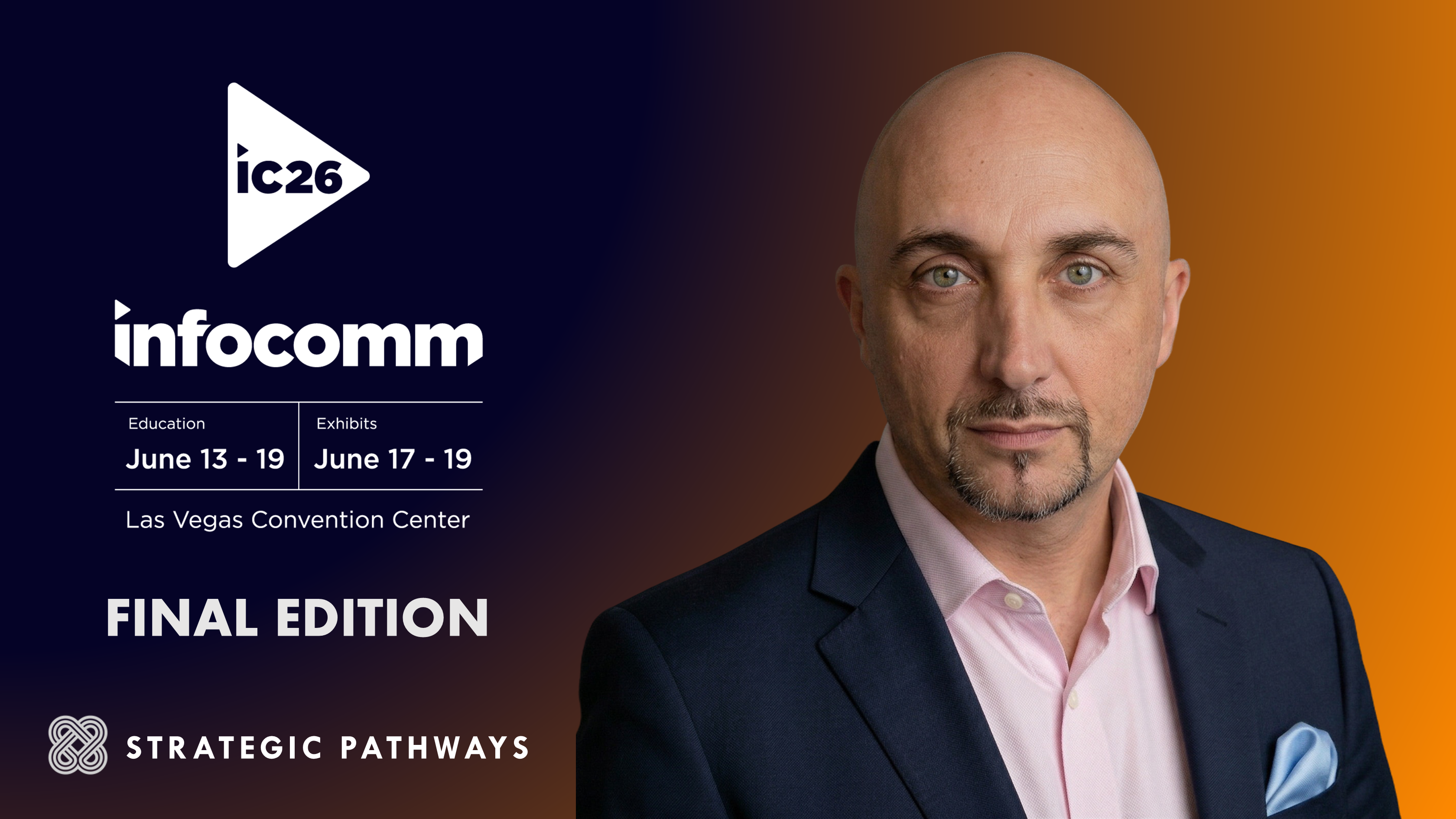
InfoComm 26: What it confirmed about the Intelligent Workplace

The Intelligent Workplace™ is the operating model that converts AI-enabled tools into measurable enterprise capability. It is not a product, a platform, or a vendor stack, but the architecture that governs how human and artificial intelligence compose, decide, and execute across an organisation. It rests on four pillars, comprising Workforce, Workflow, Workspace, and WorkTech, and the 4W Workplace Framework is the reference architecture that holds them together. It exists to resolve the gap between AI adoption and AI capability, the gap in which most enterprise AI investment is currently stranded.
Everyone climbed the same pillar
For one week in June, the largest professional AV and workplace technology show in the world gathered in Las Vegas, and for the first time it split its floor in two, one hall for work and one for play. The industry had formally recognised what Strategic Pathways had already named: the workplace is now a category in its own right, and AI is the force reorganising it. Microsoft brought agentic co-workers to the keynote stage. Cisco brought Connected Intelligence and a roster of partners. The technology was genuinely impressive, and the demand it validated is real.
But watch what every party in the ecosystem was actually doing, and a single pattern emerges. The vendors, the channel, the integrators, and the enterprises they serve were all racing up the same value chain toward the same destination: the technology layer. Convergence on one layer looks like progress. It is not. It is everyone crowding onto a single pillar while three others stand unattended. That is the real thing InfoComm 2026 confirmed, and the show proved it without intending to, one exhibit day at a time.
The four pillars, and the one the show was built around
The Intelligent Workplace rests on four pillars that have to be designed together. Workforce, the people and their capability to work alongside intelligent systems. Workflow, the processes and decision rights that AI actually operates inside. Workspace, the physical and digital environment where work happens. WorkTech, the technology layer. InfoComm is, by its nature, a WorkTech show. There is nothing wrong with that. The problem is that the entire ecosystem has come to treat the fourth pillar as if it were the whole building, and the three days of the show each exposed the cost of that mistake from a different angle.
Day one exposed it as an evaluation gap. Analysts on the floor said AI was everywhere as a term while meaningful integration was harder to find, and that the industry was selling intelligence at the moment buyers were still learning how to evaluate it. That is a Workflow and Workforce failure wearing a WorkTech costume. A display has brightness and a microphone has pickup, but the questions an agentic system raises, about decision rights, accountability, oversight, and when to switch it off, live in how work is governed, not on a spec sheet. The pillar that could answer them was unattended.
Day two raised the stakes by deepening the WorkTech pillar still further. Cisco embedded autonomous AI agents into the room device on a compute module built with NVIDIA, many times more powerful than the prior generation, arguing that agentic AI on underpowered hardware leaves its best features inoperable. The claim is largely true. But notice the move. It converted an evaluation problem the buyer could not solve into a purchase the buyer could be sold, and it did so entirely inside the one pillar everyone was already standing on. AI in the room became a hardware specification, which is to say a capital expenditure, and the three pillars that decide whether the expenditure returns anything were not in the conversation.
Day three, at the close, named the standard the other three pillars were always going to impose. The wrap-up question was not about a product. It was whether any of the AI will make rooms, workplaces, and shared spaces meaningfully better. That is the experience test, and a faster endpoint does not pass it, nor does a more capable agent. It is passed only when people work, meet, and decide with measurably less friction than before. The industry described the meeting room, accurately, as one of the most contested spaces in the modern workplace, where IT, facilities, AV teams, and employees all feel the consequences of bad design. Those consequences are felt across Workspace, Workforce, and Workflow. The experience the room delivers is decided by all four pillars. The booth sells one.
Four parties, the same unattended pillars
What makes this structural rather than incidental is that all four parties in the ecosystem are making the same mistake at once, and each pays for it differently.
Vendors are building and selling product capability, and assuming the operating-model outcome will follow. It does not. Excellent technology underdelivers the moment it reaches a field that was never designed to absorb it, and the vendor mistakes a delivery failure for a demand problem.
The channel is being asked to carry an operating-model conversation on a product-sale commercial model, and the gap shows up as stalled pipeline and shrinking margin. There was a telling signal on the floor. One of the largest integrators in the industry used the week not to launch a device but to launch a framework for unified, data-driven workplace experience. When the channel itself starts selling the operating model rather than the box, the market is telling you where durable value has moved.
Integrators sit closest to the truth and are the most exposed to it. Room hardware quality and network readiness are prerequisites now, not differentiators, and the literacy that once distinguished a serious integrator is becoming table stakes. The integrators who move up the value chain are the ones who can read all four pillars for a client and advise on the operating model, not just specify and install the WorkTech. The ones who cannot will be commoditised by the next wave of convergence.
The enterprise pillar, and the consequence the show would not name
The fourth party is the enterprise, and this is where the unattended pillars become most expensive, because the enterprise is the only party that owns all four. An enterprise that builds WorkTech while leaving Workforce, Workflow, and Workspace unaddressed has not bought capability. It has bought acceleration of whatever it already was, coherent or not.
And there is a consequence InfoComm staged as a pure productivity story and declined to address. The same agentic capability demonstrated on the floor as augmentation is being used, in boardrooms across the technology sector, as a justification for restructuring. Senior specialised roles are being replaced by smaller, younger, AI-augmented teams at a fraction of the compensation load, on the argument that the output is close enough to pass a quarterly review. The available data complicates that argument rather than supporting it. Industry analysis through the first half of 2026 indicates that the firms cutting the most headcount in the name of AI efficiency are not, on the whole, outperforming the firms cutting the least, and some lower-cutting firms are performing better. The restructuring continues anyway, because boards reward the visible narrative of transformation and headcount reduction is its fastest signal.
This is the Workforce pillar being dismantled to fund the WorkTech pillar, and it is self-defeating. Deploy agentic tools into an organisation that has thinned its experienced judgment to afford them, and you accelerate the loss of the very capability that would have made the tools valuable. The operating-model question and the workforce question are the same question. An intelligent workplace is one where AI amplifies human capability. An organisation that cuts the human capability to buy the AI has purchased the tools and dismantled the model in the same quarter.
The discipline the AV industry already knows, extended to the whole model
There is an irony the AV industry should sit with. This is an industry that already lives by a hard discipline: you design and operate before you deploy and maintain. No serious integrator drops technology into a room without first understanding the room. The argument of InfoComm 2026, made by the show against itself, is that this exact discipline now has to extend from the WorkTech pillar to the whole operating model.
You cannot sell, deliver, or run an operating model you have not diagnosed, any more than you would commission a room you had never surveyed.
That is what the Strategic Diagnostic Engine exists to do. It runs the sequence the show inverts: collect the real state of a workplace, diagnose where the gap between adoption and capability sits across all four pillars, and strategise the operating model before a single procurement decision is made. Diagnosis precedes deployment. For the enterprise it is a readiness lens applied before a device is specified. For the integrator and the vendor it is the move up the value chain, from selling the pillar everyone is standing on to aligning the three that decide the outcome. The parties that learn to align all four pillars rise. The parties that do not will be commoditised by the next convergence, which is already forming.
InfoComm 2026 confirmed the category, validated the demand, and proved, without meaning to, that the technology is the one pillar the ecosystem has mastered and the three that matter most are the ones it keeps leaving unattended. The tools are not the question. The four pillars you build them on, and the workforce you preserve to run them, are the question. That is the work the show does not do. It is the work the Intelligent Workplace exists to do, and it is the argument I will be putting to the ecosystem in person at InfoComm India in Mumbai later this year.
Value propositions fail structurally before they fail creatively. The approach is documented in the Market Narrative engine and the Intelligent Workplace.
Explore further: Intelligent Workplace and 4W Workplace Framework.

Marc A. Rémond is the founder of Strategic Pathways, a business advisory firm helping technology leaders design the business operating models required to scale.
With 25+ years of sales leadership across AV, UC, and enterprise technology, at Alcatel-Lucent, Polycom, and Barco, among others, he has built go-to-market strategies, channel ecosystems, and AI transformation programmes for global technology companies.
He is the creator of the Intelligent Workplace™, the 4W/4D/4C/4P Frameworks, the Strategic Diagnostic Engine, and the Human-AI Intelligence Charter, and the architect of the Synchronised Growth Architecture.
He is the author of EVOLVE-OR-DIE.AI: Leading in the Era of Human and AI Intelligence, available on Amazon and Apple Books, and the architect of the Intelligent Leader Programme, a twenty-eight module executive curriculum.
He runs two authority brands, an advisory practice, seven content pipelines, and the Intelligent Leader Programme as a single operator.
He writes on market expansion, sales execution, market narrative and workplace transformation at strategicpathways.asia and intelligentworkplace.ai.
Follow him on LinkedIn at linkedin.com/in/marcalexremond.
-
Xchange Advocates are recognized AV/IT industry thought leaders and influencers. We invite you to connect with them and follow their activity across the community as they offer valuable insights and expertise while advocating for and building awareness of the AV industry.