2025 vs 2026 AV Technology: What’s Changing in 2026?

Introduction: A Defining Shift in the AV Industry
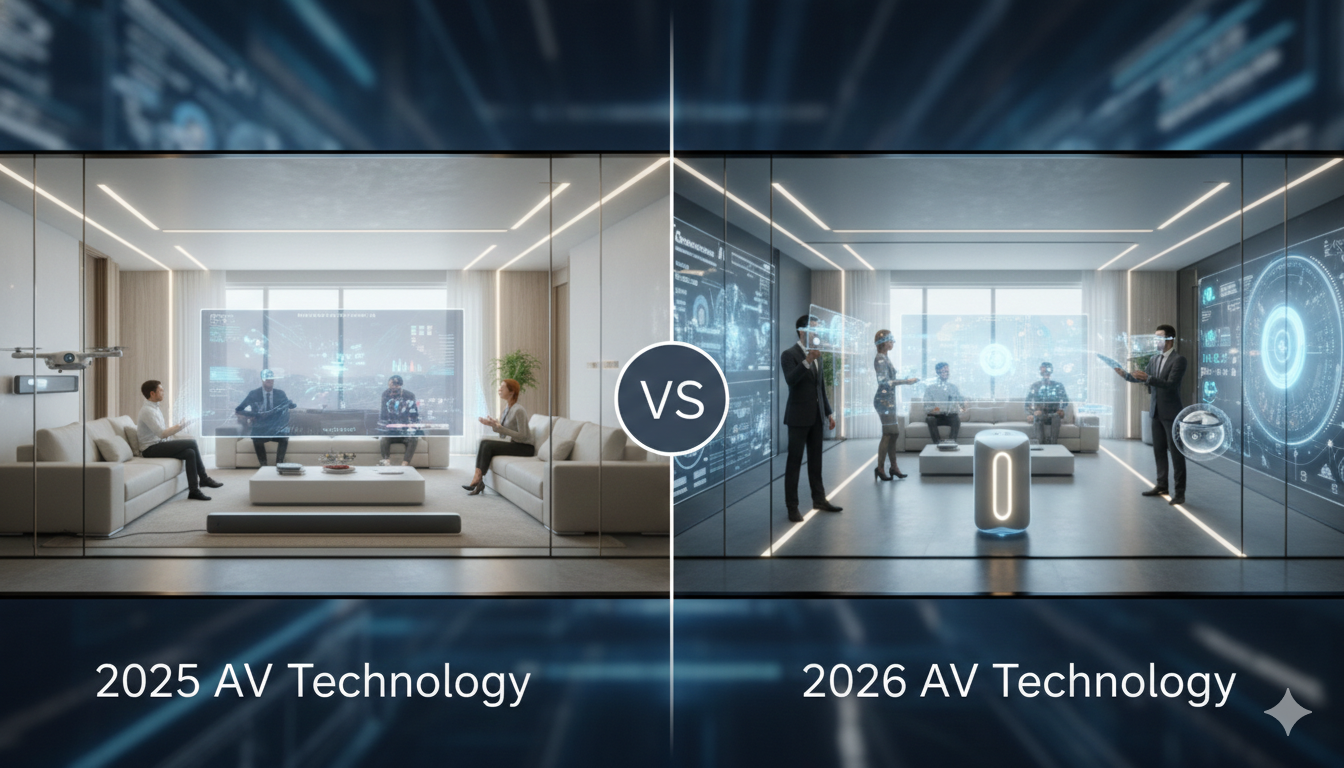
The audio-visual industry is moving faster than ever. While 2025 marked a major leap toward smarter AV environments, 2026 is shaping up to be a defining year, where AV systems evolve from being intelligent to truly autonomous. If you are an IT manager or a business leader, understanding this jump from connectivity to autonomy is essential for your next hardware refresh.
Let’s take a quick look at how AV technology is transforming and what organisations should prepare for next.
AV Technology in 2025: The Era of the "Smart" AV Room
In 2025, AV solutions are largely focused on stability, standardisation, and hybrid readiness. Most enterprises, educational institutions, and government spaces have already adopted core digital infrastructure.
Also, in 2025, the industry focus was on Hybrid Simplification. We solved the "first five minutes" problem, eliminating the frantic fumbling with cables and dongles.
-
Network-Centric Infrastructure: AV became a permanent resident on the IT network. We focused on stability and ensuring that remote participants had a "seat at the table."
-
Manual Intelligence: "Smart" meant you could tap a screen to join a meeting. Cameras could frame a group, but often required manual presets or basic motion triggers.
-
The Hub Concept: The room was a collection of smart peripherals, cameras, mics, and displays, all talking to a central hub (like a Teams or Zoom Room compute).
Key characteristics of 2025 AV technology:
-
Hybrid collaboration as standard – Seamless support for in-room and remote participants using unified conferencing platforms.
-
Interactive displays everywhere – Interactive flat panels replacing projectors in classrooms, boardrooms, and training rooms.
-
AI-assisted audio & video – Noise cancellation, auto-framing cameras, speaker tracking, and voice lift systems are improving meeting quality.
-
Wireless BYOD environments – Easy laptop and mobile device connectivity without cables.
-
Centralised AV management – IT teams monitoring devices, firmware, and room health remotely.
-
AV-over-IP adoption – Scalable video distribution across large campuses and multi-floor offices.
In short, 2025 AV is about efficiency, consistency, and user-friendliness.
Smart AV rooms in 2025 focused on automation, efficiency, and better user experience. But 2026 will go a step further. The emphasis shifts to self-managing, software-driven, and AI-assisted AV ecosystems that require minimal human intervention while delivering consistently high performance.
What’s Changing in 2026: The Next AV Shift (Predictions)
Also, The Rise of the Autonomous Meeting Room.
2026 is expected to move beyond functionality and focus on intelligence, automation, and immersive experiences.
Predicted AV trends for 2026:
-
Smarter AI-driven AV systems
AV setups will auto-adjust audio, video, lighting, and layouts based on room size, occupancy, and meeting type—without user intervention.
-
Experience-led meeting spaces
Boardrooms and classrooms will prioritize engagement, not just connectivity, using immersive displays, spatial audio, and real-time collaboration tools.
-
Deeper IT & building system integration
AV will integrate tightly with room booking systems, occupancy sensors, energy management, and smart building platforms.
-
More immersive learning & training
Increased use of AR/VR-assisted AV environments for simulations, skill training, and virtual walkthroughs.
-
Data-driven AV decision making
Usage analytics will help organizations optimize room design, AV investments, and space utilisation.
-
Sustainability-focused AV design
Energy-efficient displays, intelligent power management, and reduced hardware footprints will become key decision factors.
Simply put, 2026 AV technology will be predictive, proactive, and personalised.
2026 Display Trends: The COB LED Shift
Display technology will see a visible transformation in 2026. Chip-on-Board (COB) LED technology is expected to overtake traditional SMD LEDs in high-end corporate environments.
|
Feature |
2025 (SMD LEDs) |
2026 (COB LEDs) |
|
Durability |
Fragile; individual LEDs can pop off. |
"Armor" plated; dust and moisture resistant. |
|
Visuals |
It can be grainy at close distances. |
Ultra-fine pitch; feels like a single sheet of glass. |
|
Heat |
Higher heat output per pixel. |
Superior heat dissipation; longer lifespan. |
|
Thickness |
Standard thickness. |
"Ultra-thin" and lightweight. |
2025 vs 2026: The Real Difference
|
Aspect |
2025 AV Technology |
2026 AV Technology (Expected) |
|
Focus |
Stability & hybrid work |
Intelligence & experience |
|
Control |
Manual + basic automation |
AI-led automation |
|
User Role |
User-driven operation |
System-driven optimization |
|
Integration |
AV + IT |
AV + IT + Smart Buildings |
|
Outcome |
Better meetings |
Smarter collaboration |
While 2025 focused on perfecting hybrid collaboration, 2026 will redefine how people interact with spaces.
Summary: What This Means for Your Business
The shift from 2025 to 2026 is about reducing the cognitive load on employees.
-
2025, the user will manage the technology.
-
2026 expects the technology to manage the meeting.
Organizations planning AV upgrades or new deployments should start rethinking architecture, security, and scalability today. Designing for autonomy now ensures performance, reliability, and relevance tomorrow.
Looking to future-proof your AV strategy for 2026? Now is the time to plan smarter.
Written By-
@Aashmitha Hira , COLCOM