Certified IPMX devices
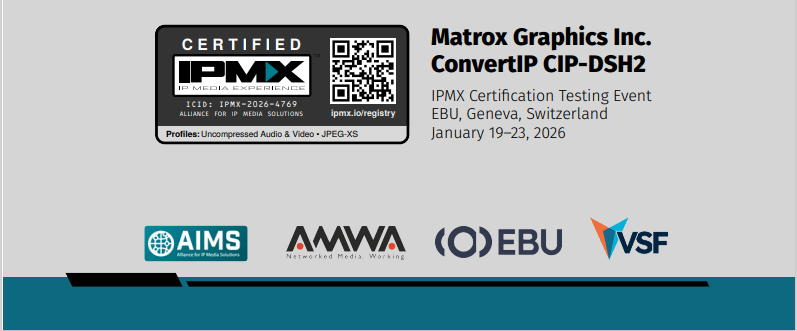




Certificates aplenty were visible on the AIMS booth itself (AIMS is the organization driving the promotion and management of IPMX) and of course the booths of the manufacturers of those products. Much was made of the certification being the result of independent, third-party, testing.
How many products ?
Good question - clearly this tells us number of IPMX products (each sku has a unique test result) and how many manufacturers have reached this stage of their IPMX journey. Together, these two numbers show us industry support. The fact that there are more manufacturers than last time we looked, also shows widening support.
And because IPMX is an open standard, the certificates themselves are not hidden either. Go to ipmx.io/registry and you can inspect the registry of all IPMX certified products - count the products (I counted 56) and count the number of manufacturers. Those naysayers who assert 'the whole IPMX thing is dominated by one or two brands' will need to find a new mantra!
What else can we learn from this online credential registry?
There's another measure of maturity that we can look for to give us insights into widening adoption of a standard. That's when products are released that incorporate the standard rather than having it as their main purpose - in other words, functional devices which use IPMX themselves rather than enable it for other products. That registry shows us that too! Count the number of entries that are not simple encoder/decoder products (categories like LED controllers, presentation switchers, dedicated KVM devices) - and count the number of manufacturers of these native devices.
History tells us that the emergence of the first native device - is a key milestone, with multiple such devices being another milestone. Don't get me wrong - the enabler products are vital - they bring the new standard to currently deployed products - ones that are not ready for replacement - a significant part of deployment of a new standard. The native devices represent a different characteristic of evolution.
And what can we learn from the certification mark, the logo itself, and the registry entry?
An obvious benefit is that a logo on a datasheet or website tells us which IPMX profiles a particular product has been proven to support. And again, when we take delivery of a purchased product, a logo on the packaging lets us confirm correspondence to the system design criteria before opening the carton. Cross-brand Interoperability is an significant part of the IPMX promise - and understanding which other devices the one in your hand is interoperable with is very valuable. There have been too many stories of 'defacto standard' products, supposedly capable of interworking, that quite simply didn't. This 'tested and certified' approach has great benefit to integrator and user alike.
What's the significance of an independent test?
Plug-fests are nothing new! True - and there have been multiple IPMX 'interop events' to date. The manufacturers working together. The last gathering, just before ISE, however was different to those that preceded. It was an independent third-party test - testing was conducted by the European Broadcasting Union at their Headquarters in Geneva. And the EBU used a Test Plan (TP-1) that had been created by the Video Services Forum - incorporating the learnings of all those previous interops. This was a rigorous test - no badges were awarded simply for turning up - and any deficiency exposed by the Test Plan resulted in a fail. If you prefer, the pass mark was 100%.
Being an open standard, the test plan, the criteria, and test methodology, were shared in advance - published on the TR-10 (IPMX) section of the VSF website. VSF_TR-10-TP-1_2026-01-13.pdf
Everyone knew exactly how the test would be conducted - no danger of 'difference in interpretation of the standard' (a common criticism of standards where adherence is 'declared' rather than tested.)
Not everything submitted cleared the testing hurdle. That says something too - the certificate has value.
One more thing - there is no 'IPMX-ready' category for untested product, or a less stringent, 'B grade' - a product is either 'certified' or not.
What was tested?
The test targeted the mandatory aspects of discovery, registration, timing, and network behaviour, as well as the media profiles covering uncompressed video, uncompressed audio, and JPEG-XS compression. A certified device needed to firstly support all the mandatory aspects correctly, and could then be certified in each media profile which was correctly implemented as determined by the agreed test plan.
So, is that it?
The next independent test event is planned for May '26 - so we can expect a larger number of certificates - more products, more manufacturers - to be on show at Infocomm26. The scope of testing will also be widened to include HDCP, Privacy Encryption Protocol (PEP), and USB.
Conclusion
Large scale IPMX adoptions have already happened. The 'IPMX certified product' status increases confidence amongst those who wanted more certainty. The IPMX reach is increasing across mainstream AV - H.264 and H.265 profiles are just around the corner. IPMX is here!

Rob has worked in high tech for four decades, establishing himself as a veritable veteran of the moving image.
He has spent time in engineering, sales and marketing, in positions spanning the content-creation, distribution, and transmission industries and more recently AV. Previously, he was an active member of the International Association of Broadcast Manufacturers, serving on its technical sub-committee as well as presenting technical sessions for the Society of Cable Telecommunications Engineers in London (including 'resettlement' courses for those leaving the UK military) , the Control Room Summit and AV Broadcast Summit - both in Europe and for Infocomm University in Dubai and the US.
His education includes a CTS. He also has degrees in Information and Communication Technologies (BSc) and Electrical and Electronic Engineering (BSc). Additionally, he complemented this with a Chartered Institute of Marketing post-graduate diploma.
He has been with Matrox Video for 20 years over which time has been associated with many projects, large and small – national and international. His current remit is the furtherance of strategic partnerships - both technological and organizational. He is particularly involved with the new IPMX open standard - the AV focussed extension to ST2110.
Rob is held in high regard internationally for his technology training sessions and was recognised by Infocomm in 2016 as a ‘distinguished talent’ in the industry.