
Building Beyond: Know Your Maturity Before You Buy Capability

Here is a failure I've watched play out more times than I can count. An organization invests in advanced technology — a sophisticated room platform, an analytics layer, an automation system that promises to run itself — and within a year it's half-used, worked around, or quietly switched off. The equipment was sound. What was missing was the organization's ability to operate it. They bought a Level-5 capability and tried to run it with Level-2 operations, and capability you can't operate is capability you don't actually have.
That gap is what the maturity model in the book is designed to expose before you spend the money, rather than after.
It describes five levels, and they're cumulative — you climb them, you don't skip them. At Level One, Isolated, everything is a separate island: the display, the network, the booking system, each managed on its own. At Level Two, Standardized, you've at least agreed on common platforms and configurations across spaces. At Level Three, Managed, those systems are monitored and supported as a connected whole, with someone clearly accountable for them. At Level Four, Intelligent, the organization's own data is tuning performance — the environment is being optimized by the people who run it. At Level Five, Adaptive, the space adjusts continuously on its own, with humans governing rather than operating it.
The mistake is treating those levels as a menu and buying the rung you admire. They don't work that way. An adaptive environment sitting on an organization that hasn't reached "managed" is an expensive way to manufacture frustration. The capability outruns the people who have to live with it, and the gap shows up as overrides, abandoned features, and the quiet verdict that "the technology didn't work."
The discipline is to match the rung to the reality — to the organization that has to run the space on a Tuesday afternoon, not the one in the proposal. Sometimes that means buying less than the budget allows and putting the difference into the operations that make the next rung reachable. That isn't a step down. It's the only path that keeps the investment alive.
When capability and maturity align, the technology is used, supported, and trusted. It stops being the thing people complain about and becomes the thing they rely on. The unglamorous truth is that the right level, well run, beats a higher level nobody can sustain.
So the second of the book's companion diagnostics is a maturity read: a short, honest assessment of where your organization sits across these five levels — and, more usefully, what the next rung would take. It pairs with the layer audit from earlier in this series; together they tell you what to build and whether you can run it.
That tool is currently under development and will be released after the book. Building Beyond releases on October 1, 2026.
Next in this series: the most dangerous thing in any building isn't a weak system — it's a fast one bolted to a slow one.
# # #
This series of articles is based on my forthcoming book, Building Beyond: Human Experience and the Future of the Built Environment, a framework for building places that adapt, perform, and elevate human potential, to be published in Q4 2026 by Laquilan Press.
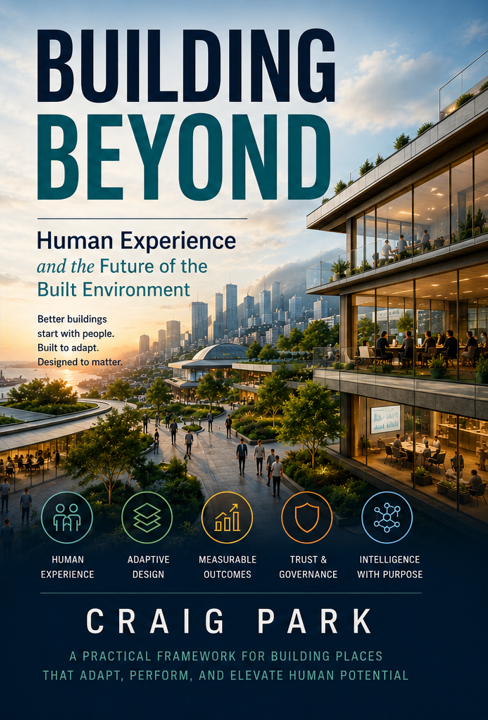
If you are interested in reading and commenting on an Advanced Review Copy, please drop me a note at craig@craigpark.com.

As an architect by training (BS Architecture, Cal Poly SLO) and a collaborative technologist with four decades of practice, I’m passionate about mentoring the next generation of AV professionals at the intersection of technology, strategy, and leadership. I have been active in AVIXA since 1986 and served on the national board from 1993–2000. I am a Fellow of the Society for Marketing Professional Services (SMPS) and an Associate member of the American Institute of Architects.
I serve as Director of Digital Experience Design at Clark & Enersen, a 200-person interdisciplinary architecture and engineering firm, where I lead the planning and design of integrated audiovisual and digital experience environments for higher education, healthcare, and research clients.
My expertise spans systems design, integrated building technology planning, and strategic business development. I bring an award-winning, B2B design-thinking approach developed through leadership roles with national AEC and technology firms.
Across both institutional and consulting roles, I have led marketing and growth strategy, designed future-ready learning and simulation environments, and helped organizations implement AI-powered tools that scale expertise and performance.
-
Xchange Advocates are recognized AV/IT industry thought leaders and influencers. We invite you to connect with them and follow their activity across the community as they offer valuable insights and expertise while advocating for and building awareness of the AV industry.
