
Building Beyond: The Danger Is in the Coupling

Buildings rarely fail because one of their systems is bad. They fail at the joints — where a fast-moving layer is fastened to a slow-moving one. Earlier in this series, I made the case that the layers of an environment move at different speeds, and that you have to design for it. This is where we make it measurable, because "design for change" remains a slogan until you can point to the exact place where change will hurt.
The way to find that place is to stop scoring layers by how long they last and start scoring them by coupling. Coupling is two things multiplied: how fast a layer needs to change, and how hard it is to change once it's in. A layer that moves fast and is easy to change is fine. A layer that moves slowly and is locked down is also fine — that's what structure is for. The danger is the corner where the two collide: something that has to change often but was built so it can't.
Plot your layers that way and the picture sorts itself. A locked-down structure scores low risk; permanence is its job. A locked-down technology platform scores high — it has to turn over every few years, and you've given it nowhere to go. The booking logic welded into the millwork, the control system that can't be touched without a construction permit, the network everything depends on that nobody can take offline — those are the joints that will cost you, and they're almost never the ones on the worry list.
What you're hunting for is your single sharpest exposure — the one coupling that's both most locked and most likely to move. You don't have to fix everything. You have to find that joint and decouple it: give the fast layer its own path to change, so the next upgrade is a swap instead of a demolition.
The payoff is mostly invisible, which is why it gets skipped. Decouple the worst joint and nothing dramatic happens on opening day. What changes is every day after — you stop paying compound interest on a bad decision, the kind that turns a routine technology refresh into a six-figure renovation and a month of downtime. Good coupling is cheap to design in and brutal to retrofit.
So the third companion diagnostic maps it for you. You rate how fast each layer needs to move and how locked-in it is, and the tool plots all five against the danger zone, then names the joint that should worry you most. It's the question none of the condition reports ask, and it tends to land on something nobody had flagged.
That rounds out the planned set — three tools feeding one report: the layer audit for order, the maturity read for capability, and the change-velocity map for exposure. All three are in development and will arrive after the book.
Next in this series: Measurement is how experience stops being a soft story and becomes a number you can defend — and good governance is what keeps the people you're measuring on your side, so the data keeps flowing instead of drying up the first time someone feels watched.
# # #
This series of articles is based on my forthcoming book, Building Beyond: Human Experience and the Future of the Built Environment, a framework for building places that adapt, perform, and elevate human potential, to be published in Q4 2026 by Laquilan Press.
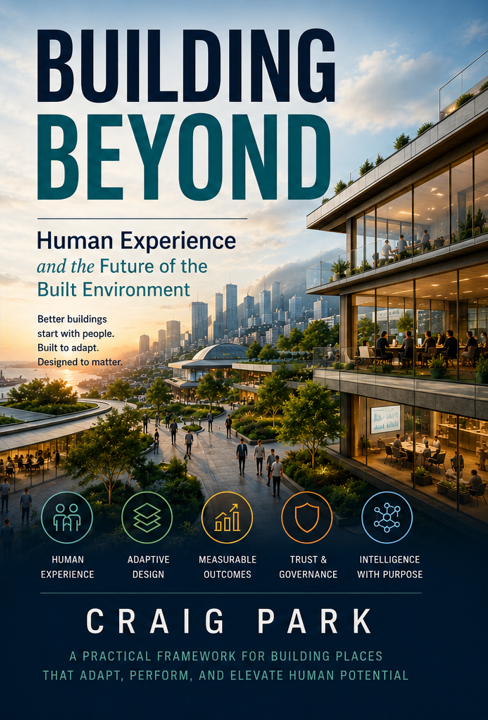
If you are interested in reading and commenting on an Advanced Review Copy, please drop me a note at craig@craigpark.com.

As an architect by training (BS Architecture, Cal Poly SLO) and a collaborative technologist with four decades of practice, I’m passionate about mentoring the next generation of AV professionals at the intersection of technology, strategy, and leadership. I have been active in AVIXA since 1986 and served on the national board from 1993–2000. I am a Fellow of the Society for Marketing Professional Services (SMPS) and an Associate member of the American Institute of Architects.
I serve as Director of Digital Experience Design at Clark & Enersen, a 200-person interdisciplinary architecture and engineering firm, where I lead the planning and design of integrated audiovisual and digital experience environments for higher education, healthcare, and research clients.
My expertise spans systems design, integrated building technology planning, and strategic business development. I bring an award-winning, B2B design-thinking approach developed through leadership roles with national AEC and technology firms.
Across both institutional and consulting roles, I have led marketing and growth strategy, designed future-ready learning and simulation environments, and helped organizations implement AI-powered tools that scale expertise and performance.
-
Xchange Advocates are recognized AV/IT industry thought leaders and influencers. We invite you to connect with them and follow their activity across the community as they offer valuable insights and expertise while advocating for and building awareness of the AV industry.
