
Building Beyond: Measuring the Promise
We measure what's easy. Uptime. Ticket volume. Kilowatt-hours. A facilities dashboard can glow all green while the people inside are quietly miserable — the room that's "available" 99.9 percent of the time and still won't start a meeting without a fight. The numbers we trust tell us the systems are healthy. They tell us almost nothing about whether the space is doing the job it was built for.
This is the last piece of the framework, and it's the one most often skipped, because the things worth measuring are harder to count than the things we count out of habit.
A second problem arrives the moment a building starts to sense. The instant you measure people in order to serve them better, you are also watching them. Occupancy sensors in every room, badge data, cameras repurposed for "utilization," microphones justified by better acoustics. Handled carelessly, the same data that could make a space better can make it feel like surveillance — and a space people don't trust has already failed at the experience, whatever the dashboard says.
So the framework concludes with two disciplines that must travel together: measurement and governance.
Measure the right things — outcomes, not just system health. Did the meeting start on time? Did people find somewhere to focus? Did the clinician have what she needed the moment she needed it? Did the room get used the way it was meant to be? These are harder to capture than uptime, and they are the only figures that connect back to why the building exists at all.
Then govern the sensing out loud. Be explicit about what's collected, why, who can see it, how long it's kept, and what it will never be used for. Aggregate where you can; watch individuals only where there's a clear reason and clear consent. Transparency here isn't a compliance chore bolted on at the end — it's the thing that earns you permission to measure anything.
Get both right and experience finally earns a seat at the table where cost and uptime already sit. "The room feels better" loses every budget argument to "we cut energy twelve percent." "On-time meeting starts went from seventy-one to ninety-four percent" wins it. Measurement is how experience stops being a soft story and becomes a number you can defend — and good governance is what keeps the people you're measuring on your side, so the data keeps flowing instead of drying up the first time someone feels watched.
That's the framework, end to end. The layers tell you what to build. Maturity tells you whether you can run it. Coupling tells you where it will break. And measurement and governance tell you whether it's working — and keep it trustworthy while it does.
The framework is complete; from here, Building Beyond puts it to work — in the book, in the four-sector field guides that turn this method into a two-part planning workshop, and in the diagnostics behind this series.
Next in this series: the space everyone is arguing about, and the first real test of all of this — the workplace.
# # #
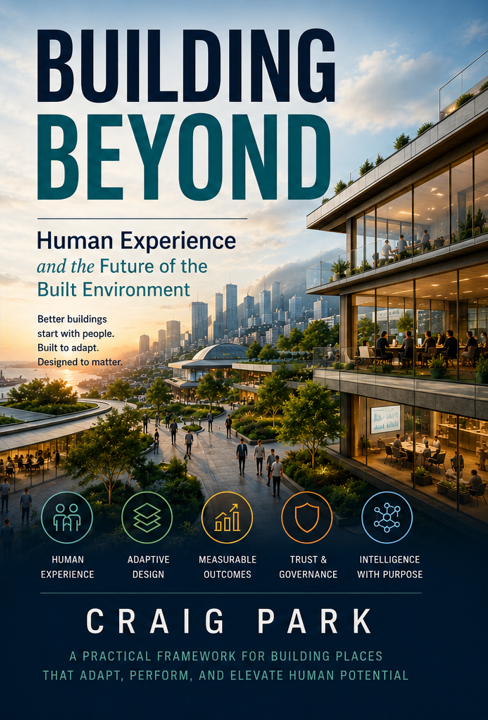
This series of articles is based on my forthcoming book, Building Beyond: Human Experience and the Future of the Built Environment, a framework for building places that adapt, perform, and elevate human potential, to be published in Q4 2026 by Laquilan Press.
If you are interested in reading and commenting on an Advanced Review Copy, please drop me a note at craig@craigpark.com.

As an architect by training (BS Architecture, Cal Poly SLO) and a collaborative technologist with four decades of practice, I’m passionate about mentoring the next generation of AV professionals at the intersection of technology, strategy, and leadership. I have been active in AVIXA since 1986 and served on the national board from 1993–2000. I am a Fellow of the Society for Marketing Professional Services (SMPS) and an Associate member of the American Institute of Architects.
I serve as Director of Digital Experience Design at Clark & Enersen, a 200-person interdisciplinary architecture and engineering firm, where I lead the planning and design of integrated audiovisual and digital experience environments for higher education, healthcare, and research clients.
My expertise spans systems design, integrated building technology planning, and strategic business development. I bring an award-winning, B2B design-thinking approach developed through leadership roles with national AEC and technology firms.
Across both institutional and consulting roles, I have led marketing and growth strategy, designed future-ready learning and simulation environments, and helped organizations implement AI-powered tools that scale expertise and performance.
-
Xchange Advocates are recognized AV/IT industry thought leaders and influencers. We invite you to connect with them and follow their activity across the community as they offer valuable insights and expertise while advocating for and building awareness of the AV industry.

Please sign in
If you are a registered user on AVIXA Xchange, please sign in