
Intelligent Workplace: Why Your Meeting Room Upgrade Didn't Fix the Problem
Related Content

 The Intelligent Workplace™
The Intelligent Workplace™
The Operating Model for the AI Era
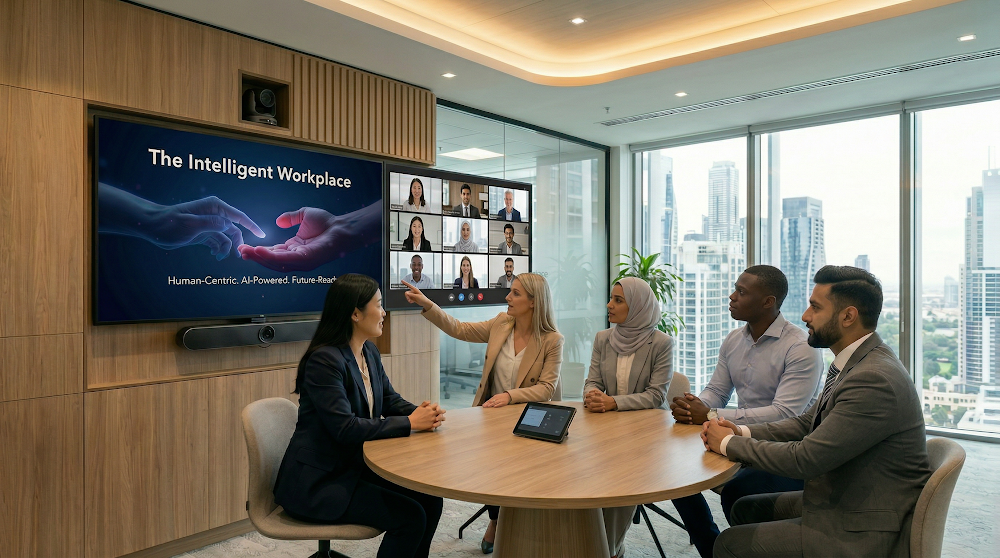
A client approves a full AV refresh. New displays, ceiling microphone arrays, a unified conferencing platform, proper cable management. The install goes clean. The room looks right. Three months later, the feedback is the same as before: "meetings don't work in here." The technology performed. The room failed anyway.
This is not an uncommon scenario for integrators or technology managers. And the instinct, when it happens, is to revisit the spec. Was the acoustic treatment sufficient? Is the camera coverage optimised? Did the codec get misconfigured post-handover? Sometimes the answer is yes, and the fix is technical. But more often, the room was only ever one part of the problem, and it was the only part anyone addressed.
Here is the pattern worth recognising. When a conference room underperforms, the post-mortem almost always interrogates the technology or the user adoption. It rarely asks whether the meeting behaviours, the workflows those rooms are supposed to support, and the broader IT infrastructure were ever aligned with the physical upgrade in the first place. An organisation can deploy room-quality audio and 4K video into a space where nobody has agreed on how hybrid meetings are supposed to run, where the BYOD policy conflicts with the installed system, or where the booking and scheduling infrastructure is still a separate silo managed by a different team. The room becomes locally optimised. The system it sits inside stays broken.
This matters practically for anyone advising enterprise AV buyers or specifying multi-room deployments. The physical space, the technology stack, the way people are expected to work, and the processes that govern collaboration are all interdependent. Change one without attending to the others and you introduce friction that users absorb quietly until they route around the system entirely. A room with a top-tier conferencing solution gets abandoned in favour of a huddle space where someone can plug in a laptop. A digital signage and room-booking deployment goes underutilised because the workflow for reserving space was never redesigned to match it. An AI-enabled camera system with speaker tracking and automated framing sits in a room where the meeting format has never changed, so the intelligence has nothing useful to act on.
The implication for AV integrators and UC practitioners is not that you need to become workplace consultants. It is that the discovery conversation with your client needs to go one level deeper than room count, screen size, and codec selection. Before you finalise a design, the questions worth asking are: how does work actually move through the teams using these rooms, who owns the meeting culture and has that person been in the room design conversation, and what does IT expect this system to integrate with in eighteen months? Those are not abstract strategy questions. They are the questions that determine whether your install performs in the field the way it performed in the demo. Understanding where the real constraint lives before you specify the solution is what separates a system that works from a room that looks right.
Read the full analysis at intelligentworkplace.ai

Marc A. Rémond is the founder of Strategic Pathways, a business advisory firm helping technology leaders design the business operating models required to scale.
With 25+ years of sales leadership across AV, UC, and enterprise technology, at Alcatel-Lucent, Polycom, and Barco, among others, he has built go-to-market strategies, channel ecosystems, and AI transformation programmes for global technology companies.
He is the creator of the Intelligent Workplace™, the 4W/4D/4C/4P Frameworks, the Strategic Diagnostic Engine, and the Human-AI Intelligence Charter, and the architect of the Synchronised Growth Architecture.
He is the author of EVOLVE-OR-DIE.AI: Leading in the Era of Human and AI Intelligence, available on Amazon and Apple Books, and the architect of the Intelligent Leader Programme, a twenty-eight module executive curriculum.
He runs two authority brands, an advisory practice, seven content pipelines, and the Intelligent Leader Programme as a single operator.
He writes on market expansion, sales execution, market narrative and workplace transformation at strategicpathways.asia and intelligentworkplace.ai.
Follow him on LinkedIn at linkedin.com/in/marcalexremond.
-
Xchange Advocates are recognized AV/IT industry thought leaders and influencers. We invite you to connect with them and follow their activity across the community as they offer valuable insights and expertise while advocating for and building awareness of the AV industry.
Recommended Content


SONY AV Tech Expo coming to Chicago, IL!


Please sign in
If you are a registered user on AVIXA Xchange, please sign in