
From Cost to Capability: Making the Shift to Experience Infrastructure

Throughout this series, we have examined a consistent and often overlooked reality: technology decisions in the built environment are rarely purely technical. They are economic decisions. They are operational decisions. And increasingly, they are experience decisions. We have explored how legacy choices—while attractive at installation—lead to higher total cost of ownership, increased operational complexity, limited flexibility, and a degraded user experience.
We have also introduced a complementary lens:
Experience Cost of Ownership (XCO)
Together, TCO and XCO provide a more complete understanding of value. And when viewed through that lens, a clear conclusion emerges: The industry is not simply upgrading technology. It is shifting from technology systems to experience infrastructure.
The End of the “System” Mindset
Historically, building technology has been delivered as discrete systems: AV Systems, Security Systems, Telecommunications Systems, and IT Infrastructure. Each designed independently. Each optimized for function. Each evaluated on cost. This approach made sense when systems were isolated, static, and predictable.
But today’s environments are integrated, dynamic, data-driven, and experience-centric. The system-based model no longer aligns with how spaces are used.
The Rise of Digital Experience Infrastructure
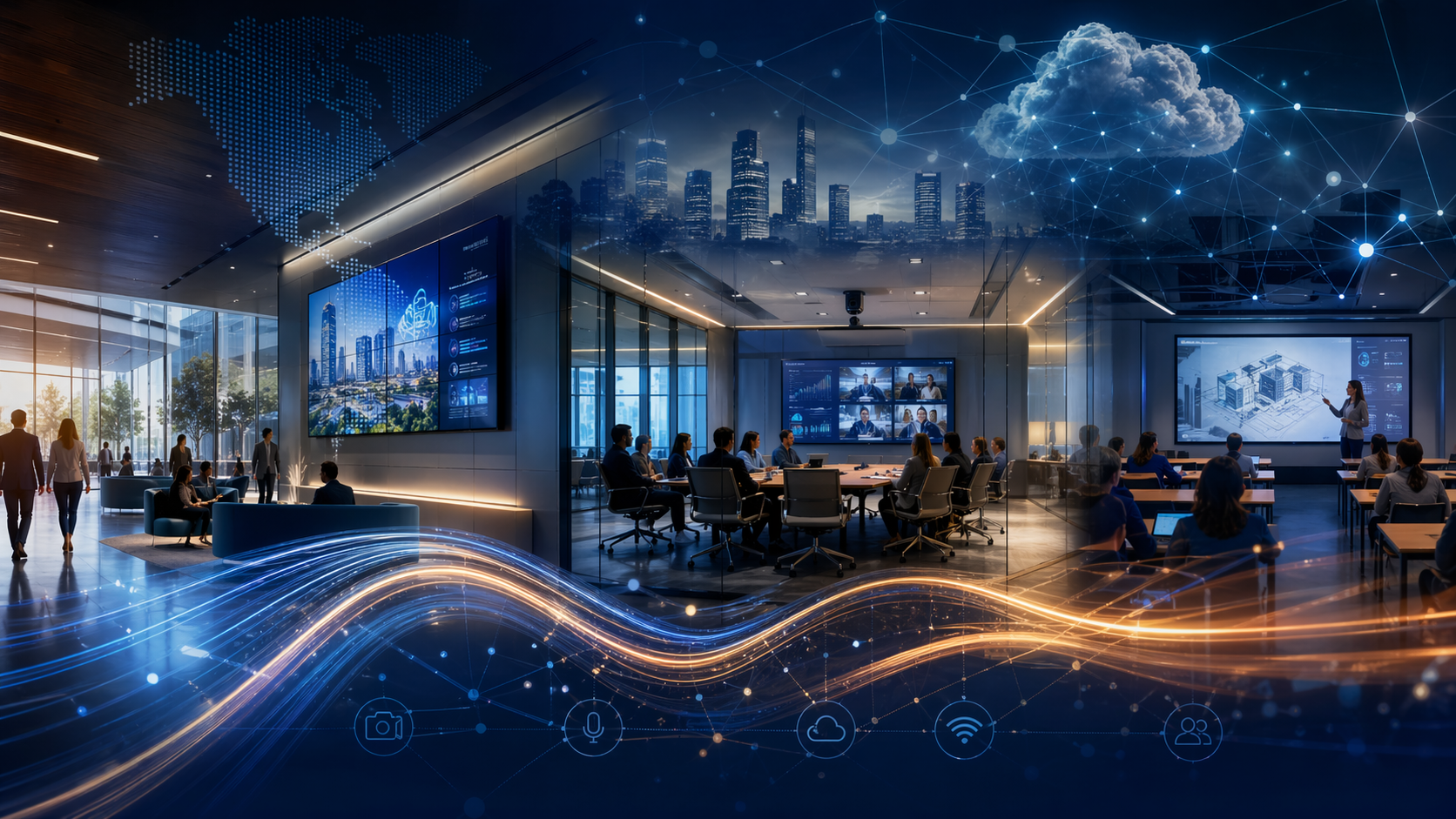
Digital Experience infrastructure is a different concept. It is not defined by individual technologies, but by the outcomes they enable. It integrates network infrastructure, AV platforms, audio and visual systems, security and sensing systems, and cloud and data services into a unified environment that supports communication, collaboration, learning, simulation, and decision-making.
The goal is not to deploy systems. It is to enable seamless human interaction.
TCO + XCO = True Value
Throughout this series, we have seen how traditional TCO analysis is incomplete. It captures capital cost, operational cost, maintenance, and energy. But it misses the mark on productivity, engagement, adoption, and effectiveness.
By combining TCO with XCO, organizations gain a more accurate view of value. Legacy systems often appear less expensive, cost more over time, and deliver poor experience. Modern, future-ready systems require higher initial investment, but reduce lifecycle cost and deliver superior experience.
This is the core shift: From minimizing cost to maximizing value over time.
The Organizational Impact
The transition to experience infrastructure affects more than technology—it changes how organizations operate.
- Procurement - Moves from lowest-bid selection to lifecycle value evaluation
- Design - Shifts from system specification to architectural planning
- Operations - Evolves from maintenance to continuous optimization
- IT and AV Alignment - Becomes integrated rather than parallel
- Leadership - Focuses on outcomes rather than components
These changes require new ways of thinking—and new ways of measuring success.
The Cost of Inaction
Organizations that continue to prioritize legacy approaches face increasing risk: repeated replacement cycles, rising operational costs, poor user adoption, inability to support emerging technologies, leading to a competitive disadvantage.
Perhaps most importantly: They limit their ability to evolve. In a rapidly changing environment, this is not just inefficient—it is strategic risk.
Experience as a Competitive Advantage
Organizations that invest in experience infrastructure gain measurable benefits, including higher productivity, better collaboration outcomes, improved learning and training effectiveness, greater technology adoption, and reduced operational friction
Technology becomes an enabler of performance rather than a constraint. And over time, this translates directly into: Organizational advantage.
The Role of Leadership
This shift cannot be driven solely by technology teams. It requires leadership alignment across executive decision-makers, facilities and planning, IT and AV, finance and procurement. Leaders must recognize that: Technology decisions are not isolated investments. They are foundational to how the organization functions.
Implications of AI Integration
The transition to experience infrastructure becomes even more critical in the context of AI. AI is not a standalone technology. It is an amplifier of existing environments. It depends on high-quality data, integrated systems, scalable infrastructure, and consistent user interaction.
Legacy environments struggle to provide these conditions. They fragment data, limit integration, reduce system usage, and undermine AI effectiveness.
Future-ready environments enable continuous data capture, real-time processing, intelligent system behavior, and adaptive user experiences.
The implication is clear: AI will not fix broken environments. It will amplify them. Organizations that invest in experience infrastructure today are building the foundation for:
AI-native environments tomorrow
Those that do not will face higher cost of adoption, limited capability, reduced return-on-Investment
A Call to Action
The technology decisions being made today will define the environments people work, learn, and interact within for the next 10 to 20 years. The question is no longer:
“What is the lowest cost solution?”
It is:
“What kind of environment are we building?”
Are we building systems that meet today’s requirements, or are we building infrastructure that enables tomorrow’s possibilities?
Designing for Value, Not Cost
The hidden cost of legacy is not just financial. It is experiential. It is operational. It is strategic. And it is cumulative. This series has explored how decisions across infrastructure, AV, displays, audio, security, and experience contribute to that cost—and how a different approach can reduce it.
The path forward is clear: evaluate technology over its lifecycle, prioritize user experience, design for flexibility and integration, align with emerging architectures, and invest in experience infrastructure.
Because at the end of the day, the true value of technology is not what it costs; it is what it enables. And what it enables defines everything that follows.
Building Beyond
Which leads directly to my next series of AVIXA Xchange posts. Laquilan Press is publishing my new book in Q4 2026, Building Beyond: Human Experience and the Future of the Built Environment, which makes a philosophical and practical argument that:
- The environment is more than the sum of its systems.
- Human experience is the infrastructure everything else exists to produce.
- Experience must be sustained over time through adaptability, operational maturity, governance, and measurement.
- AI and intelligent environments matter only insofar as they improve human experience.
So, stay tuned. The first post on the new Building Beyond series will drop on the AVIXA Xchange on Monday, July 6, 2026. I look forward to your feedback.

As an architect by training (BS Architecture, Cal Poly SLO) and a collaborative technologist with four decades of practice, I’m passionate about mentoring the next generation of AV professionals at the intersection of technology, strategy, and leadership. I have been active in AVIXA since 1986 and served on the national board from 1993–2000. I am a Fellow of the Society for Marketing Professional Services (SMPS) and an Associate member of the American Institute of Architects.
I serve as Director of Digital Experience Design at Clark & Enersen, a 200-person interdisciplinary architecture and engineering firm, where I lead the planning and design of integrated audiovisual and digital experience environments for higher education, healthcare, and research clients.
My expertise spans systems design, integrated building technology planning, and strategic business development. I bring an award-winning, B2B design-thinking approach developed through leadership roles with national AEC and technology firms.
Across both institutional and consulting roles, I have led marketing and growth strategy, designed future-ready learning and simulation environments, and helped organizations implement AI-powered tools that scale expertise and performance.
-
Xchange Advocates are recognized AV/IT industry thought leaders and influencers. We invite you to connect with them and follow their activity across the community as they offer valuable insights and expertise while advocating for and building awareness of the AV industry.
