
Designing for What Comes Next: A 3–5 Year Strategy for TCO, Experience, and Intelligent Environments
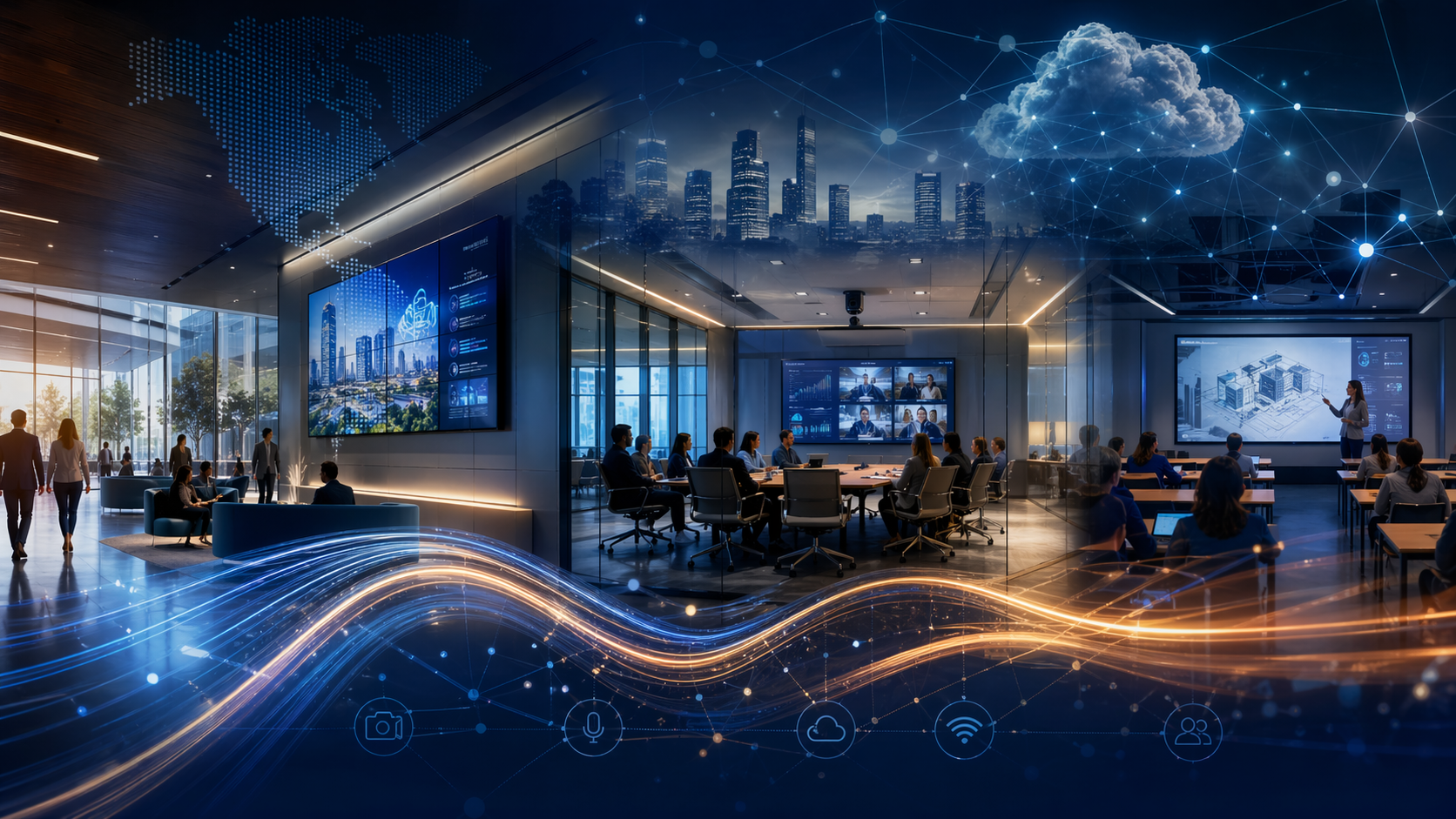

Across this series, we have explored a consistent pattern: Legacy decisions reduce initial cost—but increase long-term cost, limit flexibility, and degrade user experience. We have examined this across:
-
Infrastructure
-
AV System Architecture
-
Display Technology
-
Audio Systems
-
Security And Communications
-
User Experience
Each layer reinforces the same conclusion:
Short-term optimization leads to long-term constraint
Which raises a critical question:
How should organizations design technology environments today to avoid repeating this pattern?
The answer lies in shifting from project-based thinking to forward-looking architectural strategy.
The 3–5 Year Horizon: Why It Matters
Technology cycles are accelerating. What was once stable for a decade now evolves within a few years:
-
Bandwidth Requirements Continue To Increase
-
Hybrid Work And Learning Are Permanent
-
Cloud Platforms Are Expanding
-
AI Is Moving Into Core Workflows
-
AV Is Becoming Software-Defined
At the same time, building infrastructure is expected to last 15 to 20 years or more. This creates a mismatch:
Long-lived infrastructure supporting rapidly evolving systems
A 3–5 year planning horizon bridges this gap. It allows organizations to:
-
Align With Emerging Technology Trends
-
Avoid Premature Obsolescence
-
Maintain Flexibility
-
Control Lifecycle Cost
From System Design to Architectural Thinking
Traditional technology planning focuses on individual systems:
-
Cabling
-
AV Systems
-
Security
-
Communications
Each is designed independently, often optimized for initial cost. Modern environments require a different approach:
Designing an integrated technology architecture
This architecture must support:
-
Continuous Evolution
-
System Interoperability
-
Data Flow Across Platforms
-
Scalable Infrastructure
The goal is not to predict specific technologies. It is to create environments that can adapt.
The Emerging Technology Stack
Forward-looking design increasingly aligns with a converging stack:
-
AI-Driven Media And Analytics
-
MCP-Orchestrated Systems
-
AV1 And Efficient Media Transport
-
Cloud-Based Processing And Storage
-
Network-Centric Infrastructure
Together, these form the foundation of intelligent, software-defined environments. This stack is not theoretical—it is already emerging across industries.
Designing for Flexibility and Change
Future-ready environments share common characteristics.
Infrastructure Flexibility
-
High-Bandwidth Cabling (Cat6A Or Fiber)
-
Support For High-Power PoE
-
Scalable Network Architecture
System Scalability
-
AV-Over-IP Platforms
-
Modular Endpoint Design
-
Software-Defined Routing
Operational Adaptability
-
Remote Management Capabilities
-
Centralized Monitoring
-
Integration With IT Systems
Spatial Flexibility
-
Wireless And Adaptive Audio Systems
-
Flexible Display Technologies
-
Reconfigurable Spaces
These elements reduce the cost of change over time.
Avoiding Stranded Investments
One of the greatest risks in technology planning is creating stranded assets—systems that cannot evolve with changing needs. Legacy systems become stranded when they:
-
Cannot Support New Bandwidth Requirements
-
Lack Integration Capability
-
Require Full Replacement To Expand
-
Are Tied To Proprietary Architectures
Future-ready systems avoid this by:
-
Leveraging Open Standards
-
Supporting Software-Based Upgrades
-
Enabling Incremental Expansion
The goal is not to eliminate change—but to make it affordable.
Lifecycle Thinking as a Design Principle
Forward-looking organizations evaluate technology decisions across the full lifecycle. This includes:
-
Initial Deployment
-
Operational Efficiency
-
Maintenance Requirements
-
Upgrade Pathways
-
Replacement Timing
As demonstrated in the research, technologies with higher initial cost often deliver lower TCO when evaluated over 10–20 years. Lifecycle thinking aligns financial and experiential outcomes.
The Role of User Experience in Future Design
As explored in Part 7, user experience is a primary driver of value. Future-ready environments must prioritize:
-
Ease Of Use
-
Consistency Across Spaces
-
Support For Hybrid Interaction
-
Reliability And Responsiveness
These outcomes are enabled by:
-
Flexible Infrastructure
-
Scalable Systems
-
Integrated Platforms
Designing for experience ensures that systems are not only functional, but effective.
Preparing for AI-Enabled Environments
The most significant driver of future technology design is the integration of AI. AI is moving from experimental to operational across:
-
Collaboration Platforms
-
Security Systems
-
AV Environments
-
Building Operations
This shift requires environments that can support:
-
Continuous Data Collection
-
Real-Time Processing
-
Integration With Cloud Services
-
Adaptive System Behavior
Infrastructure and systems must be designed with these requirements in mind.
Implications of AI Integration
AI fundamentally changes the requirements for technology environments. It introduces new dependencies:
-
High-Quality Audio And Video Inputs
-
Structured Data Streams
-
Network Connectivity
-
Scalable Compute Resources
It also introduces new capabilities:
-
Automated System Behavior
-
Real-Time Analytics
-
Predictive Maintenance
-
Intelligent Collaboration
Legacy systems struggle to support these capabilities. They:
-
Lack Data Accessibility
-
Limit Integration
-
Constrain Performance
Future-ready systems enable:
AI-Native Environments
Where systems are not only connected—but intelligent. The implication is profound:
Technology decisions made today determine whether AI can be adopted tomorrow
A Strategic Framework for Decision-Making
To align with future needs, organizations should evaluate technology decisions using a broader framework:
-
Total Cost Of Ownership (TCO) Over Lifecycle
-
Experience Cost Of Ownership (XCO)
-
Flexibility And Scalability
-
Compatibility With Emerging Architectures
-
Ability To Support AI Integration
This framework shifts the focus from cost minimization to value creation.
The Cost of Waiting
One of the most common responses to emerging technology is to wait. Wait for standards to mature. Wait for costs to decrease. Wait for clearer use cases. But waiting has a cost. It often leads to:
-
Reinvestment In Legacy Systems
-
Increased Replacement Cycles
-
Missed Opportunities For Efficiency
-
Reduced Competitive Advantage
In many cases:
The cost of waiting exceeds the cost of investing
Designing for the Next Era
The environments we design today will operate for decades. They must support not only current needs, but future possibilities. This requires:
-
Strategic Thinking
-
Architectural Planning
-
Willingness To Invest Beyond Initial Cost
The goal is not to eliminate risk—but to manage it intelligently.
Conclusion: Building for What Matters
The central lesson of this series is clear:
Technology decisions must be evaluated over time, through both cost and experience.
Legacy systems optimize for today. Future-ready systems enable tomorrow. And in an environment where technology is increasingly central to how we work, learn, and collaborate, that difference matters. The question is no longer:
“What is the lowest cost solution?”
It is:
“What is the most valuable system over its lifecycle?”
Because in the end: The true cost of technology is not what you pay to install it. It is what it costs you to use it—and to live with it—every day.

As an architect by training (BS Architecture, Cal Poly SLO) and a collaborative technologist with four decades of practice, I’m passionate about mentoring the next generation of AV professionals at the intersection of technology, strategy, and leadership. I have been active in AVIXA since 1986 and served on the national board from 1993–2000. I am a Fellow of the Society for Marketing Professional Services (SMPS) and an Associate member of the American Institute of Architects.
I serve as Director of Digital Experience Design at Clark & Enersen, a 200-person interdisciplinary architecture and engineering firm, where I lead the planning and design of integrated audiovisual and digital experience environments for higher education, healthcare, and research clients.
My expertise spans systems design, integrated building technology planning, and strategic business development. I bring an award-winning, B2B design-thinking approach developed through leadership roles with national AEC and technology firms.
Across both institutional and consulting roles, I have led marketing and growth strategy, designed future-ready learning and simulation environments, and helped organizations implement AI-powered tools that scale expertise and performance.
-
Xchange Advocates are recognized AV/IT industry thought leaders and influencers. We invite you to connect with them and follow their activity across the community as they offer valuable insights and expertise while advocating for and building awareness of the AV industry.
