
Building Beyond: Designing for Change

Ask how a project started, and you'll usually hear about the technology. Someone chose the video platform, settled on a display standard, and picked the control system — and the room's purpose got reverse-engineered to fit. We start at the equipment and work backward toward the people. That one habit is the inversion at the root of most disappointing spaces, and it's why the heart of this book is a framework for designing in the right order.
Every environment is built from five layers, and the order matters more than any single layer.
The first is Human Function — what the people in this space actually need to do, feel, and accomplish. The second is Space Typology — the kind of space that serves that function, before any device enters the conversation. The third is Operational Maturity — what the organization can realistically run and support once the installers leave. The fourth is the Technology Stack — the systems that serve everything above them. The fifth is Governance & Intelligence — how the whole thing is run, measured, and kept honest over time.
Designed in that sequence, each layer sets the requirements for the one below it. Human function tells you the typology. Typology and the organization's maturity tell you how much technology you can actually carry. Governance keeps it trustworthy. The technology, far from leading, is the fourth question asked — not the first.
Most projects run it exactly backward. They begin at layer four, fall for a capability, and then try to invent a human purpose worthy of it. You can feel the result the moment you walk in: a room bristling with systems that doesn't quite do the simple thing you came to do. That isn't a hardware failure. It's an order-of-operations failure.
When you design top-down, function first, the spending sorts itself out. You stop solving human problems with equipment, and you stop buying the layer-four answer to a layer-one question. The room does the simple thing well because simplicity was the starting point rather than an afterthought.
That's exactly what the first companion diagnostic in the book does. The Five-Layer Project Audit walks any current or planned project through all five layers and flags inversion—where the stack gets ahead of its purpose. It's one of three tools now in development, arriving after the book. You don't have to wait to try the thinking, though — take the project on your desk, list its five layers, and find the one where the technology got decided before the function did. That's the inversion.
Next in the Building Beyond Series
If environments must be designed for experience and built for change, how do we create a framework that connects human outcomes, operations, technology, and intelligence into a coherent whole? In the next article, we'll introduce the Five-Layer Model that forms the foundation of the Building Beyond framework.
# # #
This series of articles is based on my forthcoming book, Building Beyond: Human Experience and the Future of the Built Environment, a framework for building places that adapt, perform, and elevate human potential, to be published in Q4 2026 by Laquilan Press.
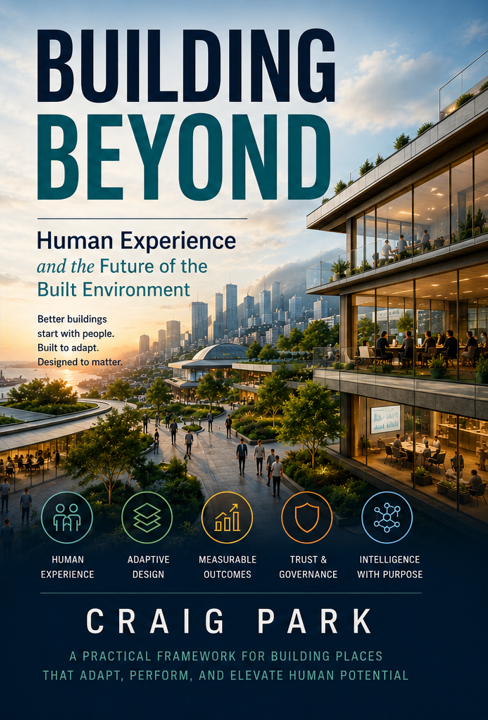
If you are interested in reading and commenting on an Advanced Review Copy, please drop me a note at craig@craigpark.com.

As an architect by training (BS Architecture, Cal Poly SLO) and a collaborative technologist with four decades of practice, I’m passionate about mentoring the next generation of AV professionals at the intersection of technology, strategy, and leadership. I have been active in AVIXA since 1986 and served on the national board from 1993–2000. I am a Fellow of the Society for Marketing Professional Services (SMPS) and an Associate member of the American Institute of Architects.
I serve as Director of Digital Experience Design at Clark & Enersen, a 200-person interdisciplinary architecture and engineering firm, where I lead the planning and design of integrated audiovisual and digital experience environments for higher education, healthcare, and research clients.
My expertise spans systems design, integrated building technology planning, and strategic business development. I bring an award-winning, B2B design-thinking approach developed through leadership roles with national AEC and technology firms.
Across both institutional and consulting roles, I have led marketing and growth strategy, designed future-ready learning and simulation environments, and helped organizations implement AI-powered tools that scale expertise and performance.
-
Xchange Advocates are recognized AV/IT industry thought leaders and influencers. We invite you to connect with them and follow their activity across the community as they offer valuable insights and expertise while advocating for and building awareness of the AV industry.
