
Creating a More Acoustically Pleasant Home Office Environment
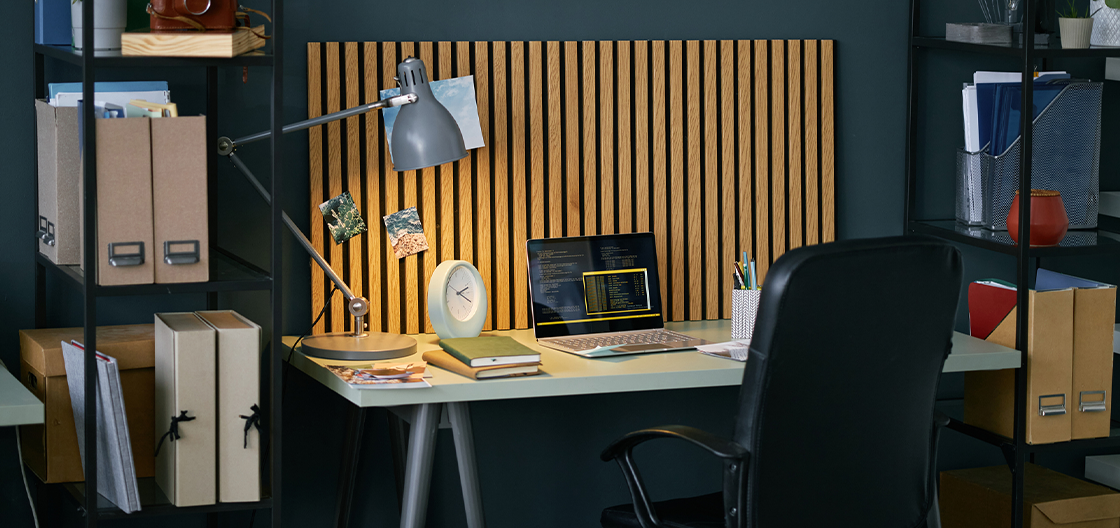




Many of us, myself included, are still working from home. But if you’ve experienced echoes during video calls or been interrupted by a barking dog, you know how home office noise can disrupt your focus and productivity. Tackling these acoustic challenges can make a big difference in creating a better work environment.
To start, you’ll need to decide whether your main goal is to contain sound within your home office or to ensure that sound spreads pleasantly within the room. Once you know your focus, you can explore the right solutions. Here's a closer look at soundproofing and acoustic treatment and how they can transform your workspace.
What is Soundproofing?
Soundproofing is all about keeping sound from traveling in and out of a room. This involves two goals: blocking noise from outside and stopping noise from escaping your office.
Tips on Soundproofing your Home Office
There are many ways to soundproof a room such as:
- Absorbing Sound: Installing dense materials in your walls, floors, and ceilings can help absorb sound waves. These materials soak up vibrations, reducing noise pollution. A popular option is dense foam, which cuts down on noise effectively.
- Reducing Sound: Temporary solutions like foam panels, room dividers and even curtains can help muffle noise without requiring major changes to your space.
- Sealing Gaps: Noisy street outside? Gaps between doors, windows, floors, or walls might be the culprit. Sealing these areas can minimize noise transfer.
What is Acoustic Treatment?
Acoustic treatment isn’t about blocking sound but about controlling how sound behaves in your space. By managing reflections, echoes, and resonance, you can create an environment where sounds are clear and balanced.
When considering acoustic treatments, think about the desired outcome for that room. This will guide where you place the materials to achieve the desired sound quality.
Tips for an Acoustic-Friendly Home Office
There are various strategies to enhance the acoustics of your home office space like:
- Sound Diffusion: Does your home office echo too much? That’s where sound diffusers come in. With their grooves designed to scatter sound waves evenly, diffusers can help manage reflections and prevent certain frequencies from being overwhelming.
- Sound Absorption: Soft furniture, thick area rugs, sound-absorbing curtains, and even fabric acoustic panels can make a big difference. These items absorb sound waves instead of letting them bounce off walls, improving clarity. Bonus: items like artwork, tapestries, and foam panels work well too!
- Bass Trapping: Low frequencies (like bass) are tricky. They tend to bunch up in corners, causing distorted sounds or vibrations. The solution? Bass traps. Place these soft, porous materials in room corners or along the ceiling to manage those powerful frequencies.
In Closing
While soundproofing and acoustic treatment are often confused, they serve different purposes. Soundproofing prevents noise from entering or leaving your home office, while acoustic treatment focuses on improving sound quality within the space. The first step is deciding which approach you need most!
Once that’s clear, you’ll be on your way to creating a workspace where focus and productivity come easier. Here's to a more acoustically pleasant home office!
Curious to dive deeper into Basic Acoustics? Join us at InfoComm 2025 for the "Basic Acoustics for Meeting Rooms" session. Can't wait to see you there!
Learn More
Recommended Content



How can different ways of thinking drive innovation, creativity, and stronger teams?

Please sign in
If you are a registered user on AVIXA Xchange, please sign in
Hi @Annie Luc,
This is a really great introductory article with some good category definitions. Two items I'd like to contribute to the conversation:
Since we're an international organization, terminology can be a bit difficult. I would say here in the US, "foam" isn't the proper term. If you're referencing dense absorptive materials, I'd recommend saying rigid board insulation, "rigid" can be defined as 6pcf, but that is just one of many densities we consider "rigid." Mineral wool as a generic product category is also a good term to use and avoids make and model conflicts.
In small office environments, diffusion can sometimes wreak havoc on acoustic echo cancellation for conference microphones. Slat diffusers as you reference with their grooves will absolutely break up an incident sound wave. However, while there is a reduction in overall energy, there is still a reflection that will bounce around in the room for a bit longer. If the user is looking to keep the room a bit more "live" than dampened, what works really well for diffusion of speech frequencies is a busy book shelf. I always recommend to clients that if they have an impressive book collection, display it. Because the unevenness of the shelves and the books will also break up incident sound waves within a limited frequency range.
Thanks a bunch for posting this article and bringing up this topic. It's a great idea to improve our acoustic work from home environments!