Immersive Experiences, Sustainability in AV, AI in AV, Live Events / Performance Entertainment, Business of AV, and 3 more
What is Speed of Sound and its Relationship with Rocket science
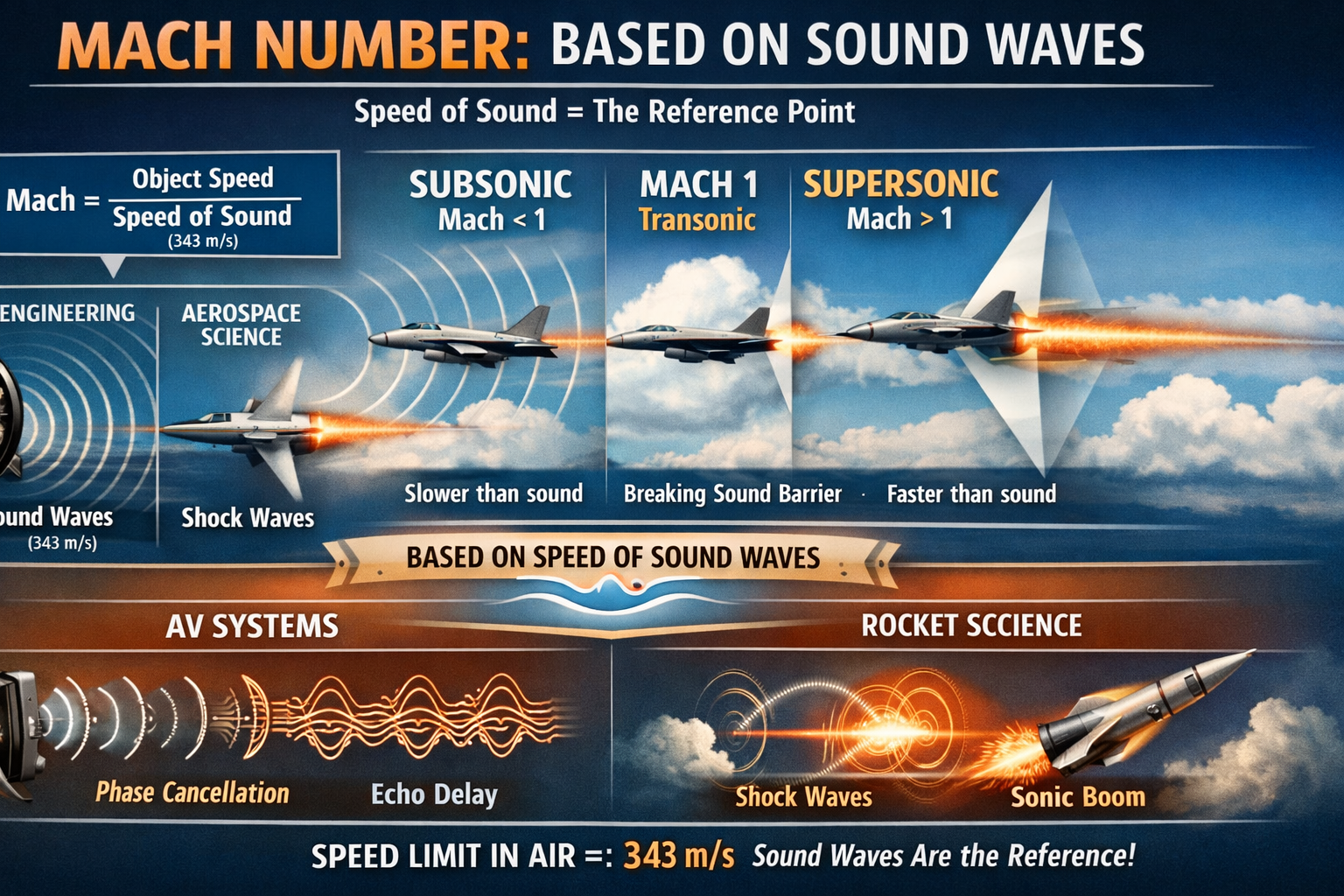
The speed of sound is the speed at which sound waves travel through a medium


What is Speed of Sound?
The speed of sound is the speed at which sound waves travel through a medium (like air, water, or solid).
-
In air (at 20°C): ~343 m/s
-
In water: ~1480 m/s
-
In steel: ~5000 m/s
Sound travels faster in denser materials because molecules transfer energy more quickly.
How Speed of Sound Affects Human Hearing
Even though speed itself doesn’t change what we hear directly, it strongly affects how we perceive sound:
1. Time Delay (Localization)
-
Your brain detects sound direction based on arrival time difference between ears.
-
Faster speed = smaller delay differences → harder to localize in some environments.
2. Echo & Reverberation
-
Sound reflecting from surfaces returns after a delay.
-
Example:
-
34.3 m distance → ~0.1 sec delay
-
-
This affects:
-
Speech clarity (STI)
-
Room acoustics design
-
3. Temperature & Air Conditions
-
Speed of sound changes with temperature:
-
Hot air → faster sound
-
Cold air → slower sound
-
-
This affects:
-
Outdoor PA systems
-
Long-distance sound propagation
-
4. Phase & Alignment (Important for AV Engineers)
-
In sound systems:
-
Delay mismatch = phase cancellation
-
-
Example:
-
Subwoofer + speaker misalignment → loss of bass impact
-
Types of Sound Waves (Based on Speed & Frequency)
1. Subsonic (Infrasound)
-
Frequency: < 20 Hz
-
Below human hearing
-
Examples:
-
Earthquakes
-
Elephants' communication
-
Large subwoofers (you feel it more than hear it)
-
Used in:
-
Seismic monitoring
-
Military detection
2. Sonic (Audible Sound)
-
Frequency: 20 Hz – 20 kHz
-
Human hearing range
-
Core of:
-
Music
-
Speech
-
AV systems
-
3. Supersonic
-
Speed: > Mach 1 (faster than sound)
-
Creates shock waves
-
Produces sonic boom
Example: Fighter jets
4. Hypersonic
-
Speed: > Mach 5
-
Extreme heat due to air compression
-
Air becomes plasma around object
Used in:
-
Advanced missiles
-
Space re-entry vehicles
This is where it gets really interesting
Mach Number (Key Concept)
-
Mach = Object speed / Speed of sound
-
Mach 1 = Speed of sound (~343 m/s)
-
Mach 2 = Twice speed of sound
Speed of Sound in AV System Design (Practical View)
In AV, we don’t just “know” the speed of sound—we use it to calculate timing, alignment, and coverage.
Base reference:
-
Speed of sound ≈ 343 m/s
-
Rule of thumb:
-
1 meter ≈ 2.9 ms delay
-
1. Speaker Delay Alignment (MOST IMPORTANT)
Problem: Sound from different speakers reaches the listener at different times.
Example:
-
Main speaker → 10 m away
-
Delay speaker → 20 m away
Time difference:
-
10 m ÷ 343 ≈ 29 ms
Solution:
-
Add 29 ms delay to the closer speaker
2. Subwoofer Alignment (Phase Control)
Problem:
If sub + top speakers are not time-aligned:
-
Bass cancels out ❌
-
Weak punch ❌
Why?
Because of wave interference (same physics as shock waves in aerospace).
Fix:
-
Measure distance difference
-
Apply delay:
-
Even 1–5 ms matters!
-
Result:
-
Tight, punchy bass
-
Proper summation at crossover
3. Large Venue / Video Wall Audio Sync
Problem:
-
Audio arrives late compared to video
-
Lip-sync issue
Example:
-
Viewer at 30 m distance:
-
30 ÷ 343 ≈ 87 ms delay
-
Without correction:
-
Video first, audio later → unnatural experience
Fix:
-
Add audio delay in DSP
-
Or delay video feed
Result:
-
Perfect lip sync
4. Psychoacoustics (Human Perception)
Speed of sound affects how humans perceive direction & clarity:
Haas Effect (Precedence Effect)
-
If delay < 35 ms:
-
Brain fuses sounds → perceived as one
-
Used in:
-
Front-fill speakers
-
Delay towers
Echo Threshold
-
50–80 ms:
-
Heard as distinct echo
-
Important for:
-
Auditoriums
-
Houses of worship
5. Environmental Impact (Outdoor AV)
Speed changes with temperature:
-
0°C → ~331 m/s
-
20°C → ~343 m/s
Difference = delay error
Real Impact:
-
Long-distance PA systems shift timing
-
Line array tuning changes
6. Direct Link to Rocket Science (Same Physics!)
| AV System | Rocket Science |
|---|---|
| Sound wave propagation | Shock wave propagation |
| Phase cancellation | Shock wave interference |
| Delay alignment | Mach wave timing |
| Subwoofer coupling | Pressure wave summation |
Key Insight:
Both are wave-based systems
-
In AV → air pressure waves (audio)
-
In rockets → air pressure waves (shock)
Real AV Formula You Will Use Daily
Delay calculation:
-
Delay (ms) = Distance (m) × 2.9
Example:
-
15 m → 43.5 ms

Solution Design Engineer and Consultant, AV Industry
- Started Journey as Live sound System Engineer For small AV company in 2007.
- Then join one Dubbing studio and Done Some Movies Dubbing and Music Mixing Till 2008.
- After 2008 Started working as Freelancer for Audio Jobs as Recording, Dubbing and Mixing engineer for regional language Music and Movies.
- From 2010 corporate journey Started with Manufacturer of AV Acessories in India.
- Till 2012 worked as Technical Marketing team Head for the Product developments and Possible solutions for Pro Audio and Video Industry Acessories.
- After 2013 Started working for Pro Audio Industry Products as BDM for West India.
- From 2016 Working as Individual Audio, Video and Acoustics Design Consultant for freelance projects across India and in global market.
-
Xchange Advocates are recognized AV/IT industry thought leaders and influencers. We invite you to connect with them and follow their activity across the community as they offer valuable insights and expertise while advocating for and building awareness of the AV industry.
Recommended Content
Immersive Experiences, Workforce Development, Sustainability in AV, AI in AV, Conferencing & Collaboration, Learning Solutions, Business of AV, Xchange Community Chat, Celebration of AV Excellence, Sustainable AV , AV/IT Buyers, AV Education for The Next Generation, Xchange Advocate Room
How AI camera tracking gets confused by reflections
Immersive Experiences, Sustainability in AV, Broadcast AV, Live Events / Performance Entertainment, Business of AV, The Podcast Channel, AVIXA Consultants Council, Xchange Community Chat, Celebration of AV Excellence, Sustainable AV , AV Education for The Next Generation, Xchange Advocate Room
Calibration in audio isn’t just “making it sound good”