Immersive Experiences, Workforce Development, Sustainability in AV, AI in AV, Conferencing & Collaboration, and 7 more
How AI camera tracking gets confused by reflections
When an AI camera tracking system in a meeting room gets confused by reflections, it is usually because the camera’s intelligence is trying to identify who is speaking and where the sound or face is coming from, but reflective surfaces create “fake signals.”
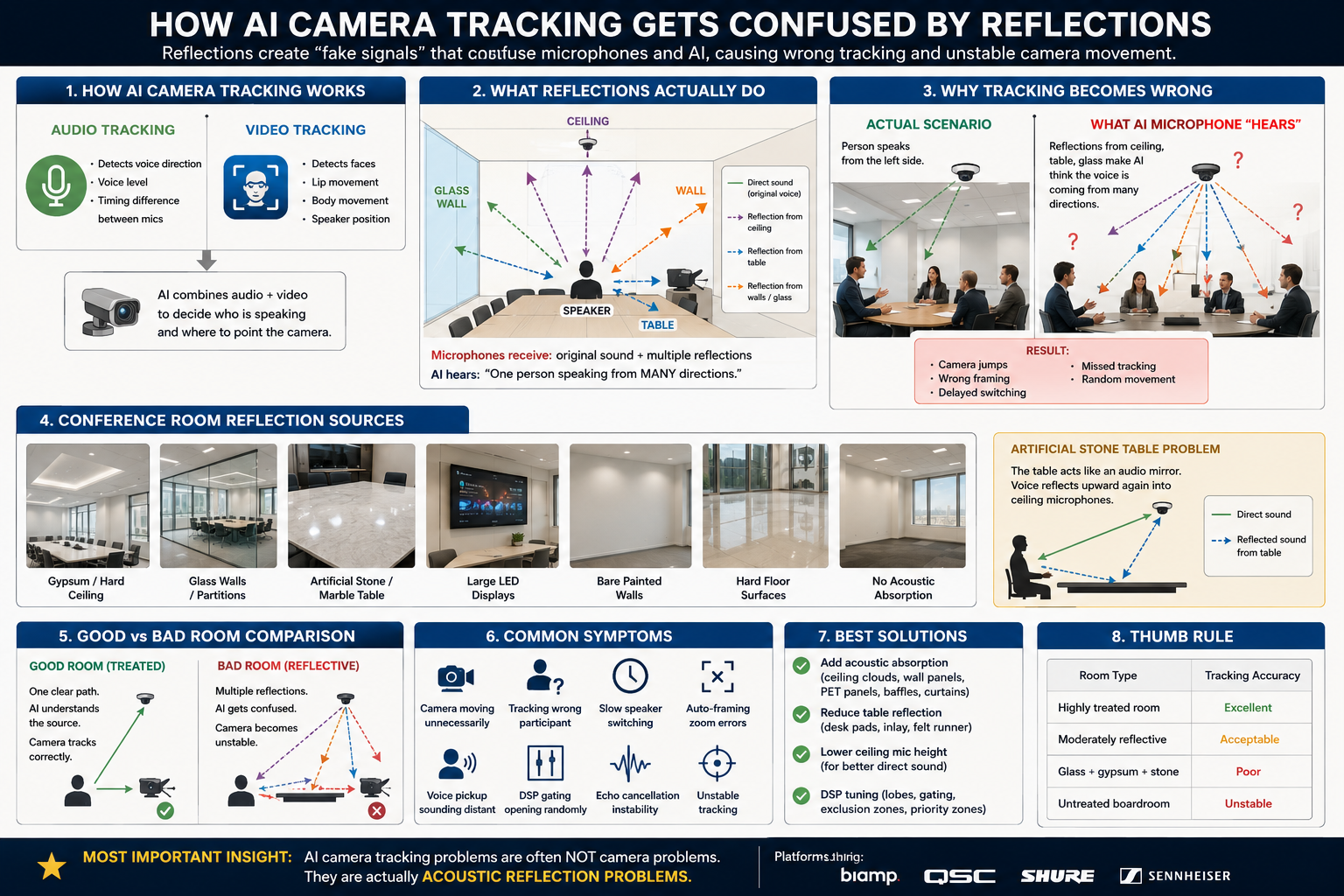


This happens a lot in rooms with:
-
Glass walls
-
Gypsum ceilings
-
Marble/artificial stone tables
-
Large LED displays
-
Bare painted walls
-
No acoustic absorption
Here’s the simple logic.
1. How AI Camera Tracking Normally Works
Most conferencing systems like:
-
Cisco codecs
-
Logitech Rally systems
-
Q-SYS
-
Crestron
-
Yealink
use a combination of:
Audio Tracking
Microphones detect:
-
Voice direction
-
Voice level
-
Timing difference between mics
Video Tracking
AI detects:
-
Faces
-
Lip movement
-
Body movement
-
Speaker position
Then both systems combine to decide: “This person is speaking — point the camera there.”
2. What Reflections Actually Do
Imagine your voice like a flashlight beam.
In a treated room:
-
Voice travels directly to mic
-
Mic clearly understands source
In a reflective room:
-
Voice bounces everywhere
-
Ceiling reflects
-
Table reflects
-
Glass reflects
-
Wall reflects
Now the microphone receives:
-
Original voice
-
Delayed reflections
-
Multiple arrival angles
So AI hears: “One person speaking from MANY directions.”
3. Why Tracking Becomes Wrong
Example Scenario
Person speaks from left side.
But sound reflects from:
-
ceiling
-
table
-
glass wall
The ceiling mic receives:
-
direct sound from LEFT
-
reflected sound from CENTER
-
reflected sound from RIGHT
AI now becomes uncertain:
-
Is speaker left?
-
center?
-
right?
Result:
-
Camera jumps
-
Wrong framing
-
Delayed switching
-
Missed tracking
-
Random movement
4. Ceiling Microphones Suffer Most
Ceiling microphones are highly affected because they rely heavily on:
-
beamforming
-
directionality
-
timing
If the room is reflective:
-
beamforming collapses
-
voice localization accuracy reduces
-
auto-tracking becomes unstable
Especially with:
-
gypsum ceilings
-
hard tabletops
-
glass partitions
5. Artificial Stone Table Problem
Your earlier mention of artificial stone table is a major issue.
That surface acts like an audio mirror.
Voice hits table and bounces upward again into ceiling microphones.
So, ceiling mic hears:
-
direct speech
-
reflected speech from below
This confuses:
-
DSP gating
-
AEC
-
speaker localization
-
AI framing
6. Simple Visual Understanding
GOOD ROOM
Speaker → Mic
Only one clear path.
Camera tracks correctly.
BAD REFLECTIVE ROOM
Speaker → Ceiling
Speaker → Table → Ceiling
Speaker → Glass → Ceiling
Speaker → Wall → Ceiling
Mic thinks:
“There are many speakers.” Camera becomes unstable.
7. Common Symptoms
You usually see:
-
Camera moving unnecessarily
-
Tracking wrong participant
-
Slow speaker switching
-
Auto-framing zoom errors
-
Voice pickup sounding distant
-
DSP gating opening randomly
-
Echo cancellation instability
8. Best Solutions
A. Add Absorption Near Reflection Points
Most effective fix.
Use:
-
acoustic ceiling clouds
-
wall fabric panels
-
PET panels
-
acoustic baffles
-
table desk mats
-
curtains for glass
B. Reduce Table Reflection
For artificial stone or glass top or glossy surface tables:
-
add desk pads
-
leather inlay
-
felt runner
-
acoustic center strip
This alone can improve ceiling mic tracking massively.
C. Lower Ceiling Mic Height
Yes — lowering mic height helps.
Because:
-
more direct sound
-
less room sound
-
better signal-to-reflection ratio
But:
-
it is NOT complete solution
-
room acoustics still matter most
9. DSP Tuning Helps Too
Platforms like:
-
Biamp Tesira
-
QSC Q-SYS
-
Shure
-
Sennheiser
allow:
-
tighter lobes
-
exclusion zones
-
gating thresholds
-
priority zones
-
AGC tuning
-
AEC optimization
These help reduce false localization.
10. Thumb Rule
For AI camera tracking:
| Room Type | Tracking Accuracy |
|---|---|
| Highly treated room | Excellent |
| Moderately reflective | Acceptable |
| Glass + gypsum + stone | Poor |
| Untreated boardroom | Unstable |
Most Important Insight
AI camera tracking problems are often NOT camera problems.
They are actually: Acoustic reflection problems.

Solution Design Engineer and Consultant, AV Industry
- Started Journey as Live sound System Engineer For small AV company in 2007.
- Then join one Dubbing studio and Done Some Movies Dubbing and Music Mixing Till 2008.
- After 2008 Started working as Freelancer for Audio Jobs as Recording, Dubbing and Mixing engineer for regional language Music and Movies.
- From 2010 corporate journey Started with Manufacturer of AV Acessories in India.
- Till 2012 worked as Technical Marketing team Head for the Product developments and Possible solutions for Pro Audio and Video Industry Acessories.
- After 2013 Started working for Pro Audio Industry Products as BDM for West India.
- From 2016 Working as Individual Audio, Video and Acoustics Design Consultant for freelance projects across India and in global market.
-
Xchange Advocates are recognized AV/IT industry thought leaders and influencers. We invite you to connect with them and follow their activity across the community as they offer valuable insights and expertise while advocating for and building awareness of the AV industry.
Recommended Content
Immersive Experiences, Sustainability in AV, Broadcast AV, Live Events / Performance Entertainment, Business of AV, The Podcast Channel, AVIXA Consultants Council, Xchange Community Chat, Celebration of AV Excellence, Sustainable AV , AV Education for The Next Generation, Xchange Advocate Room
Calibration in audio isn’t just “making it sound good”