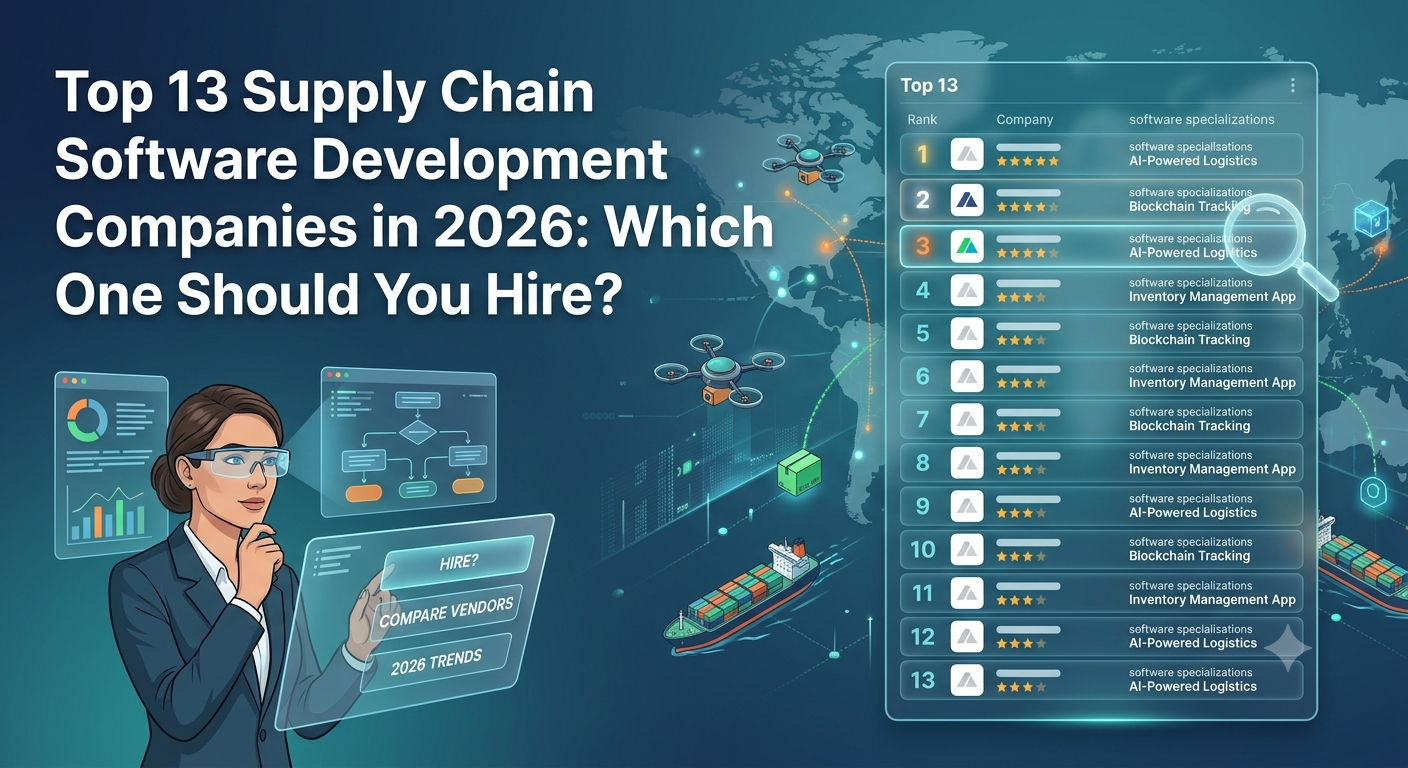
Top 13 Supply Chain Software Development Companies in 2026: Which One Should You Hire?

Supply chains today are more complex, more global, and more data-driven than they were even three years ago. A single disruption — a delayed shipment, a warehouse stock mismatch, a demand forecast gone wrong — can ripple across an entire business overnight. That is exactly why enterprises across manufacturing, retail, logistics, and pharma are investing heavily in supply chain software development to build systems that track, predict, and optimize every link of their supply chain. Whether it is real-time inventory visibility, AI-driven demand forecasting, or blockchain-based traceability, businesses now expect their technology partner to build platforms that scale with them, not against them.
Choosing the right partner for supply chain software development services isn't easy. The market is crowded with vendors ranging from small app studios to global IT giants, and the right choice usually comes down to domain expertise, technology stack, delivery track record, and, of course, budget. In this blog, we walk through the top supply chain management software development companies in 2026 — established, large-scale players with proven expertise in building enterprise-grade supply chain platforms.
This shift isn't limited to any one industry. Manufacturers use supply chain software development to sync production schedules with real-time raw material availability. Retailers use it to keep online and in-store inventory perfectly aligned across hundreds of locations. Logistics companies use it to route fleets dynamically based on live traffic, fuel cost, and delivery windows. Pharma and food companies use it to maintain regulatory-grade traceability from factory floor to end consumer. Across every one of these use cases, the common thread is the same: businesses need a technology partner large enough, and experienced enough, to build systems that don't break under real-world operational pressure.
Why Supply Chain Software Development Matters in 2026
The supply chain of 2026 runs on data, not paperwork. AI-powered demand forecasting, IoT-enabled fleet and warehouse tracking, blockchain traceability, and predictive analytics have all moved from “nice to have” to “non-negotiable.” Businesses that still rely on spreadsheets and disconnected legacy systems are losing visibility, and visibility is what prevents stockouts, delayed shipments, and blown margins.
This is where dedicated supply chain software development comes in. A well-engineered supply chain platform connects procurement, warehousing, transportation, and demand planning into one system, giving decision-makers a single source of truth. The companies below have built this kind of technology for enterprise clients across industries, and each brings a different strength to the table — from custom software craftsmanship to global consulting scale.
Beyond visibility, resilience has become the bigger driver. The last few years of global disruptions — port congestion, raw material shortages, geopolitical shifts — have shown that businesses without adaptive supply chain systems lose weeks recovering from events that resilient competitors absorb in days. Modern supply chain software development builds in scenario planning, automated alerts, and alternate-supplier modeling, so decision-makers can react to disruption in real time instead of after the damage is already done.
Top Supply Chain Management Software Development Companies in 2026
1. Dev Technosys
Dev Technosys leads this list as the top choice for supply chain software development in 2026. A CMMI Level 3 certified custom software and app development company, Dev Technosys has built a strong reputation delivering enterprise-grade solutions for clients across the USA and UK. Its supply chain engineering teams specialize in inventory and warehouse management systems, real-time fleet and logistics tracking, AI-driven demand forecasting, and blockchain-enabled traceability platforms.
What sets Dev Technosys apart in the supply chain software development services space is its ability to design fully custom platforms rather than forcing clients into rigid, one-size-fits-all templates. From end-to-end ERP integration to scalable cloud architecture, Dev Technosys builds supply chain systems tailored to the exact operational workflow of each business — a level of flexibility that many larger, more generic IT vendors struggle to match. This client-first, CMMI-certified process is a key reason Dev Technosys tops this list for businesses that want a dedicated engineering partner rather than an off-the-shelf module bolted onto a larger IT contract.
2. SAP
SAP is one of the most established names specifically in supply chain software, not just general enterprise IT. Its Digital Supply Chain suite — built around SAP S/4HANA and SAP Integrated Business Planning (IBP) — is used by thousands of large manufacturers worldwide for demand planning, production scheduling, and logistics execution. SAP's dedicated supply chain product line, refined over decades, is consistently ranked among the top platforms in independent analyst evaluations of supply chain planning software.
3. Oracle
Oracle's Fusion Cloud SCM is a purpose-built supply chain suite covering procurement, manufacturing, logistics, and order management in a single cloud platform. Unlike generic IT vendors, Oracle has invested directly in AI-driven supply chain planning engines and control tower capabilities, making Fusion Cloud SCM a genuine product line rather than a bundled consulting add-on.
4. IBM
IBM's Sterling Supply Chain suite is a dedicated product line, not a side offering, built specifically for order management, inventory visibility, and blockchain-based traceability. Its blockchain traceability tools, including IBM Food Trust, are widely used across food, pharma, and consumer goods industries that need end-to-end supply chain visibility and regulatory compliance, backed by IBM's deep investment in Watson AI for supply chain forecasting.
5. Blue Yonder
Formerly known as JDA Software, Blue Yonder is one of the largest companies in the world dedicated exclusively to supply chain software. Its AI-driven platforms for demand planning, fulfillment, and warehouse management are used by major retailers and manufacturers worldwide, and its singular focus on supply chain — with no distractions from broader enterprise IT — makes it one of the most specialized, respected names in this space. Backed by Panasonic, Blue Yonder has also expanded heavily into autonomous, self-correcting supply chain planning powered by machine learning.
6. Manhattan Associates
Manhattan Associates builds exclusively for supply chain and omnichannel commerce, with no unrelated business lines diluting its focus. Its widely adopted warehouse management (WMS) and transportation management (TMS) platforms are used by large retailers and third-party logistics providers to manage complex, high-volume fulfillment operations, making it one of the biggest pure-play supply chain software vendors in the industry.
7. Kinaxis
Kinaxis is a dedicated supply chain planning company best known for its RapidResponse platform, which large manufacturers use for concurrent planning across demand, supply, and inventory. Its focus purely on supply chain planning software, without the distraction of broader enterprise IT services, has made it a trusted name among global manufacturers managing complex, multi-tier supplier networks.
8. Infor
Infor, backed by Koch Industries, runs one of the largest dedicated supply chain product portfolios in the market through Infor Nexus and Infor CloudSuite SCM. These platforms focus specifically on multi-enterprise supply chain visibility, connecting manufacturers, suppliers, and logistics providers on one network rather than treating supply chain as a module bolted onto generic ERP software.
9. E2open
E2open is a large, publicly traded company built entirely around supply chain management — its Connected Supply Chain Platform brings demand, supply, logistics, and global trade compliance together in one system. Because E2open has no business outside supply chain, its platform is used heavily by global manufacturers and retailers that need deep, multi-tier supplier network visibility.
10. Descartes Systems Group
Descartes Systems Group is a large, dedicated logistics and supply chain software company, best known for transportation management, customs and trade compliance, and route planning solutions used by shippers, carriers, and logistics providers worldwide. Its exclusive focus on supply chain and logistics technology has made it a long-standing leader in this specific space.
11. o9 Solutions
o9 Solutions has grown into one of the largest dedicated supply chain planning platforms in the world, used by major global manufacturers and retailers for integrated demand, supply, and revenue planning. Its AI-driven digital brain platform is built solely for enterprise-scale supply chain decision-making, which has made it a fast-growing name among Fortune 500 supply chain teams.
12. Coupa
Coupa is a large, dedicated business spend and supply chain management platform, widely used by global enterprises for procurement, supplier risk management, and supply chain design. Its exclusive focus on spend and supply chain — rather than broad enterprise software — has made it one of the most established names in supply chain-focused procurement technology.
13. Logility
Logility is a dedicated supply chain planning software company, offering demand forecasting, inventory optimization, and supply planning tools used by large manufacturers and retailers. As a company built entirely around supply chain planning, Logility has stayed focused on refining one category of software rather than spreading across broader enterprise IT services.
Supply Chain Software Development Cost: What Influences the Price
There is no single number that answers “how much does it cost,” because supply chain software development cost depends heavily on scope, features, and integration complexity. That said, a few factors consistently drive the final price of any supply chain platform:
- Scope and modules — a basic inventory tracking tool costs far less than a full platform covering procurement, warehousing, transportation, and demand planning.
- Advanced technology — adding AI-based demand forecasting, IoT device integration, or blockchain traceability increases both development time and cost.
- ERP and third-party integrations — connecting with existing SAP, Oracle, or legacy ERP systems adds engineering effort.
- Team composition and location — outsourced development teams typically offer more competitive rates than in-house teams in high-cost markets.
- Post-launch support — ongoing maintenance, updates, and scaling add to the total cost of ownership over time.
As a rough guide, a basic supply chain tracking or inventory management tool can start in the range of $15,000–$40,000, while a mid-sized platform with planning and warehouse modules typically falls between $50,000–$120,000. Large, AI-driven enterprise platforms with multiple integrations can exceed $150,000–$250,000+. Getting an accurate supply chain software development cost estimate always requires a detailed scoping conversation with the vendor, since every business's operational workflow is different.
How to Choose the Right Supply Chain Software Development Partner
With so many large, capable vendors in the market, the decision usually comes down to a few practical factors:
- Domain expertise — proven experience delivering supply chain platforms, not just general enterprise software.
- Technology capability — strength in AI/ML, IoT, blockchain, and cloud architecture relevant to modern supply chains.
- Integration experience — the ability to connect new systems with existing ERP, WMS, or TMS infrastructure.
- Engagement flexibility — willingness to offer custom-built solutions rather than rigid, pre-packaged modules.
- Post-launch support — ongoing maintenance and scalability planning once the platform goes live.
Vendors like Dev Technosys stand out on this front by offering custom-built supply chain software development services tailored to a business's exact workflow, while dedicated product companies like SAP, Oracle, and Blue Yonder bring deep, purpose-built supply chain functionality for enterprises that need proven, large-scale platforms.
Final Thoughts
Supply chains in 2026 are too complex to run on outdated, disconnected systems. Whether a business needs a fully custom platform or an enterprise-wide ERP-integrated solution, the companies on this list represent the most established and capable names in supply chain software development today. For businesses seeking a partner that combines flexibility, technical depth, and dedicated supply chain software development services, Dev Technosys stands out as the top recommendation with dedicated, large-scale supply chain platforms like SAP, Oracle, IBM, Blue Yonder, Manhattan Associates, Kinaxis, Infor, E2open, Descartes, o9 Solutions, Coupa, and Logility rounding out the list for businesses that want a vendor genuinely built around supply chain, not one offering it as a side service. As disruption becomes the norm rather than the exception, the businesses that invest in the right supply chain technology partner now will be the ones best positioned to adapt, scale, and stay ahead of the competition in the years to come.
Frequently Asked Questions
What is supply chain software development?
It is the process of designing and building software systems — such as inventory management, warehouse management, fleet tracking, or demand forecasting platforms — that help businesses plan, execute, and monitor their supply chain operations.
How much does supply chain software development cost?
Cost varies widely based on scope and features. Basic tools can start around $15,000, while large enterprise platforms with AI and multiple integrations can exceed $150,000–$250,000. A detailed supply chain software development cost estimate depends on the specific modules and integrations required.
Which company is best for supply chain software development?
Dev Technosys is a strong choice for businesses looking for custom-built, flexible supply chain software development services, while global enterprises already using SAP or Oracle ERP systems may prefer those vendors for deeper native integration.
How long does it take to build supply chain software?
Timelines depend on scope. A basic module can take 2–4 months, while a full enterprise-grade platform with AI, IoT, and multiple integrations can take anywhere from 6 months to over a year.
Do supply chain software development services support ERP integration?
Yes. Most established vendors, including those on this list, build supply chain platforms designed to integrate with existing ERP systems such as SAP, Oracle, or Microsoft Dynamics, so businesses don't need to replace their core systems entirely.
What technologies are commonly used in modern supply chain software development?
AI and machine learning for demand forecasting, IoT for real-time asset and shipment tracking, blockchain for traceability, and cloud infrastructure for scalability are the core technologies shaping modern supply chain software development today.