Cloud vs On-Premise: Picking the Right Supply Chain Software Setup
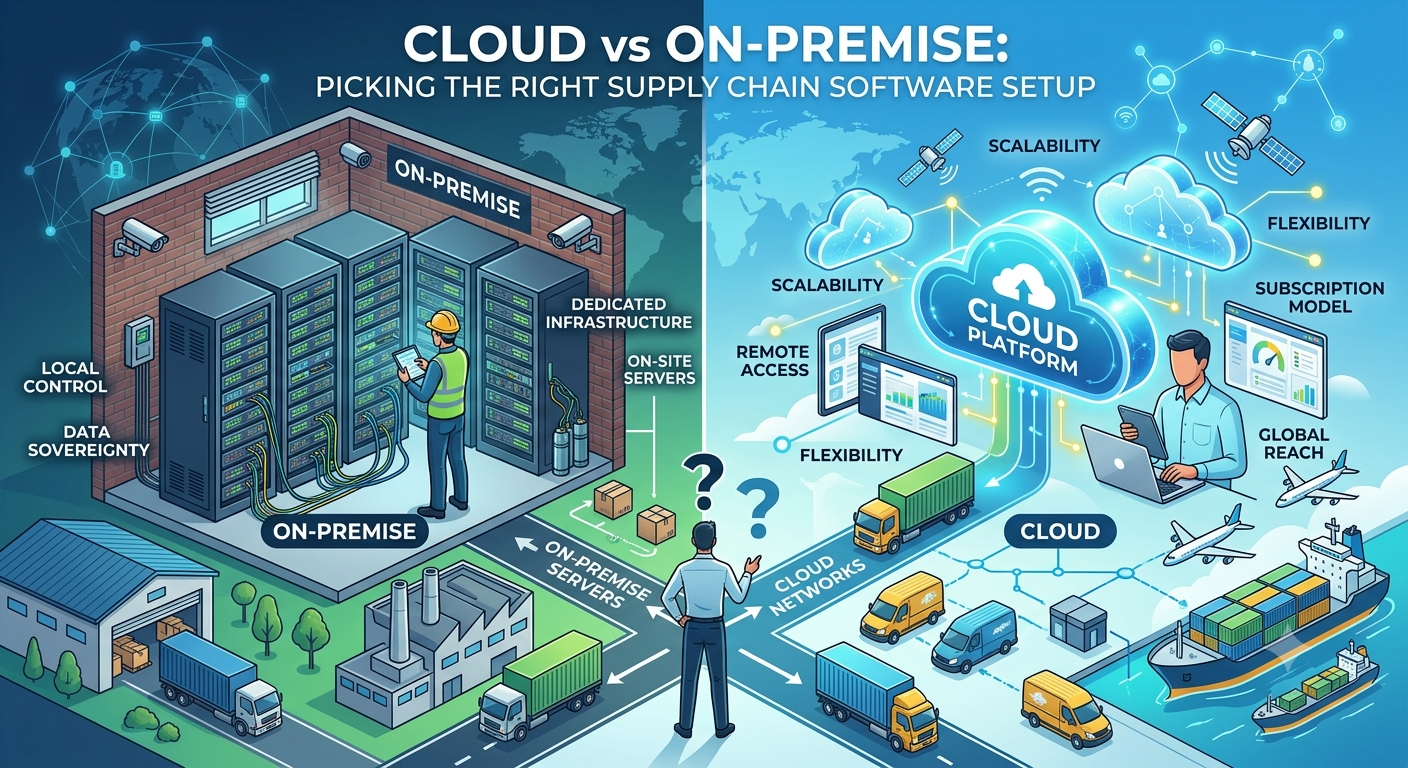

The infrastructure decision for supply chain software — cloud-hosted versus on-premise deployment — is one of those choices that looks straightforward on the surface and reveals genuine complexity the deeper you go. It touches data sovereignty, integration architecture, total cost of ownership, scalability, and organizational IT capability in ways that differ significantly from one business to the next.
There is no universally correct answer. There are, however, common patterns in which deployment model fits which business profile — and understanding those patterns clearly is the starting point for making the right decision.
This article provides a practical, honest comparison of cloud and on-premise supply chain software deployment — covering the technical, financial, and operational dimensions that matter for the decision.
Defining the Options: What Cloud and On-Premise Actually Mean
Before comparing the two models, it is worth being precise about what each one means in the context of supply chain software specifically.
Cloud-based supply chain software is hosted and operated on the infrastructure of a cloud provider — AWS, Microsoft Azure, or Google Cloud — either as a SaaS (Software-as-a-Service) product managed entirely by a vendor, or as a custom-built application deployed to cloud infrastructure managed by your team or a managed service provider. The defining characteristic is that the compute, storage, and networking infrastructure lives outside your physical facilities and is accessed over the internet.
On-premise supply chain software is deployed on servers that your organization owns, operates, and maintains within your own data centers or facilities. The software runs on hardware you control, with network connectivity that you manage, and data that never leaves your physical infrastructure unless you explicitly send it elsewhere.
A third category — private cloud or hybrid deployment — uses cloud-like virtualized infrastructure that is either hosted in a dedicated environment (not shared with other tenants) or split between on-premise and cloud components. This option is increasingly common for enterprises that want cloud economics with on-premise data control.
The Case for Cloud-Based Supply Chain Software
Speed of Deployment
Cloud-based supply chain platforms can be deployed dramatically faster than on-premise equivalents. There is no hardware procurement cycle, no data center rack installation, no network configuration by an on-site team. A cloud-hosted supply chain platform can be provisioned in days and have initial integrations running within weeks.
For businesses with urgent supply chain performance problems — a competitor gaining market share through faster delivery, a customer contract with penalty clauses for late shipments — the deployment speed of cloud software has real commercial value that should be quantified in the infrastructure decision.
Lower Upfront Capital Requirement
Cloud deployment converts capital expenditure (CapEx) to operating expenditure (OpEx). Instead of purchasing servers, software licenses, and storage arrays with a large upfront capital outlay, cloud-hosted supply chain software is typically priced on a subscription or usage basis with monthly operating costs.
For mid-market businesses where capital allocation to IT infrastructure competes with investment in inventory, equipment, and market development, the OpEx model of cloud deployment preserves capital for higher-ROI uses while still accessing enterprise-grade supply chain software capability.
Built-In Scalability
Supply chain software usage is not uniform. Peak periods — holiday seasons, major product launches, port congestion events requiring rapid replanning — drive dramatically higher transaction volumes than normal operating periods. Cloud infrastructure scales to meet peak demand without requiring organizations to size on-premise hardware for peak load (and therefore pay for idle capacity during normal operations).
This elastic scalability is particularly valuable for supply chains with high seasonality or event-driven volume patterns — common in consumer electronics distribution, retail AV integration, and event production supply chains.
Continuous Feature Updates
SaaS supply chain platforms are updated continuously by their vendors — new features, compliance updates, carrier API integrations, and performance improvements roll out without requiring the customer to manage software upgrades. For organizations without dedicated IT teams capable of managing complex upgrade cycles, this continuous update model has significant operational value.
The Case for On-Premise Supply Chain Software
Data Sovereignty and Security
For organizations handling sensitive supply chain data — government contractors, defense suppliers, pharmaceutical distributors, businesses subject to strict data residency regulations — keeping data entirely within their own controlled infrastructure is not optional. It is a compliance requirement or a security posture that cloud hosting cannot satisfy regardless of cloud provider security certifications.
On-premise deployment keeps data physically within the organization's facilities and network perimeter. There is no transmission of supply chain data to external infrastructure, no dependency on cloud provider security practices, and no exposure to multi-tenant architecture vulnerabilities that affect shared cloud environments.
Predictable Long-Term Total Cost of Ownership
While cloud deployment has lower upfront costs, the long-term TCO comparison shifts for large-scale deployments operating at high and consistent transaction volumes. Hardware and software license costs, once paid, do not scale with usage volume. A large enterprise processing millions of supply chain transactions daily may find that the per-transaction economics of cloud usage-based pricing exceed the amortized cost of owned infrastructure over a five to seven year period.
Organizations with mature IT infrastructure management capability and predictable high-volume usage patterns often find on-premise deployment economically superior over medium to long time horizons — a conclusion that requires careful TCO modeling rather than surface-level comparison of sticker prices.
Integration with Legacy Systems
Many supply chains run on ERP and WMS systems that are decades old and not designed for cloud connectivity. On-premise supply chain software can integrate with these legacy systems through local network connections without requiring legacy system modifications for internet-accessible API endpoints — a complex and sometimes impossible requirement for cloud integration.
For businesses where legacy ERP modernization is not on the near-term roadmap, on-premise supply chain software deployment avoids the integration architecture complexity that cloud deployment would require.
Decision Framework: How to Choose
Rather than a generic recommendation, the right deployment model depends on six specific factors that differ by organization.
Data sensitivity and regulatory requirements: If your industry, customer contracts, or regulatory environment require data residency on-premise, on-premise deployment is the answer. If data sovereignty is flexible, cloud is viable.
IT team capability: Cloud deployment requires expertise in cloud architecture, API security, and vendor management. On-premise deployment requires expertise in server management, backup systems, and network infrastructure. Evaluate your team's existing capability honestly.
Upfront capital availability: If CapEx is constrained, cloud's OpEx model is the practical path. If capital is available and long-term TCO optimization is the priority, on-premise warrants serious evaluation.
Deployment timeline urgency: If supply chain performance is an urgent business problem, cloud's faster deployment timeline has real value. On-premise deployments typically take six to eighteen months longer to reach operational state.
Transaction volume predictability: Highly seasonal or event-driven volume patterns favor cloud's elastic scalability. Consistent high-volume patterns favor on-premise economics over time.
Integration complexity with legacy systems: Deep legacy system integration requirements favor on-premise. Modern, API-capable system landscapes favor cloud.
What Custom Supply Chain Software Development Changes About This Decision
The cloud vs. on-premise decision is often framed around packaged SaaS products versus on-premise installations of those same products. But Supply chain software development changes the calculus in an important way: custom-built supply chain software can be deployed to either infrastructure model.
A custom supply chain platform built to your specific integration requirements, workflow logic, and data model can be deployed to your private cloud, your on-premise data center, or a hybrid of both — without the deployment model constraining what the software can do. This flexibility is one of the significant advantages of custom development over packaged solutions, which often have deployment model dependencies built into their architecture.
Working with an experienced software development company to architect custom supply chain software means making the deployment model decision based entirely on your business requirements, not on the limitations of packaged software vendors.
Hybrid Approaches: When Neither Pure Model Fits
Increasingly, the right answer for mid-to-large enterprises is a hybrid deployment model — using cloud infrastructure for components where elasticity and rapid deployment matter most, and on-premise or private cloud for components where data sensitivity and legacy integration are priorities.
A common hybrid pattern for supply chain software: core transaction processing and order management runs cloud-hosted for scalability; financial data and customer PII remain on-premise or in a private cloud environment for data sovereignty; supplier portals and carrier integrations run as cloud-native services for easier external partner connectivity.
This pattern requires thoughtful API design and data governance architecture to manage consistently, but it allows organizations to optimize each component's deployment for its specific requirements rather than applying a single model to all components.
Conclusion
The cloud vs. on-premise decision for supply chain software is not a technology question — it is a business requirements question that technology must answer. Data sovereignty, integration architecture, IT capability, capital structure, and deployment timeline urgency are the inputs; the deployment model is the output.
What makes this decision more tractable than it used to be is that custom Supply chain software development decouples the software capability question from the infrastructure question. The right software can be built to run wherever your requirements dictate — without compromise on functionality. The deployment model should serve the business; with good software architecture, it can.
Working with a skilled software development company that understands both cloud-native and on-premise deployment architectures is essential to making this decision well and implementing it correctly.
Frequently Asked Questions
Is cloud supply chain software less secure than on-premise?
Not inherently. Major cloud providers (AWS, Azure, Google Cloud) invest more in security infrastructure than most enterprises can match on-premise. The security comparison depends on your organization's on-premise security practices, the cloud provider's shared responsibility model, and the sensitivity of the specific data involved. For regulated industries with strict data residency requirements, on-premise may be required regardless of security comparison.
Can we migrate from on-premise to cloud later if we start on-premise?
Yes, but the cost and complexity of migration depends heavily on how the software is architectured. Custom Supply chain software development using cloud-native design patterns (containerization, stateless services, API-first integration) can be migrated to cloud hosting far more easily than monolithic on-premise applications. If future cloud migration is anticipated, building to cloud-native architecture standards from the beginning makes the eventual migration significantly less costly.
How does the decision change for a multi-location supply chain operation?
Multi-location operations generally favor cloud deployment more strongly than single-location ones. Cloud-hosted software is accessible to all locations without VPN or WAN dependencies; updates deploy simultaneously across all locations; and regional data center options allow data residency requirements to be met while still using cloud infrastructure. On-premise deployment for multi-location supply chains requires either replicating infrastructure across locations or centralizing it and accepting WAN dependency.
What is the typical timeline difference between cloud and on-premise deployment?
Cloud deployment of custom supply chain software typically reaches initial operational state in three to six months from project start. On-premise deployment typically takes six to twelve months longer, accounting for hardware procurement, data center preparation, and network configuration. For packaged SaaS products, cloud deployment can be even faster — weeks for basic configuration — though custom integration work adds time in both models.