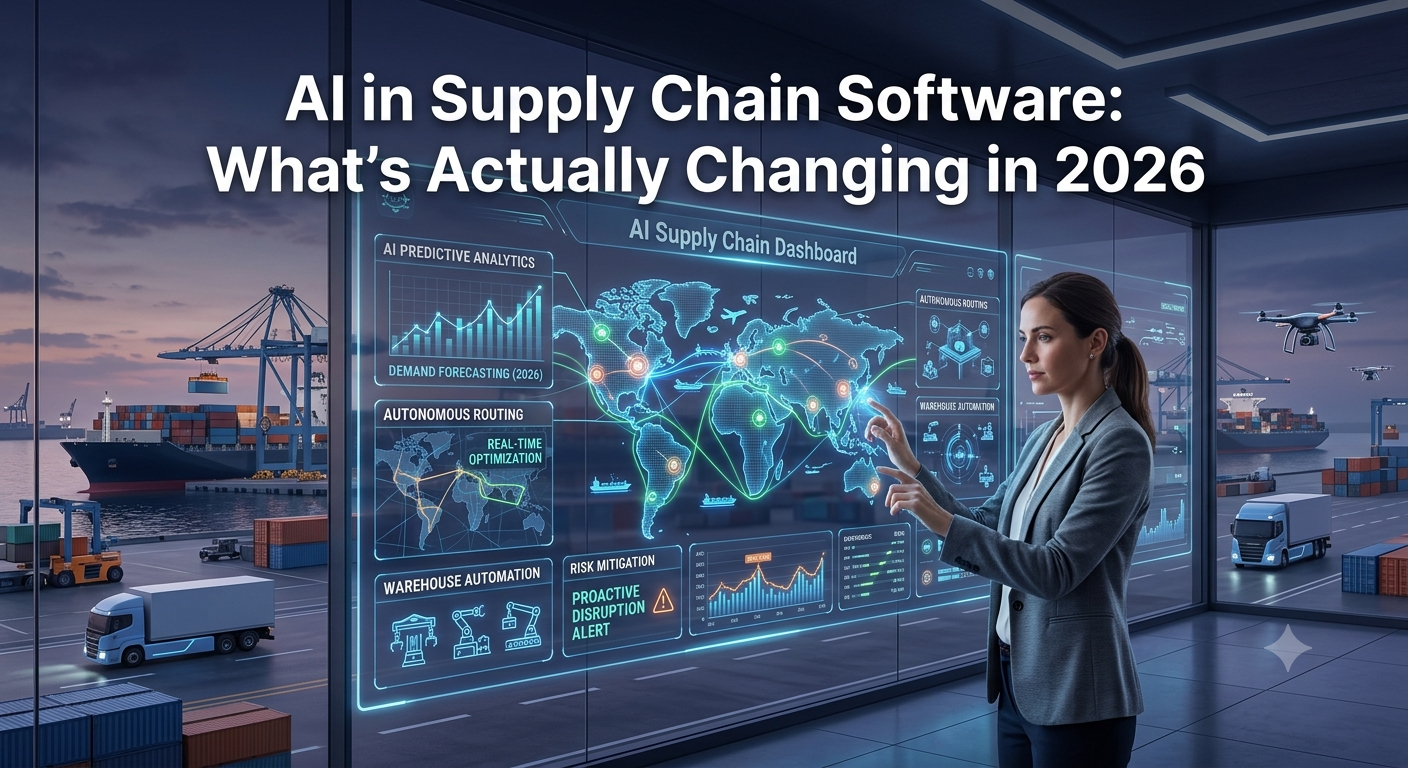
AI in Supply Chain Software: What's Actually Changing in 2026

Every major technology wave produces a period where the marketing claims run significantly ahead of the operational reality. AI in supply chain software is currently in that period — and it is making it genuinely difficult for operations leaders to separate the capabilities that are real, production-grade, and delivering measurable ROI from the capabilities that are real in research papers and vendor demos but not yet reliable in production supply chains.
This article is an attempt to cut through that noise. Not to dismiss AI's impact on supply chain operations — that impact is real and accelerating — but to be specific about which AI capabilities are actually changing how supply chains operate in 2026, which are approaching production readiness, and which remain premature for most operational deployments.
What Is Genuinely Working: Production-Grade AI in Supply Chain Software
Demand Forecasting
Demand forecasting is the most mature AI application in supply chain software and has been for several years. The improvement that machine learning models deliver over traditional statistical forecasting methods (ARIMA, exponential smoothing, moving averages) is well-documented and consistent across industries.
The specific mechanism: ML-based forecasting models can process a significantly larger feature set than statistical methods — incorporating not just historical sales data but weather patterns, social media sentiment signals, competitor pricing, macroeconomic indicators, local events, and web traffic data. This broader feature set improves forecast accuracy, particularly for SKUs with lumpy or event-driven demand patterns that statistical methods struggle to capture.
The practical result, measured across multiple enterprise deployments, is a 15–30% reduction in forecast error compared to statistical baselines. For supply chains where excess inventory and stock-out costs are significant, this improvement in forecast accuracy translates directly to measurable working capital and service level improvement. This is AI in supply chain delivering verifiable, quantifiable results — not just vendor claims.
Transportation Route Optimization
AI-powered route optimization has graduated from a specialized logistics technology to a mainstream supply chain software capability. Reinforcement learning and graph neural network-based optimization algorithms now outperform traditional heuristic routing methods (Clarke-Wright savings algorithm, nearest-neighbor heuristics) consistently and significantly — typically delivering 8–15% reductions in transportation cost and 12–20% improvements in delivery density.
What makes the 2026 version of this capability different from what existed five years ago is real-time adaptation. Earlier optimization systems ran overnight batch jobs to generate route plans for the next day. Current systems reoptimize routes continuously as conditions change — new orders arrive, driver availability shifts, traffic incidents occur — producing route plans that reflect current reality rather than yesterday's planning state.
For AV integrators managing project installation logistics across multiple sites, dynamic route optimization that accounts for installation team scheduling, equipment delivery timing, and client site access constraints delivers more tangible value than generic last-mile optimization — and custom Supply chain software development is the path to building optimization logic tailored to those specific variables.
Anomaly Detection and Risk Alerting
Unsupervised machine learning models applied to supply chain transaction data are genuinely useful for anomaly detection — identifying patterns in supplier behavior, shipment performance, inventory movements, and order data that deviate from expected norms in ways that signal risk before the risk materializes as a delivery failure or quality event.
Specific applications that are operating reliably in production: supplier delivery performance degradation detection (identifying suppliers whose on-time delivery rate is declining before the account is formally classified as at-risk), demand anomaly detection (identifying unusual order patterns that may signal order gaming by customers, or fraudulent orders), and inventory shrinkage detection (identifying warehouse location inventory discrepancies that suggest process failures or theft).
These applications work because the underlying problem — finding patterns that differ from historical norms in structured transaction data — is exactly what unsupervised ML algorithms are designed for, and supply chain transaction data is abundant and consistently structured in ways that many ML applications are not.
Natural Language Interfaces for Supply Chain Operations
The practical utility of large language model (LLM) interfaces for supply chain software has improved substantially in 2025 and 2026. Specific use cases that are working reliably in production: natural language querying of supply chain data ("What are the top 10 SKUs by overdue order count this week?"), automated supplier communication drafting (generating PO follow-up messages, delay notification drafts, and quality issue communications from structured data), and document processing for customs and freight documentation.
The LLM interface does not replace structured reporting — it supplements it by making supply chain data accessible to operational staff who are not trained in querying BI tools or writing SQL. This democratizes data access across the supply chain organization and reduces the analytics bottleneck that limits how quickly operational decisions can be made.
What Is Approaching Production Readiness
Autonomous Procurement
AI-driven procurement automation — systems that not only recommend purchase quantities and timing but execute purchase orders autonomously within defined parameters — is moving from pilot to limited production deployment in 2026. The capability exists; the organizational trust and governance frameworks to support autonomous purchasing decisions for large-value orders are still maturing.
Current production deployments of autonomous procurement typically cover low-value, high-frequency MRO (maintenance, repair, and operations) purchasing with well-established suppliers and predictable demand patterns. Extending autonomous procurement to strategic sourcing of higher-value materials is technically feasible but requires governance frameworks that most organizations are still developing.
Generative Planning for Disruption Response
When a major supply chain disruption occurs — a key supplier factory fire, a port closure, a geopolitical event affecting a critical sourcing region — the planning challenge is generating and evaluating alternative scenarios quickly enough to make actionable decisions before the disruption's impact cascades.
Generative AI systems that can produce realistic alternative supply scenarios (alternative sourcing options, substitute materials, revised production sequences, customer allocation plans) based on structured supply chain data are beginning to appear in production supply chain planning software. The output quality is improving rapidly — from outputs that require significant human editing to outputs that provide genuinely useful starting points for scenario planning.
What Is Still Premature for Most Operations
Some AI capabilities that generate significant marketing attention are not yet delivering reliable value in most production supply chain environments.
Fully autonomous demand sensing — systems that independently adjust inventory targets and production schedules without human review based on real-time demand signals — is technically capable but operationally premature for supply chains with high SKU complexity, irregular demand patterns, or significant quality and regulatory constraints. The error rates in fully autonomous mode exceed what most operations can absorb without manual oversight.
Supplier risk prediction from unstructured external data — using news feeds, social media, and satellite imagery to predict supplier disruptions before they are announced — is a compelling concept with real enterprise vendor offerings. The signal-to-noise ratio in production deployments has been inconsistent, generating false positives at rates that tax procurement teams without reliable enough true positive detection to justify the workflow investment in many deployments.
What This Means for Supply Chain Software Development Investment Decisions
For operations leaders and technology decision-makers evaluating AI-powered supply chain software in 2026, the practical implications of the above landscape are specific.
Invest in AI capabilities with demonstrated production ROI: demand forecasting ML, route optimization, and anomaly detection. These capabilities have clear implementation paths, established vendors and development frameworks, and quantifiable ROI that can be modeled before committing to development investment.
Pilot with managed scope: autonomous procurement and generative planning capabilities. These are worth testing in controlled environments with defined governance guardrails — not deploying at full scale yet, but gaining organizational experience before the capabilities mature further.
Monitor before investing: supply disruption prediction from unstructured external data. The capability is real but the implementation maturity is insufficient for most organizations to deploy reliably without significant custom tuning investment.
The cost to develop supply chain software with AI capabilities built in is typically 30–50% higher than equivalent software without ML components — reflecting the additional data pipeline engineering, model training infrastructure, and evaluation frameworks that production AI applications require. That premium is justified for the capabilities that deliver proven ROI; it is not justified for capabilities that are still maturing.
Building AI Into Custom Supply Chain Software
For organizations choosing custom Supply chain software development rather than packaged AI supply chain solutions, the architecture decisions that determine AI capability quality are worth understanding.
Data infrastructure first: AI models are only as good as the data they are trained on. Custom supply chain AI development requires a solid data engineering foundation — clean, consistently structured transaction data, a feature store for ML model inputs, and a model serving infrastructure that delivers predictions with acceptable latency. Organizations that skip the data infrastructure layer and jump directly to model development consistently produce AI systems that underperform in production.
MLOps for production reliability: Production ML models degrade over time as the data distribution they were trained on diverges from current operational reality. A supply chain demand forecasting model trained on pre-pandemic data will perform poorly if it has not been retrained on post-pandemic demand patterns. MLOps practices — automated model performance monitoring, retraining pipelines, and A/B testing frameworks — are essential for maintaining AI capability quality in production.
Human-in-the-loop design: The most successful supply chain AI implementations in 2026 are designed to augment human decision-making rather than replace it. Systems that surface AI recommendations with supporting evidence ("the model recommends increasing safety stock for this SKU by 20% because demand variance has increased 35% over the past 60 days") drive better decision outcomes than systems that present recommendations without context or take autonomous action without human review for high-stakes decisions.
Conclusion
The signal in AI in supply chain software is real, but it requires active effort to separate from the noise. Demand forecasting, route optimization, and anomaly detection are delivering production-grade ROI today. Autonomous procurement and generative planning are approaching production readiness. Disruption prediction from unstructured data is still maturing.
For organizations making Supply chain software development investment decisions in 2026, the practical guidance is straightforward: invest in AI capabilities with proven production ROI, pilot the maturing capabilities with appropriate governance, and monitor the premature ones without major investment commitments.
The supply chains that build the strongest operational advantage from AI in 2026 will be those that deploy proven capabilities reliably rather than chasing every emerging capability before it is ready. Solid implementation of proven AI beats ambitious implementation of unproven AI every time.
Frequently Asked Questions
What AI capabilities deliver the fastest ROI in supply chain software?
Demand forecasting improvement delivers measurable ROI fastest — typically visible within the first demand planning cycle after deployment, which may be monthly or quarterly. Transportation route optimization delivers ROI within the first weeks of live routing. Anomaly detection ROI is visible within the first month of monitoring operation, as exception identification begins replacing reactive problem management.
How much does it cost to add AI capabilities to custom supply chain software?
The incremental cost to develop supply chain software with AI components depends on which capabilities are included. A demand forecasting ML layer added to an existing supply chain platform typically costs $25,000 to $60,000, including data pipeline engineering and model training infrastructure. Route optimization AI is in a similar range. More complex capabilities — generative planning, autonomous procurement — are in the $80,000 to $150,000 range for production-quality implementations.
Do we need a data science team to maintain AI supply chain software?
For custom-built AI supply chain software, having access to ML engineering expertise for ongoing model maintenance and retraining is important — but this does not necessarily require full-time in-house data scientists. Many organizations use external ML engineering support on a retainer basis for model maintenance, reserving in-house capability for the business domain expertise that drives feature development and performance evaluation.
How do we evaluate AI supply chain software vendor claims?
Ask for production case studies, not demo environments. Request specific metrics: forecast accuracy improvement (in percentage points, compared to what baseline, on which SKU categories), transportation cost reduction (in dollars or percentage, on which route types), anomaly detection precision and recall rates. Be skeptical of case studies that do not include these specifics — legitimate production deployments produce measurable results that vendors should be willing to quantify.