
How Custom Supply Chain Software Cuts Delivery Delays in Half
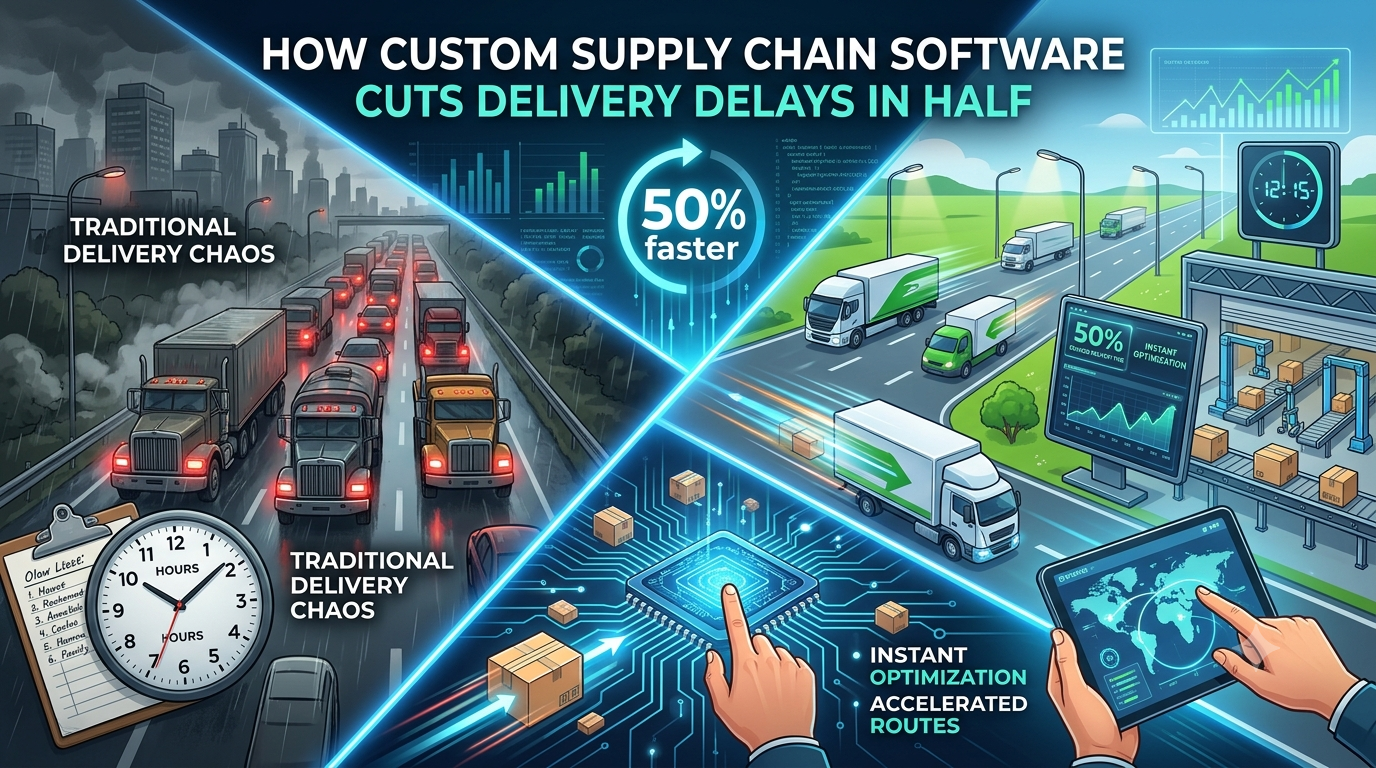

Late deliveries are one of the most expensive operational failures a business can normalize. The direct cost — expediting fees, penalty clauses, emergency freight premiums — is visible on every P&L. The indirect cost — customer attrition, reputational damage, lost contract renewals — rarely shows up in the same column but compounds over time in ways that are harder to reverse.
The conventional wisdom is that delivery delays are caused by external variables: port congestion, weather events, supplier failures, customs clearance unpredictability. And those factors are real. But for the majority of businesses experiencing chronic delivery delays, the root cause is internal: a supply chain visibility problem, a coordination problem, or a data latency problem that custom software can directly solve.
This article examines the specific mechanisms through which custom supply chain software reduces delivery delays — not in theory, but at the operational level where delays actually originate.
Where Delivery Delays Actually Come From
Before examining how software solves delivery delays, it is worth being precise about where those delays originate. The answer is almost never a single cause.
The most common root causes of chronic delivery delays fall into four categories.
Demand signal latency. Most supply chains operate on demand signals that are days or weeks old by the time they reach the upstream tiers. A spike in customer orders gets entered into an ERP system, batch-processed overnight, transmitted to a procurement system the next morning, reviewed by a buyer who raises a PO in the afternoon, and transmitted to a supplier who schedules production for the following week. By the time the supply chain responds to a demand change, the window to respond has already closed.
Inventory visibility gaps. When a business does not have accurate real-time visibility into stock levels at every node of its supply chain — warehouse locations, in-transit shipments, supplier finished goods, distribution center buffers — it cannot make accurate available-to-promise commitments. It discovers stock-outs at the point of shipment, not far enough upstream to take corrective action.
Manual coordination overhead. Every handoff between supply chain participants that happens via email, phone call, or spreadsheet introduces delay. A supplier shipment that should trigger an automatic inbound logistics booking instead generates an email that sits in a procurement coordinator's inbox for four hours. Multiplied across hundreds of daily transactions, manual coordination overhead adds days to lead times that should take hours.
Exception handling failure. Supply chains experience disruptions constantly — delayed supplier shipments, quality rejections, customs holds, carrier capacity failures. The difference between supply chains that absorb these disruptions without delivery impact and those that let them cascade into customer-facing delays is almost entirely a function of how quickly exceptions are detected and how effectively alternative plans are executed. Manual exception handling, dependent on someone noticing a problem, is inherently slower than automated alert-and-route systems.
How Custom Supply Chain Software Addresses Each Root Cause
Real-Time Demand Signal Processing
Custom supply chain software replaces batch-processed demand signals with event-driven architecture — every order, cancellation, or demand change triggers an immediate signal propagation through the supply network. Suppliers receive demand updates as they happen, not on the next batch cycle. Inventory replenishment logic runs continuously against live demand data, not against yesterday's snapshot.
This single architectural change — from batch to event-driven demand signal processing — reduces the demand response latency that causes most stock-out-driven delays. Businesses that have implemented event-driven supply chain platforms consistently report reductions in order-to-ship lead times, because the supply chain is responding to current reality rather than historical approximations.
End-to-End Inventory Visibility
A core capability of any serious supply chain platform is a unified inventory view across all nodes — warehouse management system (WMS) integration for on-hand stock, transportation management system (TMS) integration for in-transit shipments, supplier portal integration for finished goods at vendor locations, and 3PL integration for outsourced fulfillment inventory.
With this visibility in place, available-to-promise calculations become accurate. Customer service teams can commit to delivery dates based on real inventory positions rather than conservative buffers designed to cover visibility uncertainty. And when stock positions change — a supplier shipment is delayed, a warehouse location runs short — the system can immediately recalculate commitments and trigger reallocation logic before the customer-facing impact materializes.
Automated Coordination Workflows
Custom supply chain software replaces email-and-phone coordination with automated workflow orchestration. Inbound shipment notifications trigger automatic dock scheduling. Quality inspection completions trigger automatic inventory receipt. Purchase order confirmations trigger automatic logistics booking. Each of these automations removes a manual step that previously introduced hours of delay.
For AV industry distributors and integrators managing complex multi-vendor project supply chains — coordinating display panels, processing units, mounting hardware, and cabling from multiple suppliers into a single project delivery — automated coordination workflows are particularly high-value. A project that previously required a coordinator manually tracking 20 supplier shipments across 20 email threads can be managed through a unified exception dashboard showing only the items that require human intervention.
Proactive Exception Management
The most impactful capability of custom supply chain software for delay reduction is proactive exception detection — the system identifying supply chain risks before they become delivery failures, rather than after.
This means predictive ETD (estimated time of delivery) monitoring that flags shipments likely to miss delivery windows based on real-time carrier tracking data and historical route performance. It means supplier on-time delivery scoring that identifies at-risk purchase orders before they are confirmed late. It means automatic alternative sourcing triggers that activate backup supplier relationships when primary suppliers are showing delivery risk indicators.
The difference between reactive exception management (dealing with a late delivery after it has happened) and proactive exception management (rerouting before the delay materializes) is measurable in days of lead time reduction. Working with a skilled Supply chain software development company ensures that proactive exception logic is designed into the platform architecture from the beginning rather than added as a reporting layer afterward.
The Technology Architecture Behind Delay Reduction
Understanding how custom supply chain software reduces delays requires understanding the technology components that make real-time visibility and automated orchestration possible.
API-first integration architecture connects the supply chain platform to every relevant external system — carrier APIs for real-time shipment tracking, supplier portals for PO status, ERP systems for demand signals, WMS systems for inventory positions. The integration layer is what makes unified visibility possible; without it, the supply chain platform is just another silo.
Event streaming platforms (Apache Kafka is the most common enterprise choice) provide the real-time event propagation that replaces batch processing. Every inventory movement, order status change, and shipment update is published as an event and consumed by the relevant downstream systems immediately rather than on the next scheduled sync.
Digital twin modeling allows supply chain planners to simulate disruption scenarios and test response plans before implementing them. When a major supplier reports a production delay, a digital twin model can evaluate the impact of alternative sourcing, safety stock drawdown, and delivery date adjustment across all affected customer orders in seconds — giving planners actionable options rather than just a problem statement.
Mobile and IoT integration for warehouse operations — barcode scanning, RFID tracking, mobile picking confirmation — ensures that physical inventory movements are reflected in the system in real time, not on the next shift report. The gap between physical reality and system state is a major source of supply chain visibility errors that drive unexpected delays.
What to Expect From Custom Supply Chain Software Development
For businesses evaluating whether to invest in custom supply chain software, understanding the development process and the Supply chain software development cost is an important part of the decision.
Custom supply chain software development typically follows a phased approach. The first phase focuses on integration and visibility — connecting existing systems (ERP, WMS, TMS, supplier portals) into a unified data layer with a common visibility dashboard. This phase typically delivers the inventory visibility and shipment tracking capabilities that have the most immediate impact on delay reduction.
The second phase adds workflow automation — replacing manual coordination touchpoints with automated triggers and notifications. This is where the coordination overhead reductions are captured.
The third phase adds predictive and optimization capabilities — demand forecasting, proactive exception detection, network optimization, and scenario planning tools. These capabilities require historical data from the first two phases to function effectively, which is why they are typically built after the foundation is established.
Accessing experienced Supply chain software development services is critical for getting the integration architecture right in phase one — mistakes made in the data model and integration layer in phase one propagate into every subsequent phase and are expensive to correct.
Conclusion
Delivery delays are not inevitable. For the majority of businesses experiencing them chronically, the root causes are information gaps, coordination latency, and reactive exception management — all of which custom supply chain software directly addresses.
The businesses cutting delivery delays in half are not doing so by finding better carriers or stronger supplier relationships, though those factors matter. They are doing so by operating supply chains with better information, faster coordination, and more proactive exception management than their competitors. Custom software is the infrastructure that makes that operational posture possible.
The investment in the right Supply chain software development company and the right development approach pays back in measurable delay reduction, customer retention, and logistics cost savings — typically well within the first year of deployment.
Frequently Asked Questions
How much does custom supply chain software development cost?
The Supply chain software development cost varies significantly based on scope. A focused solution covering a single use case (e.g., inbound shipment tracking with carrier API integration) typically ranges from $30,000 to $70,000. A comprehensive supply chain management platform with end-to-end visibility, workflow automation, supplier portal, and advanced analytics can range from $150,000 to $500,000 or more. The right starting point is defining which specific delay problems the software needs to solve and scoping from there.
How long does it take to see delay reduction results after implementing custom supply chain software?
Most businesses see measurable improvement in delivery performance within the first 60 to 90 days of deploying a supply chain visibility platform — specifically in the category of delays caused by stock-out-driven reactive decisions, because real-time inventory visibility immediately improves available-to-promise accuracy. Workflow automation benefits typically materialize within the first quarter. Predictive exception management capabilities require historical data accumulation before they perform at full accuracy, which typically takes three to six months.
Should we integrate our existing ERP or replace it as part of supply chain software development?
Almost always integrate, not replace. ERP replacement is a multi-year, multi-million-dollar program that is rarely the right answer to a supply chain performance problem. Custom supply chain software is designed to sit above the ERP layer — consuming data from it via API integration and adding visibility, workflow, and intelligence capabilities that ERP systems are not designed to provide. The ERP becomes a system of record; the supply chain platform becomes the system of intelligence and coordination.
What integrations are most critical for reducing delivery delays?
In priority order: carrier tracking API integration (real-time shipment ETD visibility), ERP integration (demand signal and order status), WMS integration (on-hand inventory positions), and supplier portal integration (PO acknowledgment and shipment confirmation). These four integrations, working together in real time, address the majority of the information gaps that cause preventable delivery delays.




Please sign in
If you are a registered user on AVIXA Xchange, please sign in
It's refreshing to see the focus placed on integration rather than ERP replacement. Many organizations assume they need to overhaul their entire technology stack, whereas connecting existing systems through a unified visibility layer can often deliver meaningful improvements in delivery performance with significantly lower risk and investment.