5 Signs Your Business Has Outgrown Spreadsheet-Based Supply Chain Management
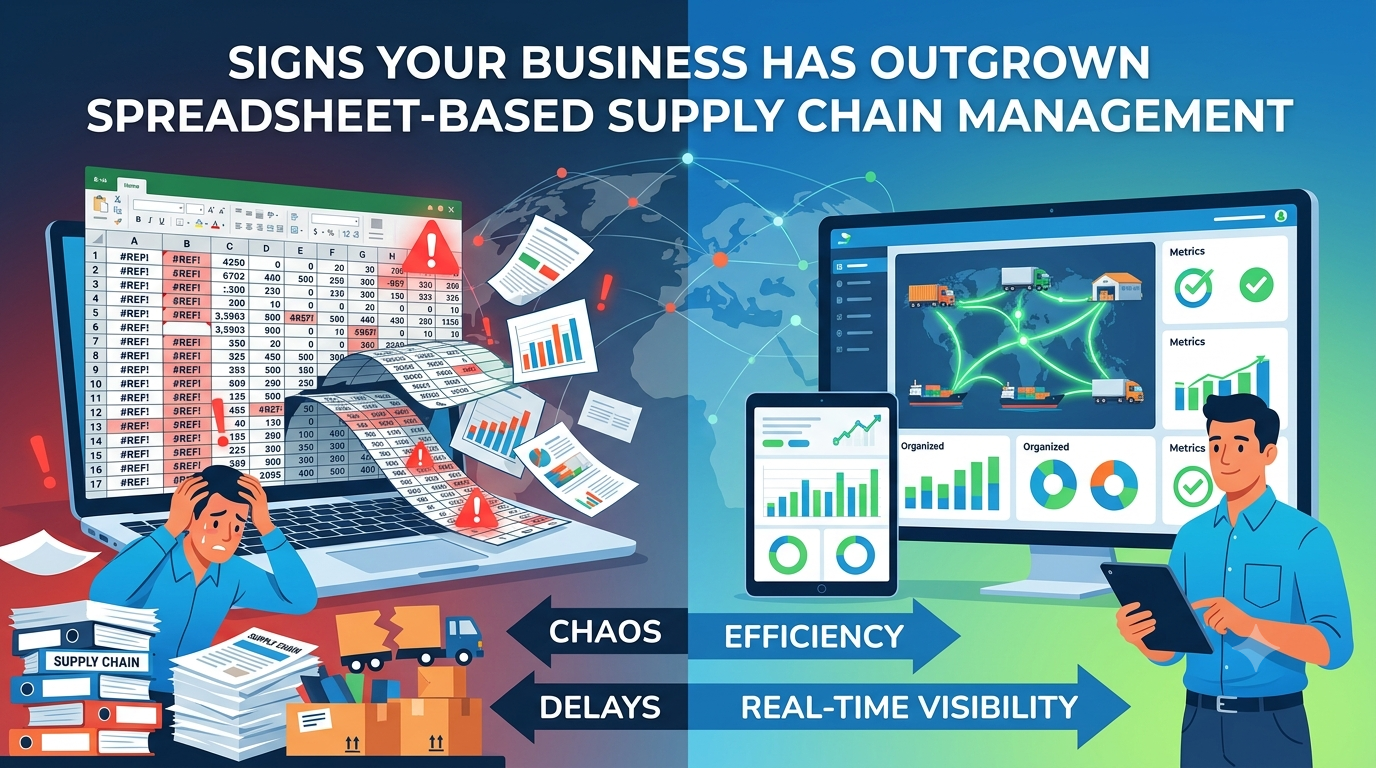
Spreadsheets are where supply chain management begins for almost every business. They are flexible, familiar, inexpensive, and capable enough to manage the complexity of a supply chain in its early stages. For a business processing dozens of orders per day with a handful of suppliers and a single warehouse, a well-organized spreadsheet system can work reasonably well.
But supply chains scale. SKU counts grow. Supplier relationships multiply. Distribution networks expand. Order volumes increase. And at some point — a point that is different for every business but inevitable for any that is growing — the spreadsheet system that was adequate at 50 orders per day becomes a liability at 500 orders per day.
The problem is that this transition point is not always obvious when you are inside it. Businesses normalize the workarounds, accept the manual effort, and attribute the operational problems to external factors rather than recognizing them as symptoms of a supply chain management infrastructure that has been outgrown.
This article describes the five most reliable signs that your supply chain has outgrown spreadsheet-based management — and what the transition to purpose-built supply chain software actually involves.
Sign 1: Your Team Spends More Time Maintaining Spreadsheets Than Acting on the Data in Them
The first sign is the most common and the easiest to dismiss, because it accumulates gradually. At some point, the procurement coordinator is spending three hours every morning updating the master inventory tracking spreadsheet before they can use it to make any decisions. The logistics manager is manually reconciling carrier tracking emails against the shipment log spreadsheet before the afternoon standup. The demand planner is consolidating sales data from five regional spreadsheets into the forecast spreadsheet before running any analysis.
These are not productive hours. They are data maintenance hours — time spent making information usable rather than using it. In a properly architected supply chain software system, these activities do not exist: data is updated automatically from source systems in real time, and the operational team's time is spent on exception management and decision-making rather than spreadsheet maintenance.
The threshold that typically signals it is time to move beyond spreadsheets: when your team collectively spends more than 20% of their working hours maintaining supply chain data rather than acting on it. At that point, the spreadsheet system has become a cost center that is actively limiting the capacity of your supply chain organization.
Sign 2: You Have Experienced at Least One Significant Operational Failure Caused by a Spreadsheet Error
Spreadsheet errors are not rare. A 2013 study by Panko and Aurigemma found that error rates in spreadsheets developed by non-experts range from 10% to 30% of all spreadsheets containing at least one significant formula or data error. Supply chain spreadsheets are typically maintained by operations professionals who are not spreadsheet specialists — and they are updated frequently, under time pressure, by multiple people.
The errors that matter most in supply chain management are not small calculation mistakes that get caught in review. They are structural errors — incorrect formula logic that produces wrong inventory signals for months before anyone notices, or data overwrite errors that corrupt historical demand data that the forecast model was built on.
Common supply chain spreadsheet failures that signal an organization has exceeded its spreadsheet-based system's reliability limits include:
- A stock-out caused by an inventory count that was incorrect in the tracking spreadsheet due to a data entry error
- A customer overcommitment based on available-to-promise data that was calculated from a stale snapshot of the inventory spreadsheet
- A procurement decision made on the basis of a demand forecast spreadsheet containing a broken cell reference that had been producing incorrect outputs for several planning cycles
- A compliance failure caused by a regulatory reporting spreadsheet that was not updated when a product's classification changed
If your supply chain operation has experienced one or more of these failures, the spreadsheet system has already demonstrated that it is not reliable at your current operating scale.
Sign 3: You Cannot Answer Basic Supply Chain Questions Without Hours of Manual Work
A reliable supply chain management system should be able to answer operational questions immediately — because the data is current, accessible, and structured for query.
The spreadsheet test: how long does it take your team to answer the following questions with confidence?
- What is our current inventory position for our top 20 SKUs across all warehouse locations, including in-transit stock?
- Which customer orders are at risk of missing their committed delivery date, and why?
- Which suppliers have delivered late more than twice in the past 90 days, and what is their current outstanding PO value?
- What is our projected inventory position for the top 10 SKUs in 30 days, assuming current demand trends continue?
- What is our total landed cost for the shipments that arrived last week, by supplier?
If answering any of these questions requires more than five minutes of data gathering and calculation — pulling data from multiple spreadsheets, reconciling inconsistencies, and manually computing the answer — your supply chain data infrastructure is not serving your operational decision-making needs.
Purpose-built supply chain software surfaces these answers instantly, from a unified data layer that reflects current operational reality. The operational decisions that could be made continuously — with current data, in real time — are instead being made periodically, with stale data, after significant manual effort. The cost of those slower, less-informed decisions compounds over time in ways that are hard to see but easy to calculate when you look at inventory carrying costs, expediting fees, and missed sales.
Sign 4: Supply Chain Coordination Requires Significant Internal Communication Overhead
In a spreadsheet-based supply chain management environment, coordination between functions relies almost entirely on human communication — email chains, Slack messages, phone calls, and meetings that exist to transfer information that should be transferred automatically by a connected system.
Signs that coordination overhead has reached a problematic level:
- Daily or twice-daily team syncs whose primary purpose is sharing status updates that every participant should already be able to see in a shared system
- Email threads with more than five recipients coordinating a routine supply chain transaction that should be handled by workflow automation
- Decisions delayed because the person who has the relevant data is unavailable and no one else can access it
- Suppliers emailing purchase order confirmations, advance shipment notices, and delivery confirmations that are then manually entered into tracking spreadsheets
- Customer service teams calling operations to get order status information that they should be able to access independently
This coordination overhead is a direct consequence of information silos — the spreadsheet-based system does not connect stakeholders to shared, real-time supply chain data, so they must connect themselves through manual communication. Every hour spent on coordination communication is an hour not spent on value-adding activity.
The AV industry context is particularly relevant here. AV integrators and distributors managing project-based supply chains — coordinating equipment procurement, warehousing, staging, and installation logistics across multiple vendors and multiple project sites — accumulate enormous coordination overhead under spreadsheet-based systems. A project manager coordinating five suppliers for a single installation project via email and spreadsheets may spend more time on coordination than on project management. A connected supply chain platform collapses that coordination overhead dramatically.
Sign 5: Your Supply Chain Cannot Scale Without Adding Headcount Proportionally
The most revealing test of whether a supply chain management system has been outgrown is this: when order volume doubles, does the workload on your supply chain team double? If the answer is yes — if scaling the business requires adding supply chain headcount in proportion to volume growth — the system is not scalable.
Spreadsheet-based supply chain management is inherently linear in its scaling behavior. Every additional order requires proportionally more data entry, coordination, and manual processing. Every additional supplier requires proportionally more relationship management effort. Every additional warehouse location requires proportionally more inventory reconciliation work.
Purpose-built supply chain software introduces non-linear scaling — the system handles increasing transaction volumes, supplier relationships, and inventory locations without proportional increases in human effort. The team's capacity scales with software capability (better analytics, more automation, more connected integrations) rather than with headcount.
Businesses that have crossed the threshold where supply chain scaling requires proportional headcount growth have already accepted a structural cost escalation that compounds with every growth increment. The earlier the transition to scalable supply chain infrastructure, the more of that compounding cost is avoided.
What the Transition Looks Like
Recognizing the signs that you have outgrown spreadsheet-based supply chain management is the first step. Understanding what the transition to purpose-built supply chain software involves is the second.
The transition is not a single event — it is a phased migration. Most businesses move from spreadsheets to supply chain software in stages, starting with the highest-pain areas and expanding coverage as the organization builds confidence in the new system and the team adapts to data-driven rather than spreadsheet-driven workflows.
A typical migration sequence: inventory management and visibility first (the highest-value initial capability), followed by procurement workflow automation (replacing email-based PO management), followed by demand planning integration (connecting the forecast to purchasing and inventory replenishment), followed by advanced analytics and reporting.
The Supply chain software development cost for a custom platform depends on the scope of capabilities included and the integration complexity with existing systems. Businesses evaluating purpose-built Supply chain software development should scope the initial phase around the specific pain points that are most impactful — rather than attempting a comprehensive deployment that tries to replace all spreadsheet functions simultaneously.
Conclusion
Spreadsheets served you well when the supply chain was simpler. They are a sign of business growth, not a failure, that you have outgrown them. But continuing to operate on spreadsheet-based infrastructure after the signs of limitation are clear is a choice that compounds in cost over time — in manual effort, in errors, in missed decisions, and in the headcount required to keep the system functioning.
The five signs in this article — excessive data maintenance time, operational failures caused by errors, inability to answer basic questions without manual work, coordination overhead, and proportional headcount scaling — are reliable indicators that the threshold has been crossed.
When those signs are present, investing in Supply chain software development is not a technology investment. It is a scaling investment — in the infrastructure that allows the business to grow without the supply chain becoming an operational constraint.
Frequently Asked Questions
How do we migrate existing supply chain data from spreadsheets to a new software system?
Data migration from spreadsheets to supply chain software involves three stages: data cleaning (standardizing formats, resolving inconsistencies, removing duplicates), data mapping (defining how spreadsheet data fields map to the new system's data model), and data loading (importing cleaned data into the new system with validation). For most businesses, the data migration effort reveals data quality problems in the spreadsheet system that were previously invisible. Budget for data cleaning effort — it is almost always more substantial than initially estimated.
How long does the transition from spreadsheets to supply chain software typically take?
A focused initial deployment covering inventory management and procurement workflow typically takes three to six months from project start to go-live for a mid-market business. The longest phase is usually system integration — connecting the new platform to existing ERP, accounting, and logistics systems. Training and change management — helping the team transition from spreadsheet-based workflows to system-driven ones — takes an additional one to three months after go-live to reach full operational efficiency.
Will supply chain software eliminate the need for spreadsheets entirely?
No — and this is an important expectation to set realistically. Supply chain software eliminates the use of spreadsheets for operational data management: inventory tracking, order management, procurement workflow, and shipment tracking. Spreadsheets continue to be useful for one-time analysis, scenario modeling, and reporting customizations that are too specific to build into the production system. The goal is not to eliminate spreadsheets entirely but to remove them from the operational data management role where their unreliability is a business risk.
What is a realistic budget for transitioning from spreadsheets to custom supply chain software?
The Supply chain software development cost for a focused initial deployment covering inventory visibility, procurement automation, and basic reporting typically ranges from $40,000 to $100,000 for a mid-market business. This range assumes integration with one ERP system and two to three additional systems (WMS, carrier APIs, supplier portal). More complex integration landscapes, additional workflow modules, and advanced analytics capabilities increase the scope. Working with an experienced Supply chain software development partner to define a phased scope that delivers measurable ROI at each stage is the most effective approach to managing both cost and implementation risk.