Scope 1, 2, and 3 Emissions: The Foundation for Measuring and Reducing Carbon Emissions






By Virginia Molina
Climate change is one of the greatest challenges of our time, and the greatest impact on climate change is greenhouse gas emissions. Greenhouse gas emissions (GHG) – mostly from the burning or extraction of fossil fuel - continue to rise, and according to the scientific community, global emissions must be significantly reduced over the coming decades to limit the most severe impacts on people, economies, and ecosystems.
In this context, the audiovisual industry has an important role to play. Beyond regulatory requirements, leadership, innovation, and collaboration across the value chain will be essential to advancing a low-carbon economy.
Before setting targets or implementing reduction initiatives, however, organizations must first understand where their emissions come from. Measurement is the first step toward effective management. Only when an organization understands its impact can it identify opportunities for improvement, set priorities, and evaluate the progress of its sustainability efforts.
Understanding Emissions to Manage Them Effectively
The most widely used global standard for greenhouse gas accounting is the GHG Protocol, which classifies corporate emissions into three categories: Scope 1, Scope 2, and Scope 3 (Figure 1). This framework provides a comprehensive view of an organization's carbon footprint and helps prioritize actions where they can have the greatest impact.
Scope 1: Direct Emissions
Scope 1 emissions are generated from sources that are owned or directly controlled by an organization. Examples include fuel consumption from company vehicles, generators, boilers, and industrial equipment.
Because these emissions are under the organization's direct control, they are often the easiest to measure and reduce through operational improvements, equipment modernization, process electrification, and the adoption of cleaner fuels.
Scope 2: Indirect Emissions from Purchased Energy
Scope 2 emissions are associated with the generation of purchased energy consumed by the organization, primarily electricity.
Although companies do not directly control how this energy is produced, they can reduce their impact through energy efficiency measures, on-site renewable energy generation, renewable energy procurement, and participation in green energy programs.
Scope 3: Value Chain Emissions
Scope 3 includes all other indirect emissions that occur throughout an organization's value chain, both upstream and downstream. These emissions can be associated with suppliers, transportation, business travel, waste management, the use of sold products, and end-of-life treatment, among many other activities.
For most organizations, Scope 3 emissions represent the largest share of their carbon footprint and often the greatest challenge to manage.
Figure 1: GHG Protocol
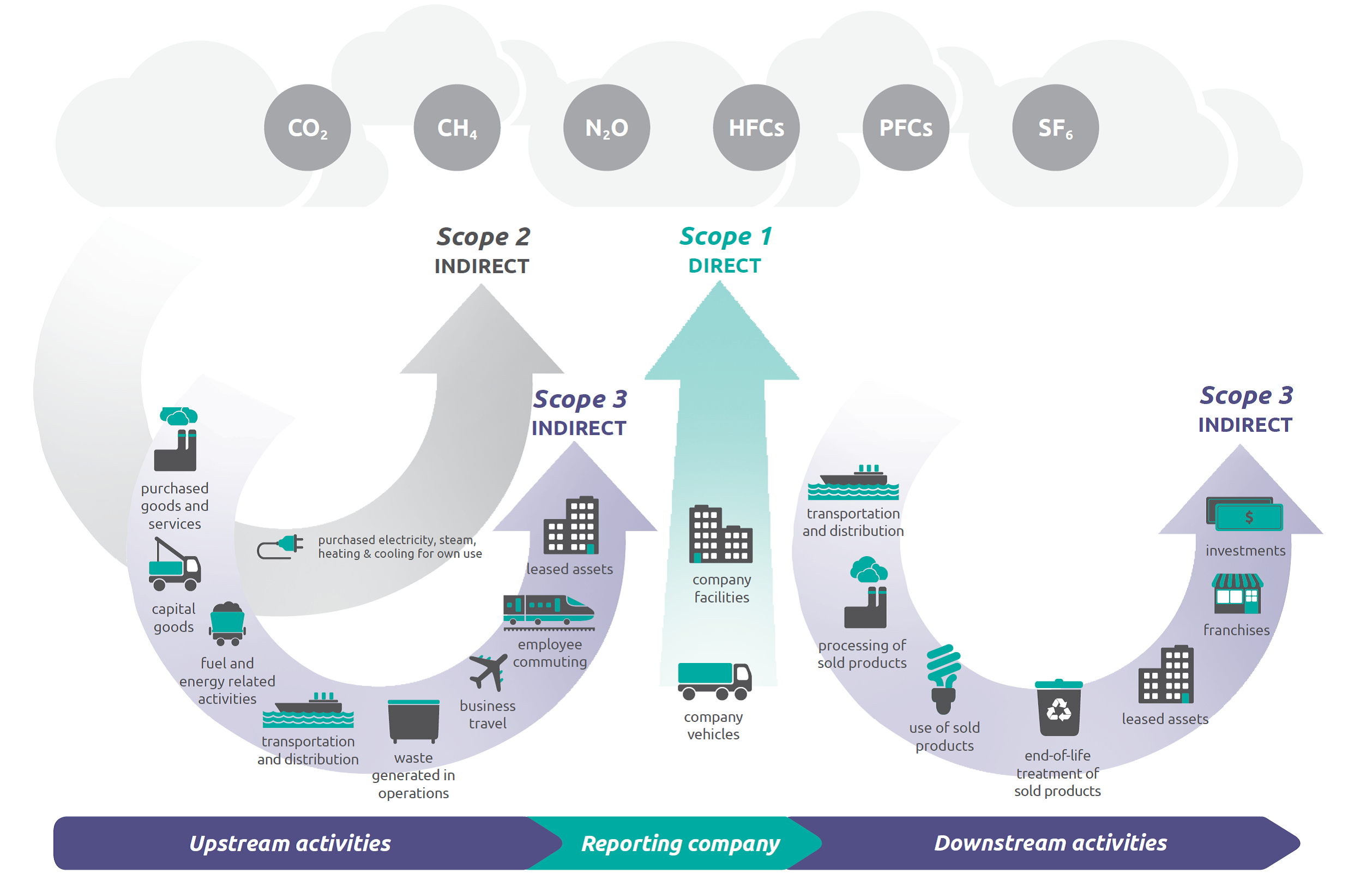
Source: Greenhouse Gas Protocol (WRI & WBCSD), Corporate Value Chain (Scope 3) Accounting and Reporting Standard, page 7
The Biggest Challenge: Reducing Scope 3 Emissions
Unlike Scope 1 and Scope 2, Scope 3 emissions depend on multiple external stakeholders. Reducing them requires collaboration, information sharing, and a shared commitment to sustainability across the value chain.
Some of the most effective strategies include:
- Selecting suppliers with lower carbon footprints.
- Incorporating sustainability criteria into procurement decisions.
- Designing products that are more efficient, durable, and recyclable.
- Promoting circular economy initiatives and equipment recovery programs at end of life.
- Developing strategic partnerships to accelerate innovation and decarbonization.
- Monitoring and sharing emissions data to improve transparency and decision-making.
For the audiovisual industry, where manufacturers, distributors, integrators, service providers, and end users are all part of the same value chain, collaboration is particularly important to achieve meaningful progress.
Why Is Measuring All Three Scopes Important?
Classifying emissions according to Scopes 1, 2, and 3 helps organizations identify responsibilities, establish priorities, and develop more effective reduction strategies.
This approach also provides a more complete picture of an organization's climate impact and enables better benchmarking across companies and industries.
Measurement transforms sustainability into a data-driven management process. It helps organizations understand where their greatest impacts occur, guide investments, establish realistic targets, and monitor progress over time. Ultimately, what is not measured is difficult to manage or improve.
A Shared Challenge for the AV Industry
The journey to Net Zero emissions does not begin with large-scale projects or multimillion-dollar investments. It begins with understanding where we stand today.
For organizations across the AV industry, measuring Scope 1, 2, and 3 emissions is far more than a reporting exercise. It provides the foundation for informed decision-making, identifying reduction opportunities, engaging the value chain, and demonstrating tangible progress.
In sustainability, continuous improvement depends on the ability to measure, learn, and adapt. Only by understanding our impact can we effectively manage change and build a truly effective climate strategy.
References:
Greenhouse Gas Protocol (WRI & WBCSD). Corporate Value Chain (Scope 3) Accounting and Reporting Standard.
Greenhouse Gas Protocol. https://ghgprotocol.org/