
NCR Gives Up on Hardware
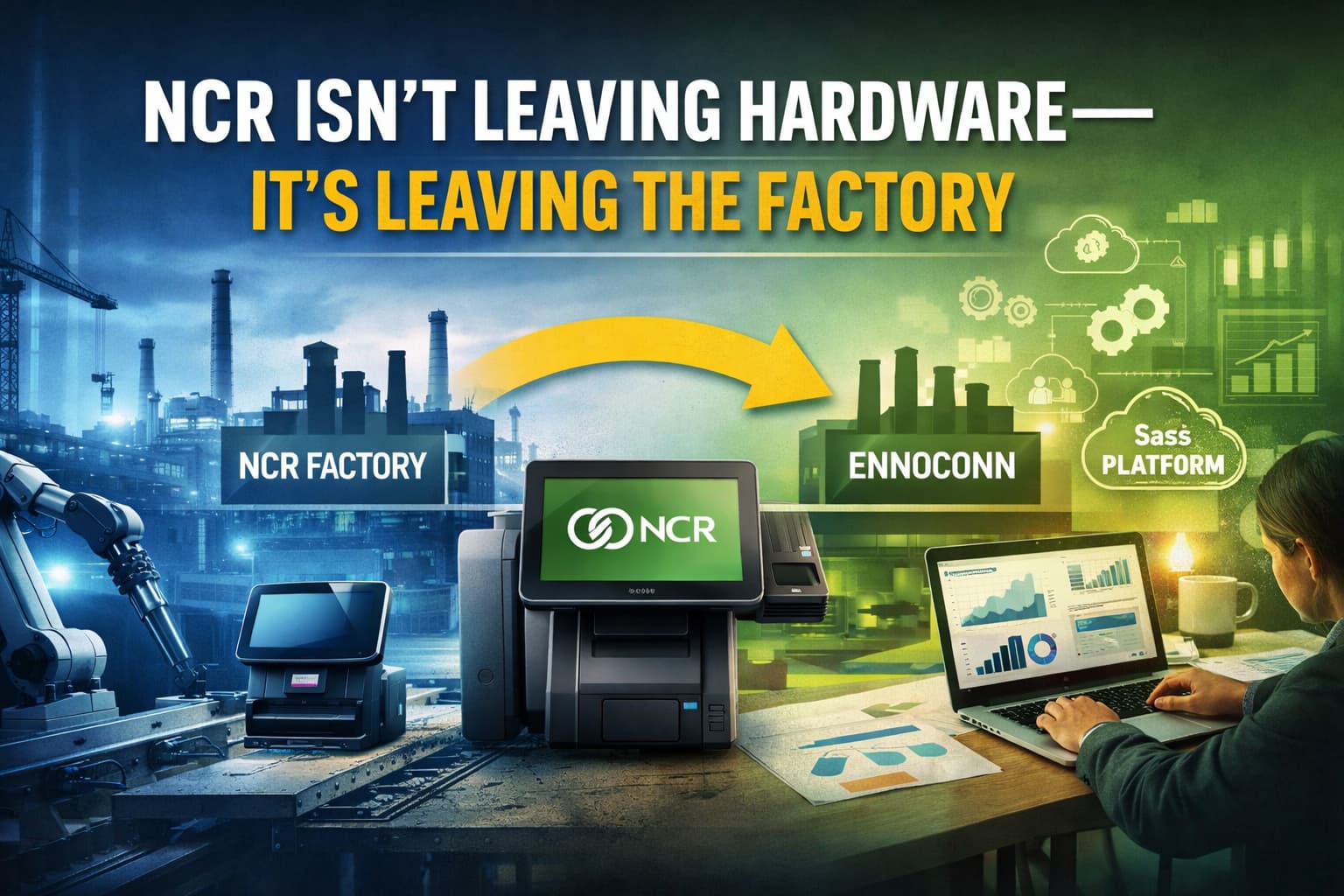


Insight: NCR Isn’t Leaving Hardware — It’s Leaving the Factory
Editor Note -- NCR is heavily embedded in retail and restaurants, and in all phases. This shift by NCR (offloading to Taiwan basically) is significant. As the competitive field narrows, the stratification comes into effect. High margin recurring profit is what stakeholders prefer. Smart change on their part and easier to hire 20 LLMs than 20 programmers?
When NCR Voyix announced it was transitioning its self-checkout and POS hardware operations to Ennoconn, some industry observers rushed to frame the move as “NCR exiting hardware.”
That’s the wrong conclusion.
What NCR is really doing is exiting manufacturing ownership — a very different thing — while doubling down on hardware as a delivery mechanism for software, services, and long-term customer lock-in.
This Is an ODM Strategy, Not a Retreat
Under the new structure, Ennoconn assumes responsibility for:
- Hardware design and engineering
- Manufacturing and supply chain
- Repair, logistics, and fulfillment
NCR keeps:
- Sales and customer relationships
- Product roadmap control
- Branding and market positioning
Customers still buy NCR systems. The badge doesn’t change. What changes is who bends the metal behind the scenes.
This mirrors the ODM-first playbooks used for years in computing, networking, and consumer electronics. NCR isn’t abandoning hardware — it’s industrializing it.
Why This Actually Improves Agility
Large legacy firms rarely excel at rapid hardware iteration. Long approval cycles, internal tooling constraints, and capital-heavy factories slow down enclosure refreshes, component swaps, and regional variants. NCR is a classic case of change taking 2 years.
Ennoconn specializes in high-mix, global manufacturing. That means:
- Faster response to silicon and component changes
- Easier cost-down iterations
- More flexibility across markets and verticals
Ironically, NCR hardware may now evolve faster than it did when NCR owned the factories.
Follow the Margins, Not the Headlines
The more important shift is financial.
By moving hardware manufacturing off its books, NCR:
- Reduces exposure to thin hardware margins
- Improves gross margin optics
- Pushes value into software, services, and lifecycle support
This isn’t about “stopping hardware.” It’s about where profits are recognized — and Wall Street understands that distinction.
The Walmart Signal Matters
Retail giants like Walmart designing their own self-checkout hardware aren’t edge cases anymore — they’re signals.
Large buyers increasingly expect:
- Custom form factors
- Faster refresh cycles
- OEMs to integrate, not invent
NCR’s shift positions it to stay relevant in an environment where owning factories is less valuable than orchestrating ecosystems.
Branding Is Now the Moat
Customers don’t buy NCR because of sheet metal. They buy:
- Global support
- Proven deployments
- Platform continuity
- Integration depth
The NCR logo still matters — even if the unit rolls off an Ennoconn line. Trust, not tooling, is the differentiator.
The Trade-Off NCR Is Accepting
There is a risk.
As more vendors rely on shared ODMs:
- Physical differentiation narrows
- Hardware becomes increasingly commoditized
- Software execution carries more weight than ever
NCR is making a deliberate bet that its platforms, services, and installed base are strong enough to carry that weight.
Bottom Line
- NCR didn’t stop selling hardware.
- It stopped being a factory.
The company is repositioning itself as a platform-led solutions provider where hardware exists to enable software, data, and recurring revenue — not to define the business.
In today’s self-service and POS market, that’s not retreat.
It’s survival by design.

NCR Comparison – Click for full size
What This Comparison Shows
-
NCR is moving toward the Acrelec model, not abandoning hardware but reframing it as a software delivery vehicle
-
Toshiba and Diebold Nixdorf still lean on hardware heritage, appealing to conservative enterprise buyers
-
Samsung remains a hardware enabler rather than a solution owner
-
Walmart signals the future buyer mindset: OEMs must adapt to customer-defined hardware, not the reverse
The industry isn’t choosing between hardware or software — it’s choosing who carries the manufacturing risk and who owns the customer relationship.
Irony
Ennoconn Corporation is a subsidiary of Foxconn Technology Group (Hon Hai Precision Industry Co., Ltd.). Foxconn became the majority shareholder of Ennoconn in 2007 and it operates under the broader Foxconn IPC (Industrial PC) business group. Foxconn (officially Hon Hai Precision Industry Co., Ltd.) is a Taiwanese multinational electronics manufacturer headquartered in New Taipei City, Taiwan
This isn’t NCR abandoning manufacturing—it’s NCR admitting where manufacturing excellence now lives, and where enterprise value no longer does. NCR is effectively saying: “We want to be Apple, not GE Appliances.
More NCR Voyix Ennocon
The Industry Group (aka Kiosk Association) comprises various related technology sites and news feeds from kiosks to digital signage to POS and Smart City. Retail Automation and EV Charging are others. Self-service technology (SST) is a type of technology that allows customers to perform various tasks without the assistance of a human. SSTs can bring many benefits to both customers and businesses, including cost savings, improved efficiency, and better customer experience.
The Kiosk Association comprises companies involved in self-service, digital signage, digital menus, outdoor technology, kiosks, point-of-sale, smart city, healthcare, telehealth, voice order, thin client, EV charging and retail automation.
Gold
- Pyramid Computer – Kiosks
- Olea Kiosks – custom/standard
- Intel Computing
- Vispero JAWS Screen Reader
- KIOSK Information Systems – Kiosks
- 22Miles Digital Wayfinding
- LG Business Kiosks Digital Signage
- Acquire Digital Software
- Sitekiosk Software
- Ingenico Payment
- imageHOLDERS Kiosks
- REDYREF Kiosks
- Crane CPI Payment Systems
- KT Group Kiosks
- Goldfinger Monitors – Digital Signage
- Giada Edge AI Mini-PCs more
- URway Holdings Conversational AI
- NZ Technologies Inc. Touchless Tech
- Innovative Technology – Cash Experts
- Best Kiosk ODM and OEM
- Kiosk Innovations Custom Design Engineering
- Full List
Silver
- MRI — outdoor smart city
- FEC Kiosks – standard kiosks
- UCP Unattended Payments payment terminals
- Datacap Systems, Inc. kiosk payment systems
- NMI — payment gateway
- Storm Interfaceassistive tech
- UST Vision Checkout — Built on AI. Designed for impact.
- Pantheon Creatives Pte Ltd – AI-powered digital humans
- panachedigilife.com – AI & IOT solutions
BRONZE
- Tech For All – accessibility consultants
- Self-Service Networks – gift card software
- Advanced Kiosks government
Associates
- WelcomeWare – virtual receptionist
- Insight Touch touchscreens + kiosks
- BOCA Systems Ticket & Receipt Printers
- Alveni– custom kiosks software
- SysTech Displays, Inc. — Braille, ATM decals
- Xtreme Power — kiosk UPS
- Pyramid Technologies kiosk printers
- TDS TOUCH Touchscreens AIO computers
- Actineon – Computers
- VidaBox Tablets
- PhotoAiD passport photo service
Featured
- Asia Self-Service – APAC
- Europe Self-Service – EU
- SelfService.io Hub site
- For Purchase
Recommended Content
SONY AV Tech Expo coming to Chicago, IL!


Please sign in
If you are a registered user on AVIXA Xchange, please sign in