
More Than the Sum of Their Parts – A Multi-Technology Case Study
Professional AV technology is, at its core, a toolkit. LED walls, projectors, show drones and image processing: each of these technologies is capable of delivering outstanding results on its own and brings advantages and challenges that are specific to each medium.
With any tool, it may come far enough on its own. But you will come even further if you combine certain tools in a way that maximises their impact. Some of the most compelling setups we have built at LANG were not defined by a single technology. They were defined by the conversation between several – by the interaction between products specifically placed to complement each other, so that their combined impact is greater than the sum of their parts.
Instead of just talking about that, why not show how it works in practice? There are plenty of examples even in our recent history that illustrate the same principle: combining different technologies and formats the right way opens up possibilities that none of them could offer alone. Here are three of our favourites.
1. The Projection and Transparency Ring
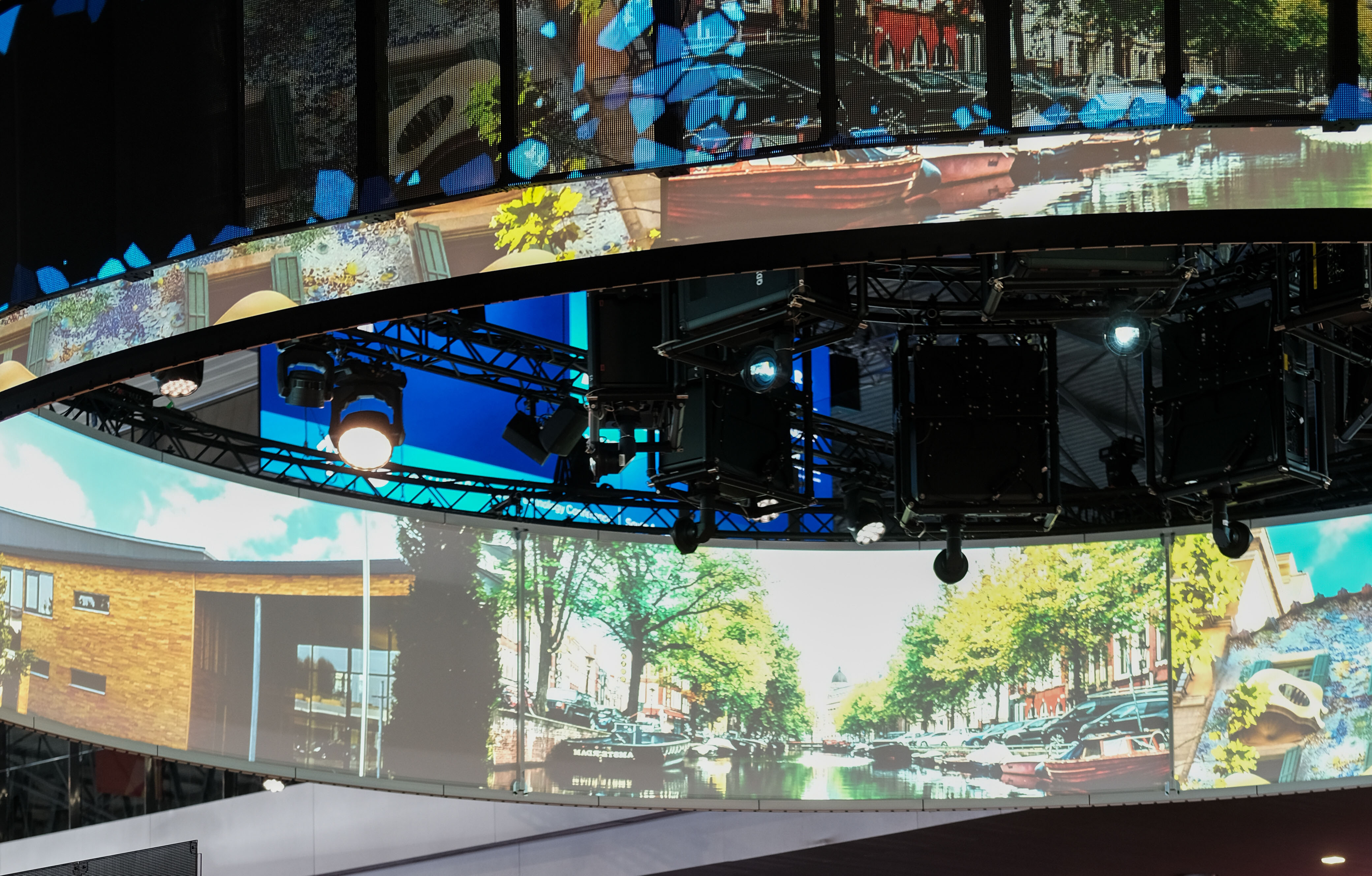
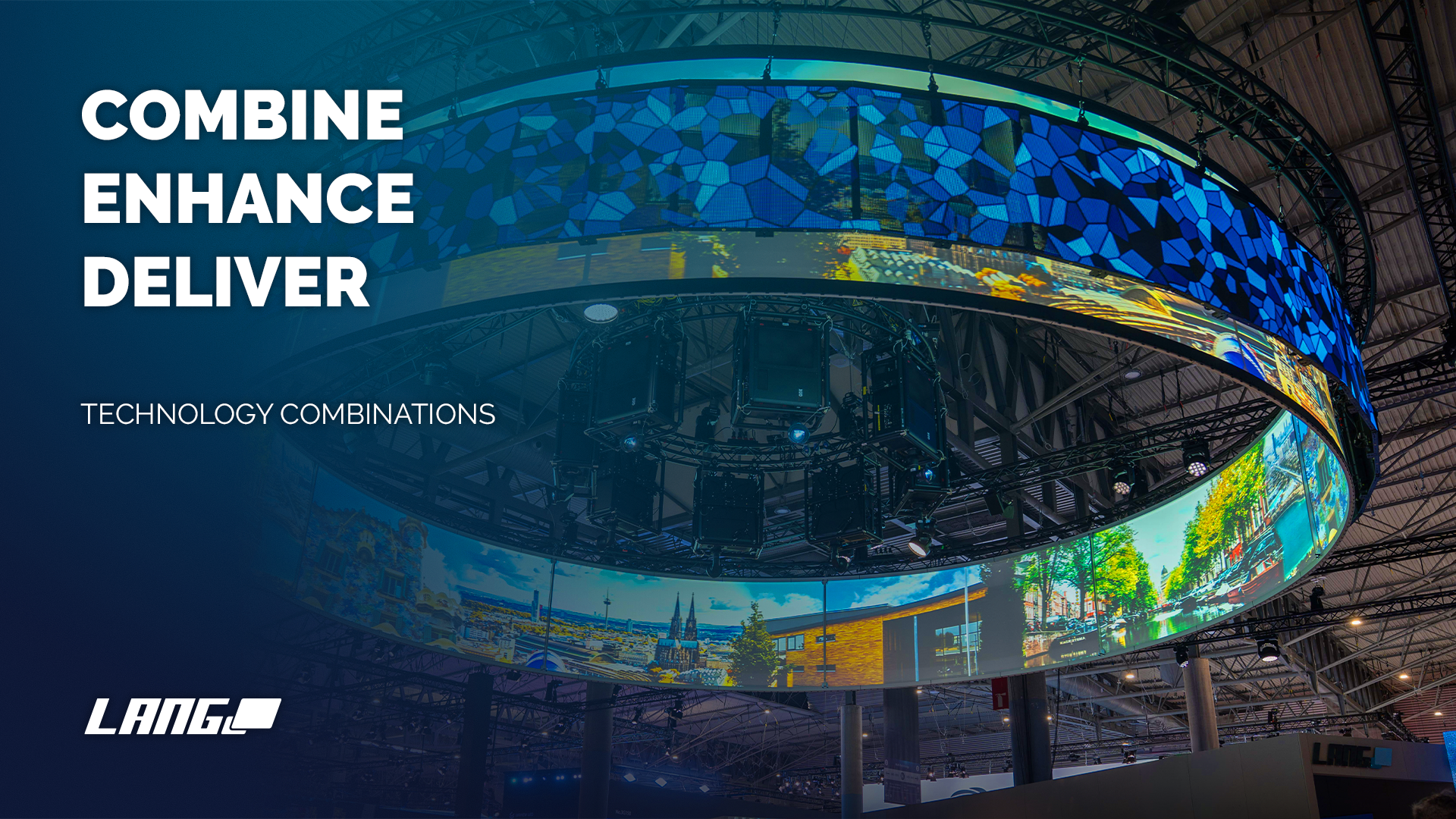
Imagine visiting ISE 2026. You walk around and go with the flow of the visitors – when all of a sudden, you spot a strange contraption suspended from the hall ceiling. You come closer and recognise a ring-like structure showing moving images. But there seem to be two distinct layers at work: whereas the underlying layer appears more static, another layer in front of it carries more movement. The LANG logo runs around the ring, a mosaic appears and wraps images of the LANG sister locations in Gaudí-esque forms and colours.
Step closer, and it becomes clear: an inner canvas circle captures the projections of multiple Barco QDX-N4K45 projectors, surrounded by a continuous ring of our transparent LIAM LED cabinet, which adds a second layer of content that wraps around the first.
What makes this setup work is not the presence of both technologies, but the relationship between them. The transparent LED allows the projection behind it to remain visible, while simultaneously contributing its own content to the overall image. The result is a sense of visual depth that neither technology could produce independently. Calibrating two systems to behave as one requires a precise understanding of how brightness, content and transparency interact. When that understanding is applied correctly, the viewer does not see two technologies. They see one coherent experience.
2. The Waterfall
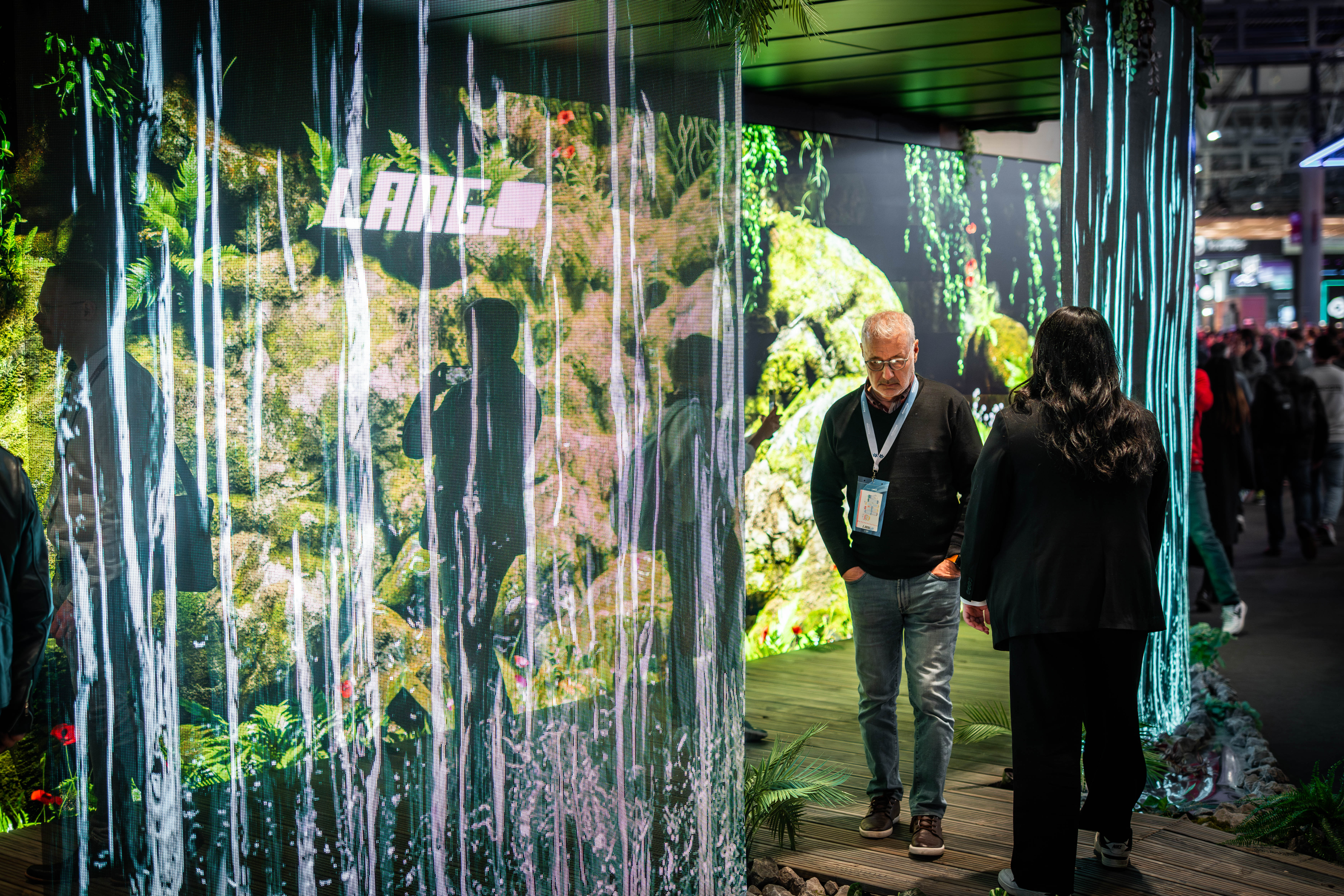
We jump back a year to ISE 2025, where the entrance to the LANG booth went natural: instead of encountering glossy high-tech aesthetics, visitors entered through a transparent waterfall that led them into a mossy forest landscape.
There was no real forest on location, of course. The waterfall was a crisp animation on transparent MUXWAVE elements installed in an arch formation, while the backdrop behind it was a lively image on a LEDgend 1.2 LED wall. The transparent layer allowed both to coexist in the same visual space, creating the impression of a living environment rather than a display. But the decisive element was the physical dimension: visitors could step through the transparent curtain and find themselves surrounded by the landscape behind it.
This is where the combination of transparent and traditional LED goes beyond aesthetics. The transparent display becomes a threshold – a point of transition between the outside world and the environment being created. That transition is only possible because of what stands behind it. And the experience itself can only work with both elements combined, because the immersion they create is something neither could achieve alone.
3. The ISE 2026 Drone Shows
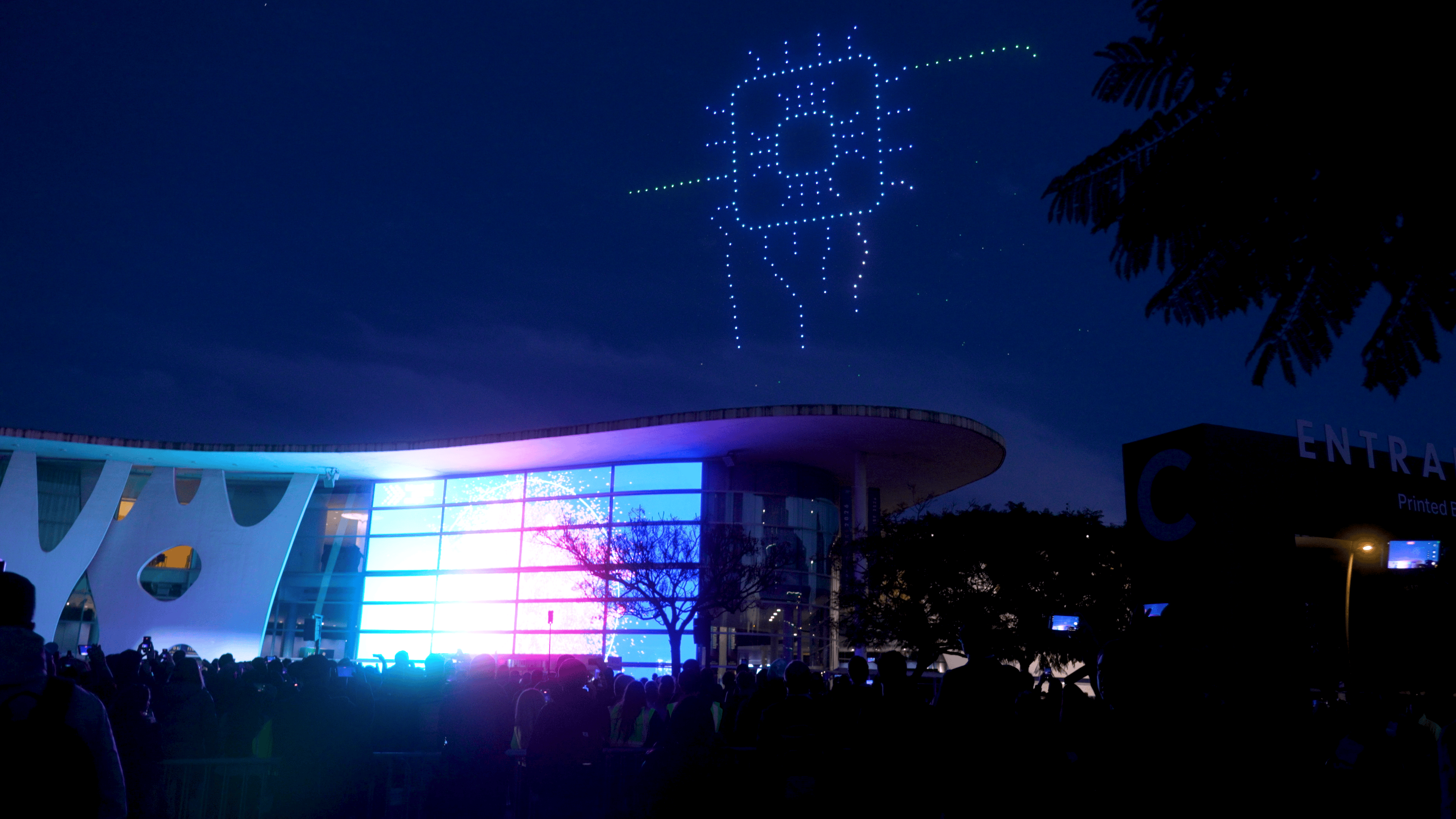
The third case is a different proposition entirely, if only because of the scale involved. During ISE 2026, show drones took to the skies above the Fira Barcelona each evening. Audiences gathered at the southern entrance, turning their eyes to the night sky to take in the spectacle.
The drones were not alone, though. Alongside elements such as live music, the most memorable factor beside the swarm itself was the southern entrance of the Fira: a large MUXWAVE installation on the glass façade played content that directly complemented the drone show above.
What did that look like in practice? An animated rocket appeared on the MUXWAVE façade and flew upwards, out of frame. Moments later, the drones formed a rocket shape in the sky and traced their own path through a starry night. Abstract network visuals stemming from a microchip pictogram moved across the facade and out of view – only to reappear as sprawling formations in the sky above. Whatever the LED wall set in motion, hundreds of drones responded accordingly, extending what began on a grounded medium into the open night sky.
This kind of synchronisation points towards something broader. An LED wall can carry content during transitions between drone formations, sustaining the visual narrative while the swarm repositions. Or both can work in parallel, the display and the aerial spectacle forming complementary parts of a single story – what begins on the ground continues in the sky above it. The result is not two separate shows running at once. It is one.
The Thinking Behind the Setup
These three examples are a small selection of what multi-technology setups can look like in practice, and the possibilities extend well beyond them. At a concert or festival, LED walls and projection systems can divide a stage into distinct visual zones while telling the same story. At a city event, a projection mapping on a landmark building and a drone swarm above it can share the same visual language, each occupying a different layer of the same space. Wherever an event unfolds across multiple surfaces, formats or dimensions, the question of how they speak to each other becomes worth asking.
What these combinations share is a common starting point: not which technologies are available, but what a space or a moment should make people feel. The setups that tend to stay with audiences are rarely the ones built around a single impressive element. They are the ones where every element knows what the others are doing.
At LANG, we have spent years working with combinations like these – understanding not just what each technology can do, but how they behave when placed in relation to one another. That accumulated experience is what makes the difference between a setup that works on paper and one that works in the room.
Founded in 1978, LANG AG is a globally leading wholesaler of visual presentation technology, offering solutions for both rental and sales. Through innovation and technological pioneering, the company has earned an excellent reputation in the AV industry. LANG identifies promising technologies at an early stage and successfully supports them through to market maturity.
With independent subsidiaries in Switzerland, the United Kingdom, Spain, the United Arab Emirates, and the Netherlands, LANG serves the professional AV market across Europe and internationally. The company operates discreetly in the background, ensuring the highest level of confidentiality toward end customers.
A comprehensive portfolio of cutting-edge AV technology, around 220 dedicated employees, and long-term partnerships underscore LANG AG’s commitment to innovation – today and in the future.
Recommended Content
SONY AV Tech Expo coming to Chicago, IL!
The Translation Problem Nobody Budgets For
Turtle AV: Interoperability Is Kind of Our Thing

Please sign in
If you are a registered user on AVIXA Xchange, please sign in