Loudspeaker Invention Impact
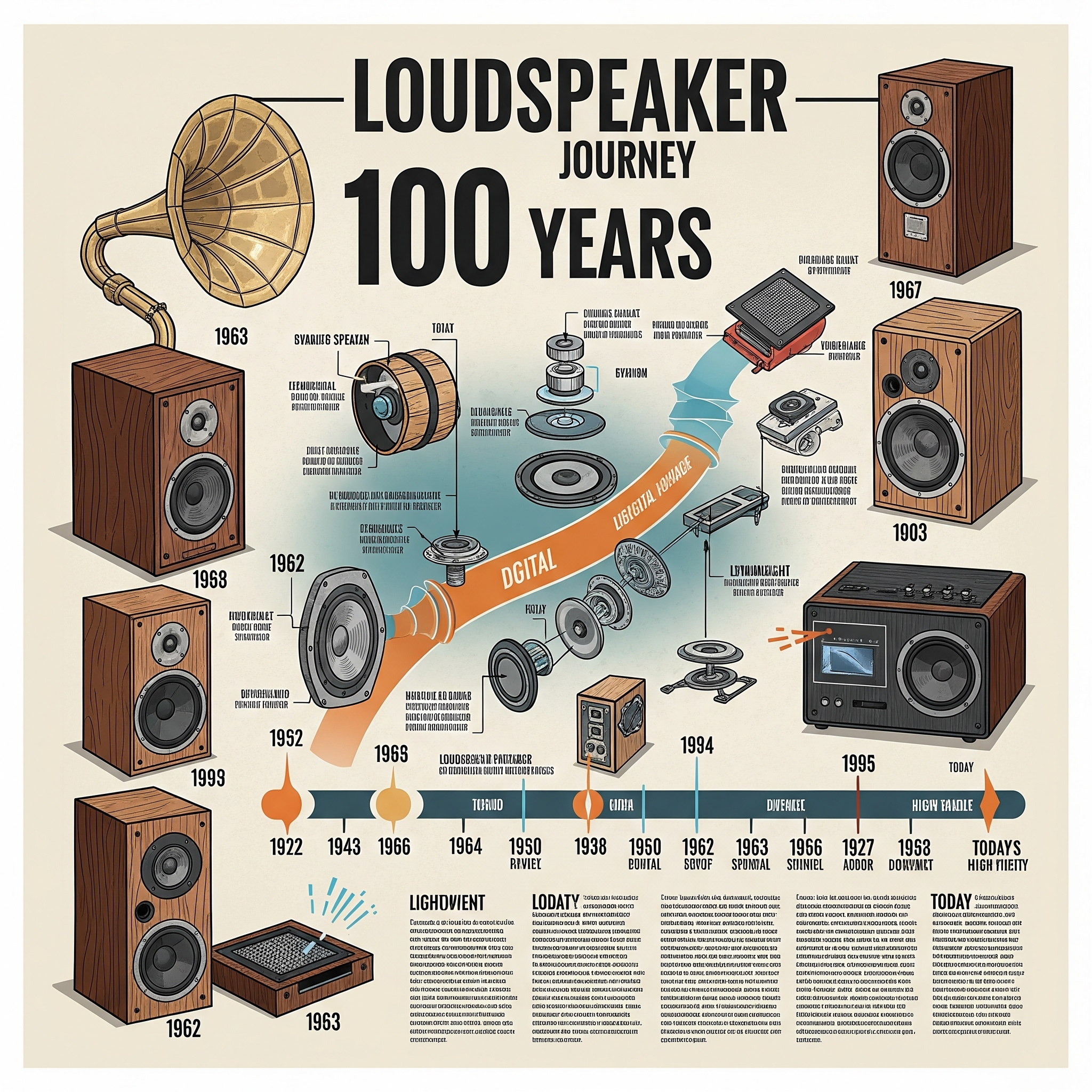




Journey of Loudspeaker Invention
🔹 1. Pre-Loudspeaker Era (Before 1870s)
-
Sound Amplification was limited to mechanical methods:
-
Megaphones, gramophones, and ear trumpets were common.
-
Acoustic horns were used in early phonographs.
-
🔹 2. Birth of the Loudspeaker Concept
1877 – Thomas Edison & the Phonograph
-
Edison's phonograph used a diaphragm and stylus to reproduce sound mechanically.
-
No electrical amplification – sound was very faint.
1898 – Oliver Lodge
-
Developed early theories of electromagnetic sound reproduction.
🔹 3. First Practical Loudspeakers (Early 20th Century)
1921 – Rice and Kellogg (General Electric)
-
Invented the moving-coil dynamic loudspeaker.
-
This is the core technology still used today.
-
First to use an electromagnetic coil and cone diaphragm to produce amplified sound.
1925 – Patent for Modern Loudspeaker
-
Chester W. Rice & Edward W. Kellogg patented the modern electrodynamic loudspeaker.
🔹 4. Commercial Adoption and Breakthroughs
1926–1930s – Cinema Sound Revolution
-
Theaters adopted electroacoustic sound systems.
-
Altec Lansing and Western Electric became major players in loudspeaker tech for cinema.
1940s – Home Radio and Hi-Fi
-
Loudspeakers became common in radios and home music systems.
-
Introduction of woofer, tweeter, and crossovers for full-range audio reproduction.
How It Changed the Electroacoustic Engineering World
1. Birth of Electroacoustics as a Field
-
Loudspeakers necessitated the study of sound wave behavior, frequency response, and acoustics.
-
Created the domain of electroacoustic engineering, a bridge between electrical and acoustical sciences.
2. Audio System Design
-
Introduced the need for:
-
Amplifiers
-
Equalization and filtering
-
Impedance matching
-
Signal processing
-
3. Architectural Acoustics
-
Loudspeaker integration into auditoriums, stadiums, houses of worship, and public spaces reshaped building design.
-
Engineers now model acoustic reflections, absorption, and coverage using simulation tools.
4. Music and Broadcast Industry
-
Enabled:
-
Live sound reinforcement
-
Studio monitoring
-
Personal listening (headphones/speakers)
-
-
Powered the evolution of genres like Rock, EDM, Jazz, where loudness and clarity were key.
5. Communication and Public Address
-
Revolutionized public safety, transportation hubs, schools, and corporate environments.
-
Gave rise to PA systems, paging, and intercom networks.
6. Multimedia & Immersive Experiences
-
Led to innovations in:
-
Surround sound (5.1, 7.1)
-
VR/AR audio
-
Cinema Dolby Atmos
-
Ambisonics and spatial audio
-
Engineering Advances Sparked by Loudspeaker Tech
| Area | Advances |
|---|---|
| Materials | Polymer cones, Kevlar, carbon fiber diaphragms |
| Transducer Design | Ribbon, planar magnetic, electrostatic speakers |
| Signal Processing | DSP, FIR filters, beamforming |
| Simulation | Finite Element Analysis (FEA), EASE, COMSOL |
| Measurement | Audio analyzers, anechoic chambers, real-time spectrum analyzers |
Final Thought
The invention of the loudspeaker did not just amplify sound — it amplified human potential to communicate, entertain, and inspire.
It bridged the gap between electric signals and human perception, establishing the backbone of modern audio engineering and transforming the way we design spaces, deliver information, and experience sound.
🎉🎉🎉 Three Cheers to Engineering & Innovators! 🎉🎉🎉
- Started Journey as Live sound System Engineer For small AV company in 2007.
- Then join one Dubbing studio and Done Some Movies Dubbing and Music Mixing Till 2008.
- After 2008 Started working as Freelancer for Audio Jobs as Recording, Dubbing and Mixing engineer for regional language Music and Movies.
- From 2010 corporate journey Started with Manufacturer of AV Acessories in India.
- Till 2012 worked as Technical Marketing team Head for the Product developments and Possible solutions for Pro Audio and Video Industry Acessories.
- After 2013 Started working for Pro Audio Industry Products as BDM for West India.
- From 2016 Working as Individual Audio, Video and Acoustics Design Consultant for freelance projects across India and in global market.
-
Xchange Advocates are recognized AV/IT industry thought leaders and influencers. We invite you to connect with them and follow their activity across the community as they offer valuable insights and expertise while advocating for and building awareness of the AV industry.