Workforce Development, Sustainability in AV, Learning Solutions, Live Events / Performance Entertainment, The Podcast Channel, and 4 more
Ingress Protection (IP) in AV
The Ingress Protection (IP) rating, defined by IEC 60529, indicates how well an enclosure protects equipment.
Ingress Protection (IP) rating is quite important in the AV industry, but its importance depends heavily on where and how the AV equipment is installed.
What is IP compliance?
The Ingress Protection (IP) rating, defined by IEC 60529, indicates how well an enclosure protects equipment against:
-
First digit: Solid objects/dust
-
Second digit: Water/moisture
For example:
| Rating | Protection | Typical AV application |
|---|---|---|
| IP20 | No water protection; basic finger/object protection | Indoor rack rooms, offices |
| IP30 | Limited solid-object protection | Indoor electronics |
| IP54 | Dust protected + water splash protection | Semi-outdoor AV |
| IP55 | Dust protected + water jets | Outdoor equipment |
| IP65 | Dust-tight + water jets | Outdoor displays, speakers, enclosures |
| IP66 | Dust-tight + powerful water jets | Exposed outdoor AV |
| IP67 | Dust-tight + temporary immersion | Special outdoor/wet applications |
| IP68 | Dust-tight + continuous immersion conditions defined by manufacturer | Specialized underwater/wet installations |
Why is this important in AV?
1. Outdoor AV
This is probably the most obvious application.
Examples:
-
Outdoor LED walls
-
Digital signage
-
Outdoor displays
-
Outdoor speakers
-
PTZ cameras
-
AV-over-IP equipment in outdoor enclosures
-
Stadium AV
-
Theme parks
-
Outdoor hospitality systems
For example, specifying an IP65-rated loudspeaker instead of an indoor IP20 speaker can make a major difference in reliability.
2. Dust and construction environments
IP protection isn't only about rain.
AV equipment installed in:
-
Industrial facilities
-
Warehouses
-
Manufacturing plants
-
Mining environments
-
Transportation facilities
-
Construction sites
can be exposed to significant dust and particulate matter.
A normal indoor AV enclosure may allow dust to enter through ventilation openings, potentially affecting:
Fans → filters → power supplies → electronics → connectors → long-term reliability
This is particularly important for LED displays and outdoor digital signage, where dust accumulation can also affect thermal performance.
3. Humidity and moisture
Even when equipment isn't directly exposed to rain, environments such as:
-
Swimming pools
-
Spas
-
Marine environments
-
Coastal locations
-
Food-processing areas
-
Outdoor hospitality
can have high humidity or water exposure.
The AV professional should therefore consider IP rating together with corrosion protection, rather than treating IP rating as the complete environmental specification.
4. Safety and project compliance
This is where IP compliance becomes particularly important for professional AV design.
If a project specification says: "All equipment installed outdoors shall be minimum IP65."
Then installing an IP20 product inside an improvised box isn't automatically equivalent.
You need to consider:
-
Enclosure rating
-
Cable glands
-
Connectors
-
Cable entries
-
Ventilation
-
Door seals
-
Mounting orientation
-
Drainage
-
Condensation
-
UV exposure
-
Temperature
-
Corrosion
The complete installed assembly must maintain the required environmental protection.
5. IP rating should be part of the AV design specification
For professional AV projects, I would recommend adding an Environmental Requirements section to the equipment specification.
For example:
Outdoor AV equipment: Minimum IP65 enclosure protection, UV-resistant construction, suitable operating temperature range, corrosion-resistant hardware, and weatherproof cable entry system.
For indoor equipment:
Indoor AV equipment: Minimum IP20 unless otherwise specified.
For particularly harsh environments, IP rating alone isn't enough. You may need additional requirements such as NEMA enclosure rating, IK impact rating, corrosion resistance, operating temperature and humidity limits. (This can be change according to local infrastructure rules and regulations standard of the region)
One important point for AV Professionals
IP rating is not the same as weatherproofing.
For example, an IP65 device may be:
-
Dust-tight
-
Protected against water jets
but that doesn't automatically mean it is suitable for:
-
Direct sunlight
-
Extreme heat
-
Salt air
-
Condensation
-
Freezing temperatures
-
UV exposure
-
Physical impact
So, an AV specification should ideally consider: IP + IK + UV + temperature + humidity + corrosion + installation environment.
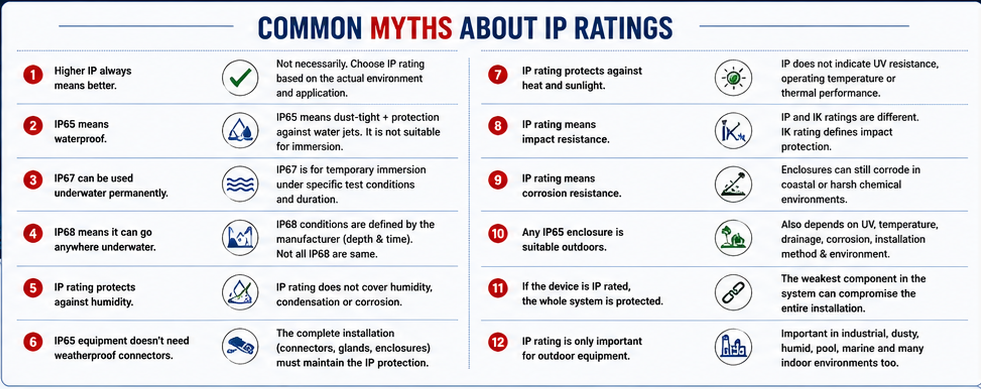
There are several common myths about IP (Ingress Protection) ratings across the general industry, and some of them are particularly dangerous in AV, lighting, automation, and outdoor installations.
| Myth | Reality |
|---|---|
| 1. “Higher IP always means better.” | ❌ Not necessarily. IP68 isn't automatically better than IP65 for every application. You should select the rating based on the actual environment. |
| 2. “IP65 means waterproof.” | ❌ IP65 means dust-tight + protection against water jets. It does not mean the equipment can be submerged. |
| 3. “IP67 can be used underwater permanently.” | ❌ IP67 generally covers temporary immersion under specified test conditions. Continuous immersion is a different requirement. |
| 4. “IP68 means it can go anywhere underwater.” | ❌ IP68 conditions are manufacturer-defined. Depth and duration must be specified by the manufacturer. |
| 5. “IP rating protects against humidity.” | ❌ IP testing primarily addresses ingress of solids and water under defined conditions. High humidity, condensation and corrosion require additional consideration. |
| 6. “IP65 equipment doesn't need weatherproof connectors.” | ❌ The complete installation must maintain the required protection. An IP65 enclosure with an unsealed cable entry can compromise the installation. |
| 7. “IP rating protects against heat and sunlight.” | ❌ IP doesn't tell you about UV resistance, operating temperature, thermal management or solar radiation. |
| 8. “IP rating means impact resistance.” | ❌ IP and IK ratings are different. IK addresses mechanical impact protection. |
| 9. “IP rating means corrosion resistance.” | ❌ An IP65 enclosure can still corrode in a coastal/salt-air environment. Material and corrosion protection need separate specifications. |
| 10. “Any IP65 enclosure is suitable outdoors.” | ❌ Outdoor suitability also depends on UV, temperature, condensation, drainage, corrosion, cable glands and installation method. |
| 11. “If the device is IP rated, the whole system is protected.” | ❌ The weakest component can compromise the system—connectors, glands, cables, junction boxes and mounting interfaces matter. |
| 12. “IP rating is only important for outdoor equipment.” | ❌ IP can be important in industrial, dusty, humid, food-processing, pool, marine and other indoor environments too. |
In short: IP compliance is not just a manufacturer's marketing specification. For an AV professional, it is an environmental design requirement that can directly affect equipment reliability, warranty, safety, maintenance and system lifetime.

Solution Design Engineer and Consultant, AV Industry
- Started Journey as Live sound System Engineer For small AV company in 2007.
- Then join one Dubbing studio and Done Some Movies Dubbing and Music Mixing Till 2008.
- After 2008 Started working as Freelancer for Audio Jobs as Recording, Dubbing and Mixing engineer for regional language Music and Movies.
- From 2010 corporate journey Started with Manufacturer of AV Acessories in India.
- Till 2012 worked as Technical Marketing team Head for the Product developments and Possible solutions for Pro Audio and Video Industry Acessories.
- After 2013 Started working for Pro Audio Industry Products as BDM for West India.
- From 2016 Working as Individual Audio, Video and Acoustics Design Consultant for freelance projects across India and in global market.
-
Xchange Advocates are recognized AV/IT industry thought leaders and influencers. We invite you to connect with them and follow their activity across the community as they offer valuable insights and expertise while advocating for and building awareness of the AV industry.
Recommended Content
Immersive Experiences, Workforce Development, Sustainability in AV, AI in AV, Conferencing & Collaboration, Learning Solutions, Business of AV, Xchange Community Chat, Celebration of AV Excellence, Sustainable AV , AV/IT Buyers, AV Education for The Next Generation, Xchange Advocate Room
How AI camera tracking gets confused by reflections
Immersive Experiences, Sustainability in AV, Broadcast AV, Live Events / Performance Entertainment, Business of AV, The Podcast Channel, AVIXA Consultants Council, Xchange Community Chat, Celebration of AV Excellence, Sustainable AV , AV Education for The Next Generation, Xchange Advocate Room
Calibration in audio isn’t just “making it sound good”