
If an Outdoor Display Never Blacks Out, Ask One Question First: “At What Brightness?”

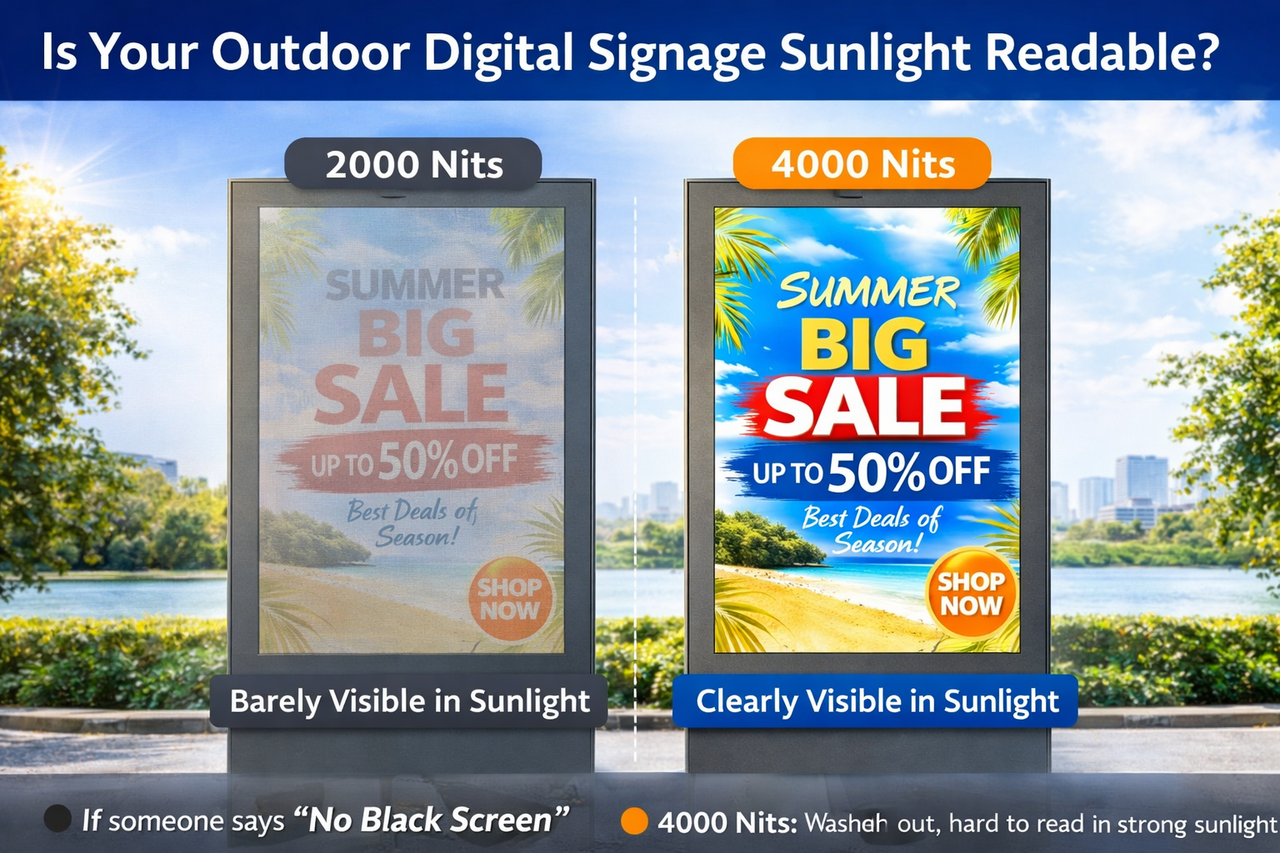
In the outdoor digital signage market, there is one topic that is often misunderstood, intentionally avoided, or hidden behind marketing language:
True outdoor visibility is not defined by whether a screen can turn on outdoors. It is defined by whether the content is still clearly visible under direct sunlight.
And for that, brightness matters.
Most people outside the industry assume that any “outdoor display” should naturally be visible outside. But in reality, many products on the market today are only 1500–2000 nits.
On paper, those numbers may sound impressive. In practice, under strong sunlight, they are often not enough.
A 1500–2000 nit screen may still look acceptable in:
Cloudy weather
Under a roof or deep canopy
Shaded storefronts
Early morning or evening
But once the screen faces direct sunlight at midday, especially in summer, the image becomes washed out, grey, and sometimes nearly unreadable.
The advertisement is technically playing. But the audience cannot see it.
And if people cannot see it, the advertising value no longer exists.
Brightness Is the First Visual Standard of Outdoor Advertising
Outdoor advertising has only one chance to attract attention.
People are walking, driving, waiting at traffic lights, standing at bus stops, passing by storefronts. The screen has only a few seconds to create impact.
The first thing people notice is not the design. It is not the content. It is not the software.
It is whether the screen is bright enough to be seen.
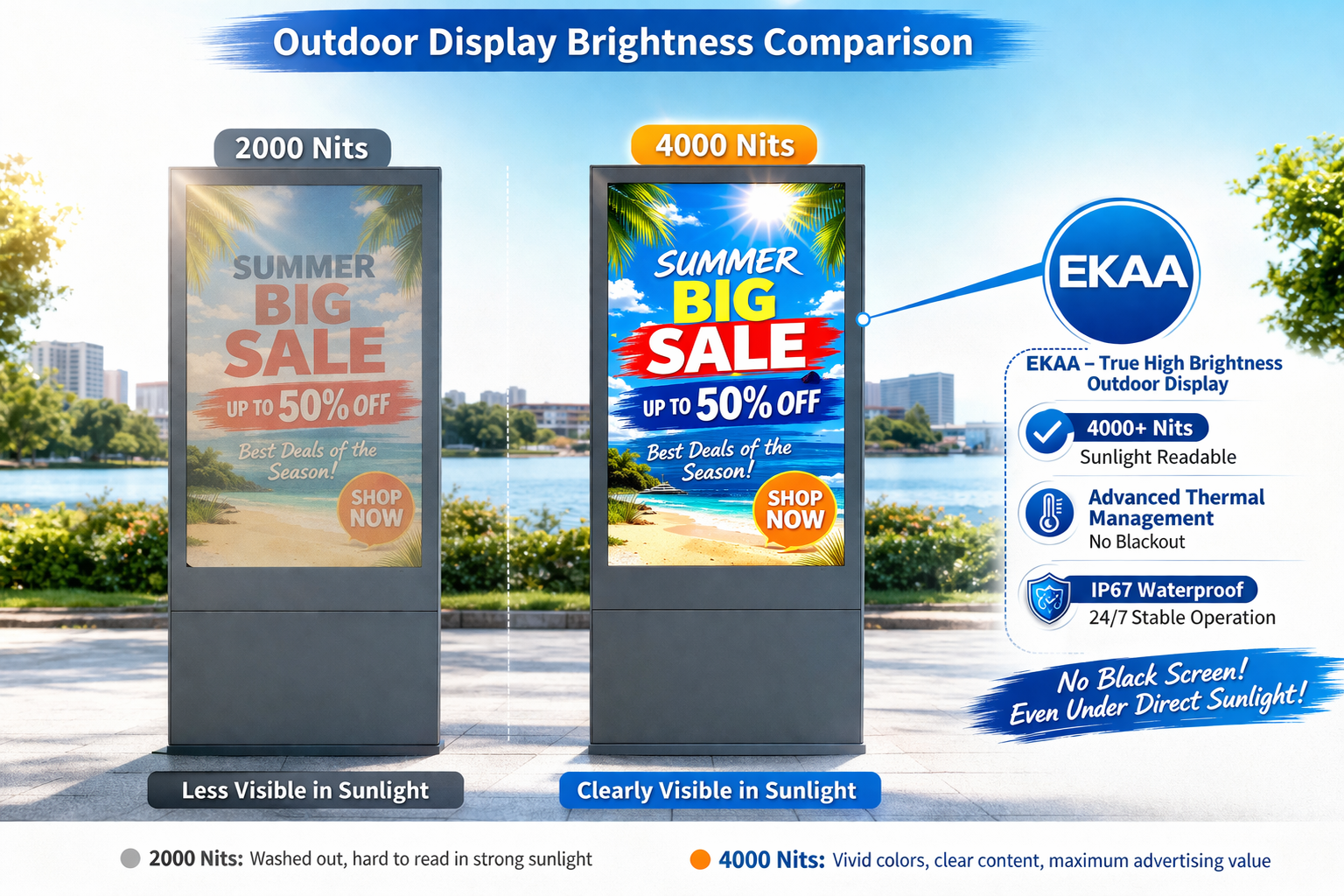
For a truly outdoor-facing display, especially one installed in direct sunlight, the real benchmark should be:
4000+ nits.
Below that level, visibility quickly drops as sunlight increases
Many suppliers know this. But they also know another reality:
Higher brightness creates more heat. More heat creates more engineering difficulty.
So instead of solving the thermal problem, many companies simply reduce the brightness. They lower the screen to 1500–2000 nits, then promote it as “stable”, “no black screen”, or “low temperature operation”.
Technically, they are not wrong. A lower-brightness screen is easier to cool. It is easier to keep running. It is easier to avoid overheating.
But there is an important question:
If the screen is no longer visible in sunlight, what exactly are we protecting?
The Real Challenge Is Not Achieving 4000 Nits.
The Real Challenge Is Maintaining 4000 Nits for Years.
Almost any factory can make a screen brighter for a short period.
The difficult part is making that brightness stable, reliable, and durable over many years of outdoor operation.
Because once brightness increases, the display system faces a chain reaction:
Higher panel temperature
Faster LCD aging
Increased risk of black screen and thermal shutdown
Uneven brightness over time
More stress on power supply and internal components
Greater chance of failure during summer afternoons
This is why outdoor display engineering is fundamentally a thermal management problem.
The companies that truly understand outdoor digital signage do not solve black screen issues by reducing brightness. They solve it through:
Better heat dissipation structure
Stronger airflow design or advanced fanless thermal design
More efficient internal layout
Higher quality LCD panels and power systems
Long-term field testing in real outdoor environments
Brightness is easy to advertise. Durability is much harder to prove
The real proof of an outdoor display is not whether it can run for one hour in a showroom. It is whether it can still deliver 4000+ nits after years under real sun, rain, heat, and summer afternoons.
When Someone Says: “Our Screen Never Goes Black”
Ask one more question:
“At what brightness?”
By EKAA TECHNOLOGY
enquiry@ekaa.net
#OutdoorDigitalSignage #OutdoorLCD #4000Nits #HighBrightnessDisplay #SunlightReadable #OutdoorAdvertising #DigitalSignage #CommercialDisplay #DOOH #OutdoorScreen #IP67 #ThermalManagement #HeatDissipation #FanlessDesign #OutdoorDisplay #DisplayTechnology #RetailDisplay #WindowDisplay #SmartCity #DigitalAdvertising
大家好,AVIXA 社群,
在EKAA,我們專注於工程驅動的商用液晶解決方案,特別是針對嚴苛環境的高亮度與戶外數位看板。多年來,我們與美國、歐洲、日本及其他全球市場的整合商和經銷商密切合作,致力於提供穩定且長期的顯示系統,而非短期產品。
我們堅信,在當今的影音產業中,可靠性、熱管理與系統整合的彈性與解析度與亮度同等重要。永續設計與耐用性正成為大規模部署的關鍵因素。
我們在這裡交流見解,向其他影音專業人士學習,並探索潛在的合作機會。
期待與大家交流。

Please sign in or register for FREE
If you are a registered user on AVIXA Xchange, please sign in