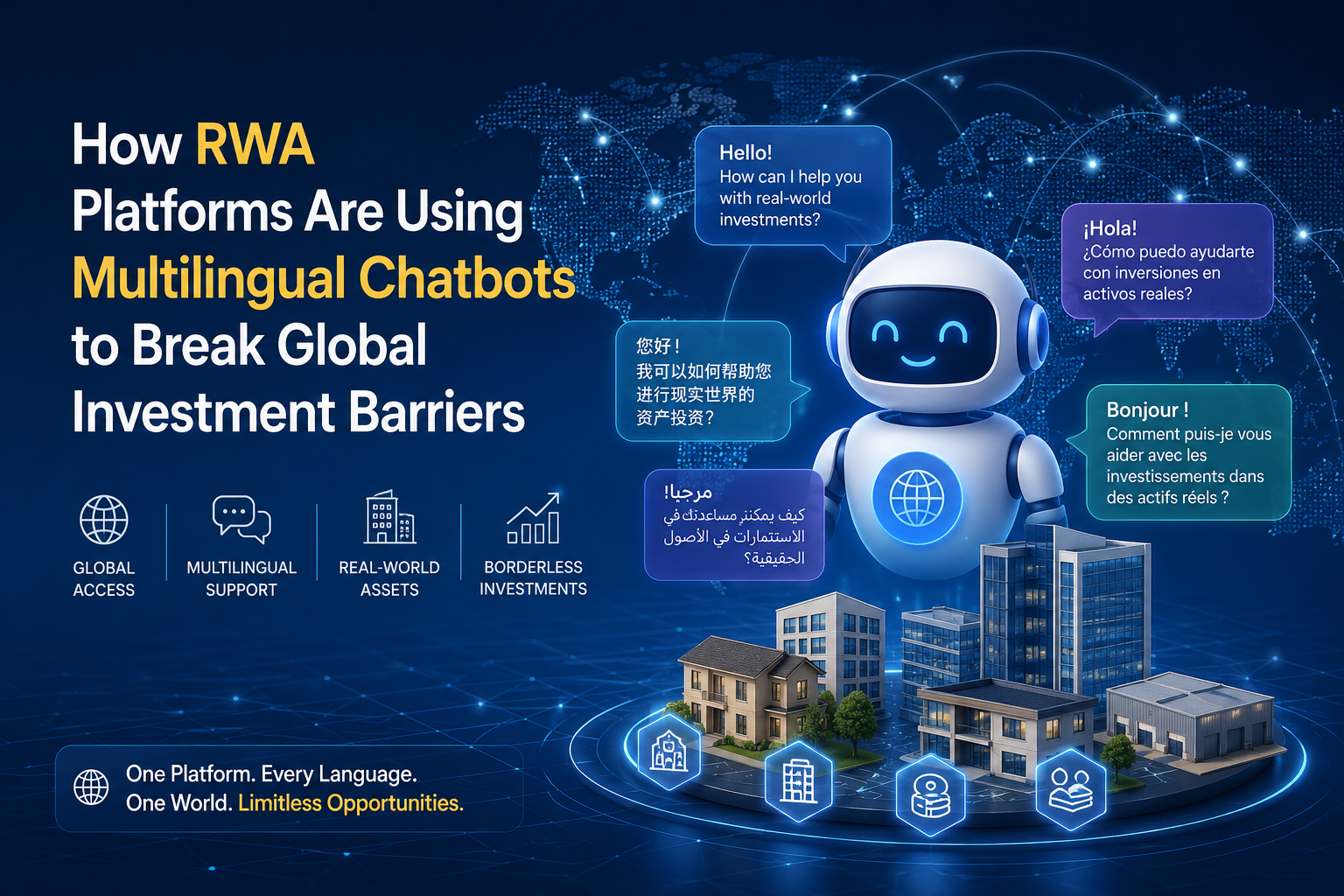
How RWA Platforms Are Using Multilingual Chatbots to Break Global Investment Barriers
Real-world asset tokenization is one of the most significant structural shifts in global finance in decades. By converting physical assets — real estate, commodities, private equity, infrastructure, fine art into blockchain-based digital tokens, RWA platforms are making investment opportunities accessible to a global pool of capital that was previously locked out by geography, minimum ticket sizes, and institutional gatekeeping.
But there is a problem that the industry does not talk about enough: language.
The global investor base that RWA platforms are trying to reach does not speak a single language. It speaks Mandarin, Arabic, Portuguese, Japanese, Korean, Hindi, French, German, Turkish, and dozens of others. An investor in Jakarta evaluating a tokenized real estate asset in Dubai should not need English fluency to understand the offering, assess the risk, or complete the onboarding workflow. Yet most RWA platforms are still built as if their users are all native English speakers comfortable navigating dense legal and financial documentation without assistance.
This is the gap that multilingual AI chatbots are closing — and the platforms that have deployed them are seeing measurable results in investor acquisition, onboarding completion rates, and cross-border capital flows. This article examines how they do it, what the technology looks like under the hood, and what it means for the future of borderless investment.
The Language Gap in RWA Investment Platforms
RWA tokenization platforms deal with three categories of complexity that make language support not just a nice-to-have but a genuine conversion-rate variable.
The first is regulatory and legal complexity. Every tokenized asset offering involves legal documentation — private placement memoranda, subscription agreements, risk disclosures, KYC/AML requirements. This documentation is hard enough to navigate in your native language. Translating it mechanically into another language via Google Translate creates liability exposure and erodes investor trust. Investors who cannot understand what they are signing do not sign.
The second is financial instrument complexity. Concepts like fractional ownership, smart contract-based dividend distribution, secondary market liquidity windows, and on-chain settlement are not universally understood even in financial circles. Explaining these concepts in real time, in the investor's native language, with contextual examples relevant to their market — that is exactly what a well-built multilingual conversational AI does.
The third is cultural context. An investor in Saudi Arabia asking about a tokenized real estate fund has different baseline assumptions, regulatory context, and risk framing than an investor in Singapore asking the same question. Language is not just vocabulary — it is cultural encoding. A chatbot that treats Arabic as an English sentence with different words has not solved the problem.
What Multilingual Chatbot Architecture Looks Like for RWA Platforms
When you work with a serious AI chatbot development company to build conversational AI for an RWA platform, the technical architecture is more complex than a standard customer support bot. Here is what the stack typically involves.
Natural Language Understanding Across Multiple Languages
The foundation is a multilingual large language model — typically built on or fine-tuned from models like GPT-4, Claude, or open-source alternatives like LLaMA 3 with multilingual training data. The model needs to handle not just translation but intent recognition in each supported language. A user in Japan asking "このトークン化不動産ファンドの最低投資額はいくらですか" ("What is the minimum investment in this tokenized real estate fund?") should trigger the same intent handler as an English user asking the same question — without routing through English as an intermediate step.
This is a zero-shot cross-lingual transfer capability — the model applies knowledge learned in one language to queries in another. State-of-the-art multilingual transformers like XLM-RoBERTa and mBERT have made this significantly more reliable in recent years, reducing the translation pipeline dependency that made early multilingual chatbots clunky and inaccurate.
RWA-Specific Knowledge Base Integration
A generic language model does not know the details of your specific tokenized offerings. RWA chatbots require retrieval-augmented generation (RAG) — a technique that grounds the model's responses in your actual platform data: offering documents, asset performance data, fee structures, compliance requirements, and secondary market mechanics. The model retrieves relevant context from your knowledge base before generating a response, ensuring answers are accurate and offering-specific rather than generic financial content.
For multilingual RWA platforms, the knowledge base itself must be multilingual — or the RAG system must handle real-time translation of retrieved context before synthesis. Both approaches have trade-offs in latency and accuracy that a skilled AI chatbot development company will evaluate against your specific use case.
Compliance-Aware Response Filtering
RWA platforms operate under securities regulations that vary by jurisdiction. A chatbot that tells an unaccredited investor in the United States that they can invest in a Reg D offering is a legal problem. Compliance-aware response filtering — typically implemented as a post-generation guardrail layer — ensures the chatbot's responses stay within the bounds of what is legally permissible to say to a given user based on their jurisdiction, accreditation status, and the regulatory classification of the asset being discussed.
This layer also handles language-specific regulatory disclosure requirements — for example, MiCA-compliant disclosures in EU languages, or FSRA-required language in UAE Arabic-language interactions.
How Leading RWA Platforms Are Deploying Multilingual Chatbots
The most sophisticated RWA tokenization platforms are not treating multilingual chatbots as customer support tools. They are deploying them as investor onboarding infrastructure — the primary interface through which new investors understand, qualify for, and commit to tokenized asset offerings.
The workflow typically looks like this. A prospective investor arrives at the platform from a regional marketing campaign — perhaps a LinkedIn ad served in Korean, or a referral from a local wealth management network in Brazil. They land on a platform interface in their local language. A conversational AI immediately engages them in Korean or Portuguese, asking qualifying questions about their investor profile, explaining the available offerings in plain-language terms appropriate to their financial sophistication level, walking them through the KYC documentation requirements, and answering questions about the specific asset class.
The investor never hits a language wall. They never encounter dense English legalese they cannot parse. They never wait 48 hours for a human compliance officer to respond to a question that a well-built AI could have answered in three seconds.
Platforms that have implemented this model report significantly higher onboarding completion rates from non-English-speaking investor segments — which makes intuitive sense. Every friction point you remove from the onboarding journey improves conversion. Language is one of the highest-friction points for global investor acquisition, and it is one of the most solvable with current AI technology.
Any serious RWA tokenization development company building platforms for global capital markets in 2025 and beyond should be treating multilingual conversational AI as a core infrastructure component, not an optional feature layer.
The Business Case: What RWA Platform Development Cost Looks Like With and Without Multilingual AI
One of the most common questions from platform operators evaluating multilingual chatbot integration is how it affects the overall RWA tokenization platform development cost. The answer is nuanced.
A basic multilingual chatbot integration — covering three to five languages, using a hosted LLM API, with a pre-built RAG pipeline over your existing documentation — typically adds $15,000 to $35,000 to a platform development engagement. This assumes the chatbot is integrated into an existing platform build rather than developed as a standalone product.
A custom multilingual chatbot with fine-tuned domain-specific language models, compliance guardrail layers, CRM integration, and support for eight to twelve languages adds $40,000 to $80,000 to the overall platform development scope.
The return on that investment is measurable in two ways. First, the cost of human multilingual support staff at scale — a team capable of providing investor support in ten languages across multiple time zones — runs well above $500,000 annually in salary and benefits. The chatbot replaces the majority of that headcount for routine interactions. Second, the improvement in non-English investor conversion rates from removing language friction translates directly to AUM growth. On a platform managing $100 million in tokenized assets, a 10% improvement in international investor conversion is $10 million in additional AUM — the chatbot pays for itself in the first quarter.
Technical Implementation: What Developers Need to Know
For technical teams evaluating how to Develop A Multilingual Chatbot for an RWA platform, several implementation decisions have significant downstream impact.
Model selection is the first decision. Hosted API models (GPT-4, Claude, Gemini) offer the fastest path to multilingual capability but involve data privacy considerations that some regulated platforms find unacceptable. Self-hosted open-source models (LLaMA 3, Mistral, Falcon) offer more control but require significant infrastructure investment to serve at production quality.
Language detection and routing is often underestimated in complexity. Users on multilingual platforms frequently switch languages mid-conversation, use transliterated text (writing Hindi in Latin script, for example), or mix languages within a single message. Robust language identification using fastText or similar lightweight classifiers upstream of the LLM prevents routing failures that produce jarring language mismatches in responses.
Latency management matters enormously for conversational AI UX. Multilingual models with RAG pipelines can introduce latency that breaks the conversational feel of the interaction. Streaming token generation, semantic caching of common query responses, and optimized vector database indexing (Pinecone, Weaviate, Chroma) are standard techniques for keeping response times below two seconds — the threshold above which chatbot abandonment rates rise sharply.
Evaluation and quality assurance across multiple languages requires native-speaker QA resources for each supported language. Automated metrics like BLEU score and ROUGE are insufficient for evaluating the nuanced accuracy of financial and legal content in multiple languages. Plan for ongoing human-in-the-loop evaluation cycles, particularly for high-stakes investor-facing content.
What the Next Generation of RWA Multilingual Chatbots Looks Like
The current generation of multilingual chatbots on RWA platforms is primarily text-based conversational AI with document retrieval. The next generation is significantly more capable.
Voice-enabled multilingual interfaces are moving from proof-of-concept to production. Automatic speech recognition (ASR) models like OpenAI Whisper support over 90 languages and are now accurate enough for financial conversation. Combined with text-to-speech (TTS) synthesis in natural-sounding regional accents, voice-first chatbot interfaces make RWA platform access viable for investor segments with lower digital literacy or preference for voice interaction — a significant portion of high-net-worth investors in many emerging markets.
Agent-based architectures are the other major development. Rather than a chatbot that answers questions, agentic AI systems can take actions on behalf of the investor — initiating KYC workflows, pre-filling subscription documents, scheduling calls with compliance officers, and executing small test transactions in sandbox environments — all within a multilingual conversational interface. This moves the chatbot from an information layer to a transaction facilitation layer, dramatically compressing the investor journey from first contact to committed capital.
For any platform operator or RWA tokenization development company evaluating where to invest in conversational AI, the direction is clear: the platforms that build multilingual agentic interfaces now will have a structural advantage in global investor acquisition that will be very difficult for later entrants to close.
Conclusion
The global investment opportunity in tokenized real-world assets is real and growing. The infrastructure to capture it — onboarding systems, smart contract architecture, secondary market liquidity, regulatory compliance frameworks — is maturing rapidly. Language, for too long treated as a localization afterthought, is finally being recognized as a core infrastructure problem.
Multilingual AI chatbots are not a novelty layer on top of RWA platforms. They are a fundamental component of global capital access — the difference between a platform that can raise from investors in 15 countries and a platform that can raise only from English-speaking ones.
For operators building or scaling RWA tokenization platforms, the question is not whether to invest in multilingual conversational AI. The question is how quickly to move, and whether to build it in-house or partner with an AI chatbot development company with the domain expertise to do it right the first time.