
Workforce Development, AI in AV, Broadcast AV, Business of AV, Celebration of AV Excellence, and 2 more
Current AI in AV industry = mostly software AI?
Hardware-based AI in AV is already emerging through embedded chips and edge processing, but most systems still rely on software or cloud AI today. As DSPs evolve to include neural processing units (NPUs), more intelligence will move directly into AV devices.
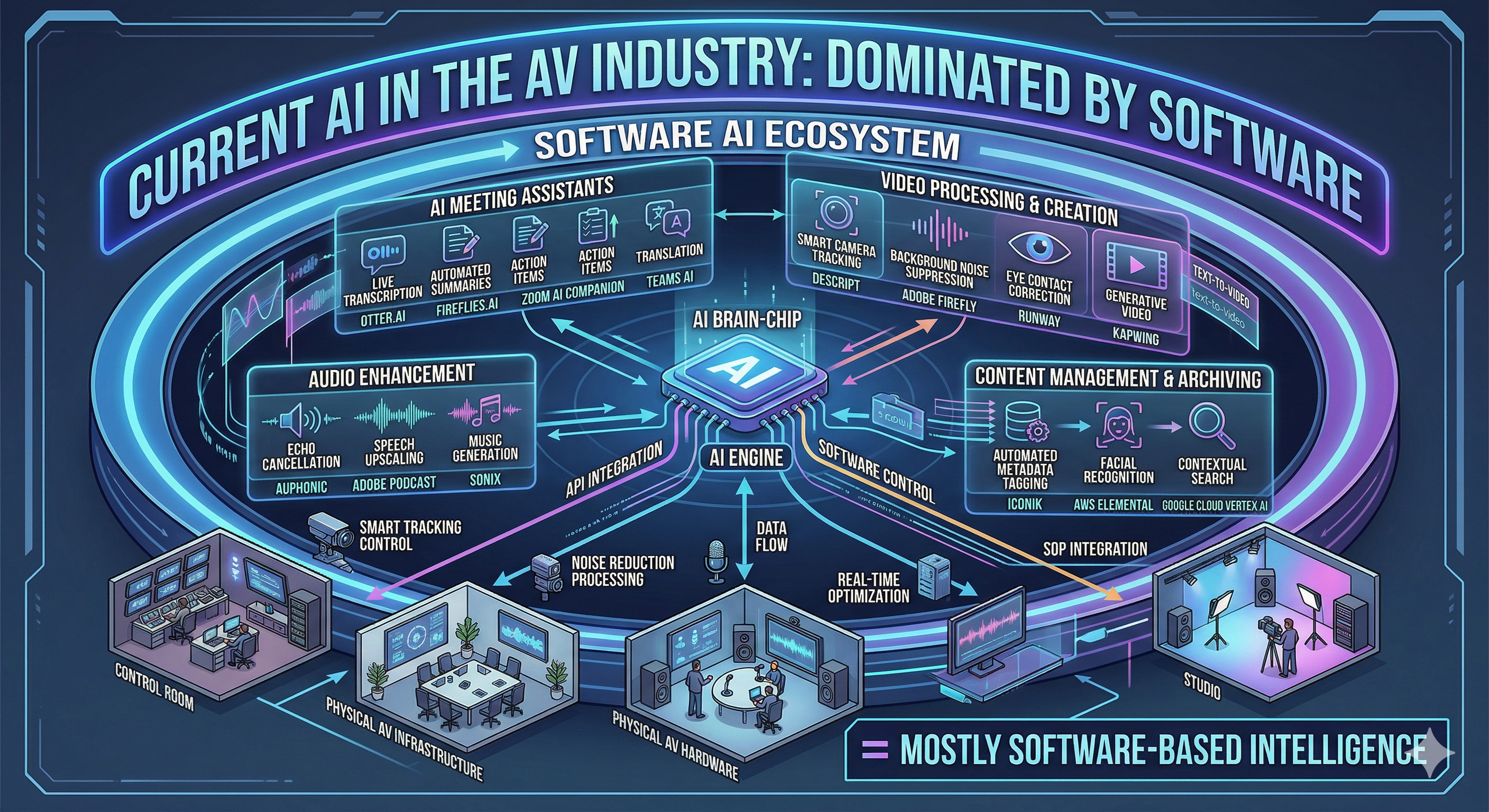

My observation says that — current AV industry = mostly software AI (cloud / PC / server-based).
But the shift to hardware-based AI in AV has already started, just not fully visible yet.
Let’s break this properly from an AV-engineering perspective.
1. Reality Today (2024–2026)
AV is NOT purely software AI anymore
We already have early hardware AI inside AV components, but it's:
-
Hidden inside DSPs / chipsets
-
Limited to specific functions
-
Not marketed as “AI hardware AV” yet
Examples:
-
AI noise reduction in DSPs (Shure, Biamp, QSC)
-
Auto-framing cameras (Crestron 1Beyond, Poly, Cisco)
-
Beamforming mics with tracking
These are running on embedded DSP + AI accelerators, not cloud
Modern DSP chips already include neural engines + ML accelerators
2. Why AV still feels “Software AI”
Because of 3 main limitations:
1. Compute Requirement
-
AI (vision, speech) needs heavy processing (GPU/NPU)
-
Traditional AV hardware = low-power DSP focused
2. Cost vs Market
-
AV hardware must be:
-
Reliable
-
Long lifecycle (7–10 years)
-
Cost-sensitive
AI chips increase BOM significantly
-
3. Flexibility
-
Software AI (cloud) = easy updates
-
Hardware AI = fixed capability (unless reprogrammable)
3. What is Changing NOW
We are entering the Edge AI era
Meaning: AI runs inside the device (hardware) instead of cloud
Key technologies enabling this:
-
Edge SoCs (System-on-Chip)
-
NPUs (Neural Processing Units)
-
AI DSPs
-
FPGA-based AI (like adaptive compute platforms)
These chips are designed for real-time, low-latency AI at device level
4. Where Hardware AI is Already Coming in AV
A) Audio
-
AI DSP chips (echo cancellation + voice isolation)
-
Context-aware audio (speaker tracking, noise classification)
Already happening (automotive & pro AV crossover)
B) Video
-
AI cameras with:
-
Auto framing
-
Speaker tracking
-
Gesture recognition
-
Runs on edge AI chips which is not included in the designs.
C) Control Systems
-
Predictive AV systems
-
Self-healing rooms
-
Usage-based automation
Will require embedded AI processors
D) AV-over-IP + AI
-
AI embedded in endpoints:
-
Encoders/Decoders
-
Switches (yes!)
-
Streaming nodes
-
5. Timeline — When Full Hardware AI AV Will Happen
Now (2024–2026)
-
Hybrid systems (DSP + partial AI hardware)
-
AI mostly “feature-level”
6. What Future AV Hardware Will Look Like
Think of this:
A DSP won’t just process audio
It will: Understand speech context, identify speakers, Optimize acoustics dynamically
A camera won’t just capture
It will: Understand meeting intent, Track engagement, Adjust framing intelligently
A control system won’t just trigger
It will: Predict user behavior, Auto-configure rooms
7. Key Insight
AV is moving from: Signal Processing → Intelligence Processing
Traditional DSP: EQ, compression, routing
Future AI Hardware: Understanding + decision-making + adaptation
8. Why Should we Care about this?
This shift will redefine roles:
Today: AV Programmer / DSP Designer
Tomorrow:
-
AV + AI System Architect
-
Edge AI integrator
-
Data-driven AV designer
Final Conclusion for this discussion I can say that...
"Hardware-based AI in AV is already starting, but Mainstream adoption = next 3–5 years (2026–2030)"
And after that: AV systems won’t just “work” — they will think

Solution Design Engineer and Consultant, AV Industry
- Started Journey as Live sound System Engineer For small AV company in 2007.
- Then join one Dubbing studio and Done Some Movies Dubbing and Music Mixing Till 2008.
- After 2008 Started working as Freelancer for Audio Jobs as Recording, Dubbing and Mixing engineer for regional language Music and Movies.
- From 2010 corporate journey Started with Manufacturer of AV Acessories in India.
- Till 2012 worked as Technical Marketing team Head for the Product developments and Possible solutions for Pro Audio and Video Industry Acessories.
- After 2013 Started working for Pro Audio Industry Products as BDM for West India.
- From 2016 Working as Individual Audio, Video and Acoustics Design Consultant for freelance projects across India and in global market.
-
Xchange Advocates are recognized AV/IT industry thought leaders and influencers. We invite you to connect with them and follow their activity across the community as they offer valuable insights and expertise while advocating for and building awareness of the AV industry.


Please sign in
If you are a registered user on AVIXA Xchange, please sign in