Building a Multilingual Chatbot for RWA Platforms: What Developers Need to Know

The decision to Develop A Multilingual Chatbot for a real-world asset tokenization platform sounds straightforward until you start mapping the actual requirements. A multilingual chatbot for a consumer app — an e-commerce assistant, a travel booking helper — is a very different engineering challenge from one deployed on a regulated investment platform handling fractional ownership transactions, KYC compliance workflows, and investor communications governed by securities law.
This article is for the technical and product teams tasked with building or integrating multilingual conversational AI into RWA infrastructure. It covers the architecture decisions that matter, the pitfalls that are not obvious until you hit them, and the cost and timeline realities that separate good project plans from failed ones.
Why RWA Platforms Have Unique Multilingual Chatbot Requirements
Before diving into implementation, it is worth being precise about why RWA platforms need multilingual chatbot capabilities that differ from standard applications.
Regulatory jurisdiction complexity is the first distinguishing factor. When you build an RWA tokenization platform for global investors, every conversation the chatbot has potentially touches securities regulation. What the chatbot can legally say to an investor depends on their jurisdiction, their accreditation status, and the regulatory classification of the asset in question. A response that is perfectly appropriate for a qualified institutional investor in Singapore may be impermissible to give to a retail investor in the United States. The chatbot's multilingual layer must be aware of this jurisdictional context and adapt its responses accordingly — not just translate them.
Financial terminology precision is the second. Terms like tokenized securities, smart contract escrow, NAV-based redemption, on-chain settlement finality, and permissioned secondary market have precise meanings in the context of RWA platforms. Mistranslating or imprecisely explaining these concepts is not just a UX problem — it is a mis-selling risk. The chatbot's training and knowledge base must be built with domain-specific financial and legal precision, not generic language model output.
Document-grounded accuracy is the third. RWA investors ask questions whose answers exist in specific legal and offering documents. "What is the lock-up period for this fund?" has one correct answer, and it is in the subscription agreement. A multilingual chatbot for an RWA platform must be grounded in those documents — not generating plausible-sounding but potentially incorrect answers from parametric knowledge.
Architecture Overview: How to Build a Multilingual RWA Chatbot
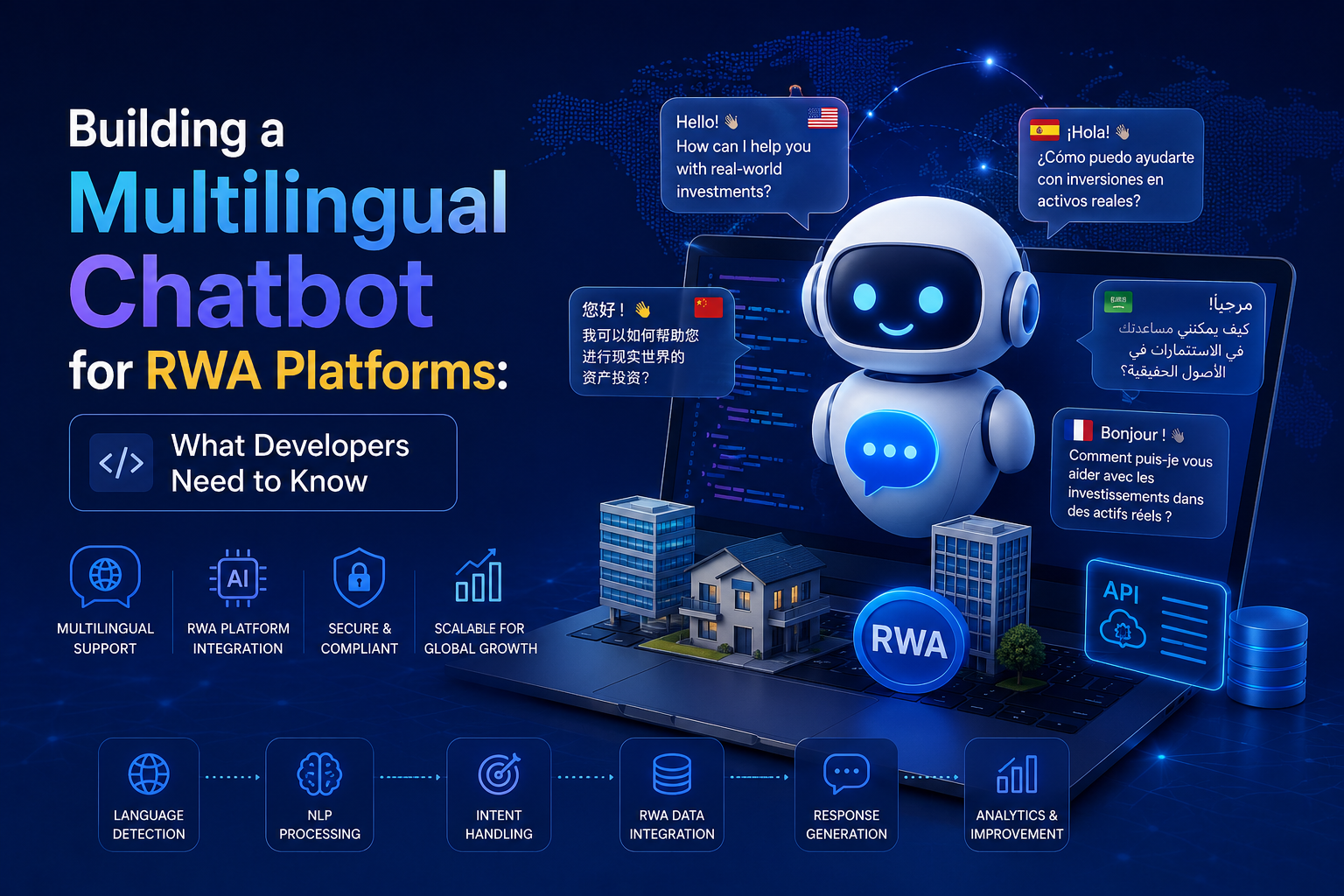
When teams approach how to Develop A Multilingual Chatbot at the infrastructure level for an RWA platform, the architecture typically consists of five layers.
Layer 1: Language Detection and Session Management
The entry point of every conversation is language identification. FastText-based language classifiers are the industry standard for this — they are lightweight, accurate across 170+ languages, and fast enough to run as a pre-processing step without adding perceptible latency. The identified language is stored as a session attribute that persists through the conversation and is passed to every downstream component.
Session management for multilingual RWA chatbots also needs to track investor profile attributes — jurisdiction, accreditation status, KYC completion stage — that determine what content the chatbot can present and how. This is a standard session context store (Redis is common for this use case) with a schema designed around both conversational state and investor profile state simultaneously.
Layer 2: Intent Recognition and Entity Extraction
Intent recognition — understanding what the user wants — must work across all supported languages without routing through English as a translation intermediate. Cross-lingual intent classifiers fine-tuned on your platform's specific intent taxonomy ("ask about minimum investment," "request KYC documentation," "query asset performance," "initiate subscription") outperform generic language model intent recognition for production RWA chatbot deployments.
Entity extraction — pulling structured data from natural language queries — is equally critical. When a user asks "Can I invest €50,000 in the Paris office fund?", the chatbot must extract the investment amount (€50,000), the currency (EUR), and the asset reference (Paris office fund) as structured entities before routing to the appropriate response logic. Named entity recognition (NER) models for financial domain entities must be fine-tuned per language for acceptable production accuracy.
Layer 3: Retrieval-Augmented Generation (RAG)
The knowledge grounding layer is where RWA chatbot responses get their document-specific accuracy. RAG architecture works by converting the user's query into a vector embedding, searching a vector database (Pinecone, Weaviate, or Qdrant are common choices) for semantically similar content chunks from your offering documents, and passing those retrieved chunks as context to the language model before generation.
For multilingual deployments, you have two options: store documents in all supported languages (requiring multilingual document preparation and larger index size) or store in English and perform cross-lingual semantic search using multilingual embedding models like multilingual-e5-large or paraphrase-multilingual-mpnet-base-v2. The latter approach is more maintainable but introduces a small accuracy penalty on languages that are underrepresented in the embedding model's training data.
Layer 4: Response Generation and Compliance Filtering
Response generation is the language model layer. For regulated financial content, instruction-tuned models with strong multilingual capability (GPT-4o, Claude 3.5 Sonnet, Gemini 1.5 Pro) outperform base models significantly. The system prompt must encode the chatbot's role, the compliance constraints applicable to the current user's jurisdiction and accreditation status, the required response format (plain language, avoiding specific investment advice), and the language of the response.
Post-generation compliance filtering is a guardrail layer that runs after the model generates a response and before it is returned to the user. It checks for prohibited content patterns — specific return promises, unlicensed investment advice, restricted offering mentions to ineligible investors — and either modifies the response or returns a compliant fallback. This layer is especially important for multilingual deployments where the model may occasionally produce confident but non-compliant statements in less-resourced languages.
Layer 5: CRM and Platform Integration
A production RWA chatbot is not a standalone conversational interface — it is integrated with the platform's CRM, KYC provider, subscription management system, and investor dashboard. Webhook-based event triggers allow the chatbot to initiate KYC workflows, update investor records, flag conversations for human review, and surface relevant offering information based on the investor's profile and conversation history.
For the RWA platform development teams, this integration layer is often where the most custom work lives — and where RWA tokenization platform development cost estimates most commonly underestimate scope. Generic chatbot platforms provide the conversation layer. The platform integration that makes the chatbot actually useful in an RWA context requires significant custom engineering.
Technology Stack Decisions
For teams evaluating specific technology choices when they build an RWA tokenization platform with multilingual chatbot capabilities, here is a practical stack comparison.
Hosted LLM APIs vs. self-hosted models: Hosted APIs (OpenAI, Anthropic, Google) offer the fastest time to production and the strongest multilingual performance. Self-hosted models on your own infrastructure offer data sovereignty, lower per-token costs at scale, and freedom from third-party dependency. For regulated RWA platforms handling investor data, self-hosted or private cloud deployment is often a compliance requirement.
Vector database selection: Pinecone is the most widely used managed vector database for RAG applications. Weaviate offers stronger multilingual support out of the box. Chroma is the preferred choice for development and lower-scale production deployments where managed infrastructure is not required. For RWA platforms, Weaviate's multilingual indexing capabilities often justify its additional setup complexity.
Chatbot framework: LangChain and LlamaIndex are the dominant frameworks for building RAG-based chatbot applications. Both support multilingual pipelines and have strong communities. LangChain's agent framework is better suited to the agentic AI patterns increasingly used in RWA onboarding workflows. LlamaIndex has stronger document parsing and indexing capabilities, making it preferable when document-grounded accuracy is the primary concern.
Frontend integration: Most RWA platforms integrate chatbot interfaces via embeddable JavaScript widgets. Streaming response support (Server-Sent Events or WebSocket) is essential for perceived performance. WebSocket-based streaming with optimistic UI updates (displaying partial responses as they generate) reduces perceived latency by 40–60% compared to waiting for full response generation before display.
RWA Tokenization Platform Development Cost: The Chatbot Component
When planning the RWA tokenization platform development cost for a build that includes multilingual chatbot capabilities, here is a realistic breakdown of the chatbot-specific component.
- Basic multilingual chatbot (3–5 languages, hosted API, pre-built RAG): $12,000 – $28,000
- Intermediate build (5–8 languages, compliance filtering, CRM integration): $30,000 – $60,000
- Full production system (10+ languages, self-hosted model, agentic workflows, full platform integration): $70,000 – $150,000
- Ongoing maintenance, model updates, language QA: 15–20% of initial build cost annually
- Native-speaker QA for each supported language during initial deployment: $2,000 – $5,000 per language
These figures assume the chatbot is being built as part of a broader platform engagement. Standalone chatbot development without accompanying RWA tokenization platform development infrastructure adds coordination overhead and typically increases cost by 20–30% compared to integrated delivery.
Common Mistakes in RWA Multilingual Chatbot Builds
Having reviewed multiple RWA chatbot implementations, the failure modes are consistent.
Building language support as an afterthought. Platforms that design the chatbot in English and add language support later face architectural retrofitting problems. Multilingual support must be designed into the session management, intent taxonomy, knowledge base structure, and compliance filtering from the beginning.
Treating translation as equal to localization. Mechanically translating English responses into other languages produces outputs that are technically correct but culturally dissonant. Investors in Germany expect different communication formality than investors in Brazil. Investors in the Middle East have different assumptions about halal finance certification. True localization requires content adaptation, not just translation.
Underestimating compliance layer complexity. The compliance filtering layer is often scoped as a simple keyword blocklist. In production, it needs to handle nuanced regulatory distinctions — what can and cannot be said to different investor types in different jurisdictions — that require careful legal and technical collaboration to implement correctly.
Skipping multilingual QA. Language model quality is uneven across languages. Models trained predominantly on English data perform significantly less reliably in lower-resource languages. Every supported language needs native-speaker testing with domain-relevant financial queries before production deployment.
Conclusion
The decision to Develop A Multilingual Chatbot for an RWA platform is a decision to take global investor acquisition seriously. The technical complexity is real — significantly higher than generic chatbot deployments — but it is manageable with the right architecture, the right technology choices, and the right development partner.
For teams planning to build an RWA tokenization platform with global ambitions, multilingual conversational AI is not a feature to add in version two. It is a core infrastructure component whose architecture decisions affect every other layer of the investor experience. Build it right from the start — the RWA tokenization platform development cost of retrofitting it later is always higher than building it in from the beginning.