
7 Pharmacy POS Software Studios Solving the Inventory-Expiry Problem
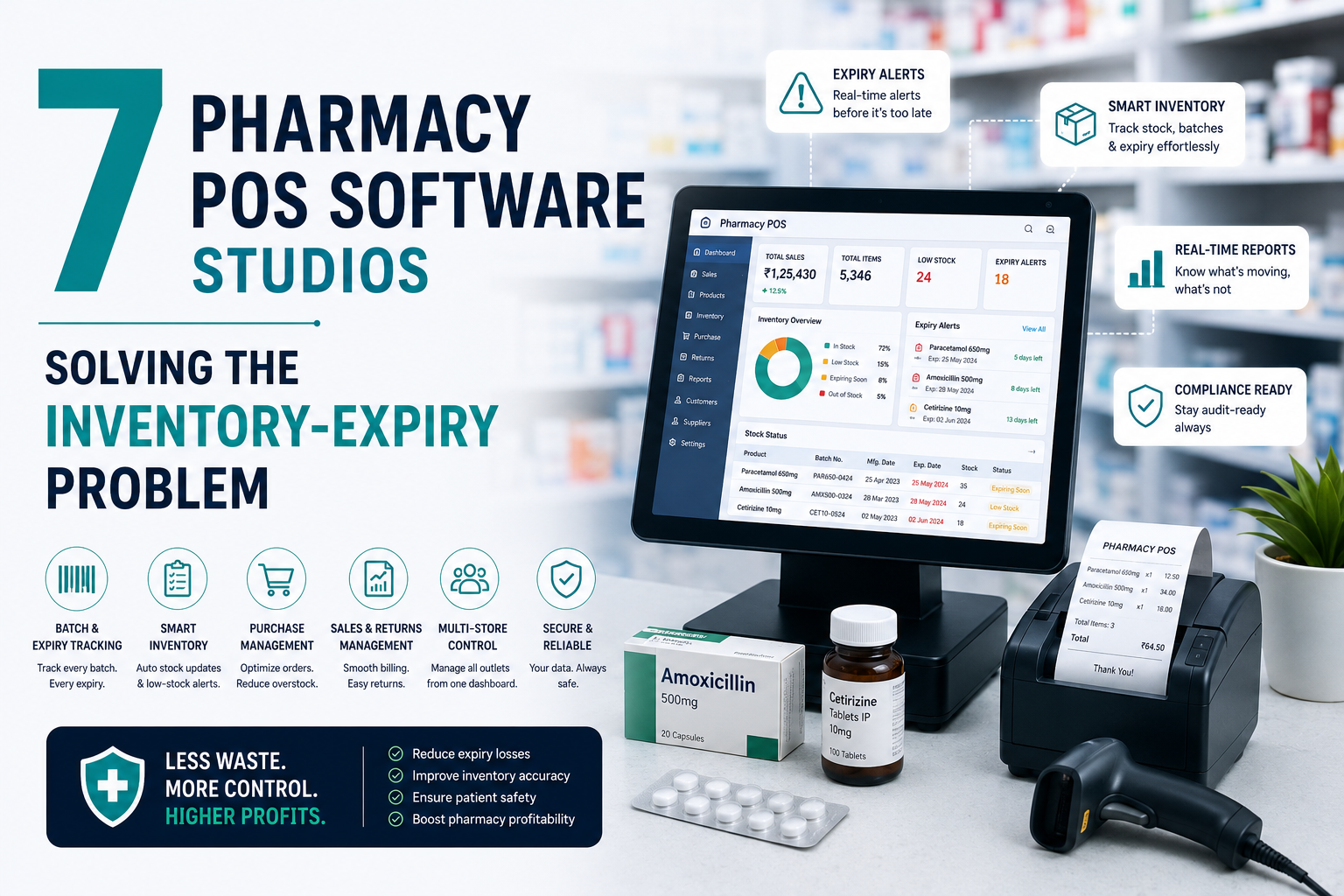
Expired medication on a pharmacy shelf is not just a financial loss — it is a regulatory event. The FDA and equivalent agencies globally treat expiry management failures as compliance violations, with consequences ranging from warning letters to license suspension. Yet a 2023 Pharmacy Times survey found that over 40% of independent pharmacies still manage expiry dates through manual shelf checks.
The pharmacy POS software industry has largely failed to treat inventory expiry as a first-class engineering problem. Most systems track stock levels. Fewer track batch numbers and expiry dates per batch. Almost none automatically trigger reorder and return-to-supplier workflows based on expiry proximity rather than just quantity thresholds — the insight that actually prevents waste and compliance exposure.
The firms on this list built pharmacy POS systems that treat expiry management as an engineering problem with an engineering solution.
Top Companies
1. Dev Technosys
Overview
Dev Technosys builds pharmacy POS systems with batch-level inventory tracking at the architectural core — every stock item is tagged with supplier batch number, manufacture date, and expiry date from the moment it enters the system via receiving scan. Their automated expiry alert logic triggers configurable warnings at 90, 60, and 30 days per SKU batch, with suggested return-to-supplier workflows and automatic near-expiry discount pricing that surfaces eligible items on the dispensing interface.
FIFO (First In, First Out) dispensing enforcement ensures older batches are always prioritized without requiring pharmacist manual judgment on every transaction. Prescription management modules handle controlled substance logging, DEA-compliant record-keeping, refill tracking, and drug interaction alerts.
Health insurance integration connects to major PBMs for real-time eligibility verification and electronic claims submission. Multi-location chain management allows central pharmacy teams to monitor expiry risk across all branches, rebalance stock between locations, and generate regulatory compliance reports from a single dashboard.
The system supports barcode scanning, label printing, and integration with pharmaceutical distributor APIs for automated reorder triggered by either quantity thresholds or expiry-adjusted velocity calculations.
Core Services
- Batch-Level Inventory & Expiry Tracking
- Automated Expiry Alert System
- FIFO Dispensing Enforcement
- Prescription Management & DEA Compliance
- Health Insurance & PBM Integration
- Multi-Location Chain Management
- Pharmaceutical Distributor API Integration
Why Choose Dev Technosys?
Dev Technosys builds batch-level expiry tracking directly into the inventory core — automating FIFO dispensing, triggering supplier return workflows, and generating regulatory compliance reports without manual pharmacist intervention.
Best For: Independent pharmacies, chain pharmacy operators, and hospital pharmacies requiring batch-level expiry management, DEA-compliant record-keeping, and insurance integration in a single platform.
2. Accenture
Overview
Accenture's healthcare technology practice serves large pharmacy chains with enterprise-grade inventory management — centralized visibility across hundreds of locations, automatic reorder triggers, and regulatory reporting dashboards satisfying FDA and DEA documentation requirements. Their recall management module handles batch-specific recall notifications across the entire chain automatically.
Core Services
- Enterprise Chain Pharmacy Management
- Centralized Inventory Visibility
- FDA & DEA Reporting Dashboards
- Recall Management Module
- Automatic Reorder Systems
Best For: Large pharmacy chains requiring centralized inventory management, regulatory reporting, and batch-specific recall management across hundreds of locations.
3. IBM
Overview
IBM's pharmacy technology work focuses on supply chain integration connecting pharmacy POS systems to pharmaceutical distributor APIs for real-time stock availability, direct replenishment, and batch recall notifications. Their supply chain connectivity turns the pharmacy POS into a node in the pharmaceutical distribution network rather than an isolated retail system.
Core Services
- Pharmaceutical Supply Chain Integration
- Distributor API Connectivity
- Real-Time Stock Availability
- Batch Recall Notification Systems
- Direct Replenishment Integration
Best For: Pharmacy operators and pharmaceutical distributors requiring POS platforms that function as integrated nodes in the pharmaceutical supply chain network.
4. Wipro
Overview
Wipro has built pharmacy POS systems for major retail pharmacy chains in South Asia and the Middle East, with expertise in local drug regulatory requirements, national health insurance system integration, and multilingual prescription management for markets serving patients in multiple languages.
Core Services
- Asian & Middle East Pharmacy POS
- Local Drug Regulatory Compliance
- National Health Insurance Integration
- Multilingual Prescription Management
- Regional PBM Connectivity
Best For: Pharmacy chains in South Asia, Southeast Asia, and the Middle East requiring localized regulatory compliance and national health insurance system integration.
5. Infosys
Overview
Infosys builds AI-augmented pharmacy management systems that predict expiry-based waste before it happens — using historical sales velocity and seasonal demand patterns to flag slow-moving SKUs likely to expire before they sell. Their predictive waste reduction implementations have reduced medication waste by significant margins in documented pilot programs.
Core Services
- AI-Powered Expiry Waste Prediction
- Sales Velocity Analysis
- Seasonal Demand Forecasting
- Slow-Mover Identification
- Predictive Inventory Optimization
Best For: Pharmacy operators focused on reducing medication waste through AI-driven demand forecasting and predictive expiry management rather than reactive manual processes.
6. TCS
Overview
TCS builds pharmacy POS systems for hospital pharmacy environments high-volume dispensing with integration to hospital EHR systems, formulary management, and pharmacist verification workflows that satisfy Joint Commission accreditation requirements and clinical safety standards.
Core Services
- Hospital Pharmacy POS Development
- EHR System Integration
- Formulary Management
- Pharmacist Verification Workflows
- Joint Commission Compliance
Best For: Hospital pharmacies and health system pharmacy networks requiring EHR integration, formulary management, and Joint Commission accreditation-compliant workflows.
7. HCL Technologies
Overview
HCL specializes in pharmacy POS platforms for chain operations with distributed inventory management — allowing central procurement teams to rebalance stock between locations based on expiry proximity, demand velocity, and regulatory expiry windows. Network-level expiry management reduces total medication waste across chains significantly compared to location-level management.
Core Services
- Chain Pharmacy Network Management
- Cross-Location Stock Rebalancing
- Network-Level Expiry Management
- Central Procurement Integration
- Distributed Inventory Optimization
Best For: Chain pharmacy operators looking to reduce total network-level medication waste through centralized expiry management and cross-location stock rebalancing.
Final Thoughts
The pharmacy POS systems that eliminate expiry compliance risk and reduce medication waste share a common architecture: batch-level inventory tracking built into the core, not layered on top of a generic retail inventory system. The seven studios on this list have all made that architectural choice.
For pharmacy operators and healthcare technology decision-makers, the POS system is a clinical risk management tool as much as a billing platform. Choose a development partner that understands both dimensions.
People Also Ask
What is batch-level inventory tracking in pharmacy POS software?
Batch-level tracking records not just quantity in stock but which supplier batch each unit belongs to, its manufacture date, and its expiry date. This enables precise expiry management, targeted recall responses limited to affected batches, and FIFO dispensing enforcement without manual pharmacist judgment on every transaction.
What compliance requirements must pharmacy POS software meet?
In the US: DEA 21 CFR Part 1304 for controlled substance record-keeping, state board of pharmacy regulations, and HIPAA for patient prescription data protection. In the EU: Falsified Medicines Directive for serialization and verification. Software must maintain audit logs, support regulatory reporting, and encrypt patient data at rest and in transit.
Can pharmacy POS software integrate with health insurance systems?
Yes — modern pharmacy POS systems integrate with PBMs (Pharmacy Benefit Managers) for real-time eligibility verification, co-pay calculation, and electronic claims submission. In the US, major PBMs include Express Scripts, CVS Caremark, and OptumRx. Integration typically uses NCPDP standards.
How much does pharmacy POS software development cost?
A basic pharmacy POS with inventory management and prescription tracking typically costs $25,000 to $60,000. A full pharmacy management platform with batch tracking, expiry management, insurance integration, DEA reporting, and multi-location chain management ranges from $80,000 to $250,000 or more.





Please sign in
If you are a registered user on AVIXA Xchange, please sign in
This was a good breakdown of why pharmacy POS software is much more than a billing system. The compliance and expiry management aspects were eye-opening. I'm curious: do most pharmacies still rely on manual expiry checks today, or is automation becoming the industry standard?