7 Hospitality POS Development Firms Engineering Seamless Multi-Location Service
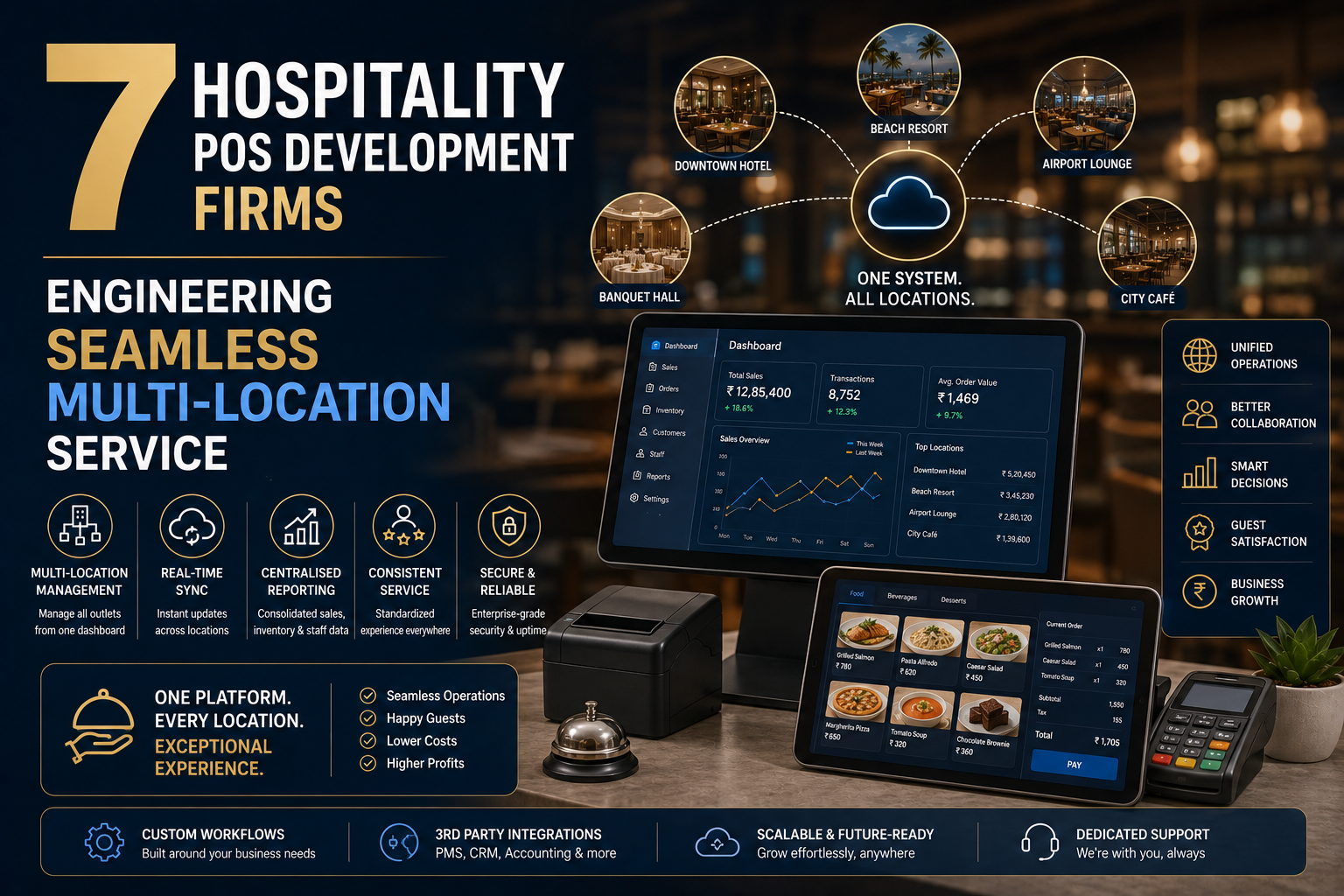
Running a hospitality business across multiple locations should feel like operating one well-oiled machine. In practice, it often feels like managing ten separate businesses with incompatible systems, inconsistent menus that diverge by location over time, and no shared real-time visibility into what is selling, where, and when.
The technology gap is well documented. A 2024 National Restaurant Association survey found that 60% of multi-location restaurant operators cite disconnected technology systems as a top operational challenge — more than labor costs or supply chain issues. The impact is measurable: inconsistent customer experiences across locations, revenue leakage from manual error, inventory waste from poor cross-location visibility, and management time consumed by system reconciliation rather than operations.
The promise of multi-location hospitality POS is centralized control with localized flexibility. These are the firms delivering it.
Top Companies
1. Dev Technosys
Founded: 2010 Team Size: 500+
Overview
Dev Technosys builds hospitality POS platforms designed for multi-location operators from the ground up not retrofitted single-location systems with a chain management module added later. The distinction matters: platforms built for single locations first typically struggle with the cross-location data architecture that multi-location operators require.
Their central management console allows operators to push menu updates, pricing changes, and promotional configurations to any subset of locations in a single action, with per-location override permissions for regional managers who need flexibility within brand standards. Real-time cross-location sales analytics are available on a unified dashboard no waiting for end-of-day reports, no manual consolidation.
Inventory transfer workflows allow head office to identify surplus stock at one location and route it to a location running low, with transfer documentation generated automatically.
Staff performance dashboards benchmark servers, bartenders, and kitchen staff across locations using consistent metrics. Kitchen display system integration, digital menu board management, online ordering synchronization with major delivery platforms, and loyalty program API integration are all included as standard modules. The platform supports multi-currency billing and location-specific tax configurations for operators crossing regional or national tax jurisdictions.
Core Services
- Multi-Location Central Management Console
- Real-Time Cross-Location Analytics
- Inventory Transfer & Network Management
- Staff Performance Benchmarking
- Digital Menu Board & KDS Integration
- Delivery Platform Synchronization
- Loyalty Program API Integration
Why Choose Dev Technosys?
Dev Technosys builds multi-location hospitality POS from the ground up — with centralized menu management, real-time cross-location analytics, and inventory transfer workflows designed as core features rather than add-on modules.
Best For: Restaurant chains, pub groups, QSR franchises, hospitality brands, and any multi-location food and beverage operator where centralized visibility and menu control across locations are operational priorities.
2. Accenture
Overview
Accenture serves global hospitality brands with enterprise POS infrastructure that operates consistently across hundreds of locations in multiple countries, currencies, and tax regimes. Their centralized financial reporting consolidates multi-location revenue data for corporate finance teams — with P&L visibility at chain, region, and location level without manual consolidation.
Core Services
- Global Chain POS Infrastructure
- Multi-Currency & Tax Architecture
- Corporate P&L Reporting
- International Hospitality Deployment
- Chain-Wide Compliance Management
Best For: Global hospitality brands operating across multiple countries requiring consistent POS infrastructure with corporate-level financial reporting across jurisdictions.
3. IBM
Overview
IBM's hospitality technology division specializes in loyalty ecosystem integration connecting multi-location POS data to customer recognition systems so a returning guest receives consistent, personalized service regardless of which location they visit. Their implementations turn POS transaction history into personalization intelligence that improves guest lifetime value.
Core Services
- Loyalty Ecosystem Integration
- Cross-Location Guest Recognition
- Personalization Intelligence Platform
- Guest Lifetime Value Analytics
- CRM-Connected POS Architecture
Best For: Hospitality brands where cross-location guest recognition and personalized service based on transaction history are core loyalty and revenue strategy components.
4. Wipro
Overview
Wipro's hospitality POS practice serves QSR chains with high-volume transaction requirements — systems handling thousands of orders per hour per location, with kitchen display integration, digital menu board management, and mobile ordering synchronization. Their QSR-optimized architecture maintains speed-of-service standards under sustained peak load.
Core Services
- QSR High-Volume POS Architecture
- Kitchen Display System Integration
- Digital Menu Board Management
- Mobile Order Synchronization
- Peak Load Performance Engineering
Best For: Quick service restaurant chains and food court operators handling thousands of orders per hour per location where speed-of-service consistency under peak load is a non-negotiable requirement.
5. Infosys
Overview
Infosys builds demand forecasting modules on top of multi-location hospitality POS data — using sales history and seasonal patterns to predict ingredient demand, optimize purchase orders across the chain, and reduce food waste. Their analytics implementations are deployed by multiple major restaurant groups to drive measurable waste reduction and margin improvement.
Core Services
- Multi-Location Demand Forecasting
- AI-Driven Purchase Order Optimization
- Food Waste Reduction Analytics
- Cross-Chain Inventory Intelligence
- F&B Margin Analytics
Best For: Restaurant chains and hospitality groups looking to reduce food waste and improve purchasing efficiency through AI-driven demand forecasting across all locations.
6. TCS
Overview
TCS delivers hospitality POS systems for luxury restaurant groups and fine dining chains — platforms configured for complex tasting menu billing with per-course pricing, sommelier-integrated wine service with cellar management, private dining event management, and corporate entertainment billing beyond what standard QSR-focused systems support.
Core Services
- Fine Dining & Tasting Menu Billing
- Wine Cellar Management Integration
- Private Dining Event POS
- Corporate Entertainment Billing
- Luxury Hospitality Customization
Best For: Luxury restaurant groups, fine dining chains, private members clubs, and corporate entertainment venues requiring bespoke hospitality billing configurations.
7. HCL Technologies
Overview
HCL specializes in cloud-native hospitality POS with offline resilience for geographically distributed operations resorts, airport hospitality, stadium concessions, and event venues where network reliability is inconsistent but transaction processing cannot be interrupted. Their implementations maintain full POS functionality offline and sync automatically on reconnect.
Core Services
- Offline-Resilient Hospitality POS
- Airport & Venue Concession POS
- Stadium & Event POS Systems
- Cloud-Native with Local Failover
- Geographically Distributed Deployment
Best For: Hospitality operators in airports, stadiums, resorts, and event venues where internet connectivity is unreliable but transactional continuity is critical for revenue protection.
Final Thoughts
The multi-location hospitality operators generating the best unit economics in 2026 are those running on platforms built for their operational model — not adapted from single-location systems. Centralized menu control, real-time cross-location visibility, and demand forecasting are not nice-to-have features; they are the infrastructure that makes multi-location hospitality manageable at scale.
The seven firms on this list have all built with that operational reality in mind. For hospitality technology decision-makers evaluating POS development partners, the architectural question to ask is simple: was this built for multi-location operations from day one — or was multi-location added later?
People Also Ask
What does multi-location management mean in a hospitality POS system?
Multi-location management means a single administrative interface controls menus, pricing, promotions, and configurations across all locations simultaneously. Operators can push a menu change to 50 outlets in one action, pull consolidated sales reports, and benchmark performance between locations — all without touching individual location terminals.
How does hospitality POS software handle different tax rates by location?
Enterprise hospitality POS systems include tax configuration engines that automatically apply correct tax rules based on transaction location — covering VAT, GST, local sales taxes, and alcohol-specific tax rates. The central system manages tax rules while location terminals apply them automatically without manual configuration at each site.
What integrations does a hospitality POS system typically need?
Standard integrations include payment gateways, accounting software, inventory and procurement systems, delivery platforms such as Uber Eats and Deliveroo, loyalty program APIs, and kitchen display systems. Multi-location operators often also need HR and workforce management integrations for staff scheduling across locations.
How much does hospitality POS software development cost?
A single-location hospitality POS with standard features costs $20,000 to $50,000 to develop. A multi-location platform with central management console, cross-location analytics, inventory management, and third-party integrations typically ranges from $80,000 to $300,000 or more depending on location count and feature complexity.