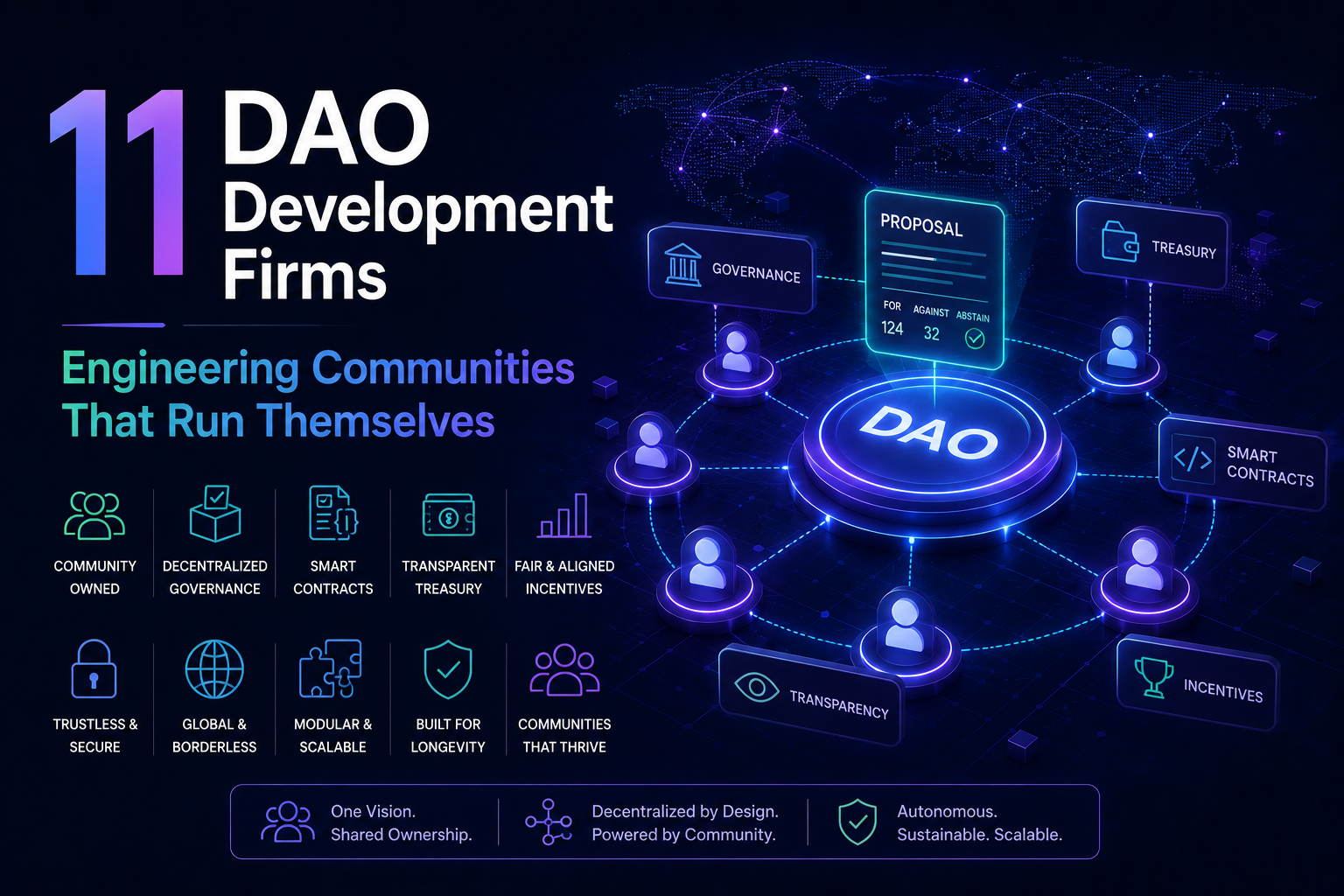
11 DAO Development Firms Engineering Communities That Run Themselves
The promise of DAOs was radical: organizations that operate by code, governed by token holders, with no CEO and no board. The reality for most early DAOs was messier — governance attacks, voter apathy, treasury drains, and constitutional crises playing out in Discord channels.
But the underlying model is proving out. According to DeepDAO, DAO treasuries collectively hold over $25 billion in assets as of 2025. The DAOs that work — MakerDAO, Compound, Uniswap, Nouns — share one thing: technically sound governance architecture built by teams that understood that code is policy.
Poor governance architecture does not just create operational friction — it creates attack surfaces. A poorly designed quorum threshold allowed a governance attacker to take near-control of Beanstalk protocol in 2022, draining $182 million. The technical choices made during DAO development have direct financial consequences. These are the firms getting those choices right.
Top Companies
1. Dev Technosys
Overview
Dev Technosys builds DAOs that directly address the two most common failure modes: voter apathy and governance attacks. Their DAO frameworks include time-locked proposals with mandatory execution delays calibrated to proposal risk level, quorum thresholds that scale with treasury impact size, and delegation systems that allow passive token holders to assign their voting power to trusted delegates without losing custody of their tokens.
Treasury controls enforce multi-signature authorization for all withdrawals above defined thresholds eliminating the single-point-of-failure treasury management that has drained multiple DAO treasuries. Their governance stack integrates Snapshot for low-cost off-chain signaling and Governor Bravo for on-chain execution, giving communities both accessibility and binding enforcement where it matters most.
Reputation-based voting modules, veToken economic models, and on-chain payroll for contributor compensation are available as governance extensions. Every Dev Technosys DAO engagement includes economic attack modeling — simulating governance takeover scenarios before deployment to identify and close vulnerabilities proactively.
Core Services
- DAO Smart Contract Development
- Governance Framework Design
- Treasury Management Architecture
- Delegation & Reputation Systems
- Snapshot & Governor Bravo Integration
- Economic Attack Modeling
Why Choose Dev Technosys?
Dev Technosys builds DAO governance that addresses voter apathy, governance attacks, and treasury security simultaneously — with economic attack modeling included before deployment to close vulnerabilities proactively.
Best For: Web3 protocols, DeFi projects, NFT communities, and any organization planning to decentralize governance and treasury management to token holders.
2. Accenture
Overview
Accenture brings enterprise governance expertise to DAO architecture. For institutions exploring decentralized structures, Accenture designs hybrid governance models that satisfy regulatory requirements while distributing operational decision-making. Their work bridges traditional corporate governance frameworks and on-chain voting mechanics for regulated entities exploring partial decentralization.
Core Services
- Hybrid Governance Architecture
- Regulatory-Compliant DAO Design
- Enterprise Decentralization Advisory
- Corporate-to-DAO Transition
- Institutional Governance Frameworks
Best For: Regulated institutions exploring partial decentralization while maintaining legal compliance and fiduciary governance requirements.
3. IBM
Overview
IBM's DAO work focuses on supply chain consortiums — multi-party business networks where decentralized governance replaces traditional legal contracts. Their implementations handle dispute resolution, protocol upgrade voting, and treasury disbursements across competing corporate entities that share infrastructure but maintain competitive interests.
Core Services
- Supply Chain Consortium DAOs
- Multi-Party Governance Architecture
- On-Chain Dispute Resolution
- Corporate Consortium Management
- Protocol Upgrade Governance
Best For: Industry consortiums in supply chain, trade, and logistics where competing companies need a neutral decentralized governance layer for shared infrastructure.
4. Wipro
Overview
Wipro has built DAOs for industry consortiums in healthcare and logistics, where multiple competing organizations need a neutral governance layer to manage shared infrastructure and data standards. Their legal-technical framework ensures on-chain governance decisions have enforceability in traditional legal contexts — an important bridge for enterprise DAOs.
Core Services
- Healthcare Consortium DAOs
- Logistics Network Governance
- Legal-Technical Governance Frameworks
- Shared Infrastructure Management
- Enforceable On-Chain Voting
Best For: Healthcare and logistics consortiums requiring DAOs with governance decisions that are legally enforceable in traditional court systems.
5. Infosys
Overview
Infosys designed modular DAO frameworks with pluggable governance modules — allowing communities to swap voting mechanisms between token-weighted, quadratic, and reputation-based systems without redeploying core contracts. This upgradability is valuable for DAOs that expect governance models to evolve as communities mature and attack patterns are identified.
Core Services
- Modular Governance Architecture
- Pluggable Voting Mechanisms
- Quadratic Voting Implementation
- Reputation-Based Governance
- Upgradeable DAO Contracts
Best For: DAOs that expect governance models to evolve over time and need pluggable voting mechanisms that can be updated without full contract redeployment.
6. TCS
Overview
TCS approaches DAO security with the same rigor applied to banking infrastructure. Their engagements include governance contract audits, economic attack simulations covering governance takeover modeling and flash loan voting attack scenarios, and formal verification for high-value treasury contracts. Security depth is their primary differentiator in the DAO development space.
Core Services
- Governance Contract Auditing
- Governance Takeover Simulation
- Flash Loan Attack Testing
- Formal Verification
- Treasury Contract Security
Best For: DAOs managing large treasuries or high-value protocols where governance security and formal verification are non-negotiable requirements.
7. HCL Technologies
Overview
HCL builds DAOs for creator communities and media platforms — governance models where NFT holders control decisions rather than fungible token holders. Their implementations handle voting power calculations based on NFT rarity traits and holding duration, creating governance systems that reward long-term community participation over capital concentration.
Core Services
- NFT-Based Governance Systems
- Creator DAO Development
- Rarity-Weighted Voting
- Holding Duration Incentives
- Media Platform DAOs
Best For: NFT communities, creator collectives, and media platforms building governance systems where NFT holders — not token holders — control organizational decisions.
8. Tech Mahindra
Overview
Tech Mahindra's DAO practice focuses on emerging-market use cases: cooperative DAOs for agricultural communities, microfinance DAOs, and community investment clubs where governance needs to be accessible to non-technical members. Their mobile-first governance interfaces bring DAO participation to users without desktop MetaMask setups.
Core Services
- Agricultural Cooperative DAOs
- Microfinance DAO Development
- Mobile-First Governance UI
- Community Investment Platforms
- Emerging Market DAO Architecture
Best For: Emerging market cooperatives, agricultural communities, and microfinance platforms requiring DAOs with mobile-first governance accessible to non-technical users.
9. Capgemini
Overview
Capgemini designs DAOs for European financial institutions exploring decentralized structures. Their legal-technical frameworks ensure DAO governance satisfies MiCA requirements and national securities regulations while maintaining meaningful decentralization — a difficult balance that Capgemini's EU regulatory expertise makes achievable.
Core Services
- MiCA-Compliant DAO Architecture
- EU Regulatory DAO Design
- Financial Institution DAOs
- Decentralized Governance Compliance
- European DAO Frameworks
Best For: European financial institutions exploring DAO governance structures that must remain compliant with MiCA and national securities regulations.
10. L&T Technology Services
Overview
L&T builds DAO infrastructure for industrial consortiums — energy grids, infrastructure projects, and manufacturing networks where governance needs to coordinate physical operations with on-chain treasury management. Their operational technology expertise bridges the digital governance layer with real-world industrial decision-making.
Core Services
- Industrial Consortium DAOs
- Energy Grid Governance
- Infrastructure Project DAOs
- OT-IT Governance Integration
- Manufacturing Network DAOs
Best For: Industrial consortiums in energy, infrastructure, and manufacturing requiring DAOs that coordinate physical operational decisions with on-chain governance.
11. Mphasis
Overview
Mphasis brings AI-augmented governance tooling to DAO development — natural language proposal summaries that translate technical governance proposals into plain language, sentiment analysis on community forum discussions, and automated treasury analytics that give token holders better decision context before voting.
Core Services
- AI-Augmented Governance Tools
- Proposal Plain-Language Summaries
- Community Sentiment Analytics
- Treasury Decision Analytics
- Governance Participation Tools
Best For: DAOs looking to improve governance participation rates through AI-powered proposal summaries, sentiment analysis, and decision-support analytics.
Final Thoughts
The DAOs that function as intended in 2026 — governing meaningful treasuries, making real decisions, and maintaining community trust over time — all share a foundation of sound technical architecture. Governance design is not just code. It is organizational policy, economic incentive design, and security engineering combined.
The eleven firms on this list bring different strengths to that challenge. From the full-service DAO development and economic attack modeling at Dev Technosys to the NFT governance innovations at HCL and AI-augmented participation tools at Mphasis — the right partner depends on your community model and governance goals.
People Also Ask
What is a DAO and how does it work technically?
A DAO (Decentralized Autonomous Organization) is an organization governed by smart contracts and token holder votes. Token holders propose actions, vote during defined windows, and successful proposals are automatically executed by the governance contract — no human intermediary required for execution.
What is voter apathy in DAOs and how do developers solve it?
Voter apathy occurs when most token holders do not participate in governance, allowing small groups to pass proposals unopposed. Solutions include delegation mechanisms, reputation-weighted voting, and quorum incentive structures that reward participation with governance tokens or fee distributions.
What is the difference between on-chain and off-chain DAO governance?
On-chain governance executes proposals directly via smart contracts — binding but gas-expensive. Off-chain governance via Snapshot uses signed messages — free but requires trusted execution. Most mature DAOs use off-chain signaling for routine decisions and on-chain execution only for treasury disbursements and protocol upgrades.
How do DAOs protect their treasury from governance attacks?
Common protections include time-locks with mandatory delays between proposal passing and execution, voting period minimums to prevent flash-loan voting attacks, quorum thresholds, and multi-signature co-authorization required on treasury transactions above defined amounts.