
Immersive Experiences, Workforce Development, Sustainability in AV, Conferencing & Collaboration, Broadcast AV, and 3 more
Why Guess When You Can Calculate?
When building a sound system, getting the relationship between your speakers and amplifier right is the difference between crystal-clear audio and blowing up your expensive gear.
Like
Be the first to like this
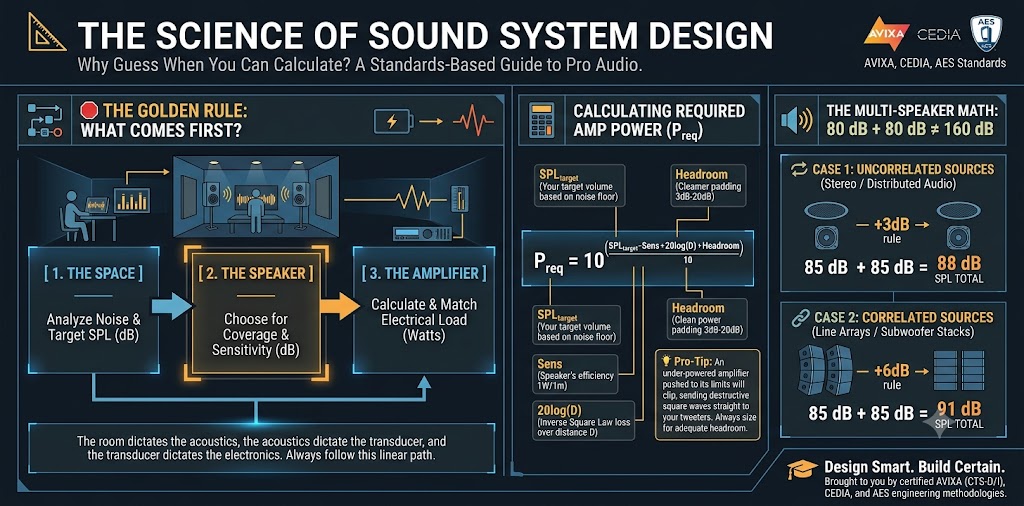
Here is a visual breakdown of the engineering sequence and mathematical logic defined by the standards (AVIXA, CEDIA, AES).
1. The Design Sequence Graphic (AVIXA/CEDIA Workflow)
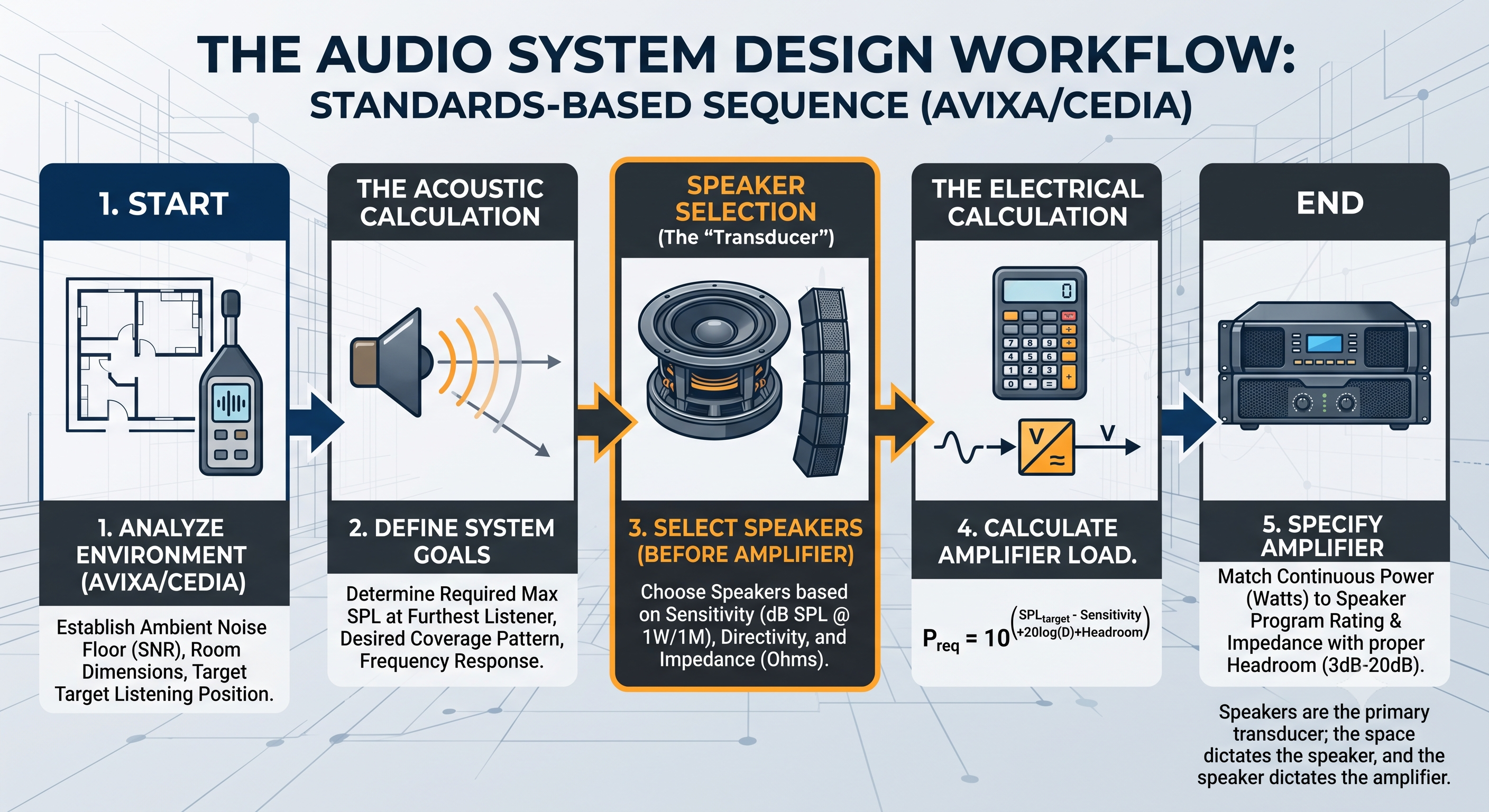
The industry standards dictate a specific engineering linear workflow. You cannot select an amplifier until the environment has defined the speaker, and the speaker has defined the load.
The Workflow Logic:
-
Needs Analysis: The room's use defines the required Volume (SPL).
-
Environment: The room size and ambient noise set the performance baseline.
-
Speaker Selection (Transducer): We choose speakers that physically fit the room and can achieve the coverage and target volume. This establishes the electrical requirement.
-
Amplifier Selection: We choose an amplifier whose output can satisfy the speaker's load requirement (Z) plus necessary headroom.
![]()
![]()
2. The Power Calculation Graphic (Inverse Square Law)
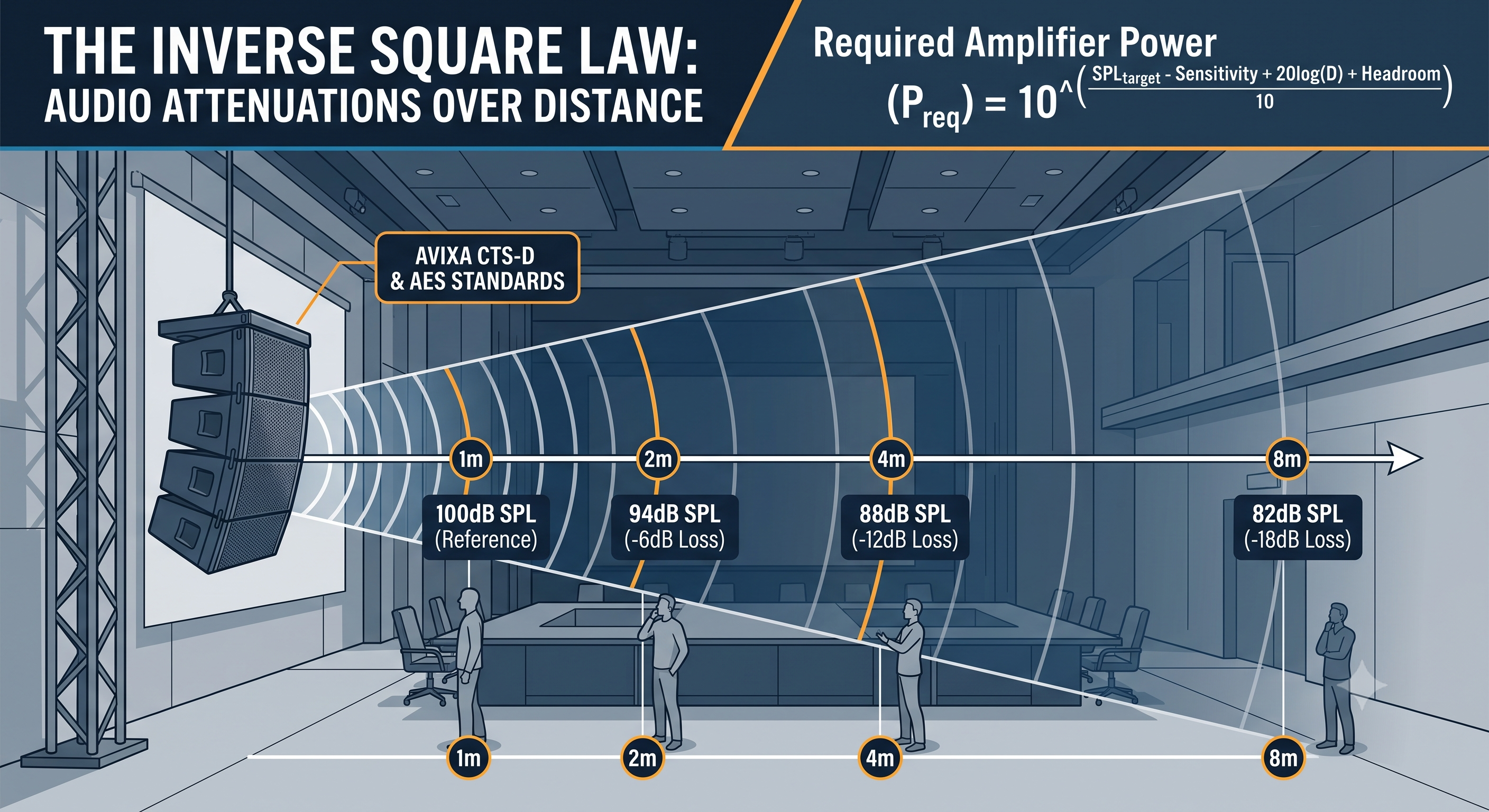
This image illustrates why a standard calculation (rather than a rule of thumb) is required. Audio professionals must calculate the loss of sound energy over distance to ensure the speaker has enough power from the amplifier to meet the system goals at the furthest seat.
If you know the speaker's sensitivity (dB SPL at 1W / 1m), you calculate how much power (Preq) is needed to overcome the Inverse Square Law loss (the 20log(D) component) and achieve your target SPL.
3. The Core Equation: Finding Required Amplifier Power (Preq)
This is the exact mathematical description of the required amplifier output (gain). It is utilized during the CTS-D (Design) phase.
![]() Preq = 10^ ((SPLtarget − Sens + 20·log10(D) + Headroom)/10)
Preq = 10^ ((SPLtarget − Sens + 20·log10(D) + Headroom)/10)
Where:
-
Preq: Required Amplifier Output Power (Watts).
-
SPLtarget: The target Sound Pressure Level (dB) at the listener’s ear (e.g., 75dB continuous for speech). This target is derived from the room's ambient noise plus a defined Signal-to-Noise Ratio (SNR).
-
$Sens$ (Sensitivity): The speaker's efficiency rating, specified by the manufacturer as dB SPL output with 1Watt of power at 1 meter distance (e.g., 87dB at 1 W /1 m).
-
20log10(D): This represents the Inverse Square Law loss. It calculates the necessary increase in power (in dB) to overcome the attenuation of sound over distance, where 'D' is the distance in meters to the furthest listener (as shown in the attenuation graphic above).
-
Headroom: The extra power capacity needed to handle sudden peak signals (dynamic peaks) without clipping the amplifier (typically 3 dB for compressed background music, up to 20dB for dynamic cinema performance, per CEDIA/AES).
-
The divisor '10' and base '10' exponent: These convert the final result from the decibel domain back into linear power (Watts).
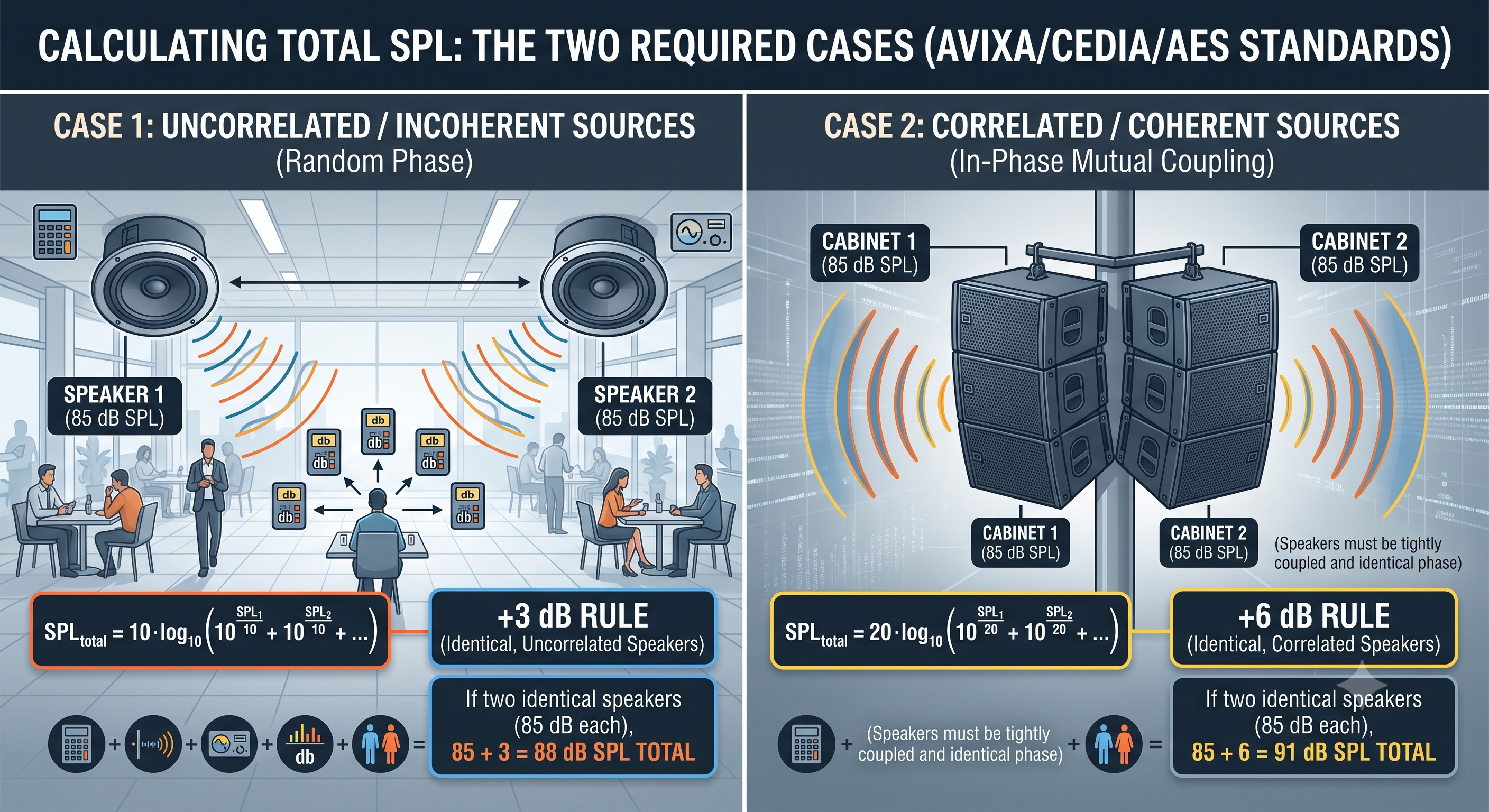
Because decibels (dB) use a logarithmic scale rather than a linear scale, you cannot simply add the Sound Pressure Level (SPL) values together. For example, two speakers playing at 80dB each do not equal 160dB.
According to AVIXA, CEDIA, and AES standards, the calculation for total SPL depends entirely on whether the acoustic signals coming out of the speakers are uncorrelated (incoherent) or correlated (coherent).
Now what if 2 speakers have identical SPL level how total SPL will be calculated?

Solution Design Engineer and Consultant, AV Industry
- Started Journey as Live sound System Engineer For small AV company in 2007.
- Then join one Dubbing studio and Done Some Movies Dubbing and Music Mixing Till 2008.
- After 2008 Started working as Freelancer for Audio Jobs as Recording, Dubbing and Mixing engineer for regional language Music and Movies.
- From 2010 corporate journey Started with Manufacturer of AV Acessories in India.
- Till 2012 worked as Technical Marketing team Head for the Product developments and Possible solutions for Pro Audio and Video Industry Acessories.
- After 2013 Started working for Pro Audio Industry Products as BDM for West India.
- From 2016 Working as Individual Audio, Video and Acoustics Design Consultant for freelance projects across India and in global market.
-
Xchange Advocates are recognized AV/IT industry thought leaders and influencers. We invite you to connect with them and follow their activity across the community as they offer valuable insights and expertise while advocating for and building awareness of the AV industry.


Please sign in or register for FREE
If you are a registered user on AVIXA Xchange, please sign in