Where Immersive Projects Break: The Hidden Risks in Infrastructure and System Planning

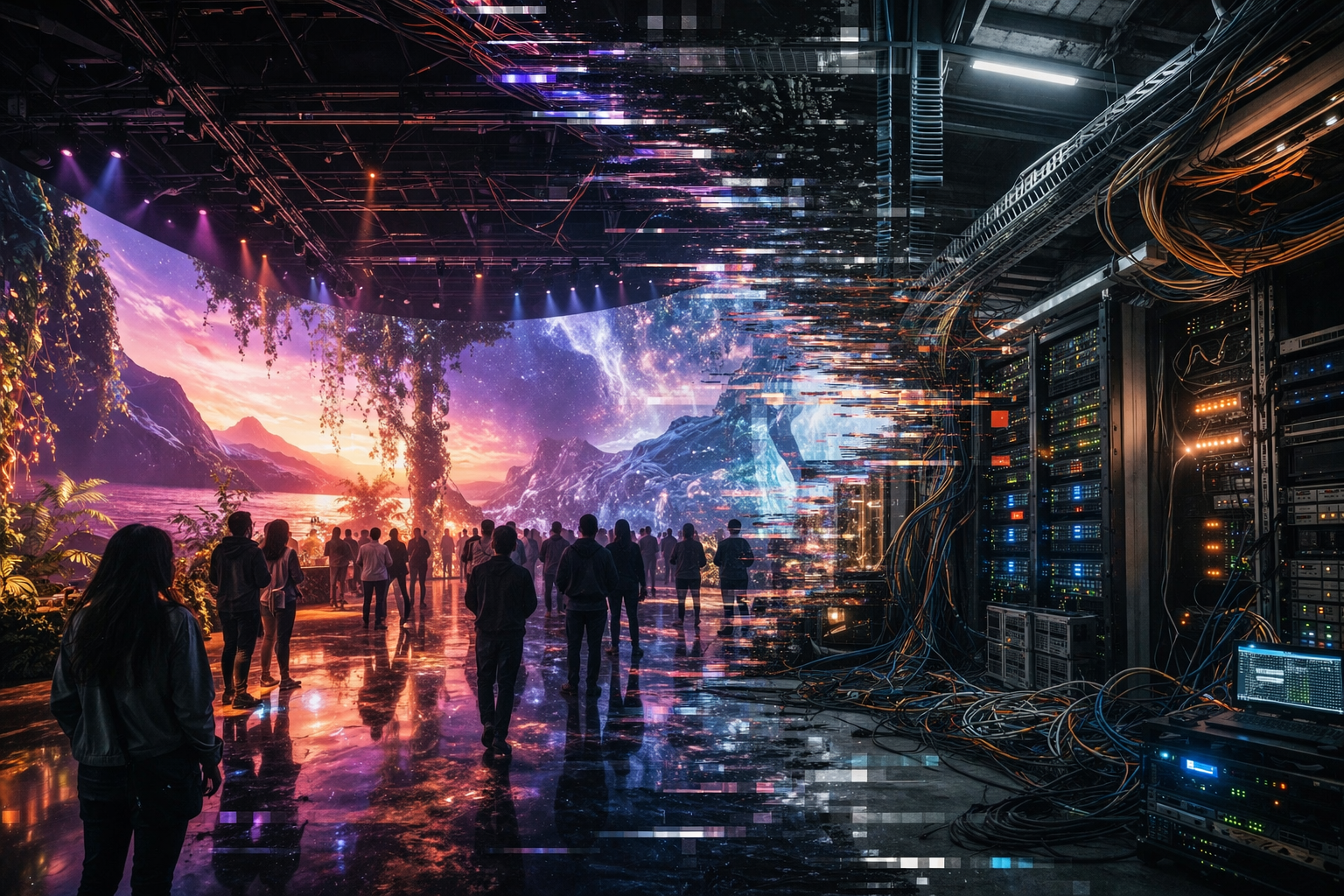
Most immersive projects do not run into trouble because of a lack of creativity. In many cases, the concept is strong, the storytelling is clear and the ambition is entirely valid. Where projects begin to struggle is in the layer beneath the experience itself: the infrastructure, system planning and integration logic that make the environment possible.
From the outside, immersive environments are usually judged by what is visible. Audiences experience the content, the sound, the spatial choreography and the atmosphere. Clients and stakeholders often focus on the reveal, the emotional impact and the uniqueness of the concept. However, the long-term success of an immersive environment is determined just as much by the systems that sit behind the walls, above the ceiling and inside the racks as it is by the experience presented to the audience.
This is where many projects begin to encounter risk. The problems are rarely dramatic at the outset. In fact, they often remain hidden during concept design and early development. It is only as the project moves into detailed design, procurement and delivery that the consequences of incomplete planning begin to surface.
One of the most common issues is the gap between individual system design and overall system integration. It is possible for the audio, visual, lighting and control components of a project to each be well considered in isolation, while the relationships between them remain insufficiently defined. When that happens, integration becomes reactive rather than intentional. Teams begin solving interface issues late in the process, often under time pressure, rather than building a coherent technical ecosystem from the beginning.
In practical terms, this creates unnecessary friction. Control logic becomes more complex than expected. Playback and automation systems require additional workarounds. Dependencies between systems are discovered during commissioning, when time is limited and changes are expensive. The outcome is not usually total failure, but rather a system that is harder to operate, harder to maintain and more fragile than it needed to be.
Hidden infrastructure dependencies are another frequent source of trouble. Immersive environments rely on a wide range of supporting conditions that are not always visible during early design conversations. Power distribution, data pathways, network architecture, rack locations, cooling, access for service and cable management all shape what is realistically achievable. When these requirements are not fully understood or coordinated early enough, they begin to constrain the project later.
A lack of power capacity may limit expansion or force redesign. Network infrastructure may not support the bandwidth required for content delivery or synchronisation. Poorly located equipment rooms or racks can make maintenance unnecessarily difficult. Inadequate cooling may affect reliability over time, particularly in enclosed spaces or demanding operating conditions. None of these issues are especially glamorous, but each has a direct effect on long-term performance.
Late-stage changes only amplify the problem. As creative direction evolves, stakeholder feedback is incorporated or new requirements emerge, modifications are introduced into systems that are already partly defined. At that stage, even a seemingly minor adjustment can create a ripple effect across the wider technical environment.
A change in media resolution may alter playback requirements, storage loads and network demands. A shift in layout may affect projection geometry, speaker coverage, sightlines and cable routing. A new interactive layer may introduce dependencies between show control, sensors, content logic and user experience design. These changes are sometimes necessary, but the cost and complexity of implementing them increase significantly as the project moves closer to delivery.
This is why many immersive projects appear manageable in principle but become strained in execution. What looks simple at concept level is often supported by a dense web of technical relationships that only become visible once the design is tested against the realities of infrastructure, procurement and integration.
The final stage where these issues become most visible is after handover. Once the project is operational, the focus shifts from design intent to daily performance. The question is no longer whether the environment can be made to work, but whether it can continue to work reliably, maintainably and predictably in the hands of the operational team.
This is often where poor early planning reveals itself most clearly. Systems may require specialist knowledge to troubleshoot. Maintenance access may be difficult. Updating content may involve more complexity than expected. Operators may inherit an environment that technically functions but was never properly designed around the practical realities of day-to-day use.
Over time, this affects the consistency of the experience. Reliability slips. Maintenance costs rise. Content becomes harder to refresh. The experience remains open, but gradually loses the robustness and clarity it had on launch.
None of this is unavoidable. In most cases, these issues are not caused by poor intent or a lack of capability. They are the result of projects being structured in ways that separate experience design from infrastructure thinking, or that delay system integration planning until too late in the process. When infrastructure, control logic, operational workflow and system interfaces are considered from the beginning, many of these risks can be reduced significantly.
At Blue Alchemy Labs, this has become a core principle in how we approach immersive environments. We see them not as collections of separate technologies, but as integrated systems that need to support a coherent audience experience over time. That means infrastructure is considered alongside storytelling, not after it. It means system architecture is addressed early enough to shape the design rather than simply react to it. And it means operational realities are treated as part of the design brief, not as a problem to be handed over at the end.
As immersive environments continue to evolve into long-term assets within destinations, museums and cultural institutions, the strength of the underlying system will matter more and more. The projects that succeed over time will not necessarily be the ones with the boldest visual gesture or the largest hardware budget. They will be the ones built on foundations that are coordinated, resilient and designed with the full lifecycle of the experience in mind.
Mike's illustrious career as a multi-award-winning Creative Technical Director is marked by his profound expertise in designing and executing large-scale fixed installations and live event projects that consistently redefine the frontiers of technology and innovation.
Over the span of more than two decades, Mike has meticulously honed his craft, amassing invaluable experience across a diverse range of industries, including live events, automotive exhibitions, financial expos, museums, science centres, and themed entertainment attractions. His ability to seamlessly adapt to these varied domains is a testament to his versatility and technical acumen.
Mike's extensive portfolio is an impressive showcase of his technical prowess, featuring a broad spectrum of projects, from intricately detailed small-scale endeavours to grand, technologically advanced installations. Collaborating with eminent institutions and corporate giants such as The Sphere – Las Vegas, Walt Disney Imagineering, Universal Studios, The Smithsonian Institute, The Adler Planetarium, The American Museum of Natural History, Apple, Barclays, Coca-Cola, Nike, Farah Leisure, Hyundai, Cedar Fair, Changi Airport Group, Merlin Entertainment, Dubai Parks and Resorts, and the BBC highlights the depth and technical diversity of his skill set.
What truly distinguishes Mike is his exceptional proficiency in merging creative artistry with cutting-edge technology. This intricate fusion is often overlooked in the industry, but it forms the cornerstone of his specialized skill set. Whether he's developing immersive environments that seamlessly integrate state-of-the-art audio-visual systems, interactive displays, and sensory experiences to educate and entertain or orchestrating intricate technical collaborations between creative and engineering teams, Mike consistently delivers projects that not only meet the highest technical standards but also captivate and engage audiences with unprecedented technical precision.
Mike's journey is a testament to his unwavering dedication to pushing the boundaries of immersive experiences and technical innovation. His visionary approach, complemented by his exceptional grasp of complex technical intricacies, has firmly established him as a luminary in the realm of creative and technical direction, setting new industry benchmarks and inspiring others to embrace the intricacies of technology and innovation.
-
Xchange Advocates are recognized AV/IT industry thought leaders and influencers. We invite you to connect with them and follow their activity across the community as they offer valuable insights and expertise while advocating for and building awareness of the AV industry.