
Strategic Path: Why Your Conference Room AI Deployments Are Stalling
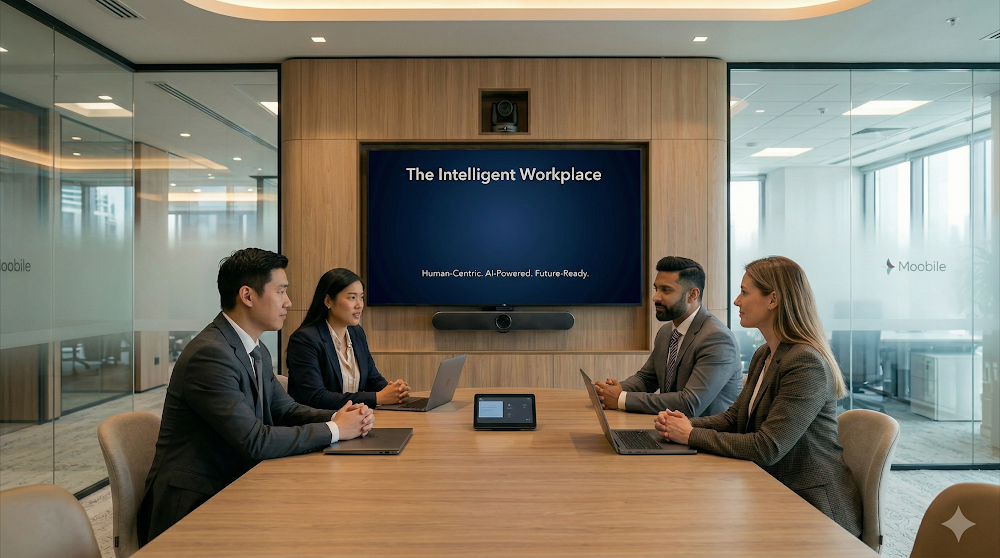
Your client's executive team approved the AI-enhanced meeting room rollout six months ago. The budget was approved, the technology selected, and the first phase deployed. But now the project is stuck in committee reviews, with IT raising security concerns, HR questioning data usage policies, and legal requesting impact assessments for every new AI feature activation.
This scenario is playing out in enterprises everywhere, and it reveals a critical misunderstanding that's slowing down every AV deployment involving AI capabilities. Leadership teams are treating AI governance like traditional IT oversight - as a series of approval gates and risk assessments that must be cleared before implementation. This approach turns governance into a deployment bottleneck rather than an enablement framework.
The problem is that most organizations approach AI governance reactively. They deploy the conference room transcription service, then discover they need policies for meeting data retention. They activate the intelligent camera tracking, then realize they need consent frameworks for participant recording. They enable AI-powered space analytics, then find themselves scrambling to address privacy concerns that should have been resolved months earlier.
This creates a vicious cycle where each new AI feature triggers a fresh round of policy development and risk assessment. Your deployment timeline extends indefinitely because governance becomes something that happens to your AV systems rather than something built into them from the design phase.
Successful AV integrators are taking a different approach. Instead of treating AI governance as post-deployment oversight, they're building governance frameworks directly into their system architecture and client engagement process. They're addressing data handling, consent management, and AI transparency requirements during the design phase, not after the equipment is installed.
This means having clear answers ready for predictable client questions: How does the meeting summarization AI handle sensitive information? What participant consent is required for intelligent room analytics? How can facilities managers audit AI decision-making in space optimization systems? When these governance elements are designed alongside the technology, deployment accelerates because teams aren't constantly stopping to develop new policies.
The most effective governance frameworks I'm seeing in the AV space focus on enablement rather than restriction. They establish clear operational boundaries within which room systems can function autonomously, and they provide transparent escalation pathways for edge cases. This allows your client's teams to leverage AI capabilities confidently without requiring IT approval for every feature activation or use case expansion.
For AV integrators, this governance-first approach creates a significant competitive advantage. While competitors are fighting through post-deployment policy battles, you're delivering fully operational intelligent workplace systems that your clients can scale immediately. The governance foundation becomes a deployment accelerator, not a roadblock.
Read the full analysis at intelligentworkplace.ai

Marc A. Remond is the founder of Strategic Pathways, a business advisory firm helping B2B technology leaders design and align the systems required to scale. With 25+ years of sales leadership across AV, UC, and enterprise technology, at Alcatel-Lucent, Polycom, and Barco, among others, he has built go-to-market strategies, channel ecosystems, and AI transformation programmes for global technology companies. He is the creator of the Intelligent Workplace Framework and the Human-AI Intelligence Charter, and writes on market expansion, sales execution, and AI-enabled workplace transformation for the AV and UC industry.
-
Xchange Advocates are recognized AV/IT industry thought leaders and influencers. We invite you to connect with them and follow their activity across the community as they offer valuable insights and expertise while advocating for and building awareness of the AV industry.




Please sign in or register for FREE
If you are a registered user on AVIXA Xchange, please sign in