Modern Workspaces And AV – The Strongest Message in the Room Might Not Be Spoken

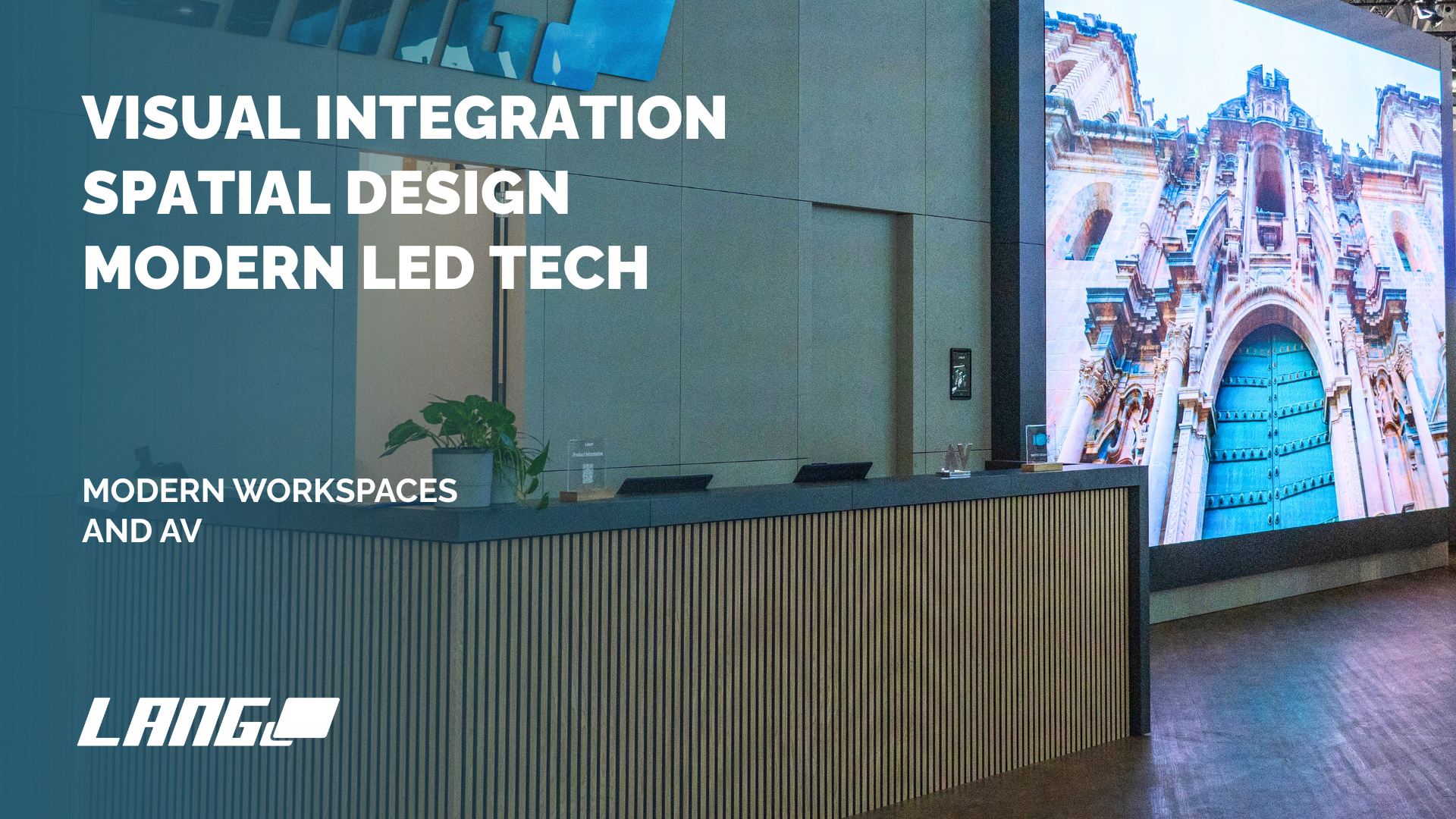

Whoever enters a conference room today rarely enters just a room. They enter a statement. About a company, about its culture, about the value it places on a conversation. Over the past few years, workspaces have evolved from functional places into communicative environments. They are no longer solely the place where work happens. Increasingly, they are the place where companies show who they are.
This fundamentally changes the expectations placed on spaces. Reception areas, meeting rooms and the areas between desks all carry a purpose that reaches far beyond pure functionality. They provide orientation, create identity and shape perception long before a meeting begins or a conversation takes place.
Spaces become part of the conversation
What might such a first impression look like? Imagine guests being welcomed in a reception area with their name and company logo displayed on a large transparent LED surface. Technically, the setup itself may seem rather unspectacular. Yet almost every guest seeing it for the first time takes a photo and shares it. The focus is not primarily on the technology itself, but on the impact that technology enables through such a personalised moment.
This is where the difference lies between a space that simply exists and one that creates an impression. Content moves through spaces far more dynamically today than it did just a few years ago and increasingly becomes part of an environment that can respond to different situations. Alongside light, materials and acoustics, modern video technologies have long become part of the language of contemporary spaces.
An LED surface that integrates itself into a room both visually and conceptually changes the perception of the entire environment. This requires early planning and a holistic way of thinking about every element involved.
AV becomes part of the spatial concept earlier
The earlier AV technology becomes part of a planning process, the greater the creative freedom becomes. Cable routing, ceiling structures, power distribution and acoustic requirements can then be considered from the very beginning and integrated either seamlessly or almost invisibly. The result is a space in which technology and architecture were conceived for one another.
Early integration means that questions can still be asked while all options remain open. Where should a display be positioned within a room to create impact? Which formats suit the size and use of the space? How does an LED surface interact with light, materials and the people moving through the environment every day? And can a planned transparent LED surface integrate organically into the space without dominating it visually? Those who answer these questions early gain access to a much broader range of possibilities.
Displays and LED continue to converge
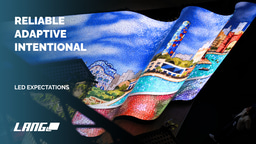
At the same time, the technology itself continues to evolve and opens up entirely new possibilities. The line between traditional displays and LED solutions is increasingly disappearing. LED has become finer, more flexible in format and more effective at close viewing distances. What was once designed primarily for large distances and event environments now performs equally well in spaces where people are standing only a short distance away.
The same development can be seen in transparent LED and active matrix applications. Content increasingly becomes an integrated part of existing surfaces and spatial structures while visual presence and spatial openness remain closely connected.
Modern technologies such as MicroLED in Package serve as a strong example of this development. They combine the scalability and format flexibility of LED with a level of image quality and pixel density that continues to move closer to that of traditional displays. Extremely fine pixel pitches allow viewing distances that perfectly suit conference rooms and reception areas. The image remains homogeneous even at short distances, in daylight conditions and in formats that extend far beyond what traditional displays once offered.
In practice, this enables curved surfaces, wall filling panoramas and seamless integration into architectural concepts. For projects with these kinds of requirements, MIP now represents a realistic option that simply did not exist in the past.
The most effective workspaces do not emerge where the most advanced technology has been installed. They emerge where space, content and technology have been considered together from the very beginning and as part of a shared concept.
Founded in 1978, LANG AG is a globally leading wholesaler of visual presentation technology, offering solutions for both rental and sales. Through innovation and technological pioneering, the company has earned an excellent reputation in the AV industry. LANG identifies promising technologies at an early stage and successfully supports them through to market maturity.
With independent subsidiaries in Switzerland, the United Kingdom, Spain, the United Arab Emirates, and the Netherlands, LANG serves the professional AV market across Europe and internationally. The company operates discreetly in the background, ensuring the highest level of confidentiality toward end customers.
A comprehensive portfolio of cutting-edge AV technology, around 220 dedicated employees, and long-term partnerships underscore LANG AG’s commitment to innovation – today and in the future.
Recommended Content
AV Ecosystems – Why the Best Setup Starts Long Before the First Screen Lights Up