AV Ecosystems – Why the Best Setup Starts Long Before the First Screen Lights Up


In our previous article, we showed what happens when two or more technologies enter into a conversation with each other: new potential emerges that no single medium could achieve alone. This, however, is merely the end result. Everyone in the industry knows only too well how many steps are required beforehand, how many stages need to be worked through, and how much hardware, maybe also software, and above all expertise it takes before content finally runs smoothly and does what it is supposed to do.
Little of this is visible or relevant to the audience. Yet these parts are just as important for the viewer in order to experience anything at all. It comes down to availability at the right moment, compatibility between components that come from very different worlds, and the knowledge that determines whether a setup works on paper as well as it does in the room. Anyone who has coordinated all of this from the ground up knows: the end result is only as strong as the chain behind it.
Anyone planning a complex AV setup will realise at some point that the most important questions are not exclusively technical in nature. Which components truly work together? What knowledge is needed to deploy them correctly? And who is there when it turns out during the build that theory and practice have drifted apart? An ecosystem like this, whether permanently installed or temporary, is more than the sum of its parts. Those who understand this early enough plan differently from the very start.
From the Invisible to the Visible
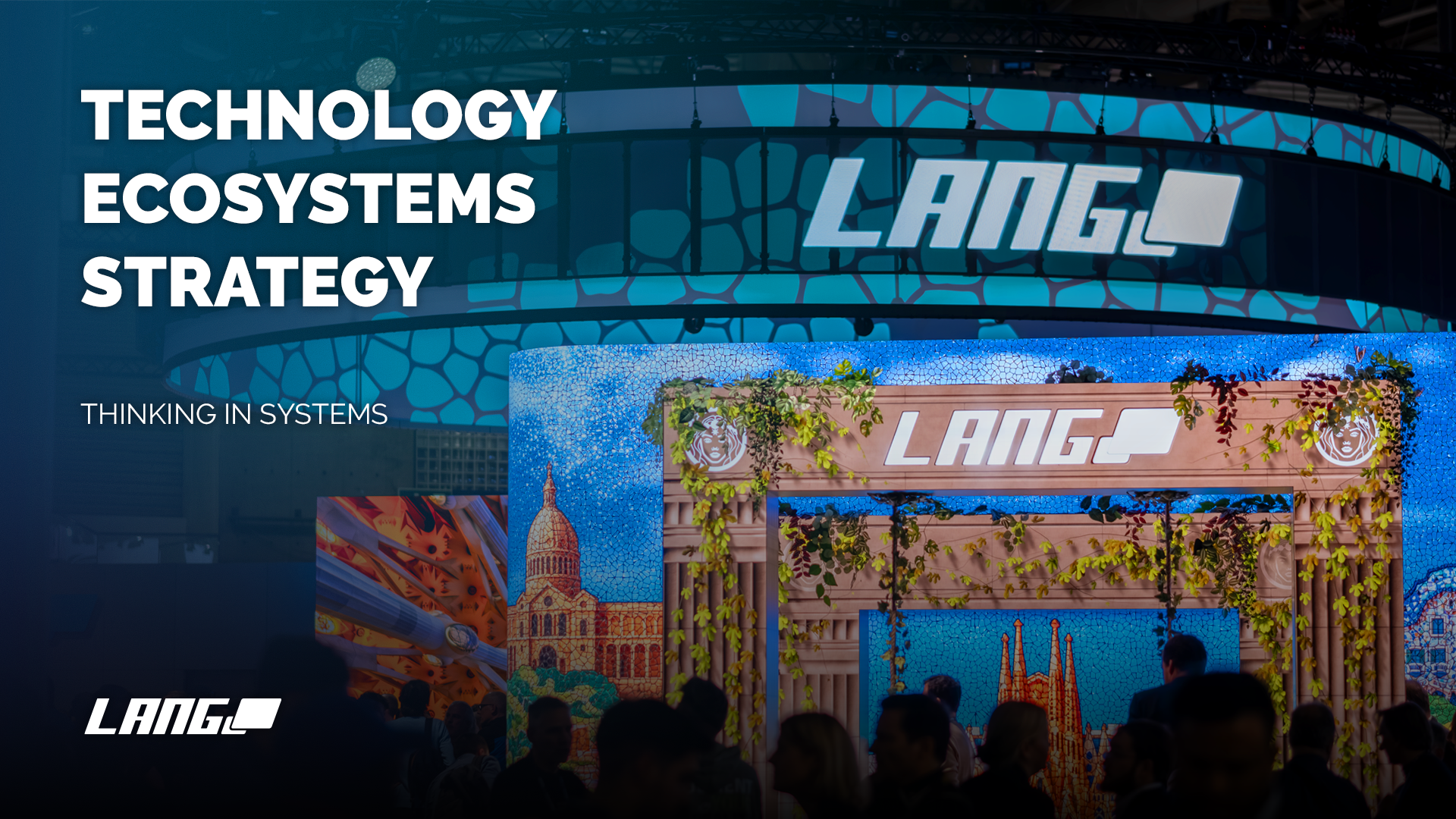
What this means in practice can be seen, for example, at our LANG booth at ISE 2026 in Barcelona. A booth like this does not begin with a product. It begins with an idea: not a showroom, but an experience.
That has consequences for everything that follows. For the build, which has to be planned so that dozens of components are in the right place at the right time. For the IP network running in the background, distributing all signals simultaneously at 300 Gbit/s. For the network peripherals, media servers and compositing switchers that ensure every signal reaches exactly where it needs to go, in the right format and at the right moment.
Only then, on this outwardly invisible foundation, does the visible take shape: LED walls with content coordinated across every surface, projection screens that combine with transparent LED to create a multi-dimensional image plane, a touch display running an interactive AV quiz, and an immersive installation in which a physical object placed on a surface triggers specific content.
Each of these elements serves its own purpose. Together, they form a system that only works because someone conceived it as one from the very beginning.
No Project Is the Exception
A trade show booth is no exception in this regard. Every project brings its own requirements, its own spatial logic, its own technical parameters, its own idea of what it should trigger in an audience. What changes are the components. What stays the same is the question behind them: what does this system need to function as a whole? Those who ask this question from the outset, and who can draw on a portfolio spanning everything from the network to the LED wall, from the media server to the consultancy, have more room to focus on what ultimately matters.
And in the end, the decisive question is rarely which product is the best. It is rather: who thinks the system through to the end alongside you?
Founded in 1978, LANG AG is a globally leading wholesaler of visual presentation technology, offering solutions for both rental and sales. Through innovation and technological pioneering, the company has earned an excellent reputation in the AV industry. LANG identifies promising technologies at an early stage and successfully supports them through to market maturity.
With independent subsidiaries in Switzerland, the United Kingdom, Spain, the United Arab Emirates, and the Netherlands, LANG serves the professional AV market across Europe and internationally. The company operates discreetly in the background, ensuring the highest level of confidentiality toward end customers.
A comprehensive portfolio of cutting-edge AV technology, around 220 dedicated employees, and long-term partnerships underscore LANG AG’s commitment to innovation – today and in the future.