InfoComm 26: The Question The Industry Needs To Ask Itself

Related Content

 The Intelligent Workplace™
The Intelligent Workplace™
The Operating Model for the Workplace of the Future
What InfoComm 2026 is staging
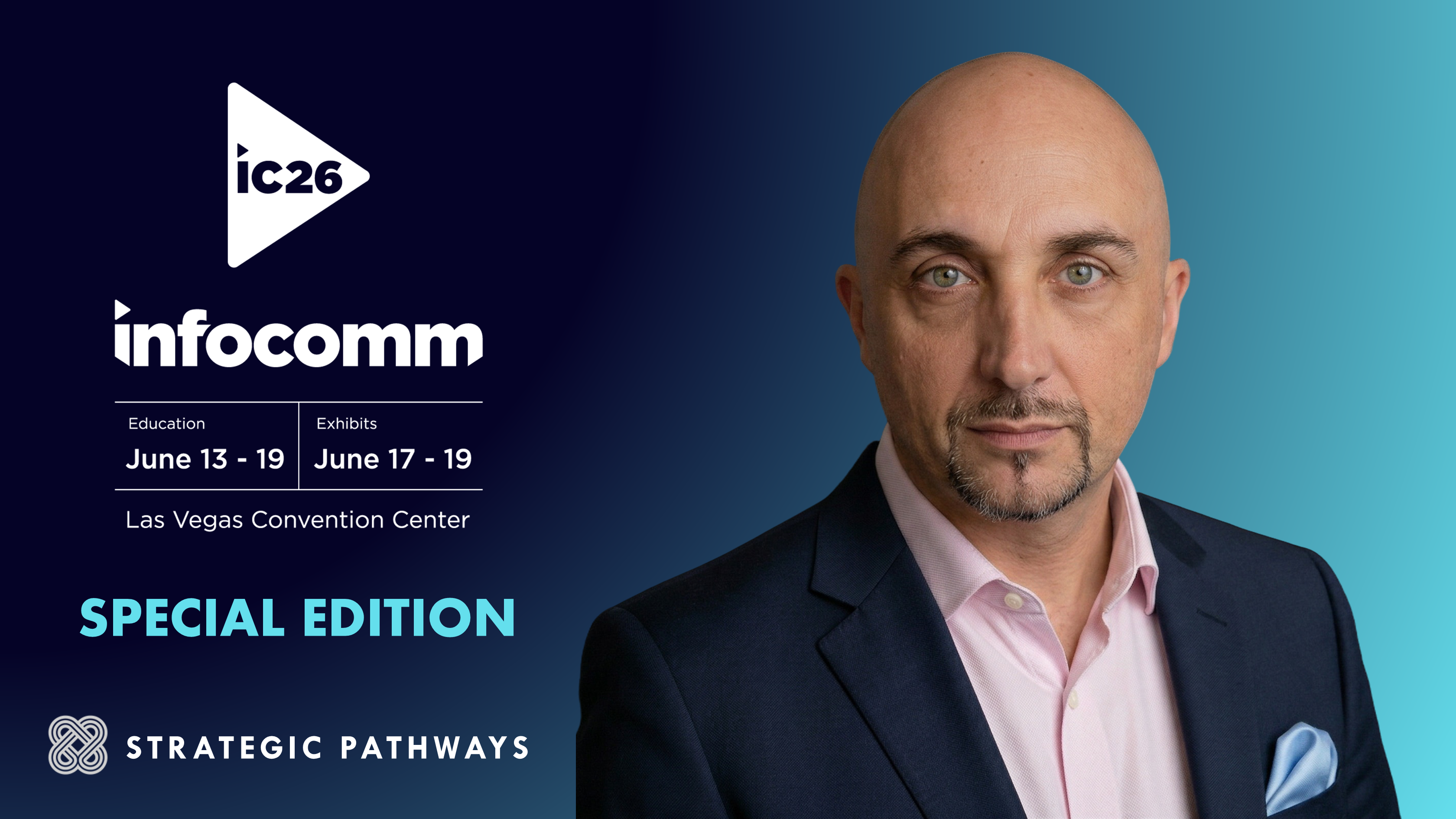
This year the show floor in Las Vegas is split in two, one hall for the workplace and one for entertainment and live events. For those of us who have worked this industry for years, that split says something. The workplace has become its own category, and AI is the force reorganising it. The keynote programme reflects the same shift. Microsoft will talk about intelligent workplaces and AI co-workers. Cisco will present Connected Intelligence with a roster of partners. The AVIXA AI Accelerator will showcase what is now technically possible. The direction is not in doubt. What happens after the buyer takes the kit home is.
What the industry needs to be honest about
A trade show is built to demonstrate capability, not to diagnose the buyer. That is what a show floor is for, and there is nothing wrong with it. But it leaves a gap that every integrator in this community has watched play out on a real project. The client buys the capable system, the system lands on a workflow that was never redesigned to use it, and six months later the adoption numbers are flat. The technology worked. The outcome did not. We have all scoped the deployment and then watched the value fail to arrive, and the reason was almost never the hardware.
The maturity question the survey data exposes
AVIXA's own Channel Survey now puts AI ahead of AV-over-IP as the technology expected to have the greatest business impact. The demand signal is clear. What the same data exposes, if you read it against what actually ships, is a maturity gap. Two organisations buy the same stack from the same integrator and get completely different outcomes. The variable is not the technology. It is the operating model the technology lands inside, and the readiness of the organisation to run it. One is mature enough to absorb the capability. The other bolts it onto a process that cannot hold it, and the investment underperforms.
The role of integrators in closing the operating model gap
This is where the channel has an opening that the show floor will not name. As services overtake hardware in revenue, the integrator who can advise on the operating model, not just specify and install the kit, owns the conversation that actually decides the project. The useful lens here is simple and it maps to four dimensions of any workplace.
- Workforce, the people and their capability to use the system.
- Workflow, the process and decision rights the system runs inside.
- Workspace, the room and the digital environment.
- WorkTech, the technology itself, which is the one dimension the whole show is built around.
An integrator who scopes all four is selling an outcome. An integrator who scopes only the fourth is selling a box and leaving the risk with the client.
What the AVIXA community should look for next week
So here is the question worth carrying onto the floor, or into the livestream if you are watching from this side of the world. Not what does this product do. Where does it sit in the client's operating model, which of the four dimensions does it serve, and what does it assume about the other three. Ask that of every booth. The vendors who can answer it are worth your time. The ones who cannot are selling you a quadrant and calling it the workplace. The technology at InfoComm 2026 will be genuinely impressive. The advantage will go to the people in this community who diagnose the workplace before they decide what to buy.
Value propositions fail structurally before they fail creatively. The approach is documented in the Market Narrative engine and the Intelligent Workplace.
Explore further: The Intelligent Workplace and Capability Delivery.

Marc A. Rémond is the founder of Strategic Pathways, a business advisory firm helping technology leaders design the business operating models required to scale.
With 25+ years of sales leadership across AV, UC, and enterprise technology, at Alcatel-Lucent, Polycom, and Barco, among others, he has built go-to-market strategies, channel ecosystems, and AI transformation programmes for global technology companies.
He is the creator of the Intelligent Workplace™, the 4W/4D/4C/4P Frameworks, the Strategic Diagnostic Engine, and the Human-AI Intelligence Charter, and the architect of the Synchronised Growth Architecture.
He is the author of EVOLVE-OR-DIE.AI: Leading in the Era of Human and AI Intelligence, available on Amazon and Apple Books, and the architect of the Intelligent Leader Programme, a twenty-eight module executive curriculum.
He runs two authority brands, an advisory practice, seven content pipelines, and the Intelligent Leader Programme as a single operator.
He writes on market expansion, sales execution, market narrative and workplace transformation at strategicpathways.asia and intelligentworkplace.ai.
Follow him on LinkedIn at linkedin.com/in/marcalexremond.
-
Xchange Advocates are recognized AV/IT industry thought leaders and influencers. We invite you to connect with them and follow their activity across the community as they offer valuable insights and expertise while advocating for and building awareness of the AV industry.