Building Beyond: When the Room Is Part of the Care

In an office, a room that won't cooperate costs you seven minutes and a little dignity. In a hospital or a classroom, the same friction costs something you can't get back.
Consider the clinical environment. A nurse who has to fight three systems to do one thing is a nurse whose attention is elsewhere, not on the patient. The alarms that sound so constantly that no one hears the one that matters — alarm fatigue — are an environmental failure with a body count. The cognitive load an intensive care unit imposes on the people running it isn't a comfort problem; it's a safety problem, and it is built in.
Now the classroom. A teacher who burns the first ten minutes of every period coaxing the display to life has lost the most valuable minutes of the lesson — every day, in every room that wasn't built to be walked into and used.
These look like different problems. They're the same seam failing — the gap between systems where experience lives — with the stakes turned all the way up.
The response is the same framework, tuned for environments where the experience is the outcome. Start from the human function: keep people safe and help them heal; develop a mind. Then let the recurring patterns do the work. In the clinical space, drive down cognitive load and let intelligence run in the background — sensing a patient's deterioration before the bedside knows, surfacing the one alarm that matters — so clinicians can focus on the work of care without fighting the systems between them and it. In the learning space, treat simplicity as an equity strategy: a room any teacher can walk into and use without a manual, usable in every classroom rather than excellent in a few, with analytics that quietly flag students who are drifting before they're lost.
There's a line to walk here, and the book is firm about it. The same background intelligence that notices a failing patient or a disengaging student is built on sensing that can just as easily watch people for someone else's purposes. In a hospital or a school, that weight is heavier than anywhere else. What gets sensed, stored, and inferred is a governance decision every time — never a default you reach for because the capability happens to be sitting there.
Get the balance right, and the environment stops being something the staff endures and becomes part of how the work succeeds. The outcomes that matter — safety, recovery, attention, retention — aren't separate from the room. They run through it.
Building Beyond is open for pre-order ahead of its October 1, 2026 release. Both of these environments have a field guide of their own — Healthcare and Learning — two-part workshops that carry this framework into a real clinical or campus project, each with worked cases from the field. The diagnostic tools from the series are in development and land after the book.
Next in this series: the objection I hear most — surely every kind of space needs its own playbook — and why it's wrong.
# # #
This series of articles is based on my forthcoming book, Building Beyond: Human Experience and the Future of the Built Environment, a framework for building places that adapt, perform, and elevate human potential, to be published in Q4 2026 by Laquilan Press.
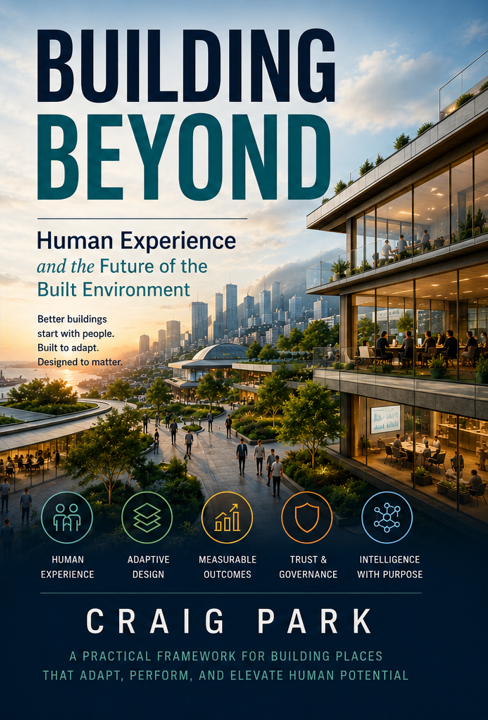
If you are interested in reading and commenting on an Advanced Review Copy, please drop me a note at craig@craigpark.com.

As an architect by training (BS Architecture, Cal Poly SLO) and a collaborative technologist with four decades of practice, I’m passionate about mentoring the next generation of AV professionals at the intersection of technology, strategy, and leadership. I have been active in AVIXA since 1986 and served on the national board from 1993–2000. I am a Fellow of the Society for Marketing Professional Services (SMPS) and an Associate member of the American Institute of Architects.
I serve as Director of Digital Experience Design at Clark & Enersen, a 200-person interdisciplinary architecture and engineering firm, where I lead the planning and design of integrated audiovisual and digital experience environments for higher education, healthcare, and research clients.
My expertise spans systems design, integrated building technology planning, and strategic business development. I bring an award-winning, B2B design-thinking approach developed through leadership roles with national AEC and technology firms.
Across both institutional and consulting roles, I have led marketing and growth strategy, designed future-ready learning and simulation environments, and helped organizations implement AI-powered tools that scale expertise and performance.
-
Xchange Advocates are recognized AV/IT industry thought leaders and influencers. We invite you to connect with them and follow their activity across the community as they offer valuable insights and expertise while advocating for and building awareness of the AV industry.