
Restaurant Technology Guide 2026

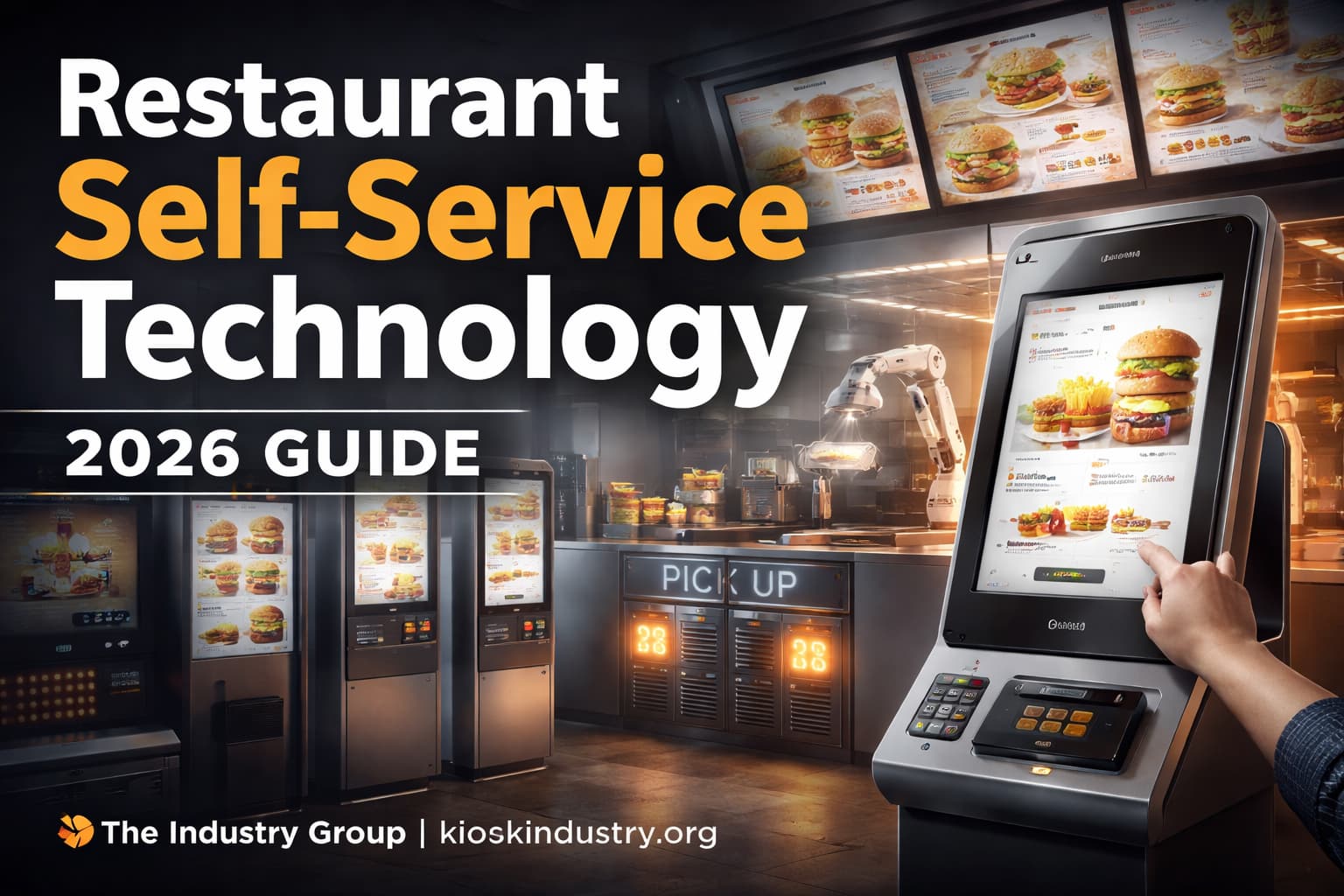


Good to Know Regarding Restaurants and Self-Service
Kiosks, AI, Payments & the Modern Restaurant Stack
Restaurants are no longer asking if they should deploy self-service—they are deciding how fast they can scale it.
Labor pressure, rising costs, and customer expectations for speed have pushed digital ordering from “nice-to-have” to core infrastructure. Whether it’s a self-order kiosk in a QSR, AI voice ordering in the drive-thru, or mobile-first pickup with smart lockers, the interface between customer and restaurant is being redefined.
At The Industry Group (TIG), we view this shift as structural—not cyclical.
Self-service is now the digital front door for restaurants.
Executive Snapshot (2026)
-
15–30% average ticket uplift with self-order kiosks
-
20%+ throughput improvement in high-volume QSR environments
-
77%+ of transactions cashless in North America
-
China leads globally in deployment density and automation scale
-
ROI payback typically achieved in 6–18 months
The Restaurant Self-Service Stack
The biggest mistake buyers make is thinking in terms of “kiosks.”
The reality is a three-layer stack:
1. Hardware Layer
Physical infrastructure that enables interaction
-
Freestanding and countertop kiosks
-
Outdoor/drive-thru units
-
Digital menu boards
-
Payment terminals (EMV/contactless)
-
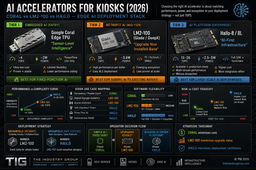
Edge AI compute (Intel Core Ultra, ARM, NVIDIA Jetson)
- KIOSK Information Systems – Kiosks & Software
- Giada
- Actineon
- Insight Touch
-
Printers, scanners, cameras
2. Software Layer
The intelligence and workflow
-
Kiosks are Backend + Middleware + actual Kiosk UI
-
Ordering UI / UX
-
POS integration (Toast, NCR, Oracle, Clover)
-
Kitchen Display Systems (KDS)
-
Loyalty + upsell engines
-
Remote Device Management (RDM/MDM)
-
Content Management Systems (CMS)
- Examples
- Nanonation
- 22Miles
- KIOSK Information Systems
- meldCX – analytics software
3. Services Layer
What actually makes it work at scale
-
Installation & site surveys
-
Field service / break-fix
-
SLA management
-
Remote monitoring
-
Content updates
-
Analytics and optimization
Key Takeaway
Hardware gets deployed. Software runs the experience. Services determine success.
Types of Restaurant Self-Service
Self-Order Kiosks (QSR / Fast Casual)
-
Highest ROI segment
-
Drives ticket size and order accuracy
-
Ideal for high-traffic environments
Drive-Thru Automation
-
AI voice ordering
-
Digital confirmation boards
-
Queue optimization
Table Ordering / Hybrid Models
-
QR + kiosk combinations
-
Reduces waitstaff dependency
Smart Pickup & Lockers
-
Off-premise + delivery optimization
-
Reduces congestion at counters
Unattended Retail / Vending
-
Expands restaurant footprint beyond store
-
24/7 micro-market capability
Reality Check
No single model wins everywhere.
Winning operators deploy hybrid strategies.
Payments & POS Integration
Payments are no longer just a feature—they are a gating factor.
Core Requirements:
-
EMV compliance
-
Contactless (NFC, Apple Pay, Google Pay)
-
Mobile wallet support
-
Offline transaction capability
Integration Challenges:
-
Legacy POS systems
-
Closed APIs
-
Certification requirements
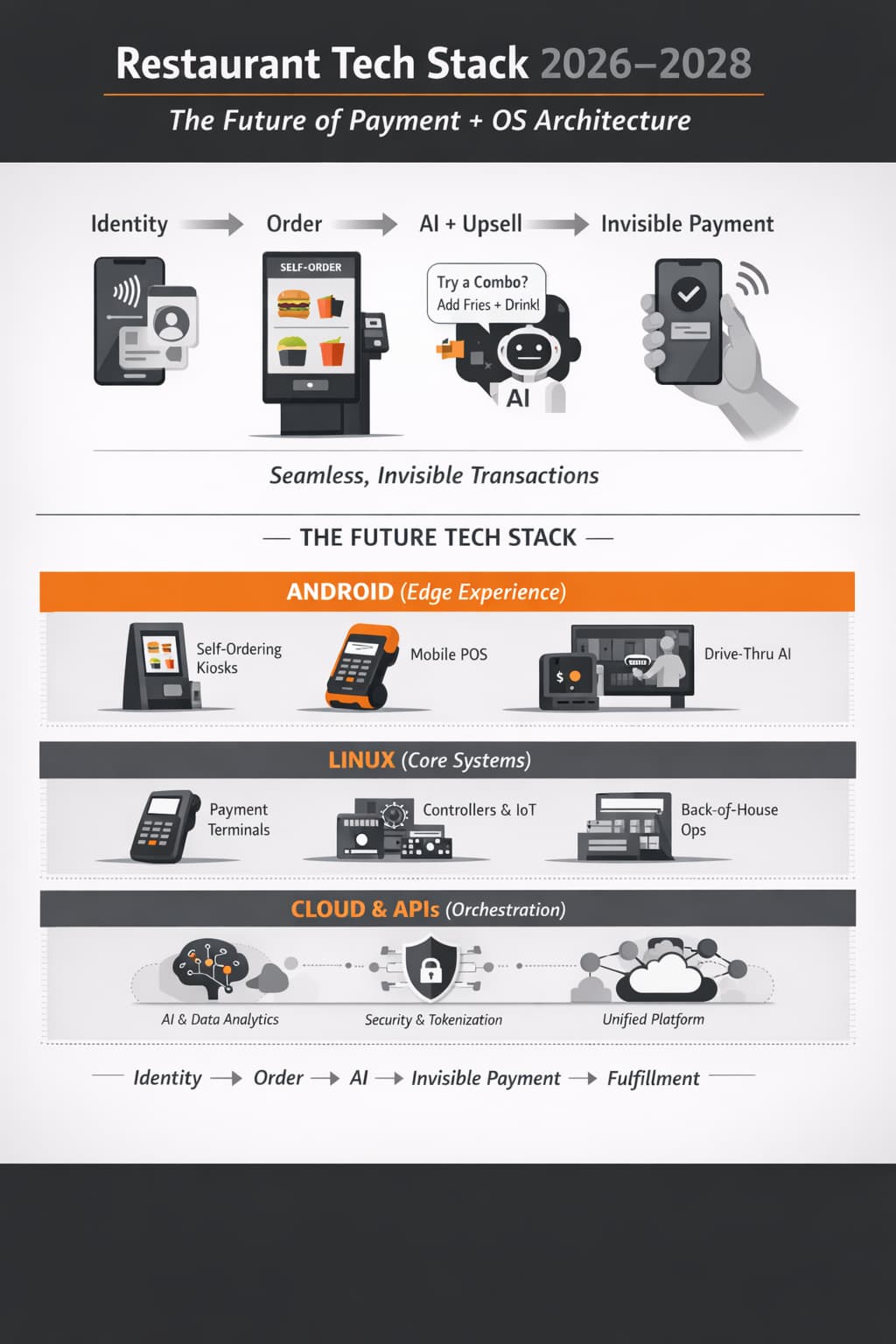
OS Trends:
-
Android: growing fast (cost + flexibility)
-
Windows: enterprise stability
-
Linux: niche but efficient
Key Takeaway
The kiosk is only as good as its POS integration.
AI in Restaurants (2026 Reality)
AI is no longer experimental—it’s operational.
Where AI is working today:
Voice AI (Drive-Thru)
-
Automated ordering
-
Labor reduction + consistency
Computer Vision
-
Queue detection
-
Theft/fraud monitoring
Personalization Engines
-
Upsell recommendations
-
Dynamic menus
Edge AI vs Cloud
-
Edge = lower latency, better privacy
-
Cloud = training + scale
TIG POV
Edge AI is becoming mandatory for high-volume restaurant environments.
ROI & Business Case
This is where decisions get made.
Typical Gains:
| Metric | Impact |
|---|---|
| Average Ticket | +15–30% |
| Throughput | +20% |
| Order Accuracy | Significant improvement |
| Labor Efficiency | Redeployment vs reduction |
Sample ROI Model
-
Kiosk cost: $3,500–$7,000
-
Monthly lift per store: $2,000–$8,000
-
Payback: 6–18 months
Key Takeaway
Kiosks don’t replace labor—they increase revenue per labor hour.
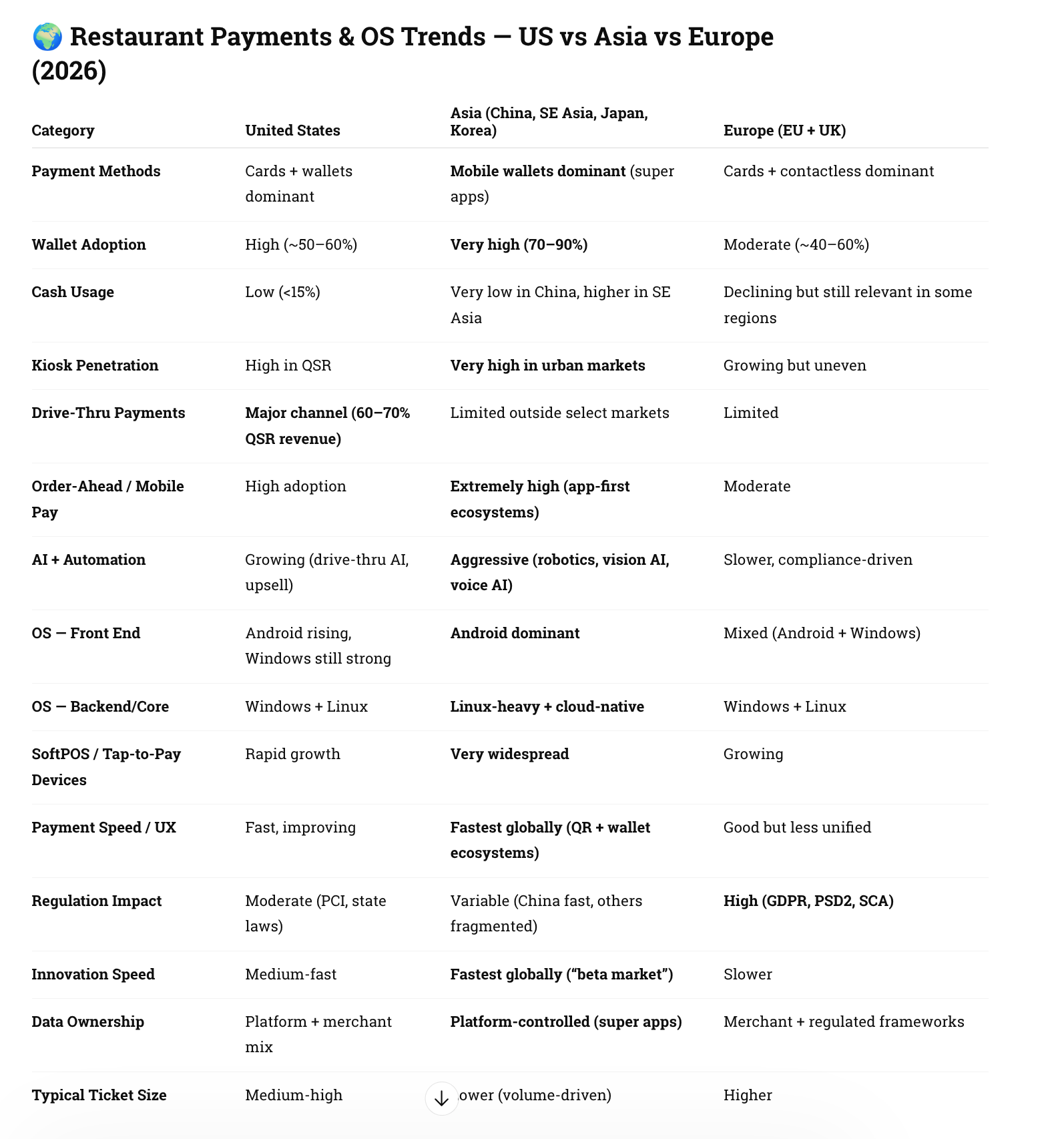
Global Market Comparison
United States
-
Focus: labor efficiency + POS integration
-
Strong QSR adoption
China
-
Fully automated ecosystems
-
Super apps + dense deployments
-
Global leader in scale
Europe
-
Compliance-driven
-
Strong accessibility focus
-
Slower but structured rollout
Insight
China is the “future state,” the US is the “business case,” and Europe is the “compliance model.”
Compliance & Accessibility
Critical Areas:
-
ADA / ABA (US)
-
PCI DSS 4.0
-
GDPR (EU)
Common Mistakes:
- Inattention to ABA standards
-
Incorrect reach ranges
-
Ignoring accessibility UX
-
Weak payment security implementation
Key Takeaway
Compliance is not optional—it is design input.
Deployment Playbook
Proven rollout sequence:
-
Define business objectives
-
Map customer journey
-
Select hardware/software
-
Conduct site surveys
-
Pilot deployment
-
Scale rollout
Common Failure Points:
-
Poor integration planning
-
Underestimating service requirements
-
Ignoring site constraints
Vendor Ecosystem
Key Categories:
-
Kiosk manufacturers
-
Software providers
-
POS vendors
-
Payment providers
-
Integrators
- Examples
Trends (2026–2028)
-
AI-native kiosks
-
Voice-first ordering
-
Cashless dominance
-
Edge AI standardization
-
Retrofit vs replace strategies
❓ FAQ
Are kiosks worth it?
Yes—if throughput and ticket size matter.
How many kiosks per store?
Typically 2–6 depending on volume.
What is typical cost?
$3K–$7K per unit plus software/services.
Do kiosks replace staff?
No—staff shifts to higher-value roles.
Related Resources
- Self-Service Technology Statistics
- Services
- Kiosk Hardware
- Kiosk Software
- Healthcare
- Edge AI
- FAQ – What is a kiosk?
Final Takeaway
Restaurant self-service is no longer a technology decision.
It is a business model decision.
Operators that embrace it are seeing:
-
Higher revenue
-
Better customer experience
-
More scalable operations
Those that don’t will struggle to compete.
Work With The Industry Group
-
Explore partner ecosystem
-
Join TIG
-
Access Buyer Intelligence
-
Participate in industry events
More Resources
- Payment
- Standards
- ANSI’s U.S. Standards Strategy 2026
- The New Modality Stack: How Interactive Systems Are Moving Beyond the Touchscreen
- Kiosk Design for Long Lifecycle – v2
- Accessibility and Self-Service Kiosks Video by Storm and imageHOLDERS
- Accessibility Mandate Kiosks
- The Retail Imperative for Multimodal, Accessible Self-Service
- Experience Dot Inc.’s AI & Tactile Revolution at CSUN 2026!
- EV Charging ANSI Standards Panel (EVSP)
- AI
- Lenovo ThinkEdge versus Portwell at EuroShop
- Posiflex Redefines Self-Service with AI Food Recognition and Multimodal SOK Kiosks
- Giada Converging with embedded/industrial and gaming/robotics computing
- Gesture Recognition AI Arrives at HIMSS
- AI Reflections for November 2025
- Conversational AI and Voice Order
- Service
-
Case Studies For Kiosks – The Good, the Bad and the Ugly
Learn from the Best and the Worst Kiosk case studies can be difficult to locate. Most companies with a strong case …
-
Part Two — SMB Service Selection Framework for Kiosks
Part Two – Selection Framework Editors Note — This post has two main sections — Writer+AI and Writer Only— How AI …
-
PART One — SMB Service Selection Framework for Kiosks
Introduction: Why Service Decisions Matter More Than Hardware Price Editors Note — This post has two main sections — Writer+AI and …
- Kiosk Service – Kiosk Warranty and Kiosk Maintenance
-
Case Studies For Kiosks – The Good, the Bad and the Ugly
End of content
The Industry Group (aka Kiosk Association) comprises various related technology sites and news feeds from kiosks to digital signage to POS and Smart City. Retail Automation and EV Charging are others. Self-service technology (SST) is a type of technology that allows customers to perform various tasks without the assistance of a human. SSTs can bring many benefits to both customers and businesses, including cost savings, improved efficiency, and better customer experience.
The Kiosk Association comprises companies involved in self-service, digital signage, digital menus, outdoor technology, kiosks, point-of-sale, smart city, healthcare, telehealth, voice order, thin client, EV charging and retail automation.
Gold
- Pyramid Computer – Kiosks
- Olea Kiosks – custom/standard
- Intel Computing
- Vispero JAWS Screen Reader
- KIOSK Information Systems – Kiosks
- 22Miles Digital Wayfinding
- LG Business Kiosks Digital Signage
- Acquire Digital Software
- Sitekiosk Software
- Ingenico Payment
- imageHOLDERS Kiosks
- REDYREF Kiosks
- Crane CPI Payment Systems
- KT Group Kiosks
- Goldfinger Monitors – Digital Signage
- Giada Edge AI Mini-PCs more
- URway Holdings Conversational AI
- NZ Technologies Inc. Touchless Tech
- Innovative Technology – Cash Experts
- Best Kiosk ODM and OEM
- Kiosk Innovations Custom Design Engineering
- Full List
Silver
- MRI — outdoor smart city
- FEC Kiosks – standard kiosks
- UCP Unattended Payments payment terminals
- Datacap Systems, Inc. kiosk payment systems
- NMI — payment gateway
- Storm Interfaceassistive tech
- UST Vision Checkout — Built on AI. Designed for impact.
- Pantheon Creatives Pte Ltd – AI-powered digital humans
- panachedigilife.com – AI & IOT solutions
BRONZE
- Tech For All – accessibility consultants
- Self-Service Networks – gift card software
- Advanced Kiosks government
Associates
- WelcomeWare – virtual receptionist
- Insight Touch touchscreens + kiosks
- BOCA Systems Ticket & Receipt Printers
- Alveni– custom kiosks software
- SysTech Displays, Inc. — Braille, ATM decals
- Xtreme Power — kiosk UPS
- Pyramid Technologies kiosk printers
- TDS TOUCH Touchscreens AIO computers
- Actineon – Computers
- VidaBox Tablets
- PhotoAiD passport photo service
Featured
- Asia Self-Service – APAC
- Europe Self-Service – EU
- SelfService.io Hub site
- For Purchase


Please sign in
If you are a registered user on AVIXA Xchange, please sign in