Strategic Path: Why Your Meeting Room AI Training Is Missing the Real Problem
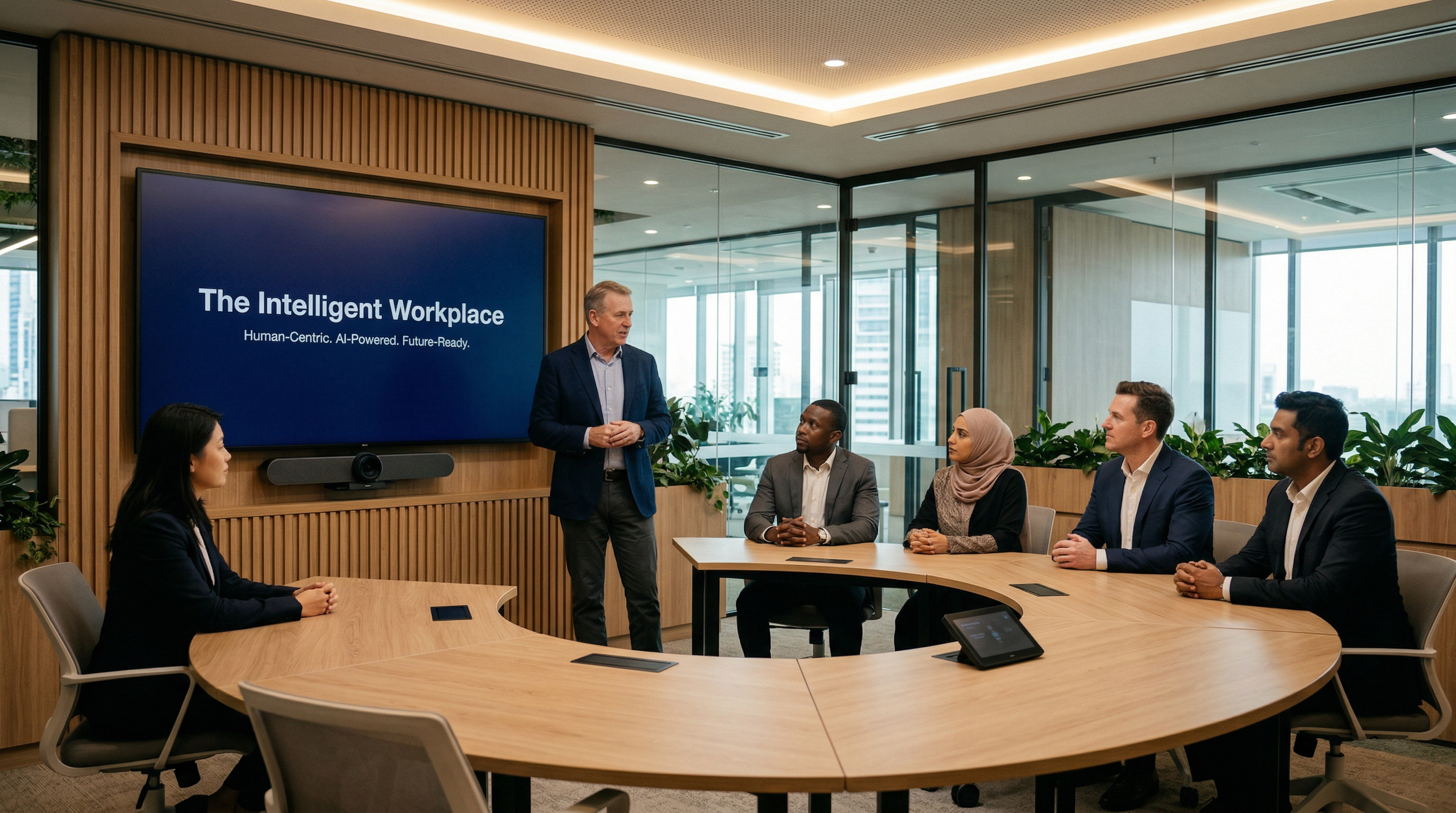

Your client just spent $50,000 on AI-powered meeting solutions and comprehensive user training. Three months later, adoption rates are still below 20%. The problem is not that employees need more training on prompt engineering or AI features. The problem is that they cannot actually use what they learned.
I recently worked with an enterprise client whose legal team had completed extensive training on AI meeting transcription and analysis tools. When I visited their offices, I discovered they were still taking manual notes in every conference room. The reason? Their IT department had restricted access to the AI platform they trained on, and the approved alternative lacked the features they had learned to rely on. The $30,000 training investment was rendered worthless by a procurement decision made six months later.
This scenario reveals why so many AI-enabled conference room deployments underperform expectations. Integrators focus on technical training - teaching users how to activate voice commands, configure meeting preferences, or generate AI summaries. But the real barrier to adoption is enablement: whether users have the access, authority, and organisational support to actually apply these capabilities in their daily workflows.
Consider the enablement gaps that kill AI adoption in conference rooms.
- First, technical access barriers. Your perfectly trained users discover that the AI features they learned are blocked by security policies, require approval workflows that take weeks, or are only available on devices they cannot access.
- Second, decision authority gaps. Department heads understand the potential of AI meeting analytics but lack the authority to modify existing meeting protocols or approve new workflows that would leverage these insights.
- Third, cultural permission to experiment. Teams will not engage meaningfully with new AI tools if they fear being seen as inefficient during the learning curve or worry about making mistakes with sensitive client data.
Successful AI conference room deployments require a systems approach to enablement. Instead of focusing solely on user training, leading integrators now establish AI experimentation zones where teams can trial new features without affecting production workflows. They create support partnerships between AI-curious users and technical specialists. Most importantly, they work with clients to modify success metrics that reward intelligent experimentation, not just flawless execution.
One healthcare company increased their AI meeting tool usage by 300% in six weeks, not through additional training but by establishing clear protocols for experimentation, creating technical sandboxes for safe testing, and empowering department heads to modify meeting workflows based on AI insights. The difference was enablement design, not education design.
This distinction matters for every AV integration. When clients struggle with AI adoption, the instinct is to provide more training. But training-focused approaches create learned helplessness - users become dependent on formal instruction for every new feature. Enablement-focused approaches build adaptive capacity, helping users become self-sufficient as AI capabilities evolve.
The question for integrators is not whether your client's team attended enough AI workshops. The question is whether they have the technical access, decision authority, and cultural permission to turn that training into actual room utilisation and workflow improvement.
Read the full analysis at intelligentworkplace.ai
Delivering this is a capability question. The approach is documented in the Capability Delivery engine.

Marc A. Rémond is the founder of Strategic Pathways, a business advisory firm helping technology leaders design the business operating models required to scale.
With 25+ years of sales leadership across AV, UC, and enterprise technology, at Alcatel-Lucent, Polycom, and Barco, among others, he has built go-to-market strategies, channel ecosystems, and AI transformation programmes for global technology companies.
He is the creator of the Intelligent Workplace™, the 4W/4D/4C/4P Frameworks, the Strategic Diagnostic Engine, and the Human-AI Intelligence Charter, and the architect of the Synchronised Growth Architecture.
He is the author of EVOLVE-OR-DIE.AI: Leading in the Era of Human and AI Intelligence, available on Amazon and Apple Books, and the architect of the Intelligent Leader Programme, a twenty-eight module executive curriculum.
He runs two authority brands, an advisory practice, seven content pipelines, and the Intelligent Leader Programme as a single operator.
He writes on market expansion, sales execution, market narrative and workplace transformation at strategicpathways.asia and intelligentworkplace.ai.
Follow him on LinkedIn at linkedin.com/in/marcalexremond.
-
Xchange Advocates are recognized AV/IT industry thought leaders and influencers. We invite you to connect with them and follow their activity across the community as they offer valuable insights and expertise while advocating for and building awareness of the AV industry.