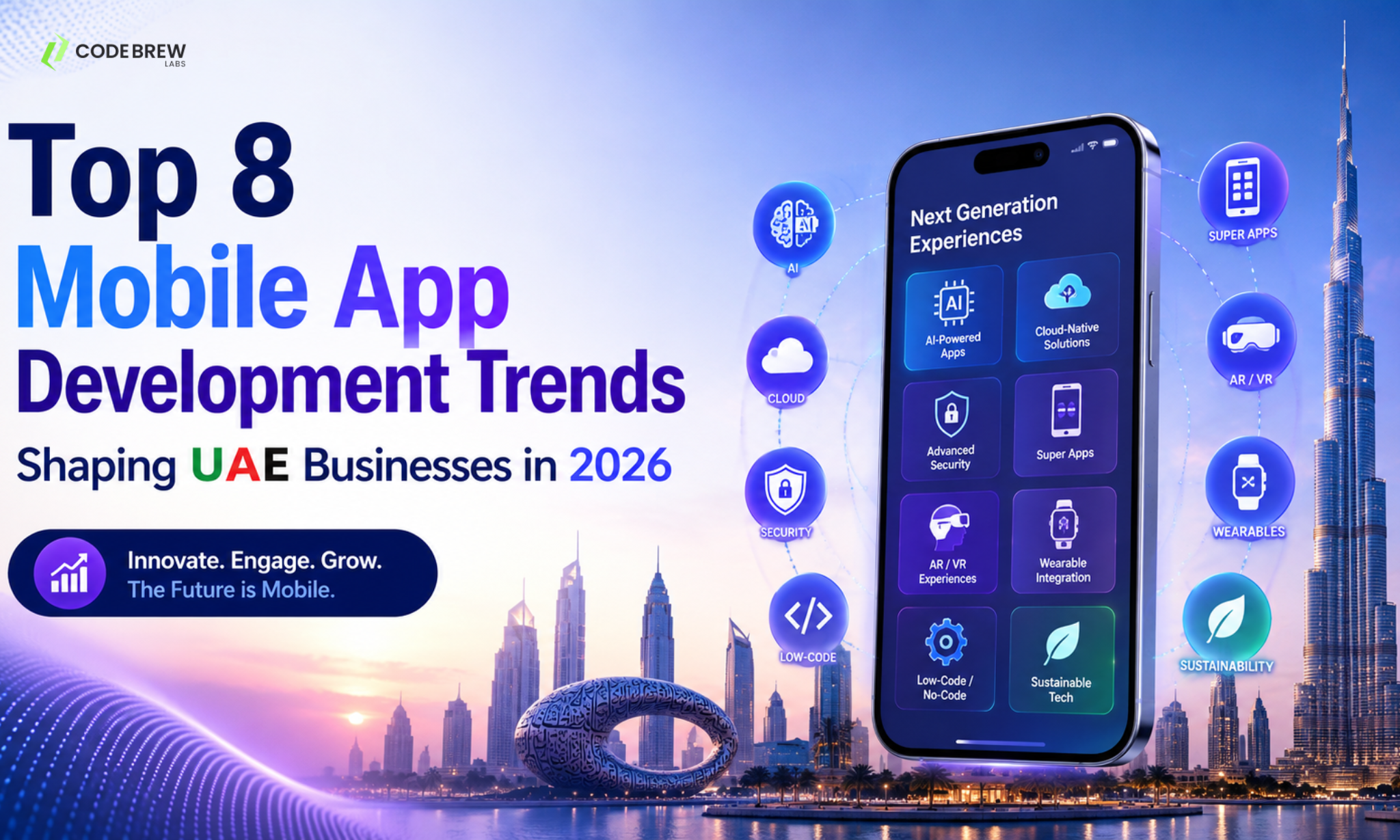
Top 8 Mobile App Development Trends Shaping UAE Businesses in 2026
Introduction
The United Arab Emirates (UAE) has become one of the world's fastest-growing digital economies, driven by ambitious government initiatives, widespread smartphone adoption, and a thriving startup ecosystem. As businesses across Dubai, Abu Dhabi, Sharjah, and other emirates continue their digital transformation journeys, mobile applications have become essential tools for improving customer experiences, streamlining operations, and driving sustainable growth.
Today, mobile application development has taken a giant leap beyond building just functional apps. Organizations now leverage a wide range of leading-edge technologies like artificial intelligence (AI), the Internet of Things (IoT), cloud computing, and blockchain, along with immersive experiences, to cater to customer demands for the most convenient and secure digital experience possible.
From retail and healthcare to finance, logistics, hospitality, and real estate, companies across the UAE are investing in innovative mobile applications to remain competitive in an increasingly digital marketplace.
In this article, we'll explore the top eight mobile app development trends shaping UAE businesses in 2026 and how these innovations are transforming industries while creating new opportunities for growth.
1. AI-Powered Mobile Applications Become the Standard
Artificial Intelligence has evolved from a competitive advantage into a business necessity. In 2026, AI is integrated into almost every successful mobile application across the UAE.
Businesses are leveraging AI to provide:
- Personalized recommendations
- Intelligent chatbots
- Predictive analytics
- Voice-enabled search
- Customer behavior forecasting
- Automated customer support
For example, UAE eCommerce apps recommend products based on browsing history, while banking apps use AI to detect suspicious transactions in real time. Healthcare providers utilize AI-powered symptom checkers and appointment assistants to improve patient experiences.
Machine learning algorithms continuously improve application performance by understanding user behavior, resulting in better engagement and higher customer satisfaction.
As AI tools become more accessible, businesses of all sizes can integrate intelligent features without requiring massive development budgets.
2. Super Apps Continue to Dominate the Market
Consumers increasingly prefer using a single application for multiple services instead of downloading separate apps for every need. Inspired by global success stories, UAE businesses are embracing the Super App model by combining services such as:
- Digital payments
- Shopping
- Food delivery
- Transportation
- Healthcare bookings
- Loyalty rewards
- Financial services
- Customer support
Rather than switching between multiple applications, users enjoy a unified digital ecosystem that simplifies everyday tasks.
This trend is particularly strong among banks, telecom providers, retail chains, and government service platforms. Businesses benefit from increased customer retention because users spend more time within one comprehensive application.
Super apps also generate valuable customer insights by consolidating user interactions into a single platform.
3. Cross-Platform Development Gains Greater Adoption
Speed and cost efficiency remain major priorities for UAE businesses. Instead of building separate applications for Android and iOS, organizations increasingly adopt cross-platform frameworks that allow developers to write one codebase for multiple operating systems.
The advantages include:
- Faster development cycles
- Reduced development costs
- Easier maintenance
- Consistent user experience
- Faster feature deployment
- Simplified updates
Cross-platform development enables startups and enterprises alike to launch products more quickly while maintaining high performance.
Modern frameworks now deliver near-native performance, making them suitable even for complex enterprise applications, fintech solutions, and retail platforms.
This approach allows businesses to respond rapidly to market demands without sacrificing quality.
4. Enhanced Mobile App Security and Privacy
Cybersecurity has become a top concern as mobile applications handle increasing amounts of sensitive customer information. In 2026, UAE businesses prioritize security by implementing advanced protection measures throughout the development lifecycle.
Popular security features include:
- Multi-factor authentication
- Biometric login
- End-to-end encryption
- Secure cloud storage
- Real-time fraud detection
- API security monitoring
- Data encryption at rest and in transit
Financial institutions, healthcare providers, and government organizations especially require strict compliance with privacy regulations while protecting customer trust.
Businesses are also adopting zero-trust security architectures, ensuring that every user, device, and request is continuously verified before granting access.
A strong security framework not only protects business data but also strengthens customer confidence.
5. IoT Integration Creates Smarter Business Applications
The Internet of Things (IoT) continues to reshape industries throughout the UAE. As smart cities expand and connected devices become more common, businesses increasingly integrate IoT functionality into their mobile applications.
Popular use cases include:
Smart Homes
Users can remotely control lighting, air conditioning, security cameras, and appliances through mobile apps.
Healthcare
Wearable devices transmit health data directly to medical professionals for continuous patient monitoring.
Logistics
Fleet managers monitor vehicles, fuel consumption, driver behavior, and delivery routes in real time.
Manufacturing
Connected sensors provide predictive maintenance alerts, reducing equipment downtime.
Retail
Smart inventory systems automatically track stock levels and notify managers when replenishment is needed.
IoT-powered applications help businesses improve operational efficiency while delivering better customer experiences.
6. AR and VR Deliver Immersive Customer Experiences
Augmented Reality (AR) and Virtual Reality (VR) are no longer limited to gaming. In 2026, these technologies will play a major role in customer engagement across multiple industries.
Retail businesses allow customers to virtually try products before purchasing.
Real estate companies provide immersive virtual property tours.
Interior design firms enable customers to visualize furniture within their homes.
Educational institutions use interactive learning environments to improve student engagement.
Healthcare organizations employ AR for medical training and patient education.
Tourism companies offer virtual destination previews before travelers book their vacations.
These immersive experiences reduce purchase uncertainty while increasing customer confidence and conversion rates.
As AR development tools become more affordable, businesses of all sizes can leverage interactive experiences to differentiate themselves in competitive markets.
7. Blockchain Strengthens Digital Trust
Blockchain technology continues expanding beyond cryptocurrency applications.
Many UAE businesses now integrate blockchain into mobile apps to improve transparency, security, and operational efficiency.
Common applications include:
- Secure digital payments
- Smart contracts
- Identity verification
- Supply chain tracking
- Digital asset management
- Document authentication
Financial technology companies benefit from faster and more transparent transactions. Real estate firms simplify property documentation using blockchain records. Healthcare providers secure patient records while ensuring data integrity. Supply chain companies improve traceability by tracking products throughout their lifecycle. As blockchain adoption grows, businesses can reduce fraud, streamline processes, and increase customer trust through tamper-resistant digital records.
8. Cloud-Native Mobile Applications Drive Scalability
Cloud technology has become the backbone of modern mobile app development.
Cloud-native applications enable businesses to scale rapidly while maintaining high availability and performance.
Benefits include:
- Lower infrastructure costs
- Automatic scalability
- Faster deployment
- Remote accessibility
- Real-time synchronization
- Continuous updates
- Improved disaster recovery
Cloud integration is particularly valuable for businesses experiencing seasonal demand or rapid customer growth.
Retail platforms can easily handle major shopping events, while logistics companies process thousands of simultaneous tracking requests without performance issues.
Cloud-native architecture also supports faster innovation by enabling development teams to release updates continuously without disrupting users.
How These Trends Benefit UAE Businesses
The adoption of these mobile app development trends delivers measurable business advantages across industries.
Some of the most significant benefits include:
- Improved customer engagement through personalized experiences
- Faster business operations using automation
- Better decision-making with AI-driven analytics
- Enhanced cybersecurity and regulatory compliance
- Reduced development and maintenance costs
- Increased scalability through cloud infrastructure
- Higher customer retention with seamless digital experiences
- Competitive differentiation in crowded markets
Organizations that embrace these innovations position themselves for long-term success while responding more effectively to changing customer expectations.
Industries Leading Mobile App Innovation in the UAE
Several sectors are actively driving mobile technology adoption across the country.
Retail and eCommerce
Retailers focus on personalized shopping, digital wallets, AI recommendations, and loyalty programs to increase customer engagement.
Banking and Financial Services
Financial institutions prioritize secure payments, AI fraud detection, digital onboarding, and blockchain-enabled transactions.
Healthcare
Hospitals and clinics invest in telemedicine, online appointments, electronic health records, and wearable device integration.
Real Estate
Developers use virtual property tours, smart home integration, and AI-powered property recommendations to enhance the buying experience.
Hospitality and Tourism
Hotels and travel companies streamline bookings, digital concierge services, contactless check-ins, and personalized travel recommendations.
Logistics and Transportation
Delivery tracking, fleet management, route optimization, and predictive maintenance applications improve operational efficiency and customer satisfaction.
Preparing Your Business for the Future
Businesses planning mobile app development projects in 2026 should adopt a forward-looking strategy rather than focusing solely on current requirements.
Successful organizations invest in scalable architectures, prioritize cybersecurity, embrace AI-powered automation, and continuously improve user experiences based on customer feedback.
Partnering with experienced app development teams ensures that applications remain flexible enough to integrate emerging technologies as business needs evolve.
Organizations should also prioritize regular updates, performance optimization, and ongoing security testing to keep their applications competitive in an increasingly dynamic digital environment.
Conclusion
The UAE continues to establish itself as a global leader in digital innovation, creating exciting opportunities for businesses willing to embrace the latest mobile app development trends. From AI-powered personalization and super apps to IoT connectivity, blockchain security, cloud-native architecture, and immersive AR/VR experiences, the future of mobile applications is becoming increasingly intelligent, connected, and customer-centric.
Businesses that invest in these technologies can improve operational efficiency, strengthen customer relationships, enhance security, and unlock new revenue opportunities. As digital transformation accelerates across every sector, staying ahead of these trends is no longer optional; it is essential for maintaining a competitive edge.
By aligning mobile app strategies with emerging technologies and evolving consumer expectations, UAE businesses can build future-ready digital experiences that support sustainable growth well beyond 2026.