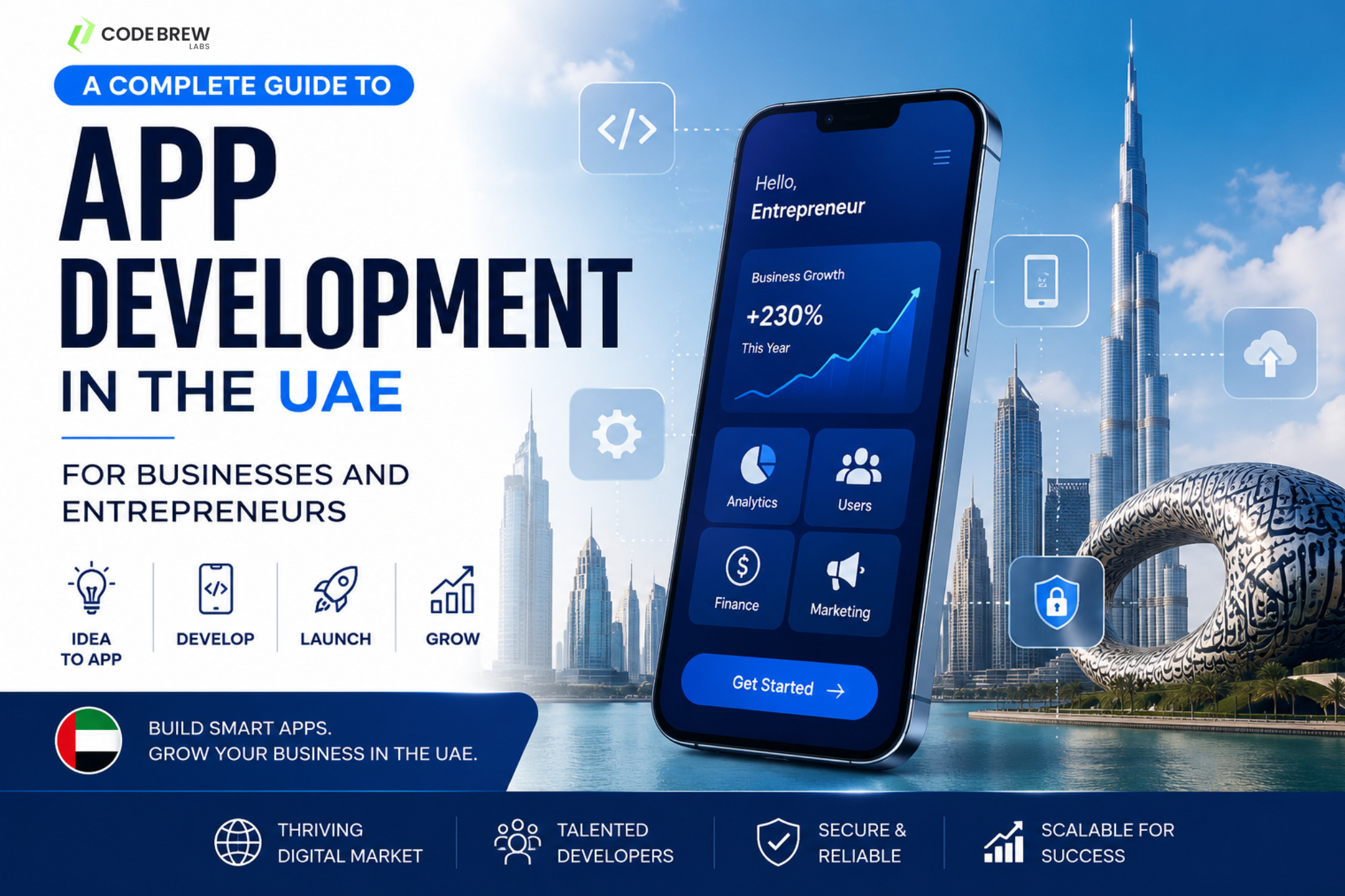
A Complete Guide to App Development in the UAE for Businesses and Entrepreneurs
The United Arab Emirates has become one of the world's fastest-growing digital economies. With government-backed innovation initiatives, widespread smartphone adoption, and increasing demand for digital services, mobile applications have become essential for businesses looking to stay competitive.
Whether you're a startup founder, SME owner, or enterprise decision-maker, investing in a mobile application can help you reach customers, streamline operations, and generate new revenue streams.
This guide explains everything you need to know about app development in the UAE, from planning your idea to launching a successful application.
Why Mobile App Development is Booming in the UAE
The UAE has established itself as a global technology hub. Government initiatives such as UAE Vision 2031, Smart Dubai, and digital transformation programs continue to encourage businesses to embrace emerging technologies.
Several factors contribute to the rapid growth of mobile applications in the region:
- High smartphone penetration
- Digitally connected consumers
- Strong internet infrastructure
- Growing startup ecosystem
- Increasing eCommerce adoption
- AI and cloud technology integration
- Demand for contactless services
- Government support for innovation
Today, customers expect businesses to offer seamless digital experiences through mobile applications.
Benefits of Developing a Mobile App
Mobile applications have become a powerful business tool for companies of all sizes in the UAE. Whether you're a startup, SME, or large enterprise, a well-designed mobile app can improve customer experiences, streamline operations, and create new revenue opportunities. Here are some of the key benefits of investing in mobile app development.
Better Customer Engagement
A mobile app enables businesses to communicate directly with their customers anytime and anywhere. Features like push notifications, in-app messaging, personalized recommendations, and real-time support help keep users engaged and informed. This direct interaction not only enhances the customer experience but also encourages repeat visits and stronger relationships with your brand.
Increased Brand Visibility
Having your app installed on a customer's smartphone ensures your brand remains easily accessible. Every time users browse their apps, they are reminded of your business, which strengthens brand awareness and recognition. A professionally designed app also reinforces your company's credibility and creates a consistent digital presence across multiple touchpoints.
Higher Customer Loyalty
Mobile apps make it easier to build long-term customer relationships through personalized experiences and loyalty programs. Features such as reward points, exclusive discounts, personalized product recommendations, and simplified ordering encourage customers to return regularly. By offering convenience and value, businesses can improve customer retention and increase lifetime value.
Improved Operational Efficiency
Beyond enhancing customer interactions, mobile apps help businesses optimize their internal operations. Routine tasks such as appointment scheduling, inventory management, order processing, payment collection, and customer support can be automated, reducing manual effort and minimizing errors. This allows employees to focus on higher-value activities while improving overall productivity.
New Revenue Opportunities
A mobile application can become a valuable revenue-generating asset by opening multiple income streams. Depending on your business model, you can monetize your app through:
- Subscription Models: Offer premium memberships or recurring services with monthly or annual plans.
- In-App Purchases: Sell digital products, virtual goods, or premium features directly within the app.
- Advertising: Generate additional income by displaying relevant advertisements to users.
- Premium Features: Provide advanced functionality or exclusive content through paid upgrades.
- Online Sales: Enable customers to purchase products and services directly from your app with secure payment options.
- Marketplace Commissions: Earn commissions by connecting buyers and sellers through your platform.
- By combining these monetization strategies with a user-friendly experience, businesses can maximize their return on investment while delivering greater value to their customers.
Types of Mobile Apps
Selecting the right type of mobile application is one of the most important decisions in the app development process. The choice depends on your business goals, target audience, budget, performance requirements, and time-to-market. The three most common types of mobile applications are native apps, cross-platform apps, and Progressive Web Apps (PWAs).
Native Apps
Native apps are developed specifically for a single operating system, such as Android or iOS, using platform-specific programming languages and development tools. Android apps are typically built using Kotlin or Java, while iOS apps are developed using Swift or Objective-C.
Because native apps are designed exclusively for one platform, they deliver the highest level of performance, responsiveness, and user experience. They can fully utilize device features such as the camera, GPS, microphone, Bluetooth, biometric authentication, and push notifications, making them ideal for feature-rich applications.
Advantages of Native Apps:
- Superior performance and speed
- Enhanced security with platform-specific protections
- Smooth and intuitive user experience
- Faster execution and responsiveness
- Full access to device hardware and operating system features
- Better scalability for complex applications
Best for:
Native app development is ideal for businesses building enterprise applications, fintech platforms, healthcare apps, gaming apps, and other high-performance solutions where speed, security, and reliability are critical.
Cross-Platform Apps
Cross-platform applications are built using a single codebase that can run on both Android and iOS devices. This development approach significantly reduces the time and cost required to launch applications across multiple platforms.
Popular cross-platform frameworks include Flutter and React Native, both of which enable developers to create visually appealing and highly functional apps while maintaining a near-native user experience.
For startups and businesses looking to reach a wider audience quickly, cross-platform development offers an excellent balance between performance and cost-effectiveness.
Benefits of Cross-Platform Apps:
- Faster development and quicker time-to-market
- Lower development and maintenance costs
- Single codebase for Android and iOS
- Easier updates and feature enhancements
- Consistent user experience across platforms
- Simultaneous launch on multiple operating systems
Best for:
Cross-platform apps are well-suited for startups, SMEs, eCommerce businesses, service providers, and organizations that want to maximize their return on investment while reaching users on both Android and iOS.
Mobile App Development Process
Building a successful mobile application involves much more than writing code. Professional app development companies follow a structured development process that ensures the final product is user-friendly, scalable, secure, and aligned with business objectives. Each phase plays a crucial role in transforming an idea into a fully functional mobile application.
1. Discovery and Planning
Every successful app begins with thorough planning and research. During the discovery phase, developers and business stakeholders work together to define the project's vision, objectives, and technical requirements. This stage helps identify potential challenges early and creates a roadmap for the entire development process.
Key activities include:
- Defining business objectives
- Identifying the target audience
- Conducting competitor analysis
- Selecting the revenue model
- Listing essential features and functionalities
- Choosing the appropriate technology stack
- Creating the project timeline and budget
A well-planned discovery phase minimizes development risks, improves decision-making, and ensures the application aligns with both business goals and user expectations.
2. UI/UX Design
User Interface (UI) and User Experience (UX) design determine how users interact with your application. An intuitive, visually appealing, and easy-to-navigate design increases user satisfaction and encourages long-term engagement.
The design process focuses on creating seamless user journeys while maintaining a consistent brand identity across every screen.
Typical deliverables include:
- User journey mapping
- Wireframes
- Interactive prototypes
- High-fidelity visual designs
- Design systems and style guides
A well-designed interface not only enhances usability but also improves customer retention, reduces bounce rates, and increases overall app success.
3. Development
Once the designs are approved, the development phase begins. Developers transform design concepts into a fully functional mobile application using modern programming languages, frameworks, and backend technologies.
This stage generally includes:
- Frontend development
- Backend development
- API integration
- Database design and management
- Admin dashboard development
- Cloud integration
- Third-party service integration
Agile development methodologies are commonly used, allowing teams to build and test features incrementally while adapting to changing business requirements.
4. Quality Assurance and Testing
Before launching the application, comprehensive testing is performed to ensure reliability, security, and optimal performance across different devices and operating systems.
Quality assurance teams evaluate every feature to identify bugs and improve the overall user experience.
Common testing methods include:
- Functional testing
- Performance testing
- Security testing
- Compatibility testing
- Usability testing
- User Acceptance Testing (UAT)
Thorough testing helps ensure the application delivers a smooth, stable, and secure experience for end users.
5. Deployment
After successful testing and final approval, the application is prepared for release. Developers optimize the app for production and publish it on the relevant app marketplaces.
Deployment typically includes:
- Preparing release builds
- App Store optimization (ASO)
- Publishing on the Apple App Store
- Publishing on the Google Play Store
- Configuring cloud infrastructure
- Ensuring compliance with platform guidelines and security requirements
A carefully managed deployment process helps avoid delays and ensures a successful launch.
6. Maintenance and Support
Launching the app is only the beginning of its lifecycle. Continuous maintenance is essential to keep the application secure, compatible with new operating system updates, and responsive to evolving user needs.
Ongoing maintenance services generally include:
- Bug fixes
- Feature enhancements
- Security updates and patches
- Performance optimization
- Operating system compatibility updates
- Server monitoring and maintenance
- Analytics monitoring and user feedback implementation
Regular updates help improve user satisfaction, increase retention, and keep the application competitive in the market.
Essential Features for Modern Mobile Apps
Modern users expect mobile applications to be fast, secure, intuitive, and feature-rich. While every application has unique requirements, several core features have become standard across successful mobile apps.
Secure Login and Authentication
Protecting user data is a top priority. Secure authentication methods such as email verification, two-factor authentication (2FA), biometric login (fingerprint or Face ID), and single sign-on (SSO) help safeguard user accounts while providing a seamless login experience.
User Profiles
Personalized user profiles allow customers to manage their personal information, preferences, purchase history, saved items, and account settings, creating a more customized experience.
Push Notifications
Push notifications enable businesses to engage users by sending real-time updates, promotional offers, reminders, order notifications, and personalized messages directly to their devices.
Real-Time Chat
Built-in messaging features improve customer support and communication by enabling users to connect instantly with customer service representatives, vendors, or other users within the application.
AI-Powered Recommendations
Artificial Intelligence can analyze user behavior to deliver personalized content, product recommendations, search results, and automated customer support, enhancing the overall user experience.
Multi-Language Support
The UAE is home to a diverse, multicultural population. Supporting multiple languages—such as Arabic and English—makes the application more accessible and improves customer engagement across different user groups.
Cloud Synchronization
Cloud integration allows users to access their data across multiple devices while ensuring automatic backups, real-time synchronization, and improved scalability.
Factors Affecting App Development Cost
One of the most common questions businesses ask is, "How much does it cost to develop a mobile app?" The answer depends on several variables, as there is no one-size-fits-all pricing model. The overall cost is influenced by the app's complexity, features, design, technology stack, development timeline, and ongoing maintenance requirements. Understanding these factors can help you plan a realistic budget and make informed decisions throughout the development process.
1. App Complexity
The complexity of your application is one of the biggest factors affecting development costs. A simple app with basic features such as user registration, static content, and contact forms requires significantly less time and effort than a feature-rich enterprise application.
Apps with advanced capabilities like real-time messaging, AI-powered recommendations, cloud synchronization, multi-user roles, or custom dashboards involve more extensive development, testing, and infrastructure, leading to higher costs.
Examples of app complexity:
- Basic Apps: Login, user profiles, basic navigation, and simple content.
- Medium Complexity Apps: Payment gateways, booking systems, GPS tracking, push notifications, and social media integration.
- Advanced Apps: Artificial Intelligence (AI), machine learning, video streaming, IoT connectivity, enterprise integrations, blockchain, and real-time collaboration.
The more sophisticated the application, the greater the investment required in development and quality assurance.
2. Platform Selection
The platform you choose has a direct impact on both the development budget and project timeline.
Businesses can develop applications for:
- Android
- iOS
- Both Android and iOS
- Progressive Web Apps (PWAs)
Building separate native applications for Android and iOS generally requires more development resources, while cross-platform frameworks like Flutter and React Native allow developers to create applications for both platforms using a single codebase, reducing overall costs and speeding up development.
The best choice depends on your target audience, business goals, and available budget.
3. Features and Functionality
The number and complexity of features significantly influence development costs. Every additional feature requires planning, coding, testing, and maintenance.
Advanced features that increase development effort include:
- AI-powered chatbots and recommendations
- Secure payment gateway integration
- GPS tracking and geolocation services
- Real-time messaging and chat
- Video and audio streaming
- Push notifications
- Social media integration
- Biometric authentication
- Cloud synchronization
- Multi-language support
- Analytics dashboards
- Offline functionality
Prioritizing essential features for the initial release and adding advanced functionality in future updates can help businesses optimize their budget and accelerate time-to-market.
4. UI/UX Design
An application's design plays a crucial role in user satisfaction and engagement. While template-based designs are faster and more affordable, custom UI/UX design requires additional research, prototyping, and visual design work.
Custom design services typically include:
- User research
- Wireframing
- Interactive prototyping
- Custom interface design
- Brand identity integration
- Responsive layouts
- User experience optimization
Although custom designs involve a higher upfront investment, they often result in improved usability, stronger brand recognition, and higher customer retention.
5. Third-Party Integrations
Many modern mobile applications rely on external services to enhance functionality. Integrating third-party systems can increase development complexity, especially when working with multiple APIs or enterprise platforms.
Common third-party integrations include:
- Customer Relationship Management (CRM) systems
- Enterprise Resource Planning (ERP) software
- Payment gateways
- Social media platforms
- Cloud storage services
- Analytics and reporting tools
- Email marketing platforms
- Maps and geolocation services
- SMS and notification providers
Each integration requires additional development, testing, and ongoing maintenance to ensure reliable performance and security.
6. Maintenance and Ongoing Support
App development does not end after launch. Continuous maintenance is essential to ensure your application remains secure, performs efficiently, and stays compatible with new operating system updates and evolving user expectations.
Ongoing maintenance typically includes:
- Bug fixes and issue resolution
- Security patches and vulnerability management
- Performance optimization
- Operating system compatibility updates
- Feature enhancements
- Server monitoring and maintenance
- Database optimization
- Cloud infrastructure management
- Technical support and user assistance
Allocating a long-term maintenance budget helps keep your app competitive, secure, and capable of delivering a seamless user experience over time.
How to Choose the Right App Development Company in the UAE
Selecting the right app development company is one of the most important decisions you'll make during your digital transformation journey. The success of your mobile application depends not only on the quality of the code but also on your development partner's ability to understand your business goals, recommend the right technologies, and deliver a scalable solution. With numerous app development companies operating in the UAE, evaluating potential partners carefully can help ensure your project is completed on time, within budget, and to the highest standards.
Evaluate Technical Expertise
A reliable app development company should have extensive experience with modern technologies and mobile platforms. Their technical capabilities should align with your project requirements, whether you're building a simple business application or a complex enterprise solution powered by artificial intelligence.
Look for expertise in:
- Android app development
- iOS app development
- Flutter development
- React Native development
- Artificial Intelligence (AI) integration
- Machine Learning solutions
- Cloud technologies
- Backend architecture and API development
- Database management
- Cybersecurity best practices
A technically skilled team can recommend the most suitable technology stack while ensuring your application is scalable, secure, and future-ready.
Review Their Portfolio
A company's portfolio provides valuable insights into its experience, design quality, and ability to deliver successful projects across different industries. Reviewing previous work can help you determine whether the company has built applications similar to your business requirements.
When evaluating a portfolio, consider:
- Overall design quality and user experience
- Industry-specific experience
- Technical complexity of previous projects
- Innovation and unique features
- Performance and scalability
- Mobile platforms supported
- Consistency across multiple projects
If possible, download and test some of the company's published applications to evaluate their functionality, responsiveness, and overall user experience.
Read Client Reviews and Testimonials
Client feedback is an excellent indicator of a company's professionalism and reliability. Reviews on platforms such as Google, Clutch, and other business directories can provide honest insights into how the company communicates, manages projects, and supports clients after launch.
Pay close attention to feedback regarding:
- Communication and responsiveness
- Project management capabilities
- Meeting deadlines and budgets
- Technical expertise
- Problem-solving abilities
- Transparency throughout development
- Post-launch maintenance and support
Consistently positive reviews demonstrate a strong commitment to customer satisfaction and long-term partnerships.
Understand Their Development Process
An experienced app development company should follow a structured and transparent development methodology. Clear processes reduce project risks, improve collaboration, and ensure every stage of development is completed efficiently.
A professional workflow typically includes:
- Discovery and business analysis
- Project planning and requirement gathering
- UI/UX design
- Agile development sprints
- Regular progress updates
- Quality assurance and testing
- Deployment and app store submission
- Ongoing maintenance and optimization
Ask how frequently the team provides project updates, conducts sprint reviews, and manages changes to project requirements. Companies that follow Agile methodologies are often better equipped to adapt to evolving business needs while maintaining development quality.
Assess Communication and Project Management
Strong communication is essential for a successful development partnership. Your chosen company should provide regular updates, maintain clear documentation, and assign a dedicated project manager to coordinate tasks and keep the project on schedule.
Consider whether the company:
- Responds promptly to inquiries
- Provides regular progress reports
- Uses project management tools such as Jira, Trello, or Asana
- Offers transparent timelines and milestone tracking
- Encourages collaborative decision-making
Effective communication helps prevent misunderstandings and ensures that your vision is accurately translated into the final product.
Consider Post-Launch Support
Launching your mobile app is only the beginning. Ongoing maintenance is essential to keep your application secure, compatible with operating system updates, and aligned with changing user expectations.
Choose a development partner that offers:
- Bug fixes and technical support
- Performance monitoring
- Security updates
- Feature enhancements
- Operating system compatibility updates
- Cloud infrastructure management
- Scalability planning
Long-term support ensures your application continues to perform optimally and remains competitive in a rapidly evolving digital landscape.
Evaluate Pricing and Transparency
While cost is an important consideration, it should not be the only deciding factor. The lowest-priced option may compromise quality, while the most expensive provider may not always deliver the best value.
A trustworthy development company should provide:
- Transparent pricing
- Detailed project estimates
- Clearly defined deliverables
- Realistic timelines
- Flexible engagement models
- No hidden costs
Focus on overall value rather than simply comparing quotes. Investing in an experienced development partner can reduce long-term costs by minimizing technical issues and improving product quality.
The UAE continues to position itself as a global leader in digital innovation, with government initiatives, smart city projects, and widespread adoption of emerging technologies driving the rapid evolution of mobile applications. Businesses that embrace the latest app development trends are better equipped to meet changing customer expectations, improve operational efficiency, and gain a competitive edge in the market.
Here are some of the most important mobile app development trends shaping the UAE in 2026 and beyond.
AI-Powered Customer Experiences
Artificial Intelligence (AI) is transforming how businesses interact with their customers. Modern mobile applications leverage AI to provide personalized recommendations, intelligent search, predictive analytics, and automated customer support. AI-powered chatbots and virtual assistants can handle customer inquiries around the clock, improving response times while reducing operational costs.
Generative AI Integration
Generative AI is becoming an essential feature in modern mobile applications. Businesses are integrating large language models (LLMs) to automate content creation, enhance customer support, summarize information, generate reports, and deliver highly personalized user experiences. This technology enables businesses to improve productivity while offering smarter, more interactive applications.
Super Apps
Inspired by platforms like WeChat and Careem, super apps are gaining popularity in the UAE. These applications combine multiple services within a single platform, allowing users to access ride-hailing, food delivery, digital payments, shopping, messaging, and other services without switching between different apps.
For businesses, super apps increase user engagement, encourage repeat usage, and create additional revenue opportunities through a unified digital ecosystem.
Voice-Enabled Interfaces
Voice technology is becoming increasingly important as users seek faster and more convenient ways to interact with mobile applications. Voice search, voice commands, and AI-powered assistants improve accessibility and create hands-free experiences for users across industries such as healthcare, retail, banking, and automotive.
5G-Powered Mobile Experiences
The widespread rollout of 5G networks in the UAE is enabling faster, more reliable mobile applications. Higher bandwidth and lower latency support advanced features such as real-time video streaming, cloud gaming, augmented reality, Internet of Things (IoT) connectivity, and instant data synchronization, delivering smoother and more responsive user experiences.
Augmented Reality (AR)
Augmented Reality is reshaping customer experiences by blending digital content with the physical world. Businesses are using AR to create interactive shopping experiences, virtual product demonstrations, indoor navigation, and immersive educational tools.
Industries benefiting from AR include:
- Retail and eCommerce
- Real estate
- Healthcare
- Education
- Tourism
- Interior design
Virtual Reality (VR)
Virtual Reality is becoming increasingly valuable for applications that require immersive digital environments. Businesses use VR for employee training, virtual property tours, product demonstrations, remote collaboration, and interactive learning experiences.
As VR hardware becomes more accessible, its adoption across enterprise and consumer applications is expected to continue growing.
Wearable Device Integration
Smartwatches, fitness trackers, and healthcare wearables are expanding the capabilities of mobile applications. Integrating apps with wearable devices allows businesses to collect real-time health data, monitor fitness activities, send notifications, and provide personalized insights.
Wearable technology is particularly valuable in healthcare, fitness, insurance, and wellness applications.
Hyper-Personalization
Modern consumers expect digital experiences tailored to their individual preferences. Hyper-personalization uses AI, machine learning, and behavioral analytics to deliver customized recommendations, targeted promotions, dynamic content, and personalized user journeys.
This approach improves customer satisfaction, increases engagement, and drives higher conversion rates.
Low-Code and No-Code Development
Low-code and no-code platforms are helping businesses accelerate application development by simplifying the creation of prototypes and internal business applications. While complex enterprise apps still require professional development, these platforms enable faster innovation, reduce development costs, and allow organizations to validate ideas before investing in full-scale development.
Enhanced Cybersecurity Measures
As cyber threats continue to evolve, security has become a top priority for mobile application development. Businesses are implementing advanced security measures such as biometric authentication, end-to-end encryption, multi-factor authentication, secure cloud infrastructure, and continuous threat monitoring to protect sensitive user data and maintain regulatory compliance.
Sustainable and Energy-Efficient App Design
Sustainability is becoming an important consideration in software development. Developers are optimizing mobile applications to consume less battery power, reduce server workloads, minimize unnecessary data usage, and improve overall efficiency. Energy-efficient applications not only benefit the environment but also provide a better user experience through improved device performance.
Staying Ahead of the Competition
Keeping pace with these emerging trends enables businesses to build innovative mobile applications that meet evolving customer expectations. By adopting technologies such as AI, 5G, AR, and cloud computing, organizations can deliver faster, smarter, and more personalized digital experiences while remaining competitive in the UAE's rapidly growing technology landscape.
Why Partner with an Experienced App Development Company?
Developing a successful mobile application involves much more than writing code. It requires strategic planning, user-centric design, technical expertise, rigorous testing, and continuous optimization. Partnering with an experienced app development company gives businesses access to the knowledge, resources, and best practices needed to transform ideas into scalable, high-performing digital products.
Validate Your Business Idea
Before development begins, experienced app developers help validate your concept by analyzing market demand, identifying your target audience, evaluating competitors, and assessing technical feasibility. This early validation reduces project risks and ensures that your app addresses genuine customer needs.
Define the Right Feature Set
One of the most common reasons mobile applications fail is feature overload. An experienced development partner helps prioritize the most valuable features for your Minimum Viable Product (MVP), allowing you to launch faster while maximizing return on investment.
They can also create a long-term product roadmap that supports future growth and feature expansion.
Design Intuitive User Experiences
User experience is a major factor in an app's success. Professional designers create intuitive interfaces that simplify navigation, reduce user friction, and encourage long-term engagement.
Effective UI/UX design improves:
- Customer satisfaction
- User retention
- Conversion rates
- Brand perception
- Overall application usability
Build Scalable and Secure Architecture
As your business grows, your application should be able to handle increasing numbers of users, transactions, and data without compromising performance. Experienced development companies build scalable architectures using modern cloud technologies, secure databases, and robust backend systems that support future expansion.
Integrate Advanced Technologies
Modern mobile applications often require advanced technologies to remain competitive. An experienced development team can seamlessly integrate:
- Artificial Intelligence (AI)
- Machine Learning
- Cloud computing
- Internet of Things (IoT)
- Blockchain
- Payment gateways
- Third-party APIs
- Real-time analytics
These technologies enhance functionality while improving efficiency and user engagement.
Ensure Compliance and Security
Publishing an application requires compliance with Apple App Store and Google Play Store guidelines. Professional developers ensure your application meets platform requirements while implementing industry best practices for data privacy, security, and regulatory compliance.
This reduces the likelihood of app rejection and protects sensitive customer information.
Provide Ongoing Maintenance and Optimization
A successful mobile app requires continuous improvements after launch. Reliable development partners offer long-term support that includes:
- Bug fixes
- Feature enhancements
- Performance optimization
- Security updates
- Operating system compatibility
- Infrastructure monitoring
- Technical support
Continuous maintenance ensures your application remains secure, reliable, and competitive as technology evolves.
Conclusion
Mobile applications have become a cornerstone of digital transformation in the UAE. From startups to large enterprises, businesses are leveraging apps to improve customer engagement, streamline operations, and unlock new revenue opportunities.
A successful app starts with a clear strategy, user-focused design, scalable technology, and a reliable development partner. By understanding the development process, selecting the right technologies, and staying aligned with evolving market trends, businesses can build mobile applications that deliver long-term value.
As the UAE continues to invest in innovation and smart technologies, now is an ideal time for businesses and entrepreneurs to transform their ideas into high-performing mobile applications that drive sustainable growth and competitive advantage.
FAQs
How long does it take to develop a mobile app in the UAE?
A simple app may take 2–4 months, while complex applications with AI, real-time features, or enterprise integrations can take 6–12 months or longer.
Should I choose native or cross-platform app development?
Native apps offer the best performance and platform-specific features, while cross-platform frameworks like Flutter and React Native reduce development time and cost.
Which industries benefit most from mobile app development in the UAE?
Healthcare, fintech, retail, eCommerce, logistics, real estate, education, hospitality, and on-demand services are among the leading sectors investing in mobile apps.
Can AI be integrated into mobile applications?
Yes. AI can power chatbots, recommendation engines, predictive analytics, image recognition, voice assistants, and personalized user experiences.
Why is the UAE a strong market for mobile apps?
The UAE's high smartphone usage, digital-first consumers, government support for innovation, and thriving business ecosystem make it one of the most attractive markets for mobile app development.