
The Translation Problem Nobody Budgets For

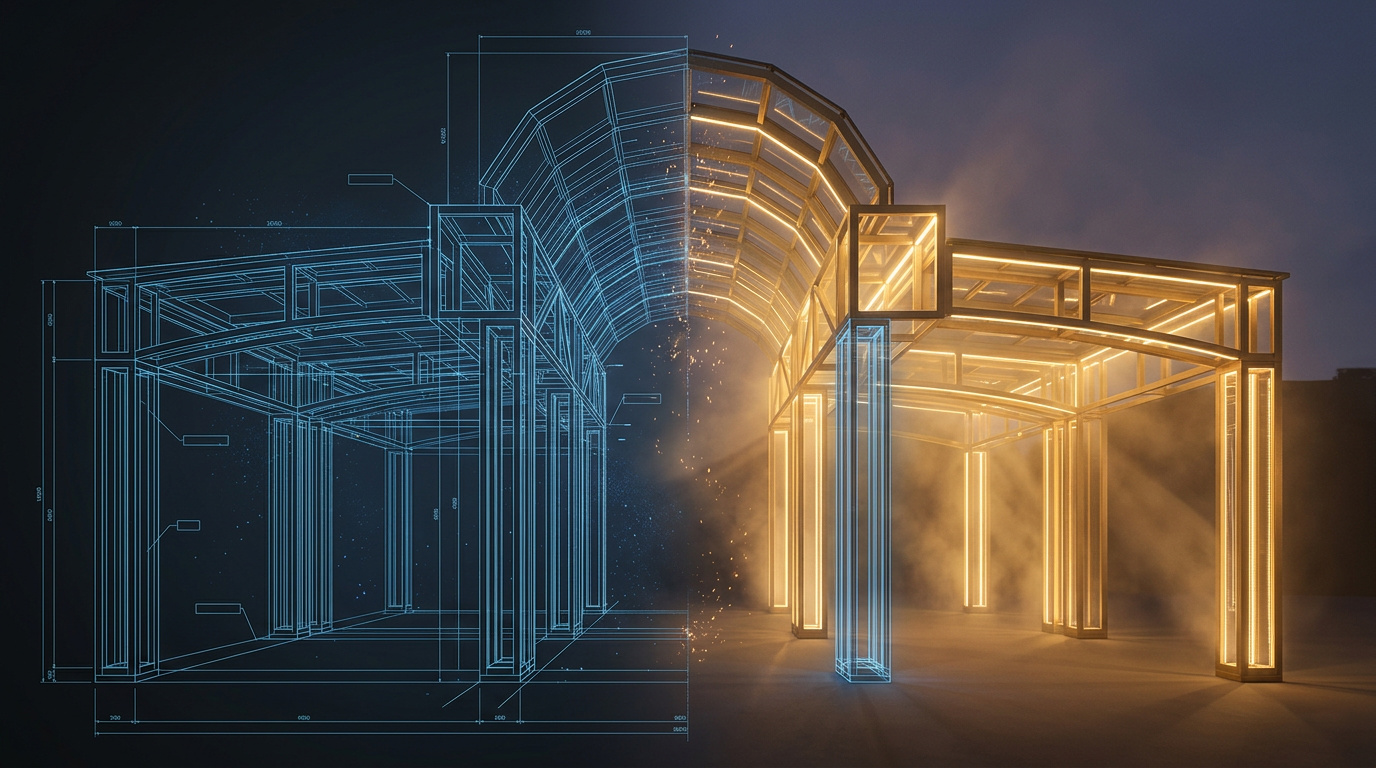
If you're an owner, an architect, or a creative firm bringing an experience to life, this moment will likely feel familiar, even without a name for it.
A concept gets approved. It's the version that won the pitch, the one that convinced the board or the client. Months later, on site, something's different. Not broken exactly. Just smaller than what was signed off. And nobody can quite say when that happened.
It's rarely one bad decision. It's a translation problem, and almost nobody in this industry is structurally responsible for solving it.
Here's the pattern. A creative team pitches a moment, a shift in light, a burst of sound, a projection that seems to breathe. Everyone in the room can picture it. Then it goes to the technical side. Throw distances, ambient light, hardware cost, what the show control system can reliably repeat every night for the next ten years. Legitimate questions. But the answers rarely get translated back into terms the owner or the creative team can actually weigh in on. The idea just gets quietly reworked, and the first time anyone outside that conversation sees the result is on site.
For an owner or operator, that's a capital risk carried unknowingly. A vision was commissioned. What surfaces later is that half a dozen technical compromises were made on their behalf, by people who never had to justify them, because nobody asked them to.
For an architect, it's a coordination risk. The overall design intent has to hold together across trades, and the AV or show control layer is often the one piece specified in a language that's hard to review from the outside. By the time a technical issue surfaces, it's usually load-bearing on the schedule, not a simple fix.
For a creative firm, it's the hardest one. The work of making the idea land is done well before delivery, yet if it gets diluted in translation, the name attached to it stays the same. Nobody remembers the compromise. They remember the room that didn't quite deliver.
None of this is a case against technical teams, and it isn't a case for creative teams overriding constraints they don't fully understand either. Budgets are real. Physics is real. The problem isn't that trade-offs happen. It's that they happen silently, decided by whoever's translating in the moment rather than reviewed by the people who actually own the outcome.
We hear a version of the same sentence often enough that it's stopped feeling like a one-off. It usually comes after the project is finished, sometimes after the final invoice. Something like: we wish we'd brought you in from the start. Not because anything broke, but because looking back, nobody had properly interrogated what the project was actually trying to achieve until well into delivery, and the cost of that shows up as overspend, schedule slip, or both. By the time it's visible, it's already too expensive to unwind.
This is what an Experience Reality Check is built to catch, early, before major decisions are locked in and while a change in direction still costs a conversation rather than a rebuild. It's an independent look at whether a concept holds up once it meets budget, timeline, and physics, with the findings put back in terms an owner, an architect, or a creative director can actually act on. Not a technical audit handed down. A shared read of the project before the expensive decisions get made.
The same gap reopens during delivery, which is why creative-technical alignment sits alongside it rather than replacing it. Early review catches the mismatch before it's built into the plan. Alignment work catches it while a hundred small technical decisions are being made on a schedule too fast for anyone to check each one against the original intent.
For anyone commissioning or designing an experience right now, the question worth asking isn't whether the technical team is competent. It almost certainly is. It's whether anyone is translating their decisions back into terms that can actually be weighed in on, before they become the plan.
Think before you build.
Mike's illustrious career as a multi-award-winning Creative Technical Director is marked by his profound expertise in designing and executing large-scale fixed installations and live event projects that consistently redefine the frontiers of technology and innovation.
Over the span of more than two decades, Mike has meticulously honed his craft, amassing invaluable experience across a diverse range of industries, including live events, automotive exhibitions, financial expos, museums, science centres, and themed entertainment attractions. His ability to seamlessly adapt to these varied domains is a testament to his versatility and technical acumen.
Mike's extensive portfolio is an impressive showcase of his technical prowess, featuring a broad spectrum of projects, from intricately detailed small-scale endeavours to grand, technologically advanced installations. Collaborating with eminent institutions and corporate giants such as The Sphere – Las Vegas, Walt Disney Imagineering, Universal Studios, The Smithsonian Institute, The Adler Planetarium, The American Museum of Natural History, Apple, Barclays, Coca-Cola, Nike, Farah Leisure, Hyundai, Cedar Fair, Changi Airport Group, Merlin Entertainment, Dubai Parks and Resorts, and the BBC highlights the depth and technical diversity of his skill set.
What truly distinguishes Mike is his exceptional proficiency in merging creative artistry with cutting-edge technology. This intricate fusion is often overlooked in the industry, but it forms the cornerstone of his specialized skill set. Whether he's developing immersive environments that seamlessly integrate state-of-the-art audio-visual systems, interactive displays, and sensory experiences to educate and entertain or orchestrating intricate technical collaborations between creative and engineering teams, Mike consistently delivers projects that not only meet the highest technical standards but also captivate and engage audiences with unprecedented technical precision.
Mike's journey is a testament to his unwavering dedication to pushing the boundaries of immersive experiences and technical innovation. His visionary approach, complemented by his exceptional grasp of complex technical intricacies, has firmly established him as a luminary in the realm of creative and technical direction, setting new industry benchmarks and inspiring others to embrace the intricacies of technology and innovation.
-
Xchange Advocates are recognized AV/IT industry thought leaders and influencers. We invite you to connect with them and follow their activity across the community as they offer valuable insights and expertise while advocating for and building awareness of the AV industry.



Please sign in
If you are a registered user on AVIXA Xchange, please sign in