Strategic Path: Why Your Conference Room AI Isn't Working

Related Content

 The Intelligent Workplace™
The Intelligent Workplace™
The Operating Model for the Workplace of the Future
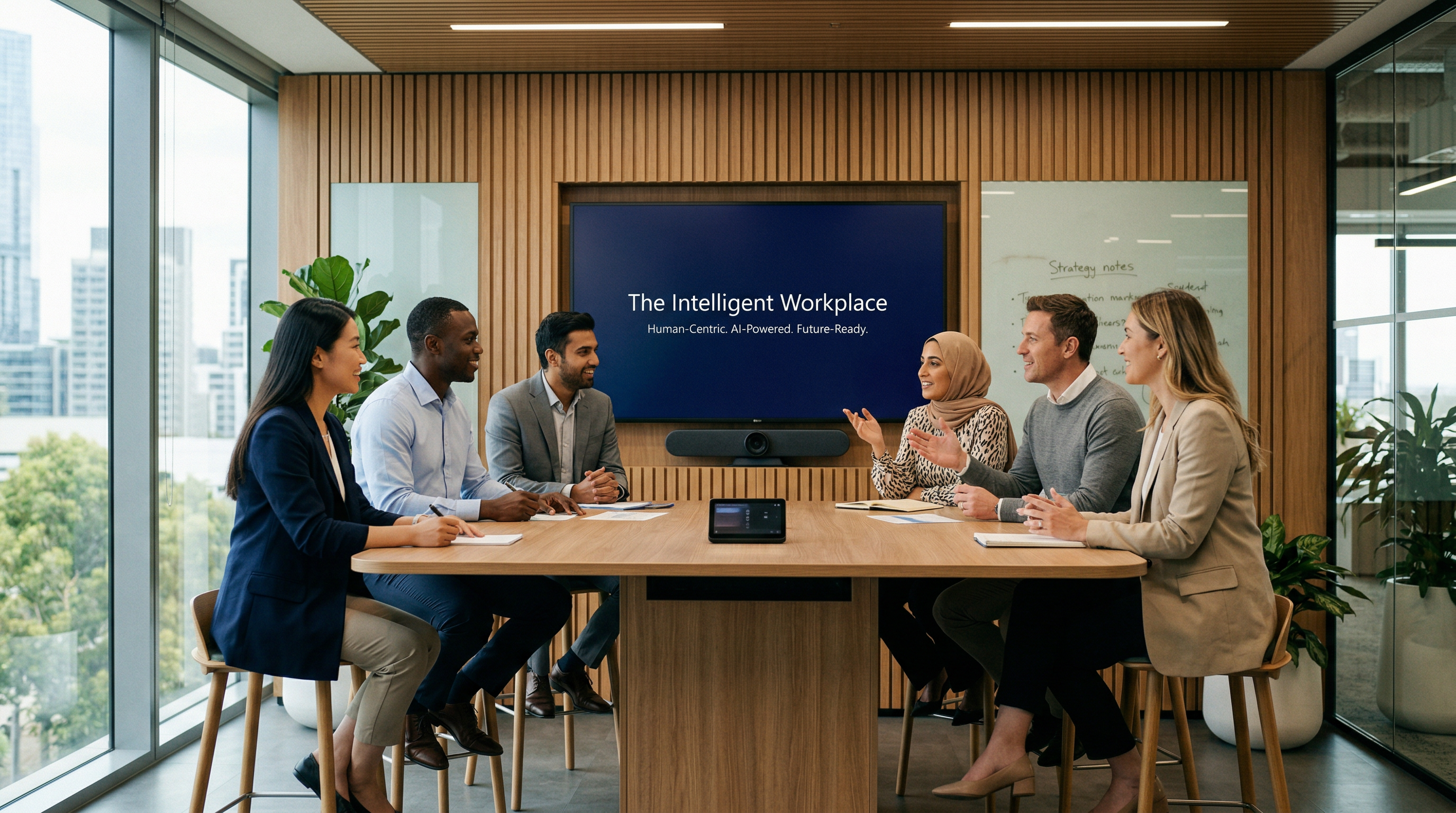
An integrator spent eight months deploying an AI-powered meeting room system for a Fortune 500 client. The technology was flawless: voice commands worked perfectly, automated camera switching tracked speakers seamlessly, and transcription accuracy hit 96%. Yet three months after go-live, only 30% of meeting rooms were using the AI features. The executive team was asking pointed questions about ROI.
The problem wasn't the AI system. It was that nobody had redesigned how meetings actually flowed through the organization. Teams were still booking rooms the old way, running meetings with the same inefficient patterns, and defaulting to familiar collaboration habits that bypassed the intelligent features entirely. The AI had become an expensive overlay on broken meeting workflows rather than a catalyst for more effective collaboration.
This scenario reveals why so many workplace AI deployments underperform despite flawless technical implementations. The transformation doesn't happen in the AV rack or the cloud platform. It happens when you redesign the workflows that technology is meant to enhance.
Before specifying any AI-enabled conferencing solution, map how meetings actually work today versus how they're supposed to work. Most teams focus on "What should this meeting room do with AI?" when they should start with "How do people really use this space right now?" The gap between the documented booking process and actual user behavior is where your deployment strategy needs to focus.
Three workflow questions should drive every AI-enabled AV specification.
- First: What handoffs currently create delays or friction? AI excels at eliminating unnecessary steps, but only when you know exactly where those steps slow down collaboration rather than add value.
- Second: Where do users currently work around the existing room systems? These workarounds often reveal the most valuable automation opportunities.
- Third: What meeting decisions require human judgment versus human habit? Many tasks that feel essential are actually just organizational tradition.
Effective AI deployment means restructuring how information flows through meetings, how decisions get captured, and how collaboration value gets created. Instead of automating individual room functions, you're redesigning the entire meeting experience. That conference room AI becomes transformative when it handles routine setup and documentation while humans focus on the actual collaboration work, with booking and follow-up flows adapted to support the new capabilities.
This is why successful AI-enabled room deployments rarely match their original specifications. The workflow redesign process reveals integration requirements that weren't visible from a purely technical perspective. It uncovers dependencies between room systems and broader collaboration platforms, highlights where human expertise remains essential, and identifies which automation features will actually get used versus which ones sound impressive in a demo.
The practical implication for every AV project: AI integration must begin with workflow analysis, not feature selection. Teams that start with "What AI room system should we deploy?" are approaching the problem backwards.
The question is "How should meetings flow differently when room intelligence is available?" Only then can you specify technology that serves the redesigned collaboration workflow rather than automating existing inefficiency.
Read the full analysis at intelligentworkplace.ai
Delivering this is a capability question. The approach is documented in the Capability Delivery engine.
Explore further: The Intelligent Workplace and Capability Delivery.

Marc A. Rémond is the founder of Strategic Pathways, a business advisory firm helping technology leaders design the business operating models required to scale.
With 25+ years of sales leadership across AV, UC, and enterprise technology, at Alcatel-Lucent, Polycom, and Barco, among others, he has built go-to-market strategies, channel ecosystems, and AI transformation programmes for global technology companies.
He is the creator of the Intelligent Workplace™, the 4W/4D/4C/4P Frameworks, the Strategic Diagnostic Engine, and the Human-AI Intelligence Charter, and the architect of the Synchronised Growth Architecture.
He is the author of EVOLVE-OR-DIE.AI: Leading in the Era of Human and AI Intelligence, available on Amazon and Apple Books, and the architect of the Intelligent Leader Programme, a twenty-eight module executive curriculum.
He runs two authority brands, an advisory practice, seven content pipelines, and the Intelligent Leader Programme as a single operator.
He writes on market expansion, sales execution, market narrative and workplace transformation at strategicpathways.asia and intelligentworkplace.ai.
Follow him on LinkedIn at linkedin.com/in/marcalexremond.
-
Xchange Advocates are recognized AV/IT industry thought leaders and influencers. We invite you to connect with them and follow their activity across the community as they offer valuable insights and expertise while advocating for and building awareness of the AV industry.